
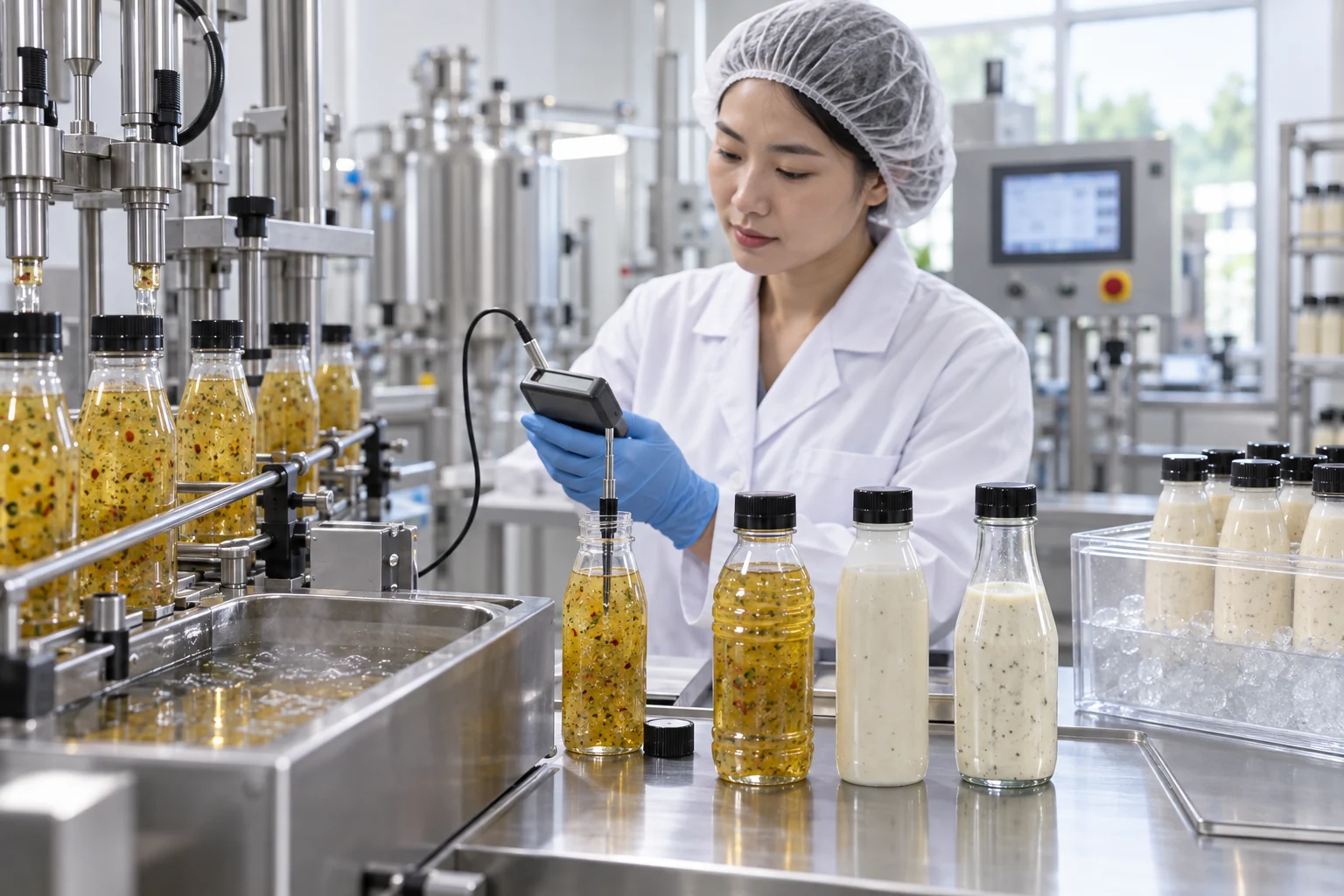
A salad dressing bottle is not validated because its resin is described as heat resistant or because an empty sample passes a leak check. Approval requires the exact bottle, closure, liner, dressing and production process to pass a defined fill, hold, cooling, handling and storage sequence. Hot fill and cold fill create different failure mechanisms, so they need different evidence even when the same bottle shape is proposed.
Hot-fill validation follows the heat delivered to the package, the dimensional response of the bottle and the vacuum created as the dressing cools. Cold-fill validation follows hygienic control, the validated preservation or refrigeration route, condensation, closure integrity and distribution temperature. Both routes still require filled-package tests for leakage, torque, label performance, dispensing and shelf stability.
The practical release question is simple: does the finished package remain safe, sealed, usable and visually acceptable through the intended process and shelf life? A resin datasheet can screen candidates, but only production-representative evidence can answer that question.
| Validation Area | Hot-Fill Focus | Cold-Fill Focus | Release Evidence |
|---|---|---|---|
| Process control | Product temperature at the container, hold or inversion step and cooling curve | Hygienic fill, validated preservation route and cold-chain limits where applicable | Recorded process profile with defined acceptance limits |
| Bottle response | Thermal shrinkage, panel movement, base stability and neck change | Condensation, handling stiffness and temperature-conditioned impact | Dimensions and appearance at pack-off, after cooling and during storage |
| Internal pressure | Vacuum generated by cooling and headspace contraction | Normally ambient; positive pressure only when a validated dosing process is used | Pressure or vacuum trend tied to package condition |
| Closure system | Thermal relaxation, cap back-off, liner or foil response | Application torque, contamination control and seal continuity | Torque, leakage and seal-integrity results at defined intervals |
Start With the Scheduled Process, Not a Generic Temperature
The required process comes from the dressing, not the container catalog. Formula pH, water activity, oil phase, preservative system, particle load, target microorganisms and distribution conditions determine whether the product uses hot fill, cold fill with refrigeration, an acidified-food process or another validated route. The bottle specification follows that process window.
For an acidified dressing program in the United States, the scheduled process may define the product-in-container temperature at the end of the hold, container inversion or laydown time, closure treatment and cooling method. The FDA acidified food process filing illustrates why these fields belong in package validation. The actual legal and process-authority requirements remain product specific.
Record temperature where the package experiences it. A setpoint at the kettle or filler bowl does not prove the temperature of the first, middle and last bottles through start-up, steady production, a short stop and restart. The protocol also needs the allowable delay from filling to capping, the fill-height range and the exact time at which cooling begins.
| Process Input | What to Record | Why It Changes Package Performance |
|---|---|---|
| Dressing formula | pH, oil percentage, emulsion type, viscosity and largest particle | Changes heat transfer, product contact and closure contamination |
| Thermal process | Actual fill range, hold step, cap timing, inversion and cooling method | Defines bottle exposure rather than a nominal machine setting |
| Package version | Bottle material, weight, cavity, finish, cap, liner and decoration | Prevents a passing result from being assigned to a different component set |
| Line condition | Speed, start-up, restart and maximum planned dwell | Captures the conditions most likely to create overheating or underprocessing |
Build the Thermal Profile at the Bottle and Through Cooling
A useful thermal profile follows the package from the filler discharge to stable storage temperature. Place calibrated probes or equivalent data loggers at locations that reveal the product temperature inside representative bottles, then record capping, any inversion step, entrance to cooling, exit from cooling and the time required for the center of the dressing to cool.
Vinaigrettes and emulsified dressings do not cool like water. Oil content, suspended herbs, starch, gums and bottle geometry can slow internal convection and create a hot core after the outer wall feels cool. Bottles held together in warm cases can retain heat longer than samples cooled individually, increasing flavor damage, emulsion separation, label distortion and carton softening.
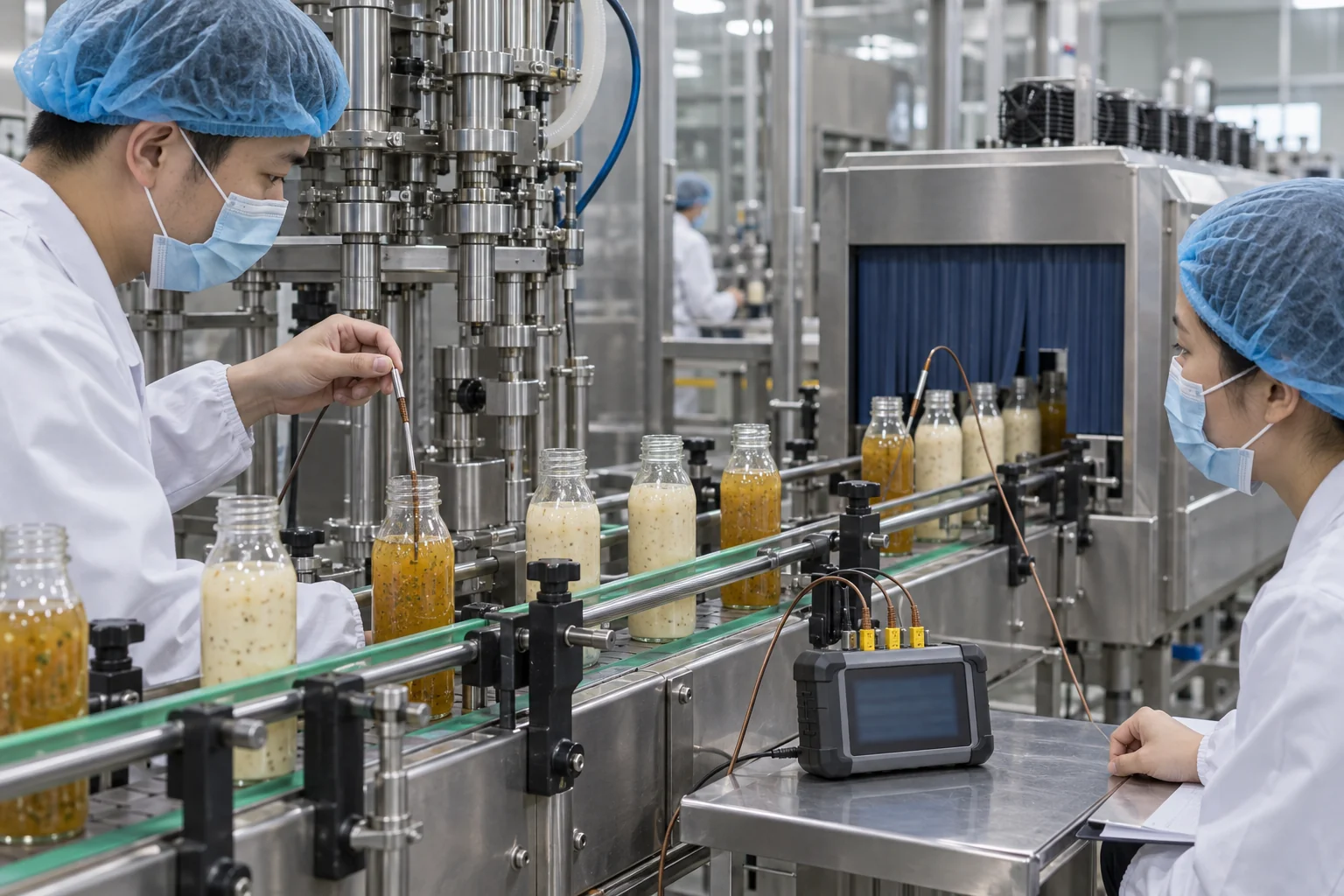
Run the study at the proposed minimum and maximum fill volumes and across line positions that can behave differently. A profile that passes only one hand-filled bottle does not describe production. The result should identify both the process condition required for product safety and the package exposure that must not be exceeded.
Measure Vacuum and Dimensional Recovery After Hot Fill
When a hot-filled package is capped and cooled, the product and headspace contract. The resulting negative pressure can pull a plastic bottle inward, move an engineered vacuum panel, distort the label area or lift a base until the bottle rocks. A package may look acceptable when warm and fail several hours later as the internal temperature equalizes.
Measure package vacuum together with bottle dimensions and appearance. Shoulder diameter, label-panel flatness, overall height, base clearance, neck angle and finish dimensions reveal different failure modes. Compare results immediately after pack-off, after complete cooling, after a 24-hour recovery period and after defined warm-storage or distribution conditioning.
The acceptance range is established for the specific bottle and process. A single universal vacuum number cannot account for headspace, bottle volume, wall distribution, panel geometry, closure seal and cooling rate. The correct result is controlled deformation in the intended zone without permanent buckling, leakage, base instability or label damage.
| Observation | Likely Mechanism | Validation Response |
|---|---|---|
| Random sidewall dents | Uneven wall distribution or uncontrolled vacuum response | Map cavity and bottle position; measure weight and local wall behavior |
| Rocking base | Base movement during cooling or excessive retained pressure differential | Measure base clearance after cooling and conditioned storage |
| Tilted neck or cap | Finish distortion, capping load or hot neck relaxation | Check finish dimensions, application torque and cap alignment by time point |
| Wrinkled label | Panel movement, retained heat or wet application surface | Validate label stock and application only after bottle recovery is understood |
Validate Cold Fill Without Borrowing Hot-Fill Assumptions
Cold fill removes the package sterilization contribution of hot product, so the process must rely on its validated hygienic, formulation, preservation and temperature controls. Refrigerated products need a defined cold-chain limit; shelf-stable cold-filled products need the process evidence appropriate to their formula and production system. The package trial should use the same sanitation and handling sequence planned for commercial production.
Condensation is a package variable, not merely a cosmetic issue. A chilled bottle moving into humid air can collect water that interferes with pressure-sensitive labels, date coding, case adhesion and corrugated strength. Record bottle-surface temperature and ambient dew point, then qualify air knives, drying time, adhesive and packing delay under the most demanding planned condition.
Nitrogen flushing or liquid-nitrogen dosing may be used for a justified oxygen or rigidity objective, but neither is a default cold-fill requirement. If dosing is included, validate dose distribution, headspace, internal pressure, base stability, cap retention and package response at warm distribution temperatures.
Test Closure Torque, Seal Integrity, and Inversion Leakage
Closure performance is measured as a time-dependent system. Record application torque or capping settings, then measure removal torque after cooling, after 24 hours and at relevant shelf-life checkpoints. Hot finishes and polymer closures can relax at different rates, while dressing on the sealing land can reduce liner contact or interfere with an induction seal.
Inspect the bottle sealing land, thread engagement, cap alignment, liner identity and foil bond as one assembly. Side-lay and inversion testing can expose weeping around the finish, but a visual hold alone may miss a small channel. When appropriate for the rigid nonporous package and the defect type, the ASTM F2338 vacuum decay method provides a nondestructive framework; sensitivity and pass limits still need to be established with known good and known leaking controls.
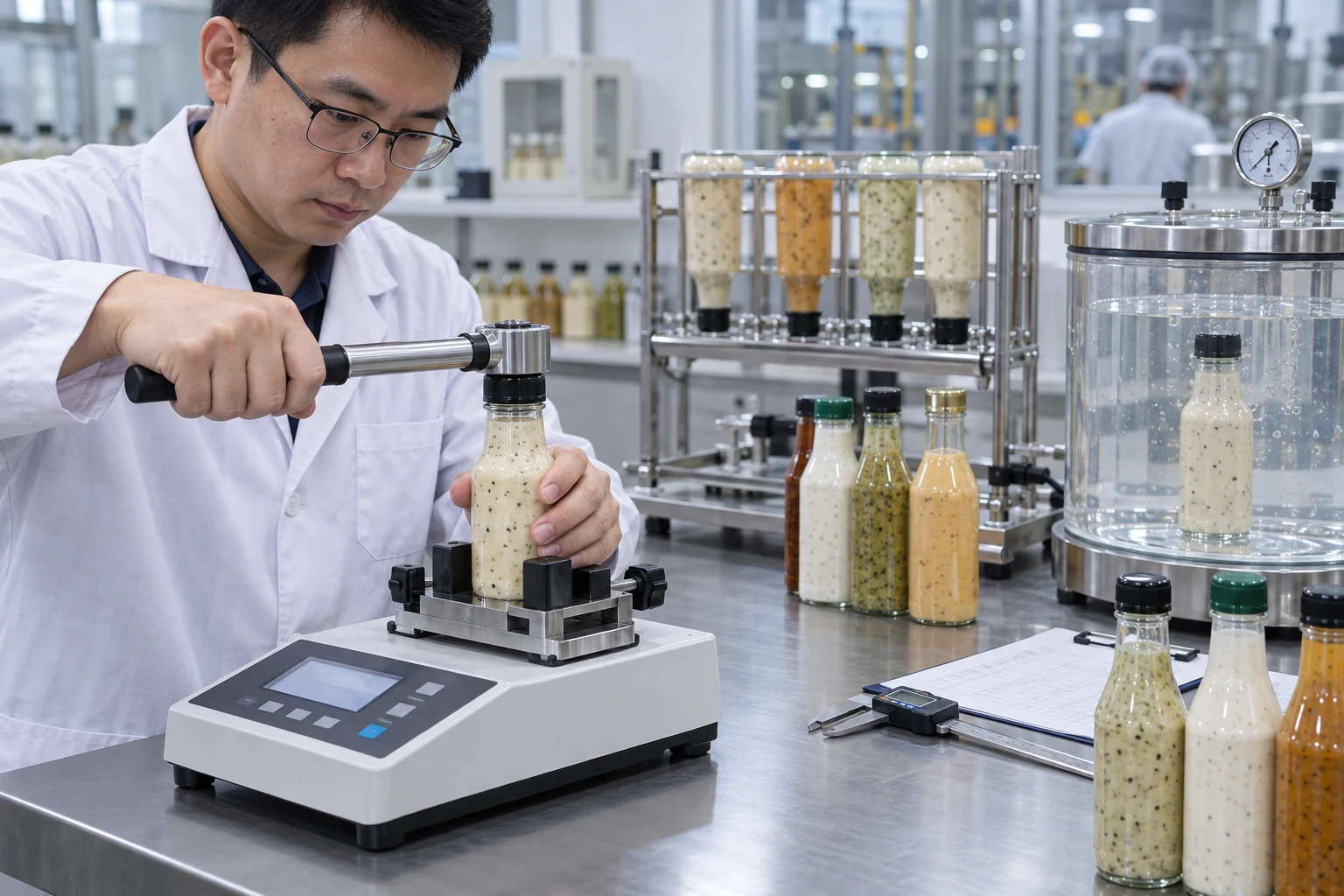
Use the intended transport orientation and consumer-use orientation. A flip-top squeeze bottle stored cap-down keeps dressing against the valve and cap well, while a pour bottle may be upright in retail and horizontal in parcel delivery. The protocol should include leakage, seal continuity, opening force, dispensing cutoff and cap cleanliness after conditioning.
Use the Actual Dressing as the Test Fluid
Water is useful for setting up instruments, but it cannot qualify a salad dressing package. Viscosity, oil, acid, salt, emulsifiers, pigments and particles change wetting, cooling, seal contamination, dispensing and long-term material interaction. The production formula or a technically justified worst-case formula must be used for the release trial.
Clear PET salad dressing bottles can make oil separation, herb distribution and fill level easy to inspect, but their actual fill-temperature limit and barrier performance must be verified for the selected bottle. For flexible formats, salad dressing squeeze bottles add squeeze force, recovery and valve cutoff to the validation plan. For rigid formats, glass salad dressing bottles add thermal-shock and breakage controls even though the body does not panel under vacuum.
Thin vinaigrettes need a different use test from creamy ranch or particulate dressings. For thin products, vinaigrette pour bottles should be checked for glugging, drip control and herb clearance; emulsified products need separation and residual-product checks; particle-containing dressings need bridging and seal-contamination checks at the largest approved particle size.
| Dressing Type | Package Stress to Reproduce | Useful Filled-Package Check |
|---|---|---|
| Thin vinaigrette | Fast wetting, oil contact, herb movement and closure weeping | Pour control, seal land, drip formation and phase appearance |
| Creamy emulsion | Slow cooling, wall coating and high dispensing force | Core cooling curve, squeeze recovery, residue and emulsion stability |
| Particulate dressing | Nozzle bridging and sealing-land contamination | Largest-particle clearance, cap cleanliness and leak result |
| Oil-rich specialty dressing | Oxidation, light exposure and aroma loss | Headspace, closure barrier and filled-product shelf-life trend |
Use a Pilot-to-Release Validation Sequence
Start with matched engineering samples, then move to an instrumented pilot on the intended filling and capping equipment. The pilot should include normal production settings plus justified edge conditions such as minimum and maximum fill temperature, line restart, cap-setting variation and cooling delay. Record bottle, cap and liner lots so a failure can be traced to a component or process condition.
Review packages after complete cooling and again after 24 hours before deciding that the bottle has recovered. Continue with defined short-term conditioning, distribution testing and shelf-life checkpoints. Product quality, package dimensions, torque, leakage, label appearance and dispensing results should stay connected to the same sample identification.
Release the commercial package only when every critical characteristic has a method, sample size, acceptance limit and owner. Retain the approved filled pack, empty bottle, cap, liner, artwork and signed specification so future orders can be compared with the configuration that passed.
| Stage | Purpose | Minimum Output Before Moving On |
|---|---|---|
| Engineering sample | Confirm fit, finish, label panel and basic filled appearance | Matched bottle and closure configuration |
| Instrumented pilot | Capture thermal, pressure, torque and dimensional response | Complete dataset across normal and edge conditions |
| 24-hour review | Allow thermal equalization and polymer recovery | Stable bottle, base, finish, seal and label area |
| Distribution conditioning | Reproduce vibration, compression, orientation and climate | No critical leak, seal or structural failure |
| Shelf-life program | Confirm product and package performance over time | Approved checkpoints and retained controls |
| Production release | Transfer the passing sample into controlled manufacture | Signed component specification and change-control route |
How Gracepack Supports a Production-Representative Trial
Gracepack coordinates the bottle, closure and sample path so the package being tested matches the package being quoted. The production base includes 13 automatic blow-molding machines, 15 automatic injection-molding machines and 9 fully automatic production lines, with labeling and printing equipment available for checks that include decoration fit and distortion after filling.
More than 500 owned mold resources and over 5,000 standard bottle types provide starting options before a new mold is considered. For a dressing project, the useful sequence is to shortlist the geometry and material, match the cap and liner, document the exact sample configuration, then test it with the proposed fill and cooling process.
Available third-party reference testing includes a 170 ml PET bottle and a 430 ml PP bottle with sealing performance recorded as no leakage under their stated test programs. Those reports support component screening; they do not replace validation of a different bottle, closure, formula or line. Final documentation is matched to the exact material set, conditions of use and destination market.
FAQ About Hot-Fill and Cold-Fill Dressing Bottle Validation
Does a heat-resistant resin guarantee that a bottle will pass hot fill?
No. Resin screening cannot predict wall distribution, finish distortion, vacuum response, base stability, closure relaxation or label performance in the finished bottle. The complete package must pass the actual thermal cycle.
When should vacuum and bottle dimensions be measured?
Measure at defined points that include warm pack-off, complete cooling, a 24-hour recovery point and relevant storage or distribution conditions. Recording only one immediate reading can miss delayed paneling or recovery.
Can water replace the actual dressing during validation?
Water can commission probes and equipment, but the release trial needs the real formula or a justified worst-case product. Oil, viscosity, particles and emulsifiers change heat transfer, wetting, sealing and dispensing.
Does cold fill eliminate bottle validation?
No. Cold-filled packages still need hygiene and process controls, closure integrity, condensation and label checks, distribution testing, dispensing evaluation and shelf-life evidence.
How should closure torque be checked after hot fill?
Record the application condition, then measure removal torque after cooling, after 24 hours and at planned aging points. Interpret torque together with seal continuity, cap alignment, liner condition and leakage results.
What information is needed for a validation sample review?
Provide the formula type, pH if available, oil percentage, viscosity, particles, fill and cooling process, bottle size, cap and liner, line speed, storage orientation, destination market, shelf-life target and current failure symptoms.
Request a Salad Dressing Bottle Validation Sample Set
A useful sample review starts with the complete process window. Share the proposed fill method, actual temperature range at the bottle, hold or inversion step, cooling method, dressing type, oil content, viscosity, particles, target capacity, closure, liner, line speed, storage orientation and destination market.
Gracepack can compare production-representative bottle and closure routes, identify the measurements needed for hot-fill or cold-fill approval, and prepare a sample direction before artwork, tooling or bulk production.


