

A BBQ sauce bottle supplier audit must prove that the legal company receiving the order controls the declared manufacturing site, can reproduce the approved bottle and closure, can trace every shipment to defined production inputs, and has a documented response when quality or delivery deviates. A factory tour alone is not sufficient; approval should be based on records, physical samples, measured capability and written responsibilities.
The audit should end with an evidence-backed decision: approved, conditionally approved with corrective actions, or not approved. Each accepted claim should become part of the product specification, supplier quality agreement or service-level agreement so that later batches are judged against the same standard.
| Audit Area | Evidence to Review | Approval Question | Contract Output |
|---|---|---|---|
| Factory identity | Business registration, site address, payee and production records | Is the quoted supplier the entity controlling production? | Approved site and subcontracting clause |
| Process capability | Machine list, mold record, work instructions and trial results | Can the site make the approved construction repeatedly? | Process route and first-article gate |
| Batch control | Material lots, machine or cavity records, inspection and pallet IDs | Can one suspect shipment be isolated quickly? | Traceability and retention requirements |
| Product quality | Drawing, golden sample, CTQ results, AQL plan and test methods | Are leakage, fit and appearance risks measurable? | Product specification and acceptance plan |
| Service performance | Lead-time history, issue logs, CAPA and change notices | Will problems be communicated and contained predictably? | SLA metrics, triggers and remedies |
Verify the Legal Factory and Actual Manufacturing Scope
Start by matching the company name on the quotation, bank beneficiary, business registration, factory address and quality documents. A supplier can own a sales office while outsourcing bottle blowing, cap injection, decoration or final packing. Outsourcing is not automatically unacceptable, but every external operation that can change food-contact status, dimensions, appearance or delivery must be disclosed and controlled.
Walk the material flow from incoming resin or glass through molding, trimming, inspection, packing and finished-goods release. Ask an operator to show the current work instruction, an inspector to retrieve the drawing and a warehouse employee to locate a selected batch. Consistent answers across departments are stronger evidence than a presentation assembled for the audit.
For remote qualification, use a live, continuous walkthrough rather than edited video. Confirm exterior signage, production-area access, machine identification plates, active molds, inspection equipment and the finished-goods location. The final approved-supplier record should name the legal entity, manufacturing address and all authorized subcontractors.
Confirm Process Capability, Equipment, and Available Capacity
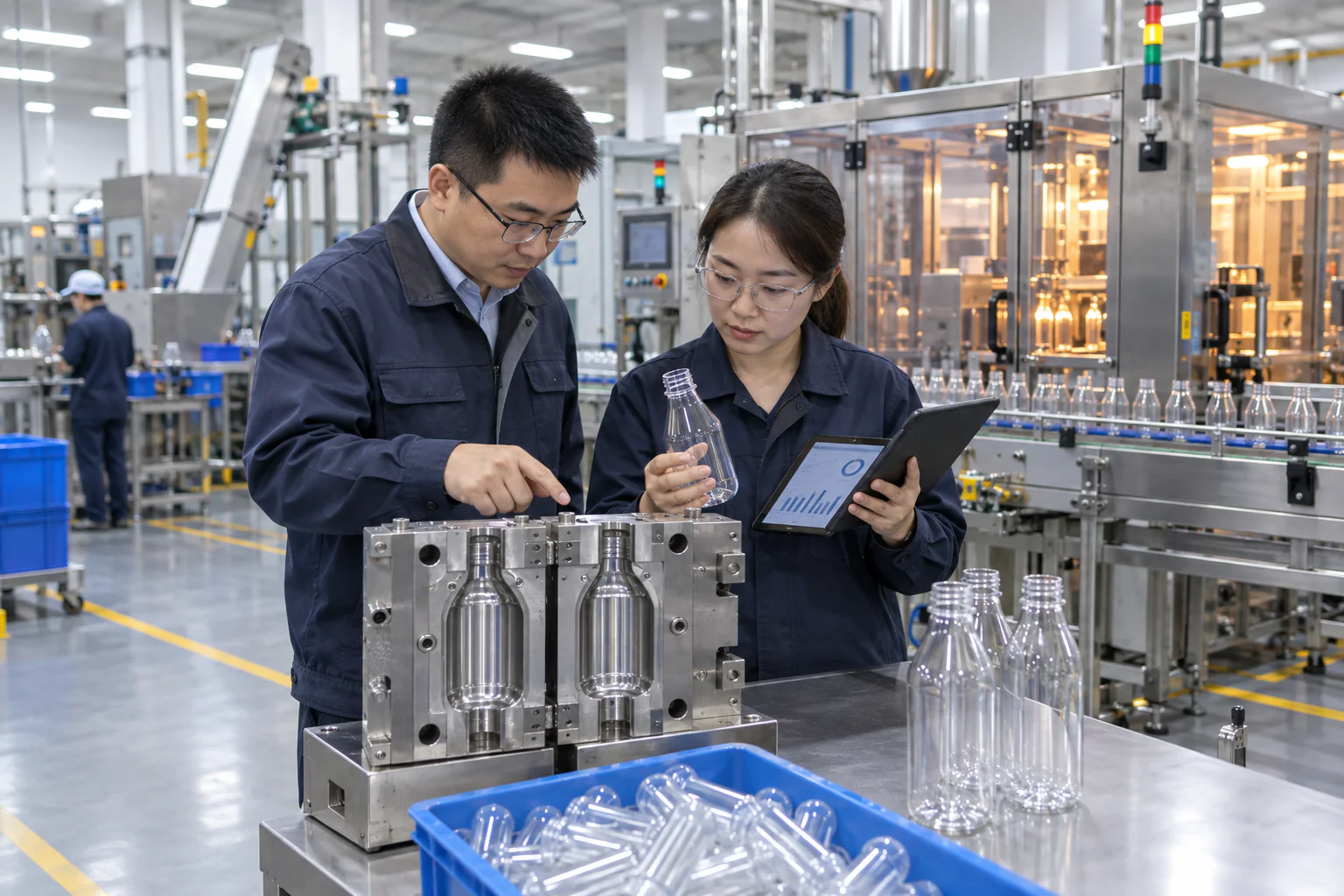
The audit must connect bottle material and geometry to the actual manufacturing route. Clear PET bottles commonly require preform injection followed by stretch blow molding. Flexible HDPE or LDPE squeeze bottles usually use extrusion blow molding, while PP bottles and caps may require separate molding processes. A machine list matters only when the listed equipment is available, maintained and capable of running the proposed mold and resin.
Review preventive-maintenance records, mold history, cavity status, approved process windows and recent downtime. Then compare demonstrated output with the order plan. Demonstrated sellable capacity equals the validated machine rate multiplied by scheduled hours, demonstrated uptime and first-pass yield; a brochure's maximum cycle speed should not be treated as available shipment capacity.
Capacity approval should also include competing demand, color-change time, cap availability, decoration constraints and peak-season loading. A realistic plan reserves room for inspection holds and rework instead of scheduling every machine hour as sellable production.
Build Batch Traceability From Resin to Pallet
A usable traceability system links the shipped pallet to the material batch, colorant or additive, production date and shift, machine, mold and cavity set, inspection lot, packing specification and release status. The system can be paper-based or digital, but it must retrieve the relationship without relying on one employee's memory.
Select a finished carton during the audit and trace it backward to production and material records. Then choose a raw-material lot and trace it forward to every affected production lot. Record the retrieval time and any broken links. A mock trace should demonstrate the site's real isolation capability; a universal four-hour target should not be assumed unless that response time has been agreed and demonstrated.
Hold-and-segregation controls are equally important. Nonconforming material should have a visible status, controlled location, authorized release path and disposition record. Pallet labels should remain legible after export handling, and the retention-sample period should cover the complaint window agreed for the program.
Control the Critical-to-Quality Dimensions for BBQ Sauce Bottles
The approved drawing should identify critical-to-quality dimensions rather than treating every dimension equally. For a BBQ sauce package, the highest-risk interfaces are usually the sealing land, neck finish, cap thread, liner or valve, bottle base and label panel. These features determine leakage, cap engagement, conveyor stability, squeeze recovery and retail appearance.
Measurements should be taken across mold cavities and over time, not from one attractive sample. The audit should verify calibrated equipment, test orientation, conditioning time, sample quantity and the reaction plan for drift. Filled-package trials are necessary when hot fill, sauce viscosity, oil content or particles can change the result.
| CTQ Feature | Typical Control | Failure It Prevents | Evidence |
|---|---|---|---|
| Sealing land | Flatness, damage and contamination inspection | Channel leaks and incomplete liner contact | Magnified inspection and leak result |
| Neck finish | Thread profile, diameter, height and start position | Cross-threading, cocked caps and torque variation | Drawing-linked dimensional report |
| Bottle body | Weight, capacity and wall distribution | Buckling, weak squeeze recovery and uneven appearance | Weight trend and section or thickness study |
| Base | Flatness, push-up geometry and stability | Rocking, conveyor falls and labeler interruptions | Surface-plate or stability check |
| Closure system | Application and removal torque, liner or valve fit | Leakage, difficult opening and inconsistent dosing | Matched-component filled trial |
| Appearance | Color, haze, black spots, flash and scuff limits | Retail rejection and batch-to-batch inconsistency | Approved boundary samples under defined lighting |
Use AQL Sampling Without Treating It as a Quality Warranty
ISO 2859-1:2026 sampling procedures provide an AQL-indexed system for deciding how many units to inspect and when a submitted lot is accepted or rejected. AQL is a statistical acceptance tool, not a promise that every accepted shipment contains no defects and not permission to ship defects up to a stated percentage.
The supplier quality agreement should define critical, major and minor defects with photographs or boundary samples, assign the inspection level and AQL for each class, and state the switching rules for normal, tightened or reduced inspection. Safety, contamination, wrong material and sealing failures are commonly treated more severely than cosmetic variation, but the exact classification belongs to the approved program specification.
Sampling does not replace process control. Weight trends, neck dimensions, cavity comparison and leak-test results should be monitored during production so drift is corrected before final inspection. The incoming inspection plan at the co-packer should use the same defect definitions to prevent disagreements at receipt.
Audit Food-Safety Controls and Component-Specific Documents
Food-contact packaging qualification covers the bottle, cap, liner, reducer, valve, colorant, coating and decoration that can contact or affect the sauce. A PET bottle report does not automatically cover a PP cap, PE liner, silicone valve or a new masterbatch. The FDA food-contact regulatory status of a component depends on the individual substances, intended use and applicable limitations, so documentation must match the final bill of materials and use conditions.
Review the scope, issuing body, site name and validity of any ISO 22000 or other food-safety certificate rather than recording only the logo. On the floor, verify hygiene zoning, pest-control evidence, cleaning records, foreign-material prevention, material identification, regrind rules and separation of released, held and rejected stock.
The technical file should identify sauce type, acidity, oil content, filling temperature, contact time and destination market. Migration or compliance statements are useful only when their material identity and test conditions cover the proposed component.
Write SLAs and a Supplier Quality Agreement That Can Be Enforced
A service-level agreement should turn broad promises such as fast delivery or quick response into definitions that both parties can calculate. One universal OTIF target, lead time or complaint response window is not suitable for every program; targets should reflect order pattern, production route, transit plan and the operational cost of failure.
The agreement should identify the data source, measurement period, exclusions, trigger and remedy for every metric. It should also separate acknowledgement from containment and final corrective action. A supplier can acknowledge a leak complaint quickly while still needing validated samples and production records before confirming root cause.
| SLA Metric | Definition to Fix in Writing | Evidence | Trigger and Response |
|---|---|---|---|
| OTIF | Required date, delivery point, complete quantity and permitted tolerance | PO, packing list and receipt record | Escalation and recovery plan after a missed threshold |
| Lead time | Start event, included approvals and ready-to-ship event | Approved schedule and milestone dates | Advance notice and revised capacity plan |
| Defect rate | Lot denominator, defect classes and inspection method | Inspection report and samples | Hold, sorting, replacement or credit route |
| Issue response | Acknowledgement, containment, root cause and CAPA deadlines | Time-stamped complaint and CAPA log | Escalation by severity and overdue stage |
| Change notice | Changes requiring approval and minimum notice period | Signed change request and validation result | Shipment hold until written approval |
| Document delivery | Required reports, language, revision and release timing | Controlled technical file | No release while mandatory evidence is missing |
Define CAPA, Change Control, and Liability Before Failure
A credible corrective and preventive action process begins with containment: identify affected lots, stop release, protect the customer's filling line and preserve evidence. Root cause should distinguish occurrence from escape. A thin shoulder may be caused by an unstable blow-molding condition, while its escape may be caused by an inspection plan that checked only bottle weight.
Corrective action removes the identified cause; preventive action reduces recurrence elsewhere; effectiveness review proves that the action worked over later production. The agreement should state who pays for sorting, rework, replacement, expedited freight, product loss or line downtime when responsibility is confirmed, while preserving a fair joint-investigation process.
Change control should cover resin supplier or grade, colorant, additive, mold or cavity repair, machine, process window, cap or liner source, decoration, pack-out and manufacturing site. Even a cost-neutral change can alter torque, leakage, migration status, squeeze feel or shelf appearance.
Protect Tooling Ownership, Confidentiality, and Approved Subcontractors
Custom bottle programs need a separate tooling schedule that identifies the tool, cavities, drawings, payment status, physical location, maintenance responsibility, expected service condition and permitted products. Paying a tooling charge does not by itself define ownership, exclusivity or the right to transfer the mold; those rights must be written into the agreement.
Confidentiality should cover drawings, sauce-related test data, labels, forecasts and customer identity. The contract should prohibit unauthorized production from proprietary molds and require written approval before moving work to another site or subcontractor. For supplier-funded or amortized tools, define the ownership transition and remaining balance calculation instead of leaving the status implicit.
What Gracepack Can Put Into the Qualification File
Gracepack can organize a qualification file around the selected package rather than supplying one generic factory brochure. Available manufacturing records cover injection-molding and blow-molding equipment used across bottle and closure programs, while project control can include approved drawings, mold confirmation, preproduction samples, in-process sample comparison and finished-goods inspection records.
For repeat orders, the working file can retain the quotation and product specification, approved sample references, packing and marking instructions, inspection evidence, carton data, loading photos and shipment documents. When a design requires new tooling, the release sequence can connect drawing approval, mold manufacture, trial samples and written mass-production authorization.

Food-contact support is matched by component and market. Available document families include PET, PP, PE, LDPE, HDPE and silicone routes, plastic bottle and cap enterprise standards, and ISO 22000 food-safety system documentation for qualification review. The final document list is confirmed only after the bottle, closure, liner or valve, sauce condition and destination are defined.
Release the Supplier Through a Trial Order and First-Article Gate
A successful audit does not replace product validation. Release a controlled trial quantity from the intended machine and mold, using the intended material, color, closure and pack-out. First-article inspection should verify the drawing, capacity, weight, cavity variation, appearance and closure interface before the balance of the run is authorized.
Fill the samples with the actual BBQ sauce and reproduce the real process: filling temperature, capping delay, torque, inversion where applicable, cooling, label application and distribution test. Observe leakage, paneling, base stability, cap removal, dispensing, residue and filled appearance after conditioning.
Supplier approval can remain conditional until the trial batch passes both factory and co-packer checks. This gate gives procurement a commercial supplier, quality a measurable baseline and operations a package that has already encountered the relevant line conditions.
BBQ Sauce Bottle Supplier Audit Checklist
Use the checklist below to convert the audit into an approval record. Attach the evidence, owner and due date for every open item rather than marking observations complete from discussion alone.
- Match the legal entity, bank beneficiary, manufacturing address and certificate holder.
- List every outsourced molding, decoration, closure, liner, testing and packing operation.
- Connect the proposed bottle material and mold to the actual machine and validated process route.
- Verify maintenance, calibration, mold-cavity status and demonstrated sellable capacity.
- Trace one finished pallet backward and one raw-material lot forward through production records.
- Check hold, segregation, release, retention-sample and complaint-preservation controls.
- Approve a controlled drawing, bill of materials, golden sample and visual boundary samples.
- Define neck, sealing land, weight, capacity, wall, base, torque, leakage and appearance controls.
- Set defect classes, sampling method, AQL values and tightened-inspection triggers by agreement.
- Match food-contact evidence to every bottle, cap, liner, valve, colorant and use condition.
- Write OTIF, lead-time, response, CAPA, change-notice and document-delivery definitions into the SLA.
- Define tooling ownership, exclusivity, maintenance, transfer rights and approved subcontractors.
- Run first-article and filled-package trials before authorizing mass production.
- Close audit findings with objective evidence and an effectiveness check.
FAQ About BBQ Sauce Bottle Supplier Audits
How is a factory audit different from a supplier questionnaire?
A questionnaire records claims; an audit tests those claims against registrations, records, equipment, materials, samples and employee practice. Both are useful, but the audit supplies objective evidence for the approval decision.
Should a supplier audit use a fixed AQL for every bottle?
No. The sampling standard can be consistent, but defect classes and AQL values should reflect the package risk, customer requirements and inspection history. Critical food-safety, material or sealing defects normally require stricter treatment than cosmetic variation.
Does ISO 22000 certification replace product testing?
No. A management-system certificate can support confidence in food-safety controls, but it does not prove that a specific bottle, cap, liner and sauce process will meet dimensional, migration, leakage or line-performance requirements.
What should be included in a BBQ sauce bottle SLA?
Define OTIF, lead-time start and finish points, defect measurement, complaint stages, change-notice rules, document deadlines, escalation and agreed remedies. Each metric needs a data source and calculation method.
When should a supplier be re-audited?
Requalification is appropriate at an agreed interval and after material changes, site moves, major quality failures, ownership changes, sustained SLA misses or significant process transfers. The interval should reflect risk and performance rather than a calendar alone.
What should be sent for a supplier qualification review?
Send the bottle drawing or target capacity, sauce type, filling temperature, closure route, destination market, expected volume, current quality concerns and any customer-specific audit or documentation requirements.
Request a Supplier Qualification Review
Share your bottle specification, sauce and filling conditions, closure route, destination market, forecast, trial quantity and required audit format. Gracepack can map the proposed bottle and cap to the manufacturing route, component documents, sample controls, first-article checks and supplier quality agreement before production approval.


