
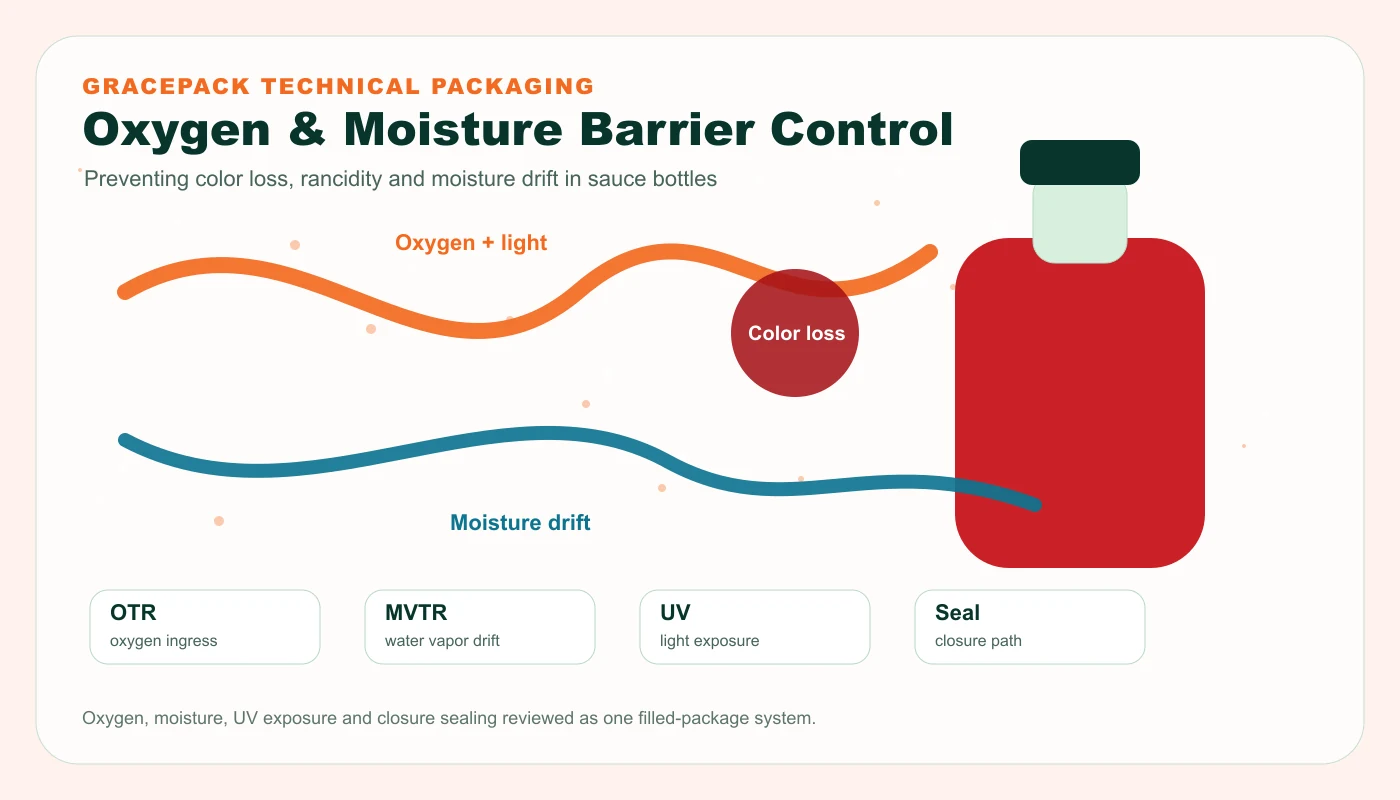
Preventing shelf-life degradation in sauce bottles means controlling oxygen ingress, water vapor movement, light exposure and closure leakage as one package system. Glass can provide near-total gas and moisture barrier, but many sauce programs need lighter plastic bottles, squeeze function, lower breakage risk or custom colors, so the engineering question becomes how much barrier the real formula needs and where the package is weakest.
For hot sauce, tomato sauce, chili oil, vinaigrette, BBQ sauce, garlic dressing and fermented condiments, oxygen can dull bright red pigments, flatten garlic and ginger aromatics, oxidize oils and support unwanted quality drift. Moisture loss can concentrate a sauce, crust material near the cap and change squeeze behavior. Moisture gain can dilute low-water-activity formulas, soften labels, affect dry seasoning inclusions or increase headspace condensation.
The practical barrier decision is not one material name. It is a validated combination of bottle wall, resin, color, UV blocker, EVOH or coating route, headspace control, liner, induction seal, cap torque, carton protection and storage conditions.
| Degradation Path | What Changes in the Sauce | Packaging Control | Validation Check |
|---|---|---|---|
| Oxygen ingress | Color dulling, rancid oil notes, aroma loss and oxidative browning. | Glass, EVOH multilayer wall, lower headspace oxygen and tighter closure sealing. | OTR screening, filled aging, sensory comparison and cap torque retention. |
| Moisture loss | Higher viscosity, crusting near the neck, poor dispensing and fill-weight perception issues. | Low-MVTR material route, induction seal and cap-to-rim compression. | Weight-loss study, cap residue review and storage at warm warehouse conditions. |
| Moisture gain | Dilution, label softening, condensation and possible microbial quality risk in sensitive formulas. | Moisture-resistant resin, liner selection, carton protection and storage control. | Humidity exposure, label adhesion, water activity review and filled-sample inspection. |
| UV / visible light | Pigment fading, herb color loss, chili color shift and oil oxidation acceleration. | Tinted resin, dark green or amber bottle, opaque route or UV blocker masterbatch. | Light-exposure comparison, color measurement and shelf display trial. |
| Closure pathway | Micro-ingress, leakage, cap staining, oxygen pickup after transport and inconsistent first opening. | Induction foil, compatible liner, controlled torque and correct sealing land design. | Inverted storage, thermal cycling, peel observation and leak testing. |
The Enemy of Hot Sauce: Oxidation and Flavor Loss
The most visible shelf-life failure in hot sauce and tomato-based condiments is pigment shift. Red color from chili pigments, paprika, tomato solids and carotenoid-rich ingredients can move from bright and fresh to brown, dull or uneven when oxygen and light exposure are high. The process is accelerated by headspace oxygen, warm storage, high surface area, metal contamination, light exposure and oxygen transmission through weak packaging paths.
Flavor loss is less visible but more damaging. Garlic, ginger, pepper aromatics, fermented notes and herb oils include volatile compounds that can oxidize, migrate into the package surface or fade through prolonged oxygen exposure. A bottle may still look acceptable on the shelf while the sauce tastes flat compared with a control sample stored in glass.
Oil-rich formulas raise the risk. Chili oil, vinaigrette, sesame-based sauces, garlic oil and infused condiments can develop rancid notes when unsaturated fats react with oxygen. Oil can also carry capsaicin and aroma compounds into the closure area, where liners, valves and cap materials are under long contact stress.
- Bright red sauces need oxygen and light review before choosing a clear bottle.
- Garlic, ginger, chili oil and herb extracts need sensory testing, not only visual inspection.
- High-acid sauces still need barrier review because low pH does not stop oxidation.
- A stable bottle wall does not guarantee a stable closure, liner or valve path.
- Filled-sample aging should compare upright, side and inverted storage when the package may ship or sit in those positions.
Oxygen Transmission Rate and Moisture Vapor Transmission Rate Explained
Oxygen transmission rate, or OTR, describes how much oxygen passes through a material or structure under defined test conditions. It is commonly discussed in `cc/m2/day` for films, and the same concept matters for bottles even though the finished package also includes geometry, cap fit, liner compression and headspace. Lower OTR usually means better protection for oxygen-sensitive sauces.
Moisture vapor transmission rate, or MVTR, describes water vapor movement through the package. Low MVTR helps a sauce keep its intended water balance and viscosity. This matters for thick sauces that can crust around the neck, emulsions that lose texture after moisture drift and dry-inclusion products where moisture pickup can create clumping or microbial concerns.
OTR and MVTR are not interchangeable. EVOH is excellent for oxygen barrier but is moisture-sensitive if not protected in the structure. Polyolefins such as HDPE and PP often provide useful moisture resistance but weaker oxygen barrier than high-barrier multilayer systems. PET offers clarity and moderate barrier performance but may still need UV, coating, EVOH or color strategy for demanding shelf-life targets.
| Material / Structure | Oxygen Barrier Direction | Moisture Barrier Direction | Best-Fit Sauce Use |
|---|---|---|---|
| Glass | Near-total oxygen barrier through the wall. | Near-total moisture barrier through the wall. | Premium hot sauce, acidic sauces, long shelf-life glass-positioned brands. |
| Monolayer PET | Better oxygen barrier than many polyolefin squeeze bottles, but not a high-barrier structure. | Useful moisture control for many liquid condiments. | Clear retail sauces where color visibility and moderate shelf life are required. |
| HDPE / LDPE | Weaker oxygen barrier than PET and EVOH routes. | Often useful for moisture resistance and squeeze durability. | Foodservice squeeze bottles, opaque sauce bottles and rough handling. |
| PP | Moderate oxygen barrier; stronger as a heat-resistant component route. | Useful moisture resistance and chemical stability. | Caps, selected heat-resistant bottle routes and warm-fill discussions. |
| EVOH multilayer | Strong oxygen barrier when the layer is protected and distributed correctly. | Requires protective layers because EVOH barrier performance can drop in high humidity. | Oxygen-sensitive sauces, creamy dressings, chili oil, garlic sauce and premium shelf-life programs. |
| Induction foil seal | Blocks oxygen through the mouth before first opening when bonded correctly. | Strong mouth barrier before opening. | Retail sauces, export cartons and products where cap-area ingress is the main risk. |
Multi-Layer Barrier Technology & UV Blockers
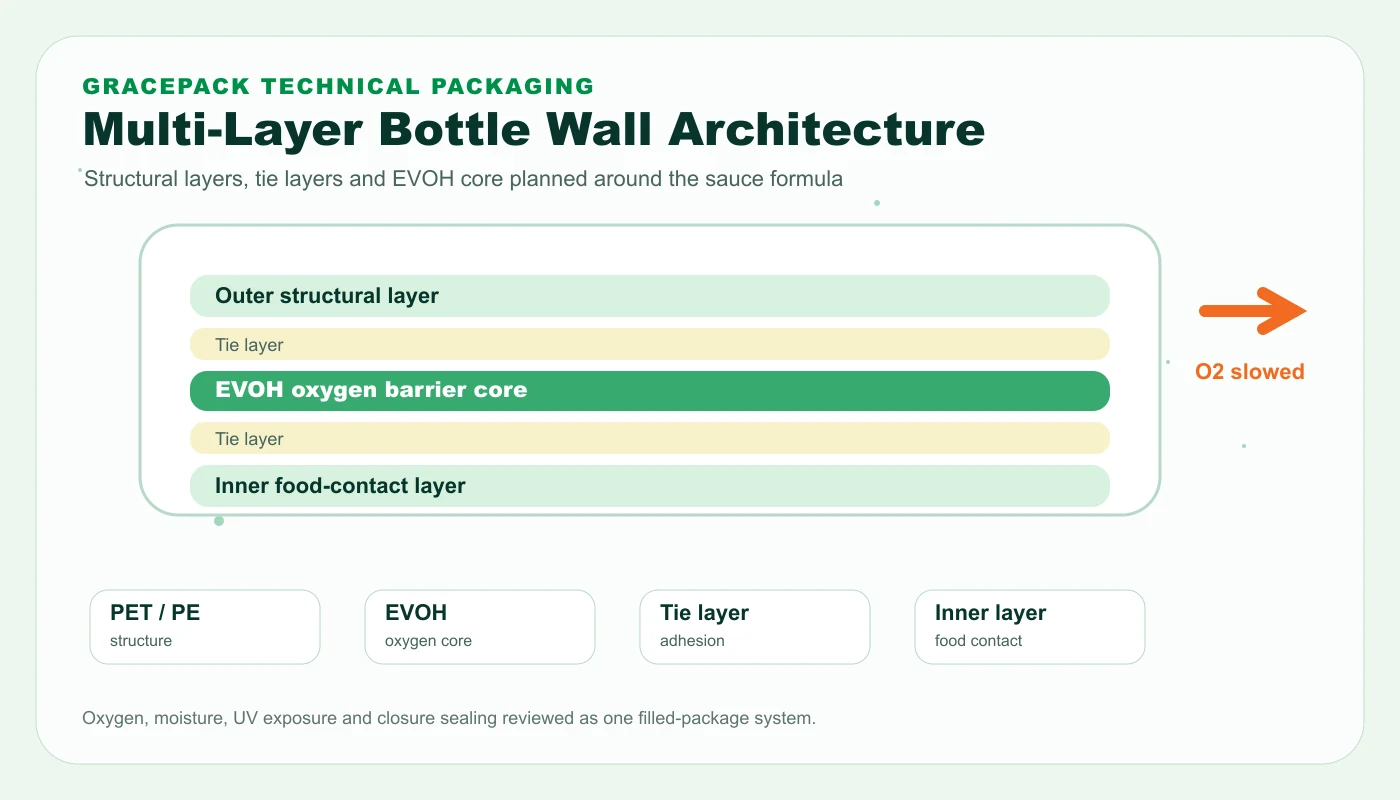
A multilayer bottle is used when a monolayer resin cannot provide the oxygen barrier, squeeze behavior, clarity, cost and production repeatability required by the formula. For rigid sauce bottles, the typical engineering logic is to place a high-barrier core such as EVOH between structural layers that provide strength, processability and food-contact suitability.
A simple five-layer logic looks like this: outer structural layer / tie layer / EVOH oxygen barrier / tie layer / inner food-contact layer. The tie layers help bond the barrier core to the structural layers. The outer layer carries scuff resistance, color and label appearance. The inner layer contacts the sauce and must be reviewed against acidity, oil, capsaicin, fill temperature and migration expectations.
UV blockers solve a different problem. They reduce light exposure through tinted resin, opaque pigment or additive masterbatch. Dark green, amber, smoke and white opaque bottle concepts can protect natural color better than clear bottles, but the choice must still support fill-level visibility, label contrast, recycling goals and brand presentation.
| Design Element | Barrier Role | Engineering Watchpoint |
|---|---|---|
| Outer layer | Mechanical protection, color, scuff resistance and label surface. | Too much pigment can affect appearance, sorting or recycling route. |
| Tie layer | Bonds dissimilar polymers in the wall structure. | Poor adhesion can create delamination or unstable wall performance. |
| EVOH core | Reduces oxygen transmission through the bottle wall. | Layer continuity and humidity protection must be validated. |
| Inner layer | Controls product contact and chemical compatibility. | Must match acid, oil, heat, capsaicin and food-contact documentation. |
| UV blocker / tint | Reduces light-driven oxidation and color fading. | Should be tested against actual sauce color and retail lighting. |
| Wall-thickness profile | Keeps the barrier layer distributed through shoulders, panels and base. | Thin shoulders or stretched corners can become local weak zones. |
Induction Heat Seals Protect the Mouth, Not Just the Wall
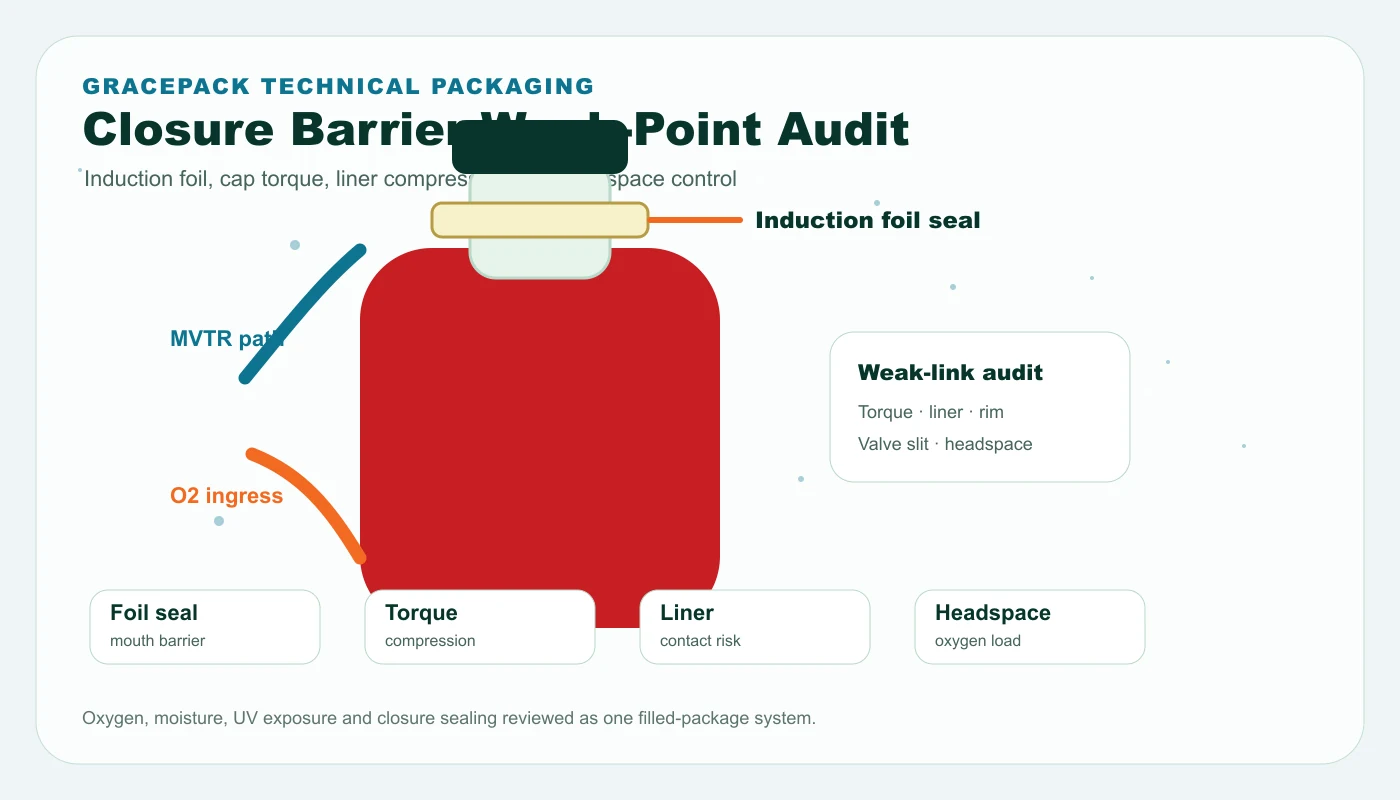
A sauce bottle can have a strong barrier wall and still fail through the mouth. The cap interface includes the sealing land, liner, foil layer, thread engagement, application torque and product residue. If oxygen or moisture enters through that path, wall OTR alone will not predict real shelf life.
Induction heat seals use an aluminum foil layer that heats under electromagnetic energy and bonds a compatible heat-seal layer to the bottle rim. When the bottle material, rim geometry, liner type, cap torque, dwell time and sealing head setting are correct, the foil becomes a strong pre-opening barrier against oxygen, water vapor, leakage and tampering.
The weak points are practical: an uneven rim can leave a channel; low torque can reduce pressure; high torque can distort soft plastic; oil on the mouth can interfere with bonding; wrong liner material can peel poorly or fail under transport. For acidic or oil-rich sauces, the induction seal must be tested with the actual fill condition, not only an empty bottle.
| Closure Variable | Shelf-Life Risk | Validation Method |
|---|---|---|
| Sealing land flatness | Micro-channels under the foil or liner. | Rim inspection, peel test and inverted storage. |
| Application torque | Loose caps, poor liner compression or thread damage. | Torque window check at filling and after 24-72 hours. |
| Foil liner compatibility | Seal lift, weak peel or poor adhesion. | Induction trial with the selected bottle material and actual cap. |
| Product residue at mouth | Seal contamination and cap-area staining. | Filler splash check, wiping requirement and filled-sample sealing. |
| Valve or reducer path | Oxygen ingress after opening, clogging or residue buildup. | Repeated dispensing, cap-down storage and oxygen-sensitive sensory review. |
| Headspace | Initial oxygen load trapped in the package. | Fill-height control, cap timing and shelf-life comparison. |
Glass, PET, EVOH and Polyolefin Routes Compared
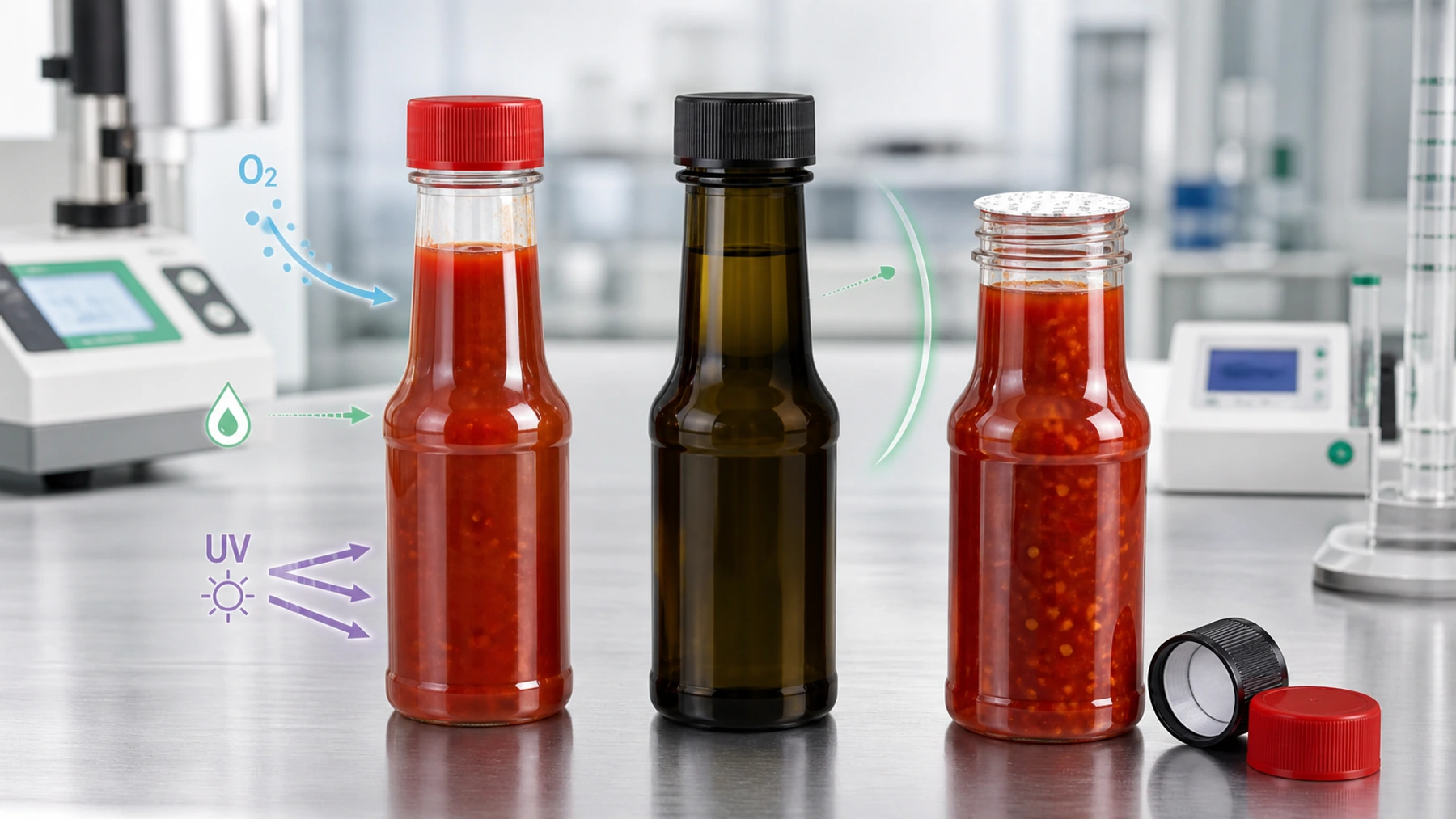
The strongest shelf-life package is not always the heaviest or most expensive one. The right bottle depends on the sauce's oxygen sensitivity, oil phase, acidity, fill temperature, shelf-life target, display requirements and logistics route. A boutique hot sauce may justify glass for flavor protection and premium presentation. A foodservice chili oil may prefer a dark plastic bottle with a controlled closure system. A squeeze dressing may need a PE-based structure with EVOH to keep the hand feel while reducing oxygen exposure.
For clear retail display, PET remains a useful starting point because it shows sauce color and provides better oxygen barrier than many basic PE squeeze routes. For rough handling and squeeze use, HDPE or LDPE may be better even though oxygen barrier is weaker. For high oxygen sensitivity, an EVOH multilayer structure or glass route should be evaluated. For warm-fill or cap components, PP may be part of the solution because of its heat and chemical stability.
| Sauce Condition | Likely Best Starting Point | Why | What to Confirm |
|---|---|---|---|
| Bright red vinegar hot sauce | Glass or clear PET with tight closure control. | Color visibility and flavor protection both matter. | OTR target, headspace, reducer fit and fill temperature. |
| Chili oil or infused oil sauce | Dark PET, glass, or oil-compatible plastic with foil seal. | Light and oxygen accelerate rancidity. | UV color, liner compatibility and cap residue. |
| Garlic ginger sauce | PET/EVOH, glass or opaque high-barrier route. | Aroma compounds can oxidize or fade. | Sensory aging, oxygen control and oil interaction. |
| Creamy dressing or emulsion | EVOH multilayer squeeze bottle or glass depending on channel. | Oxygen can destabilize flavor and color while squeeze feel matters. | Squeeze recovery, barrier layer and cap-down leakage. |
| Foodservice squeeze sauce | HDPE / LDPE, possibly with barrier review for sensitive formulas. | Durability and dispensing may matter more than full clarity. | MVTR, cap durability, filled squeeze cycles and carton compression. |
| Long export route | Barrier wall plus induction seal and stronger carton planning. | Transport time and climate exposure increase drift risk. | Thermal cycle, leak test, weight loss and sensory retention. |
Compliance and Factory Validation Behind Barrier Sauce Bottles
Barrier design does not replace food-contact review. A new multilayer wall, dark masterbatch, closure liner, silicone valve, PP cap or induction seal can change the documentation map. Food-contact suitability must be reviewed at the component level, then matched to the final bottle, cap, liner and destination market.
Gracepack's document support includes PET FDA and BPA-related reports, PET/PP/PE/silicone EU food-contact migration-related reports, HDPE EU review routes, LDPE overall migration reports, ISO 22000 food safety system documentation and enterprise standards for food-grade plastic bottles and caps. These are useful screening documents, but the final report scope should match the selected material stack and component set.
Manufacturing repeatability matters as much as the first approved sample. Gracepack's production base includes 9 fully automatic production lines, 15 automatic injection molding machines, 13 automatic blow molding machines, 3 labeling machines, 5 printing machines, 500+ owned molds and more than 5,000 standard bottle types. For barrier projects, that capacity supports bottle body, cap, liner, color and decoration review in one development path.
- Use component-level document matching for PET, HDPE, LDPE, PP, PE, silicone, liner and cap systems.
- Review migration and sensory risk when the formula contains acid, oil, capsaicin, garlic, ginger or herbal extracts.
- Validate color masterbatch or UV blocker before assuming an existing food-contact report covers the final structure.
- Check wall distribution across shoulders, panels and base because stretched zones can reduce local barrier performance.
- Confirm cap torque, liner compression, foil seal peel and filled storage before moving from samples to bulk production.
Representative Case: Shelf-Life Drift in a Chili Oil Sauce
A representative chili oil sauce project showed acceptable flavor in glass but developed dull color and slight rancid notes after storage in a clear monolayer plastic bottle. The first package also showed oil staining near the cap and light residue around the liner after side storage. The formula contained chili pigment, garlic, oil and suspended spice particles, so the failure path was not one-dimensional.
The revised package plan separated the wall, light and closure risks. The bottle moved from clear monolayer plastic to a darker barrier-oriented route for retail display trials. The closure changed to a tighter liner and induction-seal path, while fill height and cap torque were checked after 24 hours and 72 hours. Filled samples were stored upright, side-facing and inverted to reproduce export and warehouse conditions.
In the validation group, visible cap-area oil staining was reduced, weight-loss drift stayed within the project's internal checkpoint, and sensory comparison after accelerated warm storage was closer to the glass control. The lesson was simple: oxygen and moisture barriers work best when the bottle wall, color, headspace and mouth seal are engineered together.
Decision Audit Framework for Sauce Bottle Barrier Selection
A barrier package should be selected from the sauce outward. Before tooling, purchase order approval or retail artwork lock, use a technical checklist that connects formula risk with material, seal, test method and destination-market requirements.
- [ ] Identify the main degradation risk: oxygen, moisture loss, moisture gain, UV light, oil oxidation, aroma loss or cap-area ingress.
- [ ] Define the sauce chemistry: pH or acidity, oil percentage, salt level, garlic or ginger content, chili pigment sensitivity, particles and viscosity.
- [ ] Confirm filling process: cold fill, warm fill, hot fill, fill temperature, cooling curve, fill height and headspace target.
- [ ] Compare material routes: glass, PET, HDPE, LDPE, PP, tinted bottle, coated bottle or EVOH multilayer structure.
- [ ] Review the bottle wall: thickness distribution, shoulder stretch, base geometry, label panel and barrier-layer continuity.
- [ ] Validate UV protection: clear, amber, smoke, dark green, opaque or UV blocker masterbatch under actual shelf lighting.
- [ ] Specify the closure: cap material, liner, induction foil, reducer, valve, sealing land, application torque and removal torque.
- [ ] Test filled samples: upright, side and inverted storage, warm storage, humidity exposure, light exposure and transit vibration.
- [ ] Match documents: FDA, EU food-contact, BPA-related review, ISO 22000, migration, sensory and market-specific files.
- [ ] Review commercial balance: shelf-life gain, unit cost, recyclability, carton density, breakage risk and launch timeline.
FAQ About Oxygen and Moisture Barriers in Sauce Bottles
What are oxygen and moisture barriers in sauce bottles?
Oxygen and moisture barriers are bottle-wall, liner, seal and closure features that reduce oxygen ingress and water vapor movement so the sauce keeps its color, flavor, viscosity and declared shelf-life performance.
Is glass the best barrier for sauce bottles?
Glass provides excellent oxygen and moisture barrier through the wall, but it is heavier and more fragile than plastic. Plastic routes may be better when squeeze function, freight weight, breakage reduction or custom colors matter.
When should a sauce bottle use EVOH?
EVOH should be evaluated when the sauce is oxygen-sensitive, oil-rich, creamy, garlic-heavy, color-sensitive or expected to travel through a long distribution chain. It must be protected inside a multilayer structure and validated on the finished bottle.
Does PET protect sauce from oxygen?
PET gives better oxygen barrier than many HDPE or LDPE squeeze bottles, but it is not equal to glass or EVOH multilayer structures. PET may need a tighter closure, UV blocker, tint or multilayer strategy for demanding shelf-life targets.
Why does moisture barrier matter if sauce is already wet?
Moisture loss can thicken sauce and create crusting near the cap, while moisture gain can dilute sensitive formulas or affect labels and inclusions. MVTR matters whenever viscosity, water activity or storage humidity can change product quality.
Do induction seals improve shelf life?
Induction seals can improve pre-opening shelf-life protection by blocking the bottle mouth, reducing oxygen and moisture paths and adding tamper evidence. They still need correct rim geometry, liner material, torque and sealing settings.
Can a UV blocker replace an oxygen barrier?
No. UV blockers reduce light-driven degradation, but oxygen can still enter through the wall, headspace or closure. Light protection and oxygen control should be tested together for natural, oil-rich or bright-colored sauces.
What should I send for a barrier bottle sample review?
Send the sauce type, pH if available, oil content, largest particle size, viscosity, filling temperature, shelf-life target, storage orientation, bottle size, cap route, destination market and current failure symptoms.
Request a Shelf-Life Barrier Sample Evaluation
If your sauce is losing color, aroma, viscosity or freshness before the target shelf life, the next step is a filled-package barrier review rather than a generic bottle quote. Gracepack can compare glass, PET, HDPE, LDPE, PP, dark-color, UV-blocking and EVOH-style routes against the real formula and filling process.
Share the formula risk, fill temperature, bottle size, cap type, target shelf life, storage orientation, destination market and preferred appearance. The practical output can include a sample route, closure and induction-seal direction, document map and validation checklist before mass production.


