
Migration testing for an oil-based salad dressing bottle starts with a defined commercial use, not with a request for a generic food-grade certificate. The useful question is whether the proposed bottle-and-closure assembly is supported for this dressing, this filling route, this storage condition and this destination market. A vinaigrette with free oil, vinegar and herbs can create a different contact profile from a creamy emulsion, even when both are sold as salad dressing.
This article is a test-planning guide rather than a second FDA, EU or Australia legal overview. Use it to prepare a laboratory brief that makes the sample, the formula, the contact conditions and the acceptance question traceable. The broader Food Safety Compliance Guide and the cross-market food-contact document guide remain the right references when the purchasing team also needs the full regulatory-document route.
| Input to freeze before testing | Why it changes the plan | What to record |
|---|---|---|
| Dressing profile | Free oil, acidity, alcohol, salt, herbs and emulsifiers can affect the relevant contact scenario. | Formula class, oil phase, pH if available, alcohol content, particulates and worst-case SKU. |
| Package construction | Bottle, cap, liner, valve and decoration can have different materials and contact patterns. | Item codes, polymers, color or masterbatch, liner or valve and supplier revision. |
| Filling and cooling | A warm fill and slow cooling period can create a different exposure from ambient cold filling. | Maximum product temperature, dwell, cooling profile and capping sequence. |
| Storage and orientation | Cap-down storage keeps sauce against the closure; long ambient storage can change exposure time. | Shelf-life target, distribution temperature, upright or inverted use and retailer handling. |
| Target market | Applicable rules determine the accepted simulants, limits, methods and declaration route. | Countries of sale, customer specification and any retailer document requirement. |
Build a Component Map Before Choosing a Laboratory Sample
Do not submit only an empty bottle if production will use a cap, liner, reducer or silicone valve that can contact the dressing. Start with a bill of materials for every surface that directly contacts food and every component that could affect it through set-off, migration or seal exposure. For a cap-down format, the closure assembly may be the longest-contact part of the package.
Production-representative samples are more useful than convenient substitutes. Flat plaques or resin pellets can help a laboratory screen a material, but they do not automatically represent a molded neck, a colored cap, a liner laminate or a valve. The final brief should say which components will be tested as finished articles, which may be assessed with representative material specimens, and why that approach covers the actual contact surfaces.
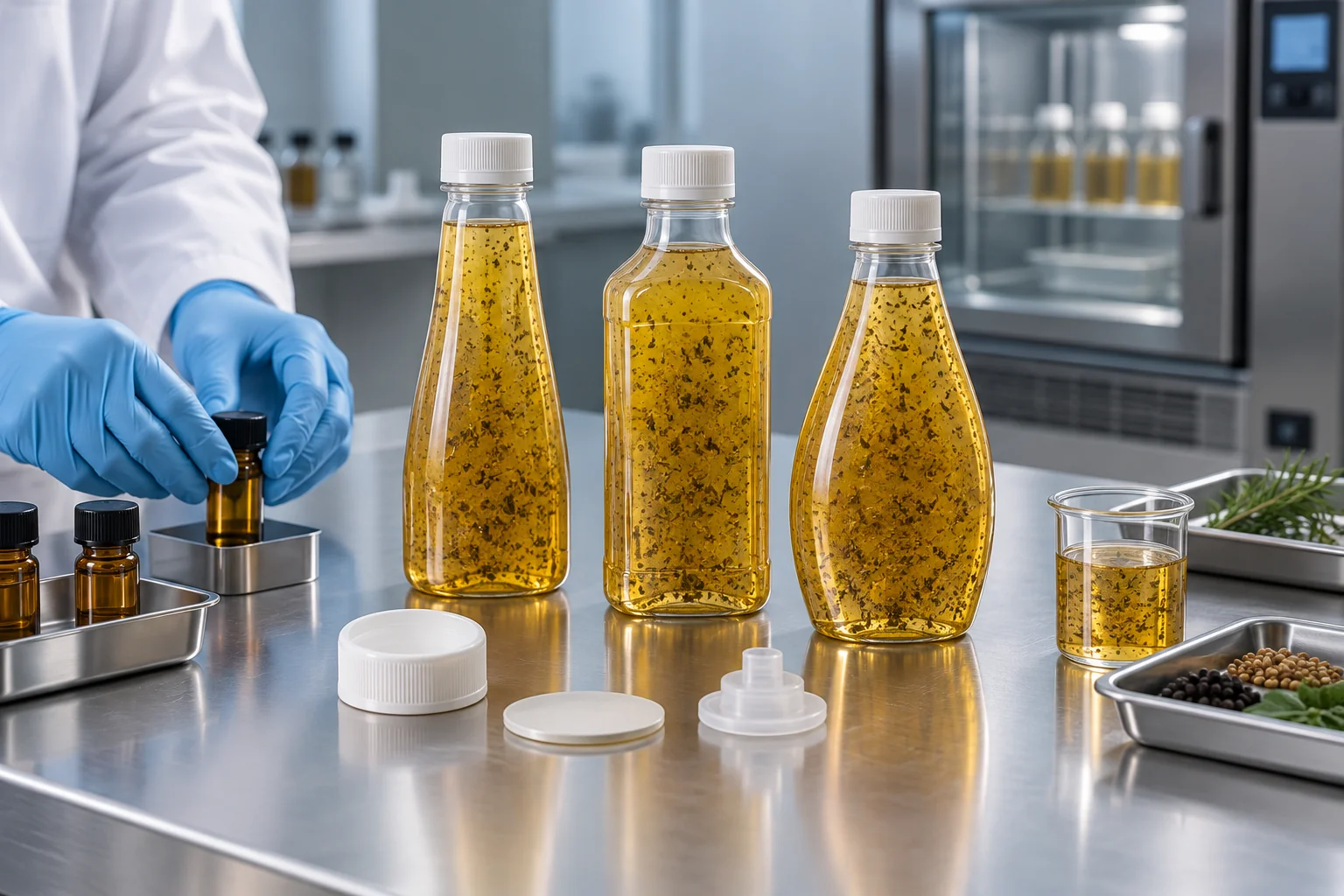
Keep decoration in scope without treating every label as a direct-food-contact component. Confirm the label position, ink system, adhesive and curing route, then check that no print or adhesive can enter the sealing land, internal surface or another foreseeable contact area. A change in cap color, valve supplier or label placement after testing should trigger a scope review.
| Component | Oil-dressing contact question | Sample-control point |
|---|---|---|
| Bottle body | Does the selected resin and color route match the intended formula, fill condition and shelf life? | Use the production material, color and wall construction. |
| Cap and sealing land | Can oil-rich dressing wet or remain on the seal interface during filling, transport or use? | Match the actual cap item, thread or plug-seal design and capping route. |
| Liner, induction seal or valve | Does a separate contact component have its own material and exposure profile? | Identify every layer or insert; do not assume it is covered by the bottle report. |
| Masterbatch or recycled-content route | Do additives, pigments or recycled inputs change the evidence needed? | Record the controlled formulation and the supplier or lot route. |
| Decoration | Could inks, coatings or adhesive reach food-contact areas through placement or set-off? | Document artwork boundaries and the finished curing or application process. |
Select the Fatty-Food Test Route From the Applicable Rule Set
For EU-bound plastic packaging, the food category, intended use and test tables in EU No 10/2011 determine the appropriate food-simulant route, conditions and any applicable reduction factors. High-fat dressings are often discussed with fatty-food simulant routes such as simulant D2 or 95% ethanol, but neither is a universal shortcut. The laboratory and responsible compliance team must select the route that matches the actual food category, article type and legally applicable conditions.
Do not add an acidic-food test merely because the dressing contains vinegar. An emulsified or oil-and-vinegar dressing can require more than one relevant food-contact scenario, but the decision needs to follow the applicable food-category and use-condition logic rather than a checklist of every available simulant. Record the formula rationale so a laboratory can explain why a given simulant represents the foreseeable worst case.
For U.S. projects, the testing brief should be read alongside the food types and conditions of use for food-contact substances, not treated as an EU migration test copied into a U.S. file. The point of the test plan is to match evidence to the actual bottle-and-closure use; it is not to present a single test result as a universal market approval.
| Dressing feature | Planning implication | Avoid this mistake |
|---|---|---|
| Free oil or high-fat phase | Ask the laboratory to evaluate the applicable fatty-food simulant route and any legal test-condition details. | Selecting a simulant solely because it is described online as an oil substitute. |
| Vinegar or citrus phase | Check whether the product category and intended use require an additional acidic-contact scenario. | Assuming pH alone describes a multi-phase dressing. |
| Alcohol-containing flavor system | Identify the maximum alcohol content and destination-market rules before sample submission. | Using a standard aqueous test without confirming the food category. |
| Herbs, spices or pigments | Separate migration planning from physical compatibility, staining and seal-contamination checks. | Treating a clear migration result as proof of dispensing and sealing performance. |
Set Time and Temperature From the Real Contact History
A test duration and temperature have meaning only when they correspond to the real package route. Record the maximum fill temperature, capping delay, cooling period, expected ambient or refrigerated storage, possible warm distribution and stated shelf life. A 10-day, 40 degrees C condition may be relevant to certain long-term room-temperature uses under a specified framework, but it is not a default recipe for every oil-based dressing bottle.
Orientation matters. An upright pour bottle may keep most of the dressing on the body wall, while a cap-down squeeze format holds product against the valve, liner and sealing land for extended periods. Include both the intended storage orientation and foreseeable consumer orientation in the brief, then pair migration evidence with separate leakage and dispensing checks.
| Use condition | What to put in the laboratory brief | Separate package check |
|---|---|---|
| Ambient shelf life | Stated shelf life, expected warehouse temperature and worst foreseeable distribution exposure. | Oil oxidation, odor or flavor change and closure leakage. |
| Warm or hot fill | Maximum fill temperature, cap-on timing, cooling curve and any post-fill hold. | Bottle shape, cap torque and seal integrity after cooling. |
| Refrigerated product | Normal and abuse-temperature range plus the actual time in storage. | Condensation, label adhesion and opening force. |
| Cap-down squeeze pack | Duration and temperature of continuous closure contact. | Valve recovery, liner interaction, cap-well cleanliness and inversion leakage. |
Define the Analytical Question Before Asking for OML or SML Results
Overall migration measures total non-volatile transfer under defined test conditions; specific migration addresses named restricted substances or other identified analytes. They answer different questions, and neither result should be requested without a sample identity, method, simulant, time, temperature, reporting limit and applicable acceptance criterion. A report that says only pass is difficult to audit later.
For an oil-based dressing package, also make clear whether the project needs organoleptic review, targeted extractables work on a cap liner or valve, or a restricted-substance screen tied to a known formulation risk. These are targeted decisions, not default boxes to add to every test order. The laboratory should be able to state what the selected method does and does not cover.
| Requested output | Question it answers | Information that must appear in the report |
|---|---|---|
| Overall migration | What total non-volatile transfer occurred under the defined scenario? | Sample, simulant, contact conditions, method, result and applicable limit. |
| Specific migration | Do identified restricted substances meet the relevant limits? | Target analytes, detection or quantification limits, conditions and results. |
| Targeted extractables or screening | Could a known liner, valve or additive risk need further assessment? | Component identity, rationale, method scope and limitations. |
| Organoleptic review | Does the package introduce unacceptable odor or taste under the planned use? | Product or justified medium, storage condition, panel or method and decision rule. |
Use Production-Representative Lots and Keep the Chain of Evidence
A good test result loses value if no one can connect it to the approved production item. Sample finished bottles and closures from the intended material and color route, then record item code, cavity or lot where available, date, supplier, resin or masterbatch revision and assembly configuration. Where a program uses multiple molding cavities or lots, the sampling plan should reflect that variation instead of relying on one favorable sample.
Before release, compare the laboratory sample description with the purchase specification and retained commercial sample. If the laboratory tested a clear PET bottle with a white PP cap but production changes to a colored bottle, lined closure or silicone valve, the team needs a documented coverage decision rather than an assumption.
- Freeze the approved bottle, cap, liner or valve item codes before dispatching samples.
- Photograph the assembled test article and retain one labelled control sample.
- Record material, color, supplier and lot or cavity information where the manufacturing route provides it.
- State whether the article is tested empty, assembled, filled with a simulant or conditioned after filling.
- Define which material, color, closure or process changes require the test plan to be reviewed.
Use a Short Pre-Lab Review Instead of Sending Uncontrolled Samples
The most useful factory contribution to a migration-testing program is not a broad compliance claim. It is a controlled pre-lab review that connects the selected bottle and closure to a sample matrix, relevant existing evidence and the stated dressing conditions. Gracepack can compare clear salad dressing bottles, salad dressing squeeze bottles and disc-top dressing caps against the proposed formula, fill condition, storage orientation and destination-market document request before commercial samples are locked.
This review should identify gaps early: a cap or liner that is not part of the original bottle evidence, a color change that needs confirmation, a cap-down exposure that was not included in the first brief, or a hot-fill route that needs separate mechanical validation. It avoids presenting an existing report family as proof for a different finished package.
| Pre-lab output | Why it helps the buyer | Decision before testing |
|---|---|---|
| Component and sample matrix | Shows exactly what article and parts the report is intended to cover. | Confirm the final bottle-cap-liner-valve configuration. |
| Use-condition brief | Stops the lab from guessing the formula, temperature or orientation. | Agree the worst relevant product and storage scenario. |
| Existing-evidence map | Separates relevant support from reports that do not match the ordered item. | Identify whether supplementary testing is needed. |
| Change-control note | Keeps repeat orders from silently drifting away from the approved sample. | Define material, color, supplier and process reassessment triggers. |
FAQ: Migration Testing for Oil-Based Salad Dressing Bottles
Does an oil-based salad dressing always require simulant D2? No. The appropriate simulant route depends on the applicable rules, food category, intended use and test conditions. The laboratory and responsible compliance team should document why the selected route represents the product.
Can a migration report for a PET bottle cover the cap and liner? Only if the report scope clearly identifies and evaluates those components. A PP cap, PE liner, silicone valve or different color route may need separate evidence.
Is 10 days at 40 degrees C the standard test for every ambient dressing? No. It can be relevant to certain specified long-term room-temperature conditions, but it must not be copied into a test request without checking the applicable rule set and actual package route.
Should a vinegar-and-oil dressing be tested only as acidic food? Not automatically. The test plan should account for the actual product category and its fatty and aqueous phases under the applicable regulatory framework.
Does a passing migration report prove that the finished dressing package will not leak? No. Migration evidence and mechanical validation answer different questions. Run torque, seal, cap-down and dispensing checks with the actual dressing and closure assembly.
Request a Migration-Test Sample Plan for Oil-Based Dressing
Send the dressing type, approximate oil content, acidity or pH if available, alcohol content if applicable, filling temperature, shelf-life target, storage orientation, destination market and retailer document list. Add the bottle capacity, material and color, cap or valve route, liner or induction-seal construction and a drawing or sample where available.
Gracepack can then prepare a practical test-sample and document matrix before you book laboratory work: which finished components to send, which use conditions to state, which changes require review and which separate bottle, closure or filled-package checks should run alongside the migration program.

