
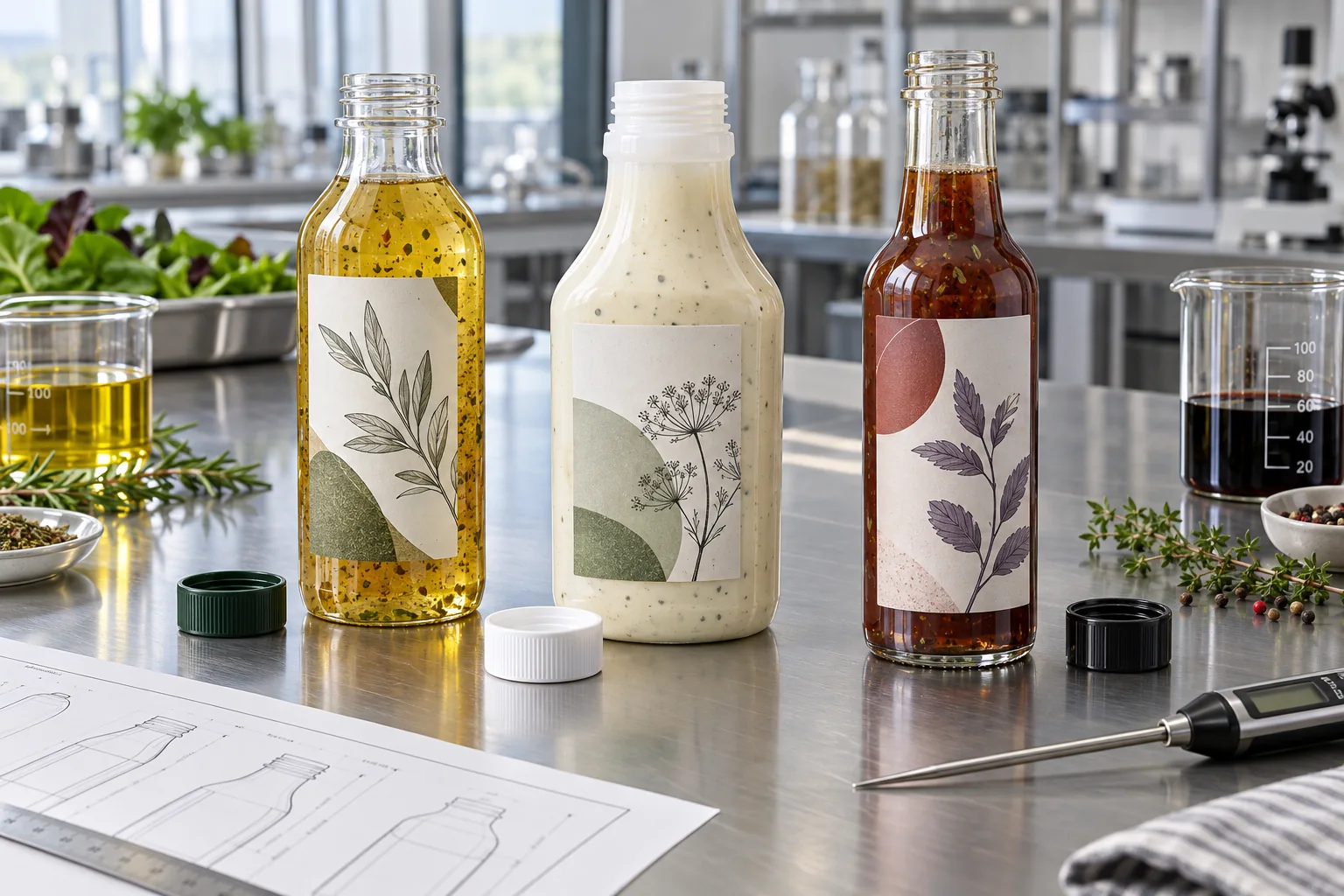
PET, PP and glass can all be valid salad dressing bottle materials, but they are not interchangeable. The practical choice starts with the dressing's oil phase, acidity, emulsion structure, oxygen sensitivity, particle size and filling temperature. It then has to work with the closure, label, distribution route and consumer dispensing method.
Standard PET is usually the first route to evaluate when a cold-filled or ambient-filled dressing needs high clarity, low freight weight and a rigid retail presentation. A selected PP construction can be useful where elevated-temperature resistance, flexing or an integrated closure system matters, but performance depends on the resin grade and bottle geometry. Glass provides the strongest passive gas and moisture barrier and broad formula compatibility, while adding thermal-shock, breakage and freight constraints.
A material name is therefore only a screening decision. Final approval should be based on a filled-package trial using the production formula, actual time-temperature profile, selected cap and the intended storage orientation.
| Project Condition | Strong Starting Route | Why It Fits | Validation Gate |
|---|---|---|---|
| Clear, cold-filled vinaigrette | PET | High clarity, useful stiffness and lower transport weight | Oil compatibility, oxygen target, closure seal and shelf-life study |
| Warm or hot-filled dressing | Qualified heat-set PET, selected PP or glass | Each can support elevated fill conditions when the exact package is engineered for them | Fill temperature at bottle, hold time, cooling profile, shrinkage and paneling |
| Creamy squeeze dressing | Selected PP, PE-based squeeze bottle or flexible PET route | Body compliance can reduce dispensing force | Viscosity, squeeze recovery, valve opening pressure and residue |
| Premium oil-rich dressing | Glass or validated high-barrier plastic | Barrier performance protects oxidation-sensitive oils and aromas | Headspace oxygen, closure liner, light exposure and real-time shelf life |
| Dressing with herbs or particulates | Wide-orifice plastic or glass system | The opening can be sized around particle passage instead of appearance alone | Largest particle, bridging, cap cleanliness and controlled-pour behavior |
Start With the Dressing Formula, Not the Bottle Resin
A low-pH dressing is not automatically easy to package. A vinegar-forward vinaigrette may be chemically compatible with several bottle materials, yet its unsaturated oils, herbs and volatile flavors can still oxidize. A creamy emulsion adds fat contact, longer wall contact during inverted storage and a different dispensing load. A dressing containing garlic, cracked pepper or chopped herbs introduces particle clearance and residue at the closure.
Four formula variables should be defined before the material shortlist is approved. Oil percentage and oil type influence oxygen sensitivity and migration test selection. The aqueous phase and pH help characterize acidic contact but do not describe the whole formula. Emulsion stability affects how the dressing looks through a clear bottle and how it drains. The largest particle and the tendency of particles to cluster determine the minimum useful flow path through the neck and cap.
The package also sees more than the initial fill. A retail bottle may spend months upright in a carton, then weeks on its side or cap-down in a refrigerator. That changes which surfaces stay wet, where oil collects and whether the liner or valve becomes the limiting component.
| Formula Variable | Packaging Effect | Question to Resolve |
|---|---|---|
| Oil and fat content | Raises oxidation sensitivity and changes food-contact test selection | Is the formula an aqueous acidic food, a fatty food or a mixed system under the target market rules? |
| pH and acid type | Influences corrosion, flavor stability and simulant selection | What is the equilibrium pH, and is the formula vinegar-, citrus- or lactic-acid based? |
| Emulsion and viscosity | Controls squeeze force, pour cutoff and wall residue | Does viscosity change with temperature or shear during filling and use? |
| Particles | Can bridge at an orifice or remain beneath a sealing surface | What is the largest particle after processing, not only the nominal ingredient cut size? |
| Light-sensitive ingredients | Can accelerate color and flavor change in clear bottles | Does the shelf-life study include realistic retail and refrigerator light exposure? |
PET Salad Dressing Bottles: Clarity, Barrier, and Fill Limits
PET salad dressing bottles are a strong starting point for clear retail vinaigrettes and pourable dressings because they combine glass-like product visibility with low empty-container weight and good dimensional stiffness. That clarity also exposes emulsion separation, herb distribution and fill-level variation, so a clear package makes formula appearance part of the packaging specification.
Standard PET should not be assigned a hot-fill temperature from the resin name alone. Bottle performance depends on preform design, stretch ratios, wall distribution, crystallinity, mold conditions and the actual thermal cycle. For elevated-temperature filling, a heat-set PET construction must be selected and validated as a complete bottle rather than inferred from a generic PET data sheet.
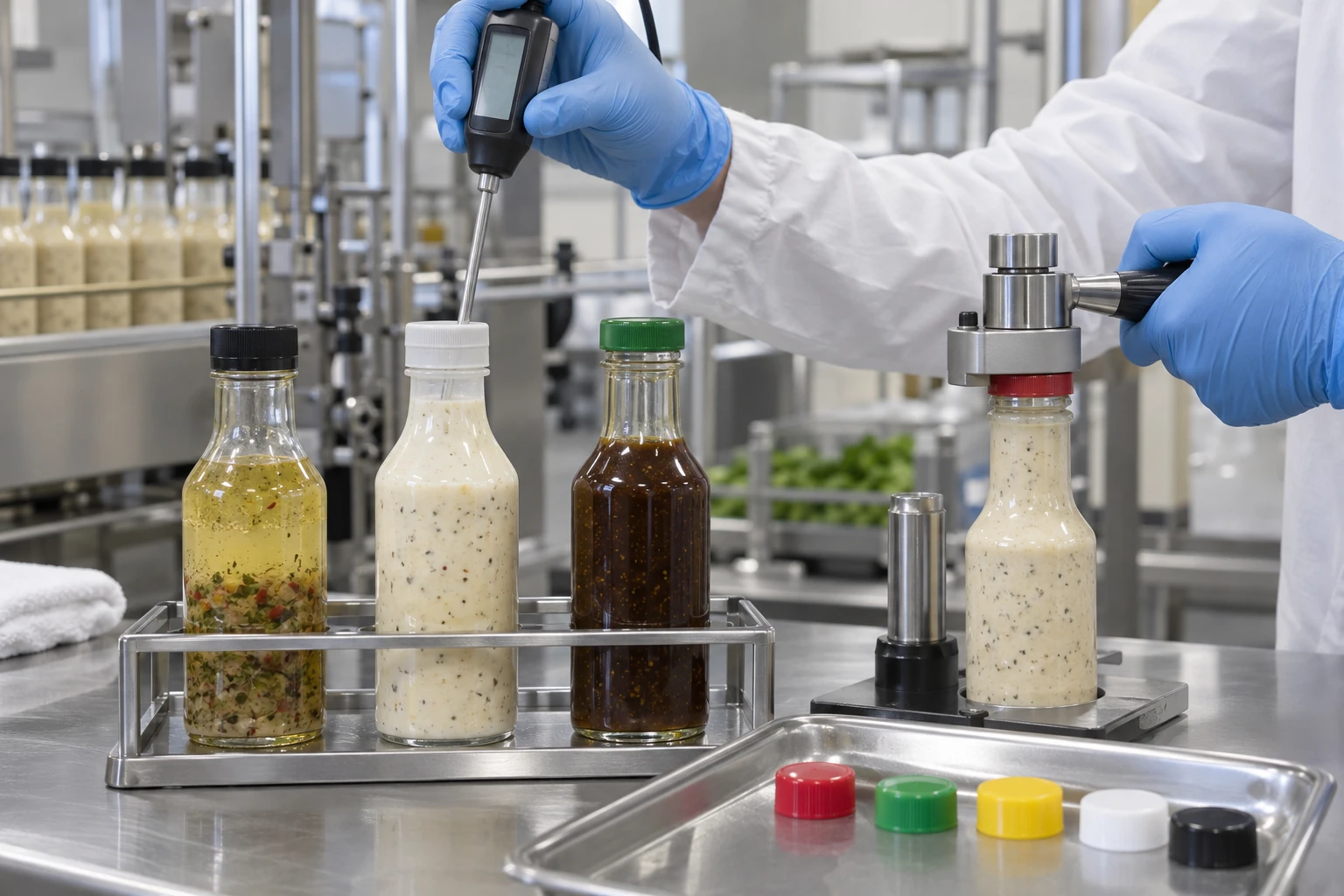
PET provides useful oxygen and moisture performance for many dressings, but shelf-life needs can exceed a monolayer bottle's capability. Oxidation-sensitive oils, natural colors and volatile flavor systems may require a barrier coating, multilayer route, UV protection, lower headspace oxygen or a stronger closure seal. The shelf-life study should separate oxygen entering through the bottle wall from oxygen entering at the closure or remaining in the headspace.
PP Bottles: Heat Tolerance, Haze, and Squeeze Behavior
Polypropylene has a higher melting range than PET and is widely used in food-contact closures, living hinges and selected bottle applications. That does not make every PP bottle a hot-fill package. Copolymer choice, wall thickness, orientation, mold design, unsupported panel area and cooling conditions determine whether a specific bottle keeps its capacity, label panel and neck alignment under the target process.
PP is normally translucent or hazy rather than glass-clear. That appearance can suit creamy dressings, opaque formulas or brands that do not need consumers to inspect herb suspension. Where squeeze performance is important, salad dressing squeeze bottles should be compared by measured hand force and recovery rather than by resin name: some PP constructions remain relatively stiff, while PE-based bottles or purpose-designed flexible PET can provide a softer response.
PP can also simplify bottle-and-cap material planning when a PP closure is selected, but label stock, liner, valve and color concentrate still affect the final structure. A mono-material claim should be based on the full component set and the rules used in the destination market.
Glass Bottles: Barrier Strength, Thermal Shock, and Logistics
Glass salad dressing bottles provide an essentially impermeable bottle wall for oxygen and water vapor and do not depend on polymer additives for formula compatibility. This makes glass a useful benchmark for premium vinaigrettes, aroma-sensitive oils and shelf-life work where the bottle wall should contribute minimal gas transmission.
The closure still governs the opening. A poorly matched liner, damaged sealing land or inconsistent application torque can undermine the barrier advantage of the glass body. The full package must therefore be checked for leak resistance, headspace oxygen, cap removal torque and liner compatibility with oil and acid exposure.
Hot filling into glass requires control of bottle temperature, product temperature and cooling to prevent thermal shock. Freight weight, glass-to-glass contact and parcel breakage also affect the cost per saleable unit. These factors often make glass strongest for premium positioning or demanding barrier targets, rather than the automatic choice for every dressing.
Formula and Fill-Process Compatibility Matrix
The matrix below is a project-screening tool, not a universal material approval. A promising route still needs a resin declaration, component-specific food-contact evidence and filled-package testing at the actual production conditions.
| Dressing / Process | PET Route | PP Route | Glass Route | Primary Risk to Test |
|---|---|---|---|---|
| Cold-filled clear vinaigrette | Strong candidate | Possible where haze is acceptable | Strong candidate | Oil oxidation, headspace oxygen and pour control |
| Cold-filled creamy emulsion | Candidate when body stiffness is acceptable | Candidate for selected squeeze designs | Candidate for pourable formats | Emulsion appearance, residue and dispensing force |
| Warm-filled dressing | Validate the exact bottle and thermal cycle | Good candidate with a qualified grade and design | Good candidate with thermal-shock control | Shrinkage, neck movement, seal and label distortion |
| Hot-filled dressing | Use a validated heat-set construction | Use a validated elevated-temperature construction | Use hot-fill-qualified glass and controlled cooling | Volume change, paneling, vacuum, torque and seal integrity |
| Oil-rich or natural-flavor formula | Assess barrier enhancement or light control | Assess oxygen barrier and light control | Strong wall-barrier benchmark | Rancidity, aroma loss, color shift and closure ingress |
| Chunky herb dressing | Use a matched neck and large flow path | Use a matched squeeze or pour closure | Use a matched wide opening | Particle bridging, cap fouling and sealing-land contamination |
The Closure Can Reverse a Good Material Decision
Bottle resin cannot compensate for a closure that restricts the dressing, leaks in side storage or admits too much oxygen. Thin vinaigrettes often need a controlled-pour opening that limits surge without trapping herbs. Creamy dressings need a flip-top, disc-top or valve system that opens at a comfortable force, cuts off cleanly and does not hold product where it can dry.
Neck finish, sealing-land flatness, liner chemistry, cap torque and opening geometry must be qualified as one interface. An induction seal may add tamper evidence and initial leak control when the bottle and foil heat-seal layer are compatible, but it does not replace a resealable cap that performs after opening. Valve systems also require formula exposure tests because oil, acids, pigments and particles can change valve cleanliness and recovery.
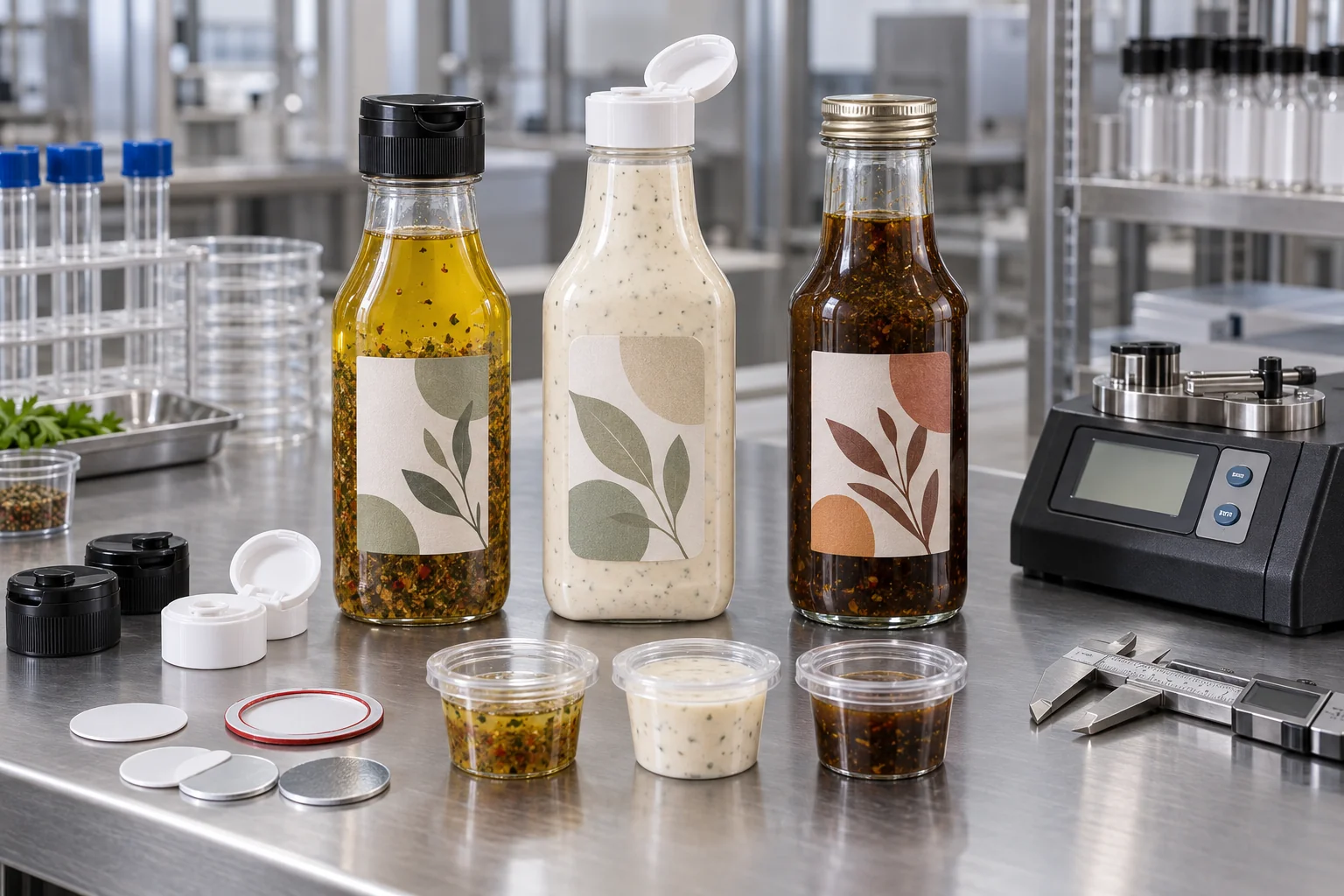
Cap-down packaging adds continuous product contact at the closure and a larger hydrostatic load at the opening. Upright and inverted samples should be aged separately, then checked for weeping, crusting, removal torque, valve opening pressure and consumer residue.
Validate the Filled Package Under the Real Process
A water trial can reveal gross leaks, but it cannot reproduce an oil-rich dressing's wetting behavior, a creamy emulsion's wall drag or particles collecting under a cap. Production-representative samples should be filled with the actual dressing, closed with production components and exposed to the intended temperature, hold, inversion and cooling sequence.
Dimensional checks should record brimful and nominal capacity, bottle height, panel width, neck alignment and mass before and after the thermal cycle. Functional checks should measure applied and removal torque, seal continuity, side-storage leakage, dispensing force, cutoff, recovery and residual product. Shelf-life observations should include color, odor, flavor, phase separation, paneling and closure staining under defined time and temperature conditions.
Acceptance criteria should be written before the trial. Without a target range, a sample that merely looks acceptable can conceal a drift in capacity, torque or wall deformation that later creates line stops or retail complaints.
| Test Stage | What to Record | Typical Failure Signal |
|---|---|---|
| At filling | Product and bottle temperature, fill weight, foam and headspace | Underfill, overflow, excessive foam or thermal distortion |
| After capping | Applied torque, cap position and seal activation | Cocked cap, incomplete foil bond or contaminated sealing land |
| After cooling | Capacity change, panel shape, base stability and neck position | Shrinkage, ovalization, rocking base or finish tilt |
| Distribution simulation | Upright and side leakage, scuffing and carton interaction | Weeping closure, label damage or bottle deformation |
| Use test | Opening force, pour or squeeze rate, cutoff, recovery and residue | Glugging, clogging, stringing, difficult squeeze or high product waste |
| Shelf-life checkpoints | Color, aroma, oxidation markers, phase stability and seal condition | Rancid notes, fading, separation, liner attack or loss of vacuum |
Food-Contact Evidence Must Match Formula and Use
Food-contact compliance is tied to the actual substance, component, food type and conditions of use. The FDA food types and conditions of use distinguish acidic aqueous foods from foods containing free oil or fat and distinguish elevated-temperature filling from lower-temperature contact. A generic statement that a resin is food grade does not establish the suitability of a colored bottle, cap, liner or valve for a specific dressing program.
For the European Union, EU Regulation 10/2011 uses authorized-substance requirements, migration limits, simulants and time-temperature conditions. Oil-and-vinegar dressings may require evidence that addresses both acidic and fatty contact. The Declaration of Compliance, supporting migration work and intended-use restrictions should agree with the exact material and additive set being supplied.
Gracepack's available component evidence includes a tested PET-preform route referencing 21 CFR 177.1630 and EU work on a PET, PP-cap and silicone component set using acidic and fat-related simulants under specified test conditions. Those reports are useful only after the proposed bottle, color, closure and use condition are matched to the tested sample scope; they should not be treated as blanket approval for every item in a catalog.
How Gracepack Screens a Salad Dressing Bottle Project
A useful sample review begins with the dressing rather than a catalog photo. Gracepack maps the formula and fill conditions to an existing bottle and closure route first, then identifies the remaining tests and documentation gaps. This can shorten development when one of more than 500 owned molds and 5,000 standard bottle designs is suitable without new tooling.
The manufacturing base includes automatic injection molding, blow molding, bottle production, labeling and printing capabilities. For a salad dressing program, the relevant advantage is not the machine count by itself; it is the ability to coordinate bottle body, neck finish, closure, decoration, sample approval and repeat-order specification within one technical review.
The approved specification should retain the bottle drawing, resin or glass definition, color, closure and liner identity, unit-weight range, capacity, critical dimensions, decoration file, pack-out and reference samples. Changes to any of those inputs should trigger an impact review before the next production batch.
| Project Input | Engineering Review | Practical Output |
|---|---|---|
| Formula and shelf-life target | Oil, acid, emulsion, particles, light and oxygen sensitivity | Material and barrier shortlist |
| Fill process | Temperature at bottle, hold, cap timing, inversion and cooling | Thermal trial plan and dimensional checks |
| Dispensing use | Upright or cap-down storage, pour rate, squeeze force and residue | Neck, cap, liner or valve sample set |
| Destination market | Component scope, food type, conditions of use and document chain | Evidence checklist for the selected package |
| Line and logistics | Capper, labeler, conveyor, carton, pallet and parcel exposure | Pilot-run and transport-validation criteria |
Decision Checklist for Salad Dressing Bottle Materials
Use the checklist to turn a material preference into a package specification that can be tested and repeated.
- [ ] Record pH, oil percentage, emulsion type, viscosity range and largest processed particle.
- [ ] Define the product temperature at the bottle, filling time, capping delay, inversion and cooling method.
- [ ] State whether the bottle will be stored upright, on its side or cap-down after opening.
- [ ] Set the required transparency, UV protection, oxygen barrier and target shelf life.
- [ ] Match the neck finish, closure, liner, valve and induction-seal layer to the bottle material.
- [ ] Confirm component-level food-contact evidence for the formula, use temperature and destination market.
- [ ] Run filled trials for leakage, torque, deformation, dispensing, residue and shelf-life appearance.
- [ ] Freeze the approved bottle, closure, color, decoration, carton and reference sample for repeat orders.
FAQ About PET, PP, and Glass Salad Dressing Bottles
Is PET suitable for oil-based salad dressing?
PET can be suitable for oil-based dressing when the bottle, colorants, closure and conditions of use have appropriate food-contact support and the package meets the required oxygen and light barrier. The finished formula still needs compatibility and shelf-life validation.
Can a standard PET bottle be hot filled?
A standard PET bottle should not be assumed to tolerate hot filling. Elevated-temperature applications normally require a purpose-designed heat-set or otherwise qualified PET construction tested with the real fill, hold and cooling cycle.
Is PP always softer than PET?
No. PP resin type, wall thickness and bottle geometry can produce very different stiffness. Squeeze force and recovery should be measured on the proposed bottle rather than predicted from the polymer name.
Does glass guarantee salad dressing shelf life?
No. Glass provides an excellent bottle-wall barrier, but headspace oxygen, light exposure, closure ingress, liner compatibility, processing and formula stability can still limit shelf life.
What tests should be run before selecting a bottle material?
Use production-representative filled samples to check dimensional change, leakage, torque, seal integrity, dispensing, residue, transport condition and shelf-life performance. Test both the intended fill cycle and expected storage orientation.
What information is needed for a material sample review?
Provide the dressing type, pH if available, oil content, viscosity, largest particle, fill temperature, cooling method, bottle size, cap preference, storage orientation, destination market, target shelf life and forecast quantity.
Request a Salad Dressing Bottle Material Sample Review
The most useful comparison is a matched sample set evaluated with the real dressing and fill process. Send the formula profile, process temperatures, target capacity, closure preference and shelf-life requirement to compare PET, selected PP and glass routes on the same decision criteria.
Gracepack can prepare a sample direction, component document checklist and filled-package test plan before artwork, tooling or mass production is released.


