

An inverted salad dressing bottle works only when three behaviors stay in balance: the dressing must move under a comfortable squeeze, the bottle must recover fast enough for the next dose, and the valve must close against gravity after dispensing. A valve that performs well with water can leak with vinaigrette, clog with herb particles or require excessive force with refrigerated ranch.
Validation therefore starts with the actual formula and a production-representative bottle, valve, cap housing and neck finish. The useful result is not simply pass or fail. It is a measured operating window for opening force, dose repeatability, cutoff, air return and cap-down leakage at the fill levels and temperatures the package will experience.
The test plan should separate each failure mechanism. Opening pressure describes the valve membrane. Hand force also includes bottle stiffness. Recovery time depends on the bottle wall and the available air-return path. Leakage can originate at the slit, the valve seat, the cap-to-neck seal or product trapped on the sealing land. Recording those mechanisms prevents an expensive tooling change from being used to solve the wrong problem.
| Performance Question | Primary Measurement | Evidence Needed for Release |
|---|---|---|
| Does product start to flow predictably? | Trigger force, internal pressure or both | Stable start point without delayed spurting across the planned temperature range |
| Is each serving controllable? | Dose mass, flow pattern and cutoff residue | Repeatable portions without tails, blobs or phase-biased first squeeze |
| Does the bottle prepare for the next squeeze? | Time to recover a defined percentage of the original profile | Recovery without permanent creasing, vacuum lock or valve contamination |
| Can the package remain cap-down? | Static, conditioned and pressure-differential leakage | No drops, seal-path leakage or progressive valve weeping under the agreed conditions |
Define Dressing Rheology Before Selecting a Valve
A single viscosity reading is not enough to predict inverted dispensing. Vinaigrette, ranch and mayonnaise-style dressings can share a nominal viscosity and still behave differently because their yield stress, shear-thinning response, thixotropic recovery, oil phase and particle load are different. The valve experiences all of these properties at a narrow slit while the bottle wall adds changing pressure behind the product.
Record viscosity at a stated temperature, spindle or geometry and shear condition. Add the largest particle dimension, particle concentration and any settling or creaming seen during storage. For emulsified products, compare the first dose after storage with later doses. A watery first squeeze followed by a thicker stream can indicate separation inside the bottle rather than a valve defect.
Temperature conditioning is essential. Refrigerated ranch may demand much more squeeze force than the same batch at room temperature, while a warm oil-rich dressing may place greater hydrostatic and wetting stress on the closed valve. Test conditions should represent the intended retail, kitchen and distribution environment instead of a single convenient laboratory temperature.
| Dressing Type | Likely Dispensing Challenge | Validation Focus |
|---|---|---|
| Thin vinaigrette | Low resistance and possible phase separation | Low-force leakage, splash control, first-dose composition and clean cutoff |
| Creamy ranch | Higher refrigerated resistance and herb particles | Trigger force, particle passage, recovery time and slit cleanliness |
| Mayonnaise-style dressing | High yield stress and strong wall demand | Bottle stiffness, delayed opening, dose tail and near-empty evacuation |
| Particulate specialty dressing | Seeds, pepper, garlic or herb bridging | Slit clearance, repeat dispensing, valve resealing and retained residue |
Measure Valve Opening Pressure Without Confusing It With Squeeze Force
Valve opening pressure, often called cracking pressure, is the pressure differential required to begin separating the slit. Consumer hand force is different: it includes the stiffness and geometry of the bottle, the grip area, fill level and the resistance of the dressing. Both measurements matter, but they answer different questions.
A repeatable bench method holds the filled bottle in a controlled compression fixture and applies displacement at a fixed rate. Record the force-displacement curve, synchronize it with the first product movement and weigh the dispensed dose. If internal pressure can also be measured without changing package behavior, the pressure trace helps distinguish a stiff bottle from a high-opening valve.
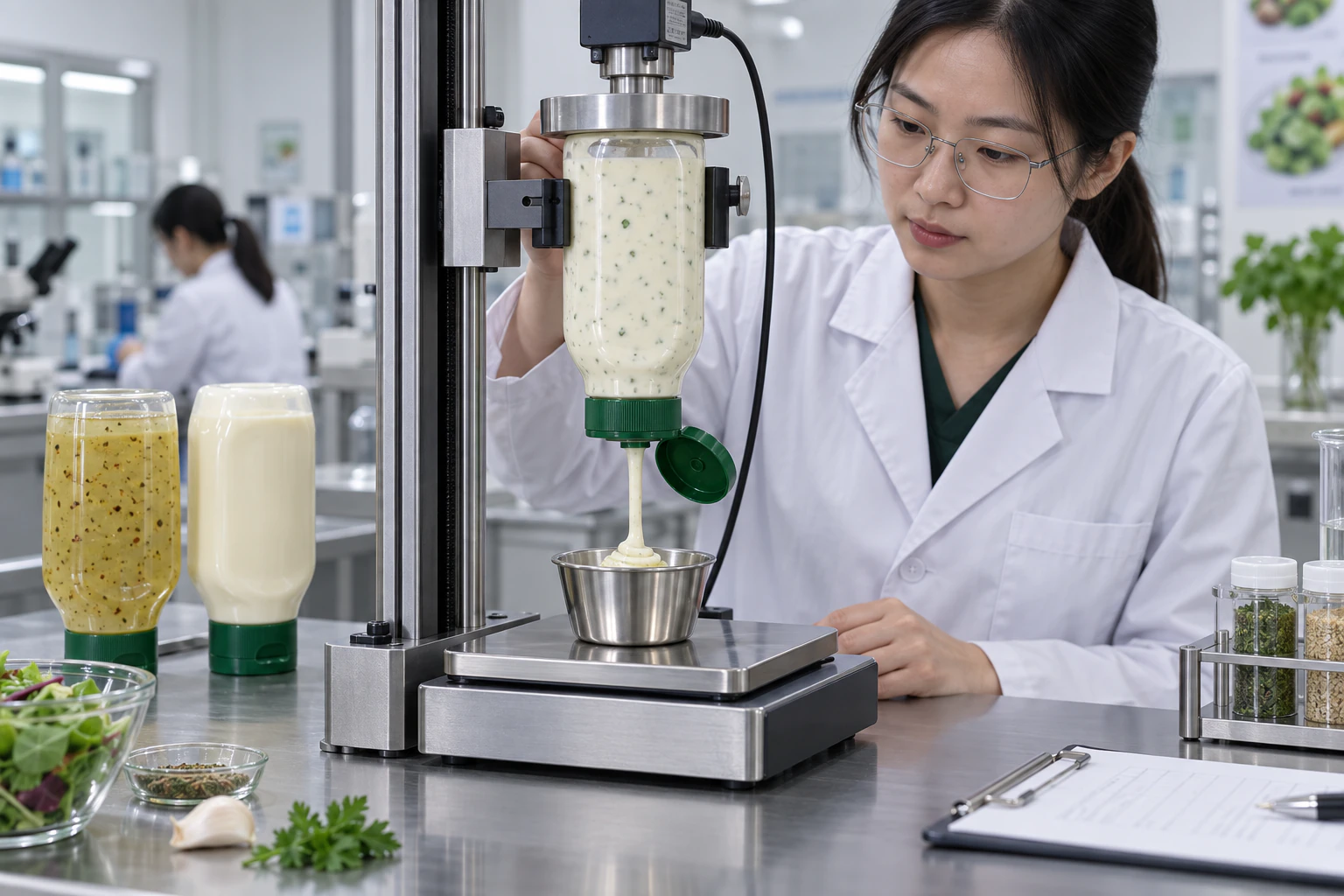
Run the sequence with full, half-full and near-empty bottles because the air volume and wall leverage change during use. Repeat it at the planned ambient and refrigerated conditions. The acceptance limit should be based on the target user, package size and required leak resistance. A comfortable force target can be written into the project specification, but it should not be copied from an unrelated bottle or treated as a universal standard.
Track Dose Repeatability, Cutoff, and First-Squeeze Behavior
Opening is only the first event. The package must also deliver a useful portion and stop cleanly when pressure is released. Use a fixed compression profile or a clearly defined manual protocol, collect each dose on a balance and compare the dose mass across repeated cycles. Record both average dose and variation; an acceptable average can hide large serving-to-serving drift.
Video is useful for separating three events: product start, steady flow and cutoff. Delayed opening followed by a sudden ribbon usually indicates pressure accumulation before the slit releases. A long tail can point to slow elastic recovery, excessive valve opening or a product that strings after the squeeze ends. Product that remains on the valve face can dry into a deposit that changes the next cycle.
For emulsified or suspended dressings, include a storage-to-first-use test. Condition filled bottles cap-down for the planned period, dispense the first several portions separately and examine appearance or composition. This reveals phase-rich first doses, particle sediment at the valve and temporary blockage that a freshly mixed sample would miss.
| Observed Behavior | Likely Mechanism | Next Diagnostic Check |
|---|---|---|
| Late opening followed by a spurt | High trigger pressure relative to bottle compliance | Compare internal pressure, force curve and valve geometry |
| Dose becomes smaller over repeated squeezes | Incomplete air return or progressive wall deformation | Measure recovery profile and inspect the air path |
| Thin first dose, thicker later doses | Formula separation during cap-down storage | Analyze first-dose composition and storage stability |
| Product tail or hanging drop | Slow cutoff, stringing rheology or contaminated slit | Review release speed, valve face and conditioned samples |
Quantify Air Return and Bottle Recovery
After the hand releases, the bottle wall provides the restoring force that draws air back through the designed path. If the wall is too stiff, the first squeeze feels difficult. If it is too soft or has poor material distribution, it may crease and recover slowly. If the valve or vent does not admit air consistently, the bottle can remain collapsed even when the resin has adequate elastic memory.
Measure recovery against a defined reference profile. A side-view camera, displacement sensor or dimensional fixture can track the bottle as it returns toward its original width or volume. Time to 95 percent recovery is a useful reporting point when it is written as a project metric, but the allowable time must follow the intended serving rhythm rather than an arbitrary industry-wide number.
Repeat recovery after multiple doses, after refrigerated conditioning and near the end of the package. Inspect for permanent whitening, hinge creases, label wrinkling and changing dose size. A bottle that recovers once when empty may still fail after the dressing coats the valve, the air volume increases and the wall has been cycled many times.
Run Cap-Down Leakage Under Static and Dynamic Stress
Cap-down storage keeps the dressing directly against the dispensing system. A release test should therefore include the maximum intended fill, the exact valve and cap assembly, the real dressing and the complete closure application condition. Stand bottles on clean, gridded absorbent sheets so the location and extent of any leak can be traced to the slit, valve seat or cap-to-neck interface.
Use defined checkpoints such as one hour, 12 hours, 24 hours and seven days when they suit the project, and condition samples at relevant refrigerated, ambient and warm-storage temperatures. Classify the result consistently. A clean valve has no product on the exterior face. Weeping is visible product that remains on the face without forming a drop. Dripping is a separated drop and is normally an immediate failure for retail packaging.

Static storage alone does not represent distribution. Add vibration, drop or impact conditioning appropriate to the shipper, then repeat the cap-down observation. The ASTM D6653 altitude simulation method can support a defined pressure-differential study for packaged products. The method does not set a salad-dressing pass limit; the protocol still needs the package configuration, pressure profile, exposure time and leakage criteria.
Vacuum decay can help locate a gross or fine package leak when the method is calibrated for the package. The ASTM F2338 vacuum decay method is nondestructive, but it should be validated with known-good and known-leak controls. It does not replace direct observation of valve weeping, product deposits or dispensing behavior.
Separate Formula Failure From Package Failure
When a valve test fails, changing the valve is not always the correct response. Herb stems or minced particles may bridge the slit. An unstable emulsion may leave a thin oil-rich phase against the valve. Dried product can prevent the membrane from returning to its neutral position. A contaminated bottle finish can leak below the cap while the valve remains fully closed.
Disassemble failed samples without wiping away the evidence. Photograph the valve face, underside, seat, cap well, neck sealing land and threads. Compare product-contact surfaces with unused controls, and note swelling, softening, distortion, residue and odor. Keep the component lot numbers and cavity identifiers with each sample so a localized molding or assembly issue is not mistaken for a formula-wide problem.
Silicone grade, membrane thickness, slit geometry and preload affect the opening and closing window. The cap housing controls how the valve is retained and compressed. The neck finish and plug or land seal control leakage outside the valve. These parts must be approved as a matched assembly rather than purchased independently from nominal dimensions alone.
Set Acceptance Limits Around the Intended Use
A useful specification states the method, condition, sample state and acceptance rule. Writing only 'easy squeeze' or 'no leak' leaves production and quality teams to interpret the requirement differently. The specification should identify the conditioning temperature, fill level, compression rate or stroke, number of cycles, measurement interval and classification of clean, weeping and dripping results.
Use the same definitions for development samples, pilot production and mass-production checks. If a result changes, the data should show whether the shift came from the dressing batch, bottle cavity, valve lot, cap assembly or storage condition. That traceability is more valuable than a single attractive demonstration sample.
| Metric | Method Definition | Acceptance Logic |
|---|---|---|
| Opening behavior | Conditioned fill level, compression rate, trigger force and first-flow point | Within the project force window with no delayed burst or uncontrolled splash |
| Dose repeatability | Fixed squeeze profile, stated number of cycles and weighed portions | Mean and variation remain within the serving target |
| Cutoff | Video or timed observation after force release | No separated drop and residue class within the agreed visual limit |
| Body recovery | Percentage of original profile reached over time | Recovers within the serving interval without permanent crease or dose drift |
| Cap-down leakage | Time, temperature, orientation and pressure or transit conditioning | Zero drops and no leakage through the neck seal; weeping limit defined by application |
Build a Production-Representative Sampling Plan
Development samples should include more than one bottle and one valve. Pull bottles from multiple molding cavities or time points, valves from the intended production lot and caps from representative assembly conditions. Test the planned minimum and maximum fill, not just the nominal midpoint. Retain unused components and filled controls for comparison if a delayed failure appears.
Pilot runs should reproduce the way the closure is assembled and applied in production. Record bottle weight, neck finish, valve lot, cap lot, application settings, fill temperature, headspace, dressing batch and storage history. Randomize the order of tests where possible so equipment warming or operator sequence does not bias one configuration.
Release should include repeatability, not only the best result. Report individual measurements, averages, variation and observed failure mode. A controlled sample that passes opening force but fails leakage is not improved by averaging the two outcomes. Each critical requirement needs its own pass rule.
Match Component Documents to the Tested Package
Food-contact evidence should follow the actual bottle, cap and valve materials. For projects using PET preforms, PP closures and silicone components, Gracepack can assemble component-specific document routes rather than treating one generic bottle report as coverage for the complete dispensing system.
One available SGS component file for a PET preform, PP caps and silicone evaluates overall migration under the report's specified conditions. The PET and PP scope includes aqueous acidic, alcoholic and fatty-food simulant routes, while the silicone scope includes 10 percent ethanol, 3 percent acetic acid and rectified olive oil. Separate PP and PE cap reports include dimensional, sealing and migration-related checks. The applicable file set is confirmed against the final component combination and destination market.
These reports support material and component review; they do not prove that a filled inverted bottle will dispense cleanly, recover quickly or remain leak-free. That evidence comes from testing the approved components with the actual dressing and the intended filling, storage and distribution conditions.
FAQ About Inverted Salad Dressing Bottle Validation
Can water be used to select a silicone valve?
Water can confirm that a fixture operates and reveal gross leakage, but it cannot release the package. The real dressing or a justified worst-case formula is needed because viscosity, yield stress, oil, emulsifiers and particles change opening, cutoff and air return.
Is valve cracking pressure the same as consumer squeeze force?
No. Cracking pressure describes the pressure differential that opens the slit. Consumer squeeze force also includes bottle stiffness, grip geometry, fill level, dressing resistance and temperature.
How should ranch dressing be conditioned before testing?
Test the intended storage conditions, including refrigerated use when applicable. Record the temperature and stabilization time because ranch can become substantially harder to dispense when cold.
What is the difference between weeping and dripping?
Weeping leaves visible product on the valve face without a drop separating. Dripping produces a detached drop. Both should be recorded, while a separated drop is normally a clear retail-package failure.
Should body recovery be measured with an empty bottle?
Empty-bottle checks are useful for screening, but the release test should use filled bottles at multiple fill levels. Product resistance, air volume and valve wetting all change recovery during use.
What information is needed for a validation sample request?
Provide the dressing type, oil content, pH if available, viscosity method, largest particle, storage temperature, bottle capacity, target dose, fill process, cap-down storage period, destination market and current failure symptoms.


