
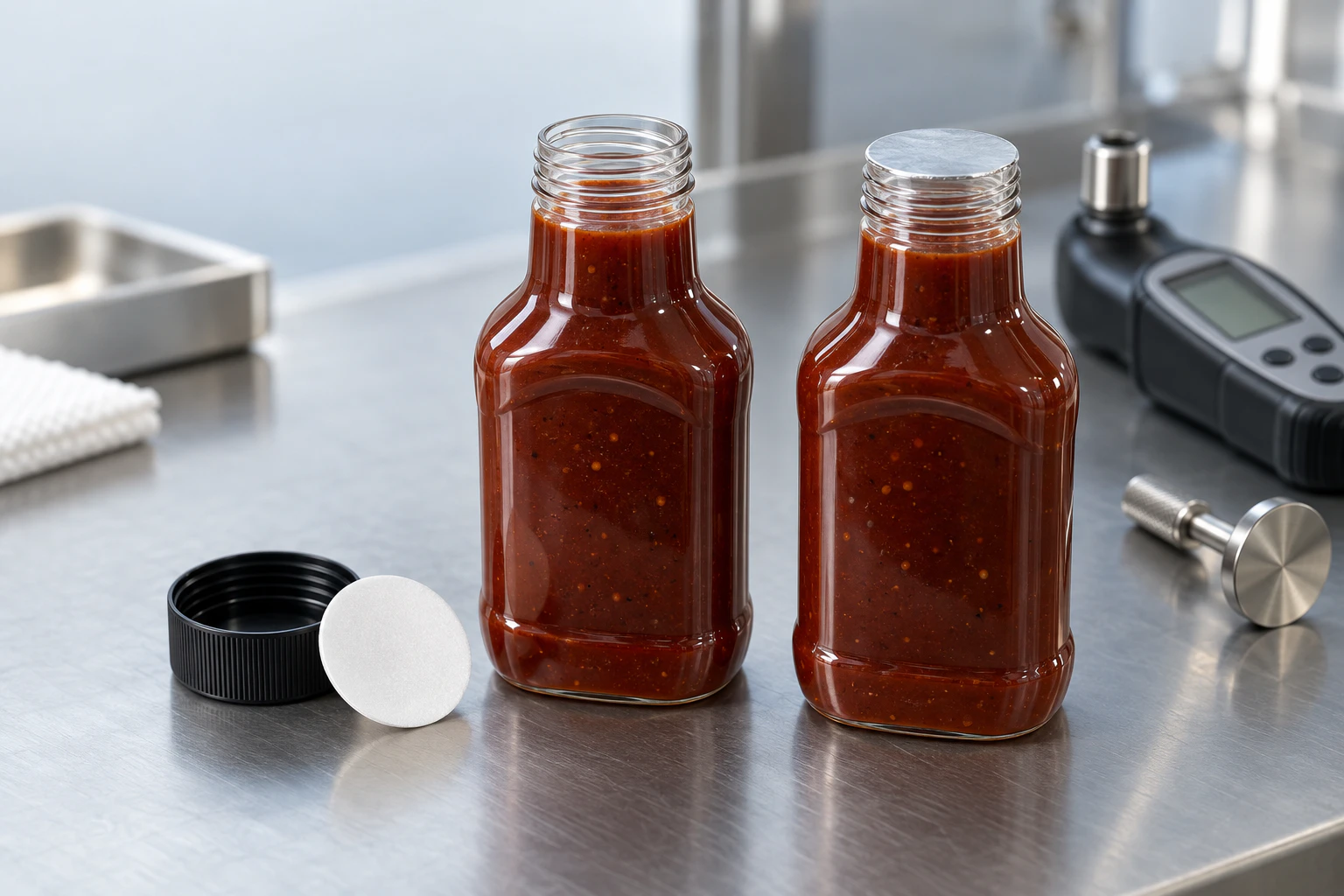
For acidic BBQ sauce bottles, a properly matched induction seal is usually the stronger primary mouth-seal route because its heat-seal layer bonds to a clean bottle rim and provides a continuous barrier before first opening. A pressure-sensitive liner depends on cap compression and adhesive transfer; common versions are normally intended for dry products, so they should be used with liquid sauce only when the liner manufacturer has qualified the exact construction, bottle material, formula and filling conditions.
Acidity alone does not decide the result. Tomato solids, vinegar, oil, smoke flavor, sugar, rim contamination, warm filling, storage orientation and removal-torque drift all affect seal integrity. The bottle, cap, liner and process therefore need one approval window rather than separate component approvals.
| Decision Factor | Induction Seal | Pressure-Sensitive Liner | Practical Direction for Acidic BBQ Sauce |
|---|---|---|---|
| Seal formation | Electromagnetic energy heats foil and activates a resin-matched heat-seal layer on the bottle rim. | Cap compression transfers a pressure-activated adhesive to the rim over time. | Induction provides the more controllable primary mouth bond when the package is correctly matched. |
| Liquid contact | Available in structures engineered for liquid foods and specific bottle materials. | Many standard grades are specified for dry products rather than liquid contact. | Require written suitability for the exact sauce and conditions of use. |
| Tamper evidence | The bonded foil must be peeled or punctured before dispensing. | The disk can separate with limited visible evidence, depending on construction and bond. | Use induction or another destructive first-opening feature for retail assurance. |
| Line equipment | Requires an induction sealer after capping and a controlled energy window. | Requires no induction unit, but still depends on cap torque, dwell, rim condition and liner specification. | Lower equipment cost does not compensate for an unqualified liquid seal. |
| Frequent failure | Partial bond, scorching, wrinkling, channel leak or wrong heat-seal layer. | Adhesive lift, liner pullout, incomplete transfer or loss of contact after storage. | Diagnose the interface and process variable before changing the entire bottle. |
| Best starting use | Retail liquid sauce, shipment leakage control and visible mouth-level tamper evidence. | Dry or low-moisture contents explicitly listed by the liner supplier. | Begin an acidic BBQ sauce project with an induction-compatible route unless testing supports another system. |
Why Acidic BBQ Sauce Challenges the Bottle-Liner Interface
BBQ sauce is not simply a low-pH liquid. A typical formula can combine water, vinegar, tomato solids, sugars, salt, smoke compounds, spices and an oil phase. These ingredients change surface wetting, residue formation and the way sauce behaves on the sealing land. A liner that works over a clean, dry rim can fail when a filling nozzle leaves a thin film of sauce across one section of the mouth.
The risk is especially high when a viscous sauce strings after nozzle cutoff. Even a narrow strand can create a channel between the rim and the seal. Sugar-rich residue can harden during storage, while oil can spread across a wider area than the visible droplet. The corrective action is usually better fill cutoff, rim control and package matching, not a blanket claim that vinegar chemically destroys every adhesive.
Temperature adds another variable. Warm or hot product can soften the cap, alter liner compression and change internal pressure during cooling. Side storage and parcel vibration then keep the sauce in contact with the closure for much longer than an upright bench check. Seal approval should reproduce those conditions with the production formula.
| Sauce or Process Variable | Interface Risk | What to Record |
|---|---|---|
| Vinegar and low pH | Requires a food-contact seal structure qualified for the formula and exposure condition. | pH, titratable acidity if available and intended shelf life. |
| Oil and smoke flavor | Can wet the land, migrate into residue and expose liner incompatibility. | Oil phase, flavor system and side-storage duration. |
| Tomato, sugar and particles | Can bridge the rim or dry into a hard channel under the cap. | Nozzle cutoff, largest particle and visible rim cleanliness. |
| Warm or hot filling | Changes cap dimensions, liner compression, cooling vacuum and removal torque. | Bottle-entry temperature, capping delay and cooled removal torque. |
| Inverted transport | Maintains direct liquid contact with the closure and reveals weak edge seals. | Orientation, conditioning time, leakage and carton staining. |
How Pressure-Sensitive Liners Form a Seal and Where They Fail
A pressure-sensitive liner is usually a foam or board-backed disk carrying a pressure-activated adhesive. Tightening the cap presses the liner against the bottle rim. After the specified dwell period, the adhesive grips the land and the disk remains on the mouth when the cap is removed. No heat-sealing machine is required.
That convenience has a narrow operating envelope. The rim must be flat, clean and dry; the cap must apply enough even compression; and the adhesive has to match the bottle surface. Neck ovality, a raised parting line, flash, a warped cap or low application torque can leave one edge under-compressed. Excessive torque can distort a plastic finish or squeeze the liner unevenly without improving the bond.
Many commercially available pressure-sensitive liners are positioned for dry products. Selig liner selection guidance, for example, separates dry-product pressure-sensitive options from liner structures developed for liquid and oxygen-sensitive contents. For acidic BBQ sauce, do not infer liquid suitability from the words food grade or pressure sensitive. Ask for the specific liner construction, intended contents, bottle-material compatibility and validated conditions of use.
A pressure-sensitive disk also should not be treated as equivalent to a destructive tamper-evident seal. Depending on its adhesive and how the cap is opened, it may lift, remain in the cap or be reapplied with limited visible evidence. Retail tamper requirements should be handled as a separate design decision.
How an Induction Foil Liner Creates the Bottle-Mouth Bond
An induction liner includes an aluminum foil layer and a heat-seal polymer selected for the container surface. After the cap is applied, the bottle passes beneath an induction head. The alternating electromagnetic field heats the foil; the sealing layer softens, wets the clean sealing land and bonds around the circumference as it cools.
One-piece liners remain on the bottle mouth as a single foil membrane. Two-piece systems can include a wax layer and a secondary backing that stays inside the cap after induction separates the foil. The choice affects resealing, consumer peel behavior, cap fit and available liner space. Neither construction is universal: the foil laminate and heat-seal layer must be specified for PET, HDPE, PP or coated glass as applicable.
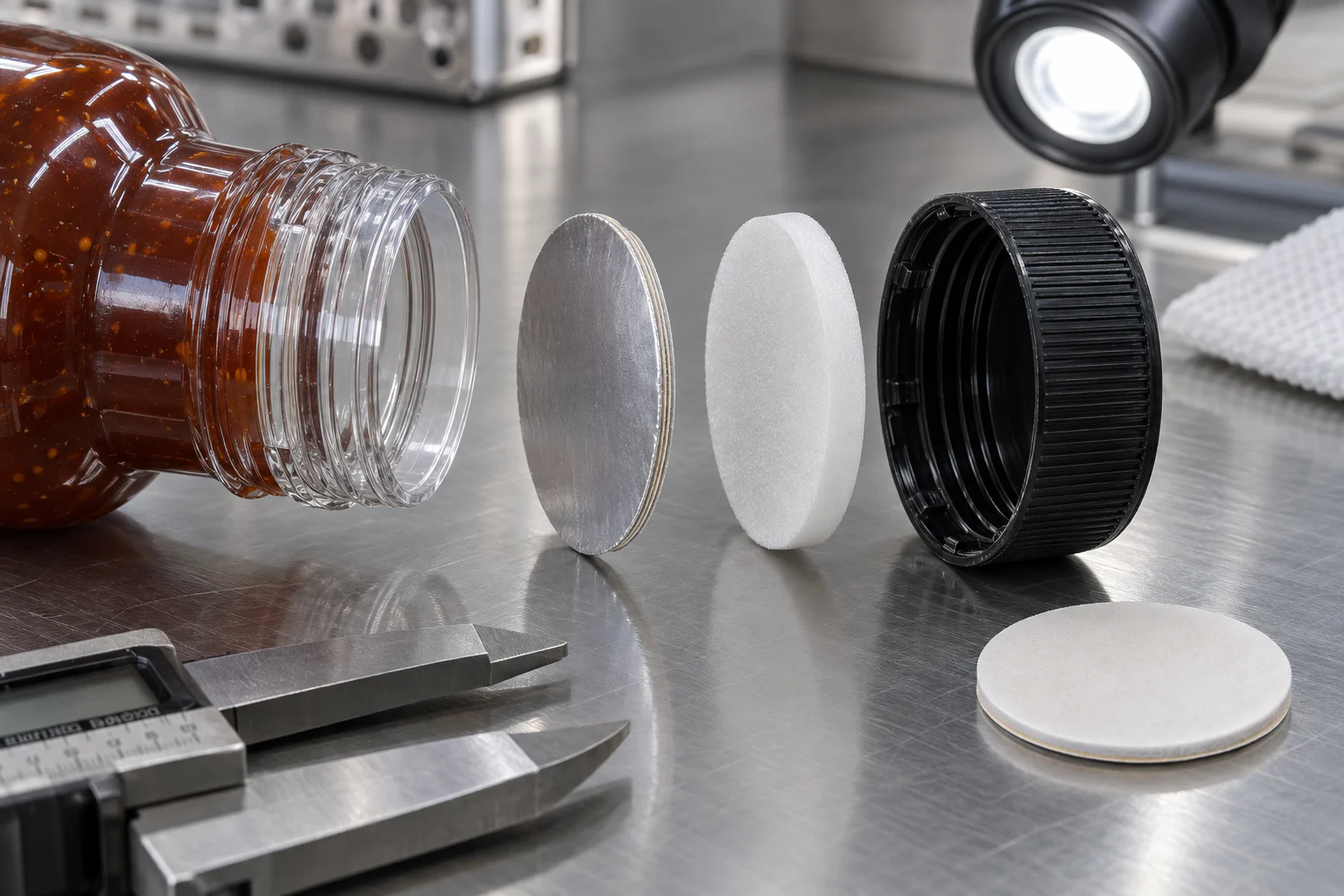
The bonded foil improves first-opening evidence and blocks a major leakage path before opening, but it does not repair an uneven bottle rim or dirty land. It also does not guarantee that the threaded cap will dispense cleanly after the foil is removed. Condiment Bottles with Caps should therefore be qualified as a complete system, including finish geometry, cap thread, liner space, foil structure and post-opening seal behavior.
| Induction Liner Layer or Interface | Function | Mismatch Symptom |
|---|---|---|
| Cap backing or secondary liner | Maintains contact before sealing and may provide post-opening reseal support. | Uneven pressure, liner rotation or insufficient room inside the cap. |
| Aluminum foil | Couples with the induction field and distributes heat across the mouth. | Localized overheating, wrinkling or incomplete heating at the edge. |
| Heat-seal polymer | Bonds the foil to the specified bottle or glass coating. | Clean foil release, weak peel or no bond despite adequate energy. |
| Bottle sealing land | Provides the continuous flat surface required for a 360-degree bond. | Channel leak, partial ring or failure at parting-line mismatch. |
| Cap and applied torque | Hold the liner in intimate contact during induction and cooling. | Intermittent seals across bottles processed at the same power. |
Match the Seal Structure to PET, HDPE, PP or Glass
The foil itself does not bond directly to every container. Its lower heat-seal layer is formulated for a material family, which is why an induction liner described only by diameter is incomplete. Two 38 mm liners can fit the same cap but use different sealants and deliver opposite results on PET and HDPE.
PET usually offers a smooth, rigid sealing land, but excessive delivered energy or long dwell can distort a lightweight neck. HDPE has different surface behavior and can move under cap load, so its liner coating and torque window must be selected accordingly. PP bottles and jars need a PP-compatible seal layer and careful heat control. Glass commonly uses a glass-compatible seal system or surface treatment specified by the liner producer; a liner intended for an untreated plastic rim should not be substituted.
The food-contact scope must follow the actual component set. A PET bottle report does not automatically cover a PP cap, foam backing, heat-seal polymer, printing ink or the surface that may contact sauce after opening. Gracepack can align bottle, closure and liner documentation after the resin, formula, filling method and destination market are defined.
| Bottle Route | Seal-Matching Priority | Line Validation Focus |
|---|---|---|
| PET | PET-compatible heat-seal layer and flat, undamaged land. | Neck distortion, full-circumference peel and cooled removal torque. |
| HDPE | HDPE-compatible sealant with stable liner compression. | Land movement, cap backoff, edge lift and side-storage leakage. |
| PP | PP-specific heat-seal structure and suitable cap/liner stack height. | Energy window, heat exposure and bond uniformity. |
| Glass | Glass-compatible coating or liner route confirmed by the liner supplier. | Finish variation, chip inspection, bond mode and consumer peel. |
| Any material | Food-contact support for every product-contact component. | Real sauce, fill temperature, storage orientation and shelf-life conditions. |
Set the Induction Window: Torque, Power, Line Speed and Head Position
A reliable induction seal is produced inside a process window, not at one isolated machine number. Delivered sealing energy is governed conceptually by generator power multiplied by exposure time and coupling efficiency. Conveyor speed changes exposure time; head position, coil design, cap height and bottle spacing change coupling. A setting transferred from another container may under-seal one finish and scorch another.
Cap application torque comes first because the liner must touch the rim evenly before it enters the field. The target cannot be chosen from closure diameter alone. It must account for thread engagement, liner compression, finish strength, cap material, fill temperature and the opening force expected after conditioning. Record applied torque at the capper and removal torque after the defined rest and cooling period.
Enercon induction sealing guidance emphasizes the interaction between cap torque, power, conveyor speed and sealing-head position. In production, use a low-to-high setting study at the intended line speed, then inspect the entire peel ring rather than checking only whether the foil feels attached. The approved center setting should leave enough margin for normal bottle-height, cap and line-speed variation.
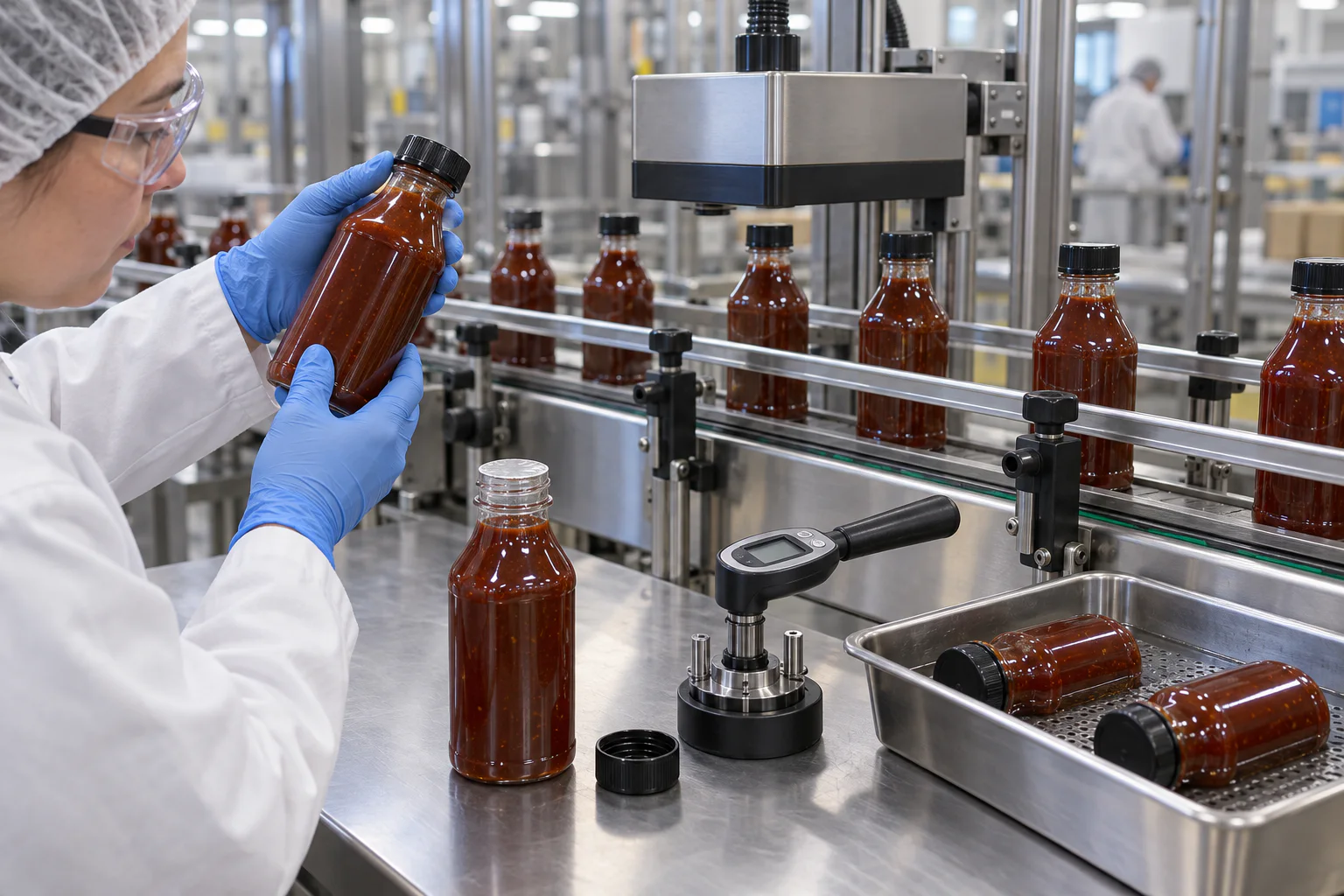
Keep the sealing land dry and control the time between filling and capping. If the nozzle drips or strings, increasing induction power will not close a sauce-filled channel. The correction belongs at fill cutoff, bottle handling or rim inspection.
| Process Variable | Too Low or Misaligned | Too High or Excessive | Control Method |
|---|---|---|---|
| Application torque | Incomplete liner contact and intermittent edge bonds. | Finish distortion, cap stress or difficult opening. | Measure application and conditioned removal torque by sampled lane and time. |
| Induction power | Cold foil, weak peel or unsealed sections. | Scorched backing, distorted cap or overheated sealant. | Run a documented power ladder at production speed. |
| Exposure time / line speed | Insufficient energy transfer. | Excess heat and reduced throughput margin. | Validate minimum, nominal and maximum planned speeds. |
| Head position and gap | Uneven coupling or one-sided bond. | Cap heating and a narrow operating window. | Lock the approved height and verify after changeover. |
| Bottle spacing and height | Variable field exposure and inconsistent results. | Crowding, contact or cap-height variation. | Control guides, timing and bottle-finish dimensions. |
Diagnose Seal Failures by Their Pattern
A leaking bottle does not automatically mean that the foil grade is wrong. The failure pattern usually points toward the weak interface. Mark the cap position before removal, inspect the complete land and foil, and compare failures by capper head, production time and conveyor lane. Random failures suggest different causes from a consistent unsealed sector.
Peel mode is useful evidence. A correctly matched seal may leave a uniform polymer transfer pattern or a consistent peel surface defined by the liner specification. A foil that lifts cleanly without the expected bond can indicate the wrong heat-seal layer or insufficient energy. A charred ring, bubbled backing or distorted neck indicates excessive heat. Sauce tracks crossing the rim indicate contamination even when the rest of the seal looks strong.
Do not judge a seal only while it is warm. Condition samples, then inspect after cooling, side storage, vibration and temperature exposure. A cap can relax, a liner can compress and internal pressure can change after the bottle leaves the line.
| Observed Failure | Likely Causes to Check First | Corrective Direction |
|---|---|---|
| One unsealed sector | Uneven land, tilted cap, liner fold, head alignment or local contamination. | Inspect finish geometry and cap contact before raising power. |
| Weak seal around the full rim | Low delivered energy, high line speed, excessive head gap or incompatible heat-seal layer. | Confirm liner code, then establish the energy window. |
| Scorched or wrinkled foil | Too much power, excessive dwell or liner movement. | Reduce delivered energy and verify torque and liner retention. |
| Leak after side storage | Channel contamination, cap backoff, incomplete edge bond or pressure change. | Review fill cutoff, conditioned torque and orientation testing. |
| Neck or cap distortion | Heat load or application torque exceeds the package's structural window. | Adjust energy, dwell, cap compression or container design. |
| Pressure-sensitive liner remains in cap | Insufficient dwell, poor rim contact, wrong adhesive or liquid-incompatible construction. | Stop qualification and obtain a supplier-approved liner route. |
Filled-Package Validation SOP for Acidic BBQ Sauce
Begin with production-representative bottles, caps, liners and sauce. Measure bottle-finish condition and reject visible flash, chips, ovality or sealing-land damage before the line trial. Confirm liner code and orientation, then record capper head, application torque, fill temperature, capping delay, induction power, line speed, head position and sample time.
Run enough samples at low, nominal and high process settings to expose the edges of the operating window. After cooling, check removal torque and inspect a 360-degree peel from every test condition. Separate seal failures from cap-thread or dispensing failures so one defect does not hide another.
Condition filled bottles upright, on their side and in the intended cap-down orientation where applicable. Add vibration, temperature cycling and parcel or pallet simulation appropriate to the distribution route. Inspect for wet threads, label staining, carton marks, foil lift and changes in opening force. Retain approved filled packages, bottle and cap samples, liner codes and process settings as repeat-order references.
- Confirm the exact bottle resin, neck finish, cap resin, liner code and foil heat-seal layer.
- Inspect sealing-land flatness and cleanliness under consistent lighting.
- Record applied and conditioned removal torque instead of relying on capper dial settings alone.
- Map the induction window across power, line speed and sealing-head position.
- Inspect the complete peel ring and document failure location by bottle and capper head.
- Test the real sauce in upright, side and cap-down storage where relevant.
- Add vibration and temperature exposure that reflect the shipment route.
- Retain approved components and filled samples for future production-lot comparison.
Gracepack Bottle, Cap and Liner Qualification
We qualify the closure around the finished BBQ sauce package rather than treating the bottle, cap and liner as unrelated items. Gracepack's manufacturing base includes 15 automatic injection molding machines, 13 automatic blow molding machines, nine fully automatic production lines, more than 500 owned molds and more than 5,000 standard bottle designs. Existing bottle-and-cap routes can be screened before a custom finish or closure is considered.
The review starts with bottle resin, neck drawing, sealing land, cap thread, liner space, sauce formula, fill temperature and distribution route. We can then compare pressure-sensitive samples only where their intended use supports the application, or match induction liners by bottle material and cap geometry. Tamper-Evident Sauce Caps, lined screw caps and induction-ready closures can be sampled with the intended bottle instead of quoted as isolated nominal diameters.
Food-contact support can be matched by component for PET, PP and PE routes, with ISO 22000 documentation available for the manufacturing system. Private Label BBQ Sauce Bottles can also be reviewed for label area, cap color, carton packing and first-opening experience so the approved seal does not create a new filling-line or consumer-use problem.
For flexible packs, Squeezable BBQ Sauce Bottles need an additional post-opening check: once the foil is removed, the cap, valve or orifice must still control a viscous sauce without weeping or trapping residue. That complete-package test is what separates a strong launch specification from a liner selected only by diameter.
| Qualification Stage | Inputs | Practical Output |
|---|---|---|
| Formula and process screen | pH, oil, particles, viscosity, fill temperature and capping delay. | Suitable liner and sealing-route candidates. |
| Component match | Bottle resin and finish, cap drawing, liner stack and foil sealant. | Matched bottle-cap-liner sample set. |
| Line window | Torque, power, speed, head position and cooling conditions. | Documented trial matrix and inspection points. |
| Distribution check | Orientation, vibration, temperature and carton packing. | Leak and tamper-evidence validation plan. |
| Repeat-order control | Approved physical samples, component codes and recorded settings. | Reference standard for future lots. |
FAQ About BBQ Sauce Bottle Liners
Are induction seals always required for acidic BBQ sauce bottles?
No single seal is legally or technically universal for every sauce bottle. Induction is usually the stronger starting route for retail liquid sauce because it can provide a bonded mouth barrier and visible first-opening evidence, but the exact liner, bottle, cap and process still need validation.
Can a pressure-sensitive liner be used with BBQ sauce?
Only when the liner manufacturer explicitly qualifies that exact construction for the sauce, bottle material and conditions of use. Many common pressure-sensitive liners are intended for dry products and should not be assumed suitable for acidic or oily liquids.
Does vinegar corrode pressure-sensitive liner adhesive?
Vinegar alone is not a complete failure diagnosis. Liquid contact, oil, water, rim contamination, adhesive chemistry, dwell, torque, temperature and bottle-surface compatibility can all contribute. Inspect the failure pattern and verify the liner specification before assigning one cause.
Why does an induction seal bond on one side but not the other?
Common causes include a tilted cap, uneven sealing land, folded liner, sauce on the rim, bottle-height variation or sealing-head misalignment. Increasing power can overheat the bonded side without fixing the unsealed interface.
What information is needed to select an induction liner?
Provide bottle material, neck finish, cap drawing or sample, sauce composition, filling temperature, capping method, line speed, intended storage orientation, destination market and required peel or tamper-evidence behavior.
Can one induction liner seal PET, HDPE, PP and glass?
Not automatically. The foil's heat-seal layer must match the container surface. Confirm the liner code and intended bottle material, then verify a full-circumference bond on production-representative samples.
Request an Acidic BBQ Sauce Seal Compatibility Review
Send the BBQ sauce pH if available, oil and particle content, fill temperature, bottle resin, neck finish, cap sample or drawing, current liner, line speed, capping method, storage orientation, destination market and recent leakage symptoms. Gracepack can compare induction and qualified liner routes as a complete bottle-cap system.
A practical review can include matched bottle and closure samples, liner-structure direction, sealing-land checks, a torque and induction trial matrix, leak-test conditions and an RFQ for production components.


