
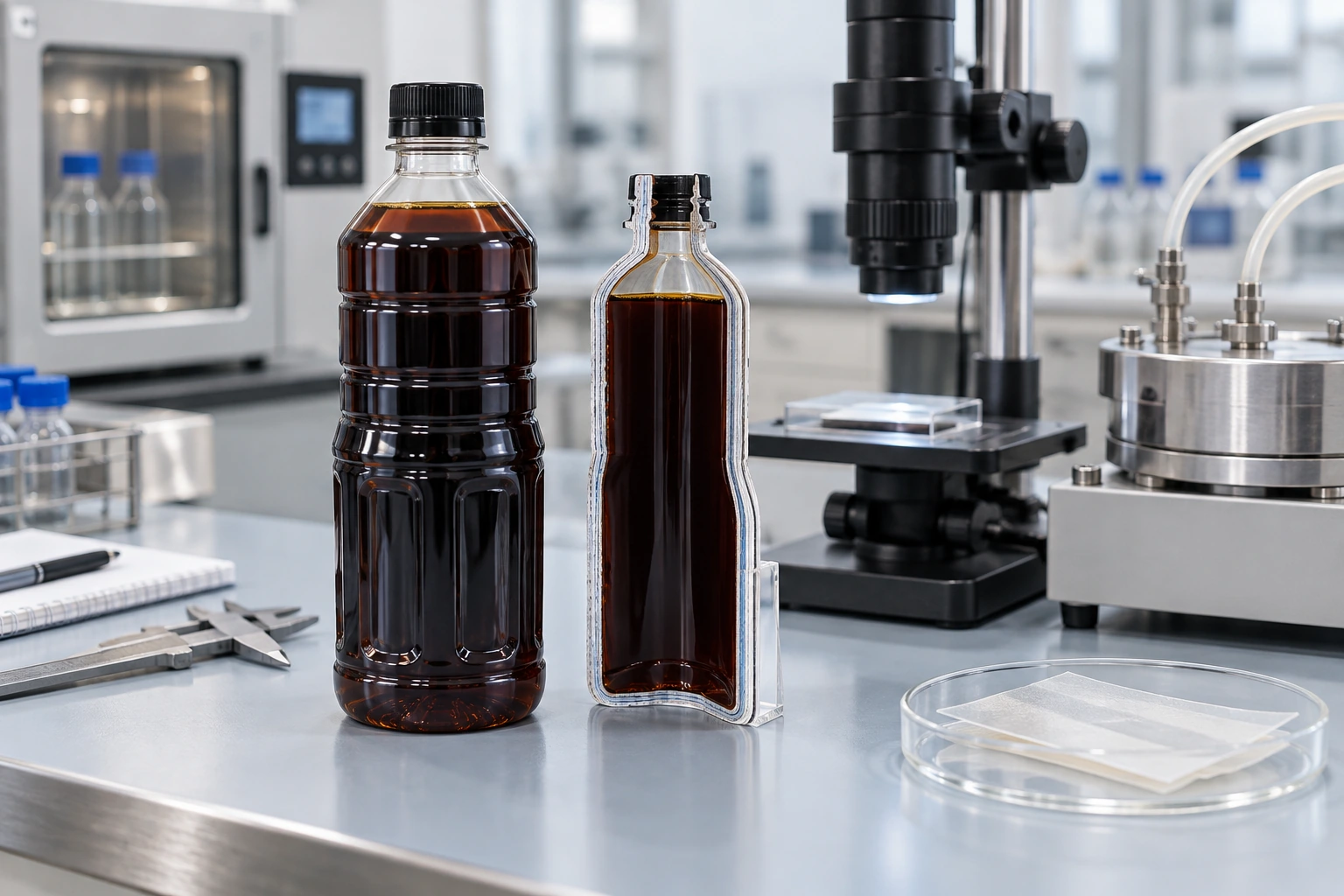
A multilayer EVOH soy sauce bottle is ready for production only when the barrier layer is continuous in the finished geometry, remains bonded after conditioning, and helps the complete bottle-and-closure system meet a defined oxygen budget. A nominal EVOH percentage or a supplier data sheet cannot establish those outcomes by itself.
Soy sauce adds a demanding moisture environment to the package. EVOH can provide strong oxygen resistance when it is kept within a suitable polymer structure, but its oxygen-barrier performance changes as it absorbs moisture. The structural and tie layers, their thickness distribution, the bottle shape and the closure therefore determine whether the laboratory material advantage survives manufacturing and storage.
The practical validation sequence starts with an approved layer specification, then checks critical bottle zones, interlayer adhesion, oxygen transmission under declared conditions, filled-package behavior and batch controls. Each result needs a test method, sample count, conditioning history and acceptance limit that belong to the actual commercial bottle.
| Validation question | Evidence to collect | Release risk if omitted |
|---|---|---|
| Is the barrier layer present where it is needed? | Cross-sections from the body, shoulder, transition zones and base | A passing average can hide a local thin spot or interruption |
| Will the layers stay bonded? | Conditioned adhesion or delamination checks on production bottles | Squeezing, transport or storage can expose a weak interface |
| What is the oxygen performance? | OTR or package oxygen data with temperature, humidity and fixture details | Dry-film data may overstate performance in use |
| Does the whole pack protect soy sauce? | Closure-controlled, filled storage with chemical and sensory endpoints | Bottle-wall performance can be lost at the cap or headspace |
| Can production repeat the approved result? | Lot records, process limits, retained samples and change control | A good trial bottle does not guarantee stable commercial batches |
1. Decide Whether a Multilayer Barrier Is Necessary
Begin with the product and distribution requirement. Record the soy sauce type, dissolved-oxygen control at filling, fill volume, headspace, closure, target unopened shelf life, expected storage temperature, light exposure and route duration. A long target does not automatically require EVOH, and a short target does not automatically make a monolayer bottle acceptable.
Create a baseline with the simplest realistic package. If an approved glass control or qualified monolayer plastic bottle already meets the color, aroma, taste and package-integrity limits, an added barrier layer may create cost and recycling complexity without measurable product benefit. If the baseline fails, determine whether the dominant oxygen source is the wall, headspace or closure before changing the bottle structure.
Set a package oxygen budget that the development team can test. It can include oxygen present at filling, ingress through the bottle body, ingress at the closure and the expected unopened storage period. The target should connect to a soy-sauce endpoint such as defined color shift, aroma retention or an internal sensory limit instead of a generic claim such as 'high barrier.'
- Use one identified soy sauce lot for comparative screening.
- Keep fill volume, headspace and cap application conditions controlled.
- Separate unopened shelf-life performance from oxygen introduced after first opening.
- Record the commercial temperature and humidity range before choosing test conditions.
- Document the failure that the multilayer structure is expected to prevent.
2. Freeze the Actual Layer Structure Before Testing
A specification must describe the structure rather than simply state that the bottle contains EVOH. For a polyolefin bottle, a five-layer concept may be written as structural polymer / tie / EVOH / tie / product-contact polymer. Other constructions are possible, and the selected sequence must match the forming process, intended contact layer and food-contact documentation.
Record the resin manufacturer and grade for every functional layer, the nominal layer ratio, the approved color or additive package, and whether any non-contact regrind layer is included. Tie resins are functional materials, not invisible processing aids: their grade, feed stability and compatibility with the adjoining layers affect resistance to separation.
The process route also matters. Extrusion blow molding creates a multilayer parison and includes pinch-off regions at the container base. Injection-based multilayer routes create different stretch and transition histories. Do not apply one sampling map or defect assumption to every bottle-making method.
| Specification item | What to record | Why it matters |
|---|---|---|
| Layer sequence | Inside-to-outside order and function of every layer | Confirms product contact, structural support and barrier placement |
| Resin identity | Supplier, commercial grade and approved alternatives | Prevents unreviewed substitutions with different adhesion or barrier behavior |
| Nominal ratio | Target percentage or feed-rate window for each layer | Creates a process target but does not replace cross-section checks |
| Forming process | EBM, multilayer injection route or other qualified process | Defines likely thin zones, welds and sampling positions |
| Color and additives | Masterbatch, UV package and addition rate | Supports repeatability and the applicable compliance review |
| Closure system | Finish, cap, liner or seal and application settings | Connects bottle-wall data to whole-package performance |
3. Map Layer Distribution at the Bottle's Critical Zones
Average EVOH content across a production run cannot show whether the barrier remains continuous in the weakest part of the bottle. Forming stretches and redistributes the wall. The shoulder, body transitions, grip panels, base radius, standing ring and any pinch-off or weld area can behave differently from a straight sidewall.
Build a repeatable sectioning map on the approved bottle drawing. Mark every cutting position and orientation so trial, cavity or head comparisons use the same geometry. Prepare clean sections with a method that does not smear or tear the thin layers. Optical microscopy may be sufficient when layer contrast and resolution allow reliable measurement; scanning electron microscopy or another validated analytical technique can be reserved for thinner or ambiguous interfaces.
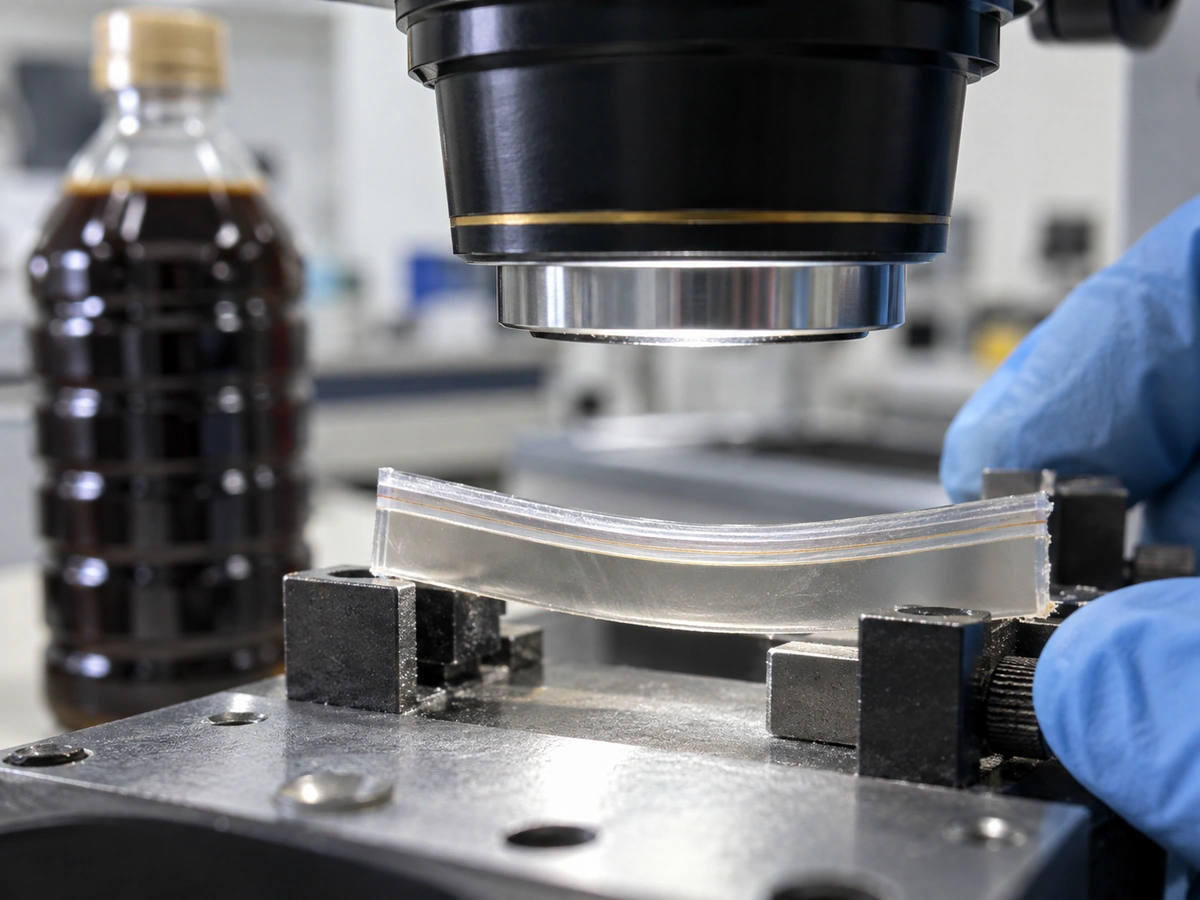
For each location, record total wall thickness, barrier-layer thickness, continuity, centering and visible defects. Examine gels, voids, folds, displaced interfaces and interruptions rather than reporting only one average number. A localized gap in a high-stretch zone can matter more than a generous EVOH layer in an easy-to-form panel.
| Sampling zone | Typical concern | Record |
|---|---|---|
| Straight body panel | Reference distribution and process stability | Total wall, each visible layer and variation |
| Shoulder and neck transition | Stretch-related thinning or layer displacement | Minimum barrier thickness and continuity |
| Grip or squeeze panel | Repeated flexing plus local wall variation | Layer position before and after conditioning cycles |
| Base radius and standing ring | Complex material flow and impact stress | Continuity, folds, voids and local asymmetry |
| Pinch-off or weld zone where applicable | Interface disturbance or incomplete joining | Section appearance and package leak result |
| Across cavities or extrusion heads | Tooling and feed-balance variation | Identification mark, measurement set and trend |
4. Verify Interlayer Adhesion After Relevant Conditioning
Good adhesion prevents the structural and barrier layers from separating during handling, squeezing, thermal cycling and long storage. Examine the bottle first for whitening, bubbles, edge lifting or visible separation. Then use a documented coupon or peel method that fits the bottle geometry and layer thickness.
Published peel standards can inform equipment and reporting, but a cut bottle wall is not automatically a standard flexible laminate specimen. ASTM D1876 and ISO 11339 describe T-peel approaches for bonded flexible assemblies. If the bottle coupon cannot meet the specimen requirements, describe the procedure as an adapted comparative method, validate its repeatability and avoid claiming formal compliance with a standard that was not followed in full.
Test as-produced controls and conditioned samples. Conditioning can include the maximum intended storage humidity, defined warm exposure, filled contact with the real soy sauce and a realistic squeeze or flex cycle when the bottle is designed to deform. The acceptance limit should prevent progressive delamination and should be based on development data, not copied from an unrelated laminate.
- Photograph the prepared edge and failure path before discarding the coupon.
- Record whether failure occurs within a resin, at a tie-layer interface or through sample damage.
- Use identical coupon width, orientation, conditioning and test speed for comparisons.
- Include production locations that experienced the highest forming strain.
- Escalate any visual separation even when the average peel result appears acceptable.
5. Design OTR Testing Around Temperature and Humidity
EVOH oxygen permeability is moisture dependent. An attractive result obtained under a dry laboratory condition may not represent a water-based product stored in humid distribution. The report must therefore state the temperature, relative humidity on each side of the specimen where applicable, conditioning time, sample orientation, test area and the point used to declare equilibrium.
ASTM D3985 and ISO 15105-2 describe coulometric methods for oxygen transmission through plastic film or sheeting. They are useful technical references, but their published scopes do not turn a complete bottle into a flat-film specimen. Whole-container testing requires suitable equipment, a defined fixture and a validated procedure. If a bottle wall is cut into a flat coupon, the result represents that location and preparation, not automatically the entire container.
Run conditions that answer the commercial question. A dry screening condition can help compare material potential, while a conditioned moderate- or high-humidity point can reveal how the structure behaves closer to use. Allow enough time for moisture and gas transport to stabilize through the protective layers. Report an equilibrium criterion rather than stopping every sample after an arbitrary number of hours.
Normalize and label results correctly. Film data may be expressed by area, while a whole-container result may be reported per package per day. Record whether the closure was included, masked or replaced by the fixture. Without those details, two OTR numbers may look comparable while measuring different systems.
| Test decision | Minimum information | Common error |
|---|---|---|
| Specimen type | Flat coupon, bottle body or closed package | Calling a coupon result a whole-bottle result |
| Condition | Temperature and RH on the oxygen and carrier sides | Quoting only '23°C' and omitting humidity |
| Conditioning | Preconditioning history and equilibrium criterion | Ending before the multilayer structure stabilizes |
| Closure treatment | Commercial closure, test cap, masked finish or fixture | Comparing open-body and closed-package values |
| Result basis | Area-normalized or package-normalized units | Comparing values with incompatible units |
| Replicates | Sample count, lot, cavity or head identification | Reporting one favorable specimen without variation |
6. Test the Finished Bottle-and-Closure System
The barrier layer controls only one oxygen path. Oxygen can remain in the soy sauce, occupy the headspace or enter at the finish, liner, induction seal or dispensing insert. A high-performing bottle body paired with a marginal closure may give a poor shelf-life result even though its wall coupons pass.
Build the finished-package trial with the commercial neck finish, cap and liner or seal. Record application torque, induction settings where used, fill volume, headspace and sealing-land cleanliness. Include leak and seal checks after temperature conditioning, side-lay storage and the transport stresses that apply to the real distribution route.
Do not mix unopened and repeated-use conclusions. An induction seal can reduce ingress before first opening but no longer controls the package afterward. A pour insert or reclosable cap creates its own air-return and sealing behavior. Large household bottles may experience many oxygen-replacement cycles after opening, which requires a separate use-cycle study.
- Identify every bottle and closure component by revision.
- Measure headspace rather than describing the package as simply full.
- Retain cap-application and sealing records with each test group.
- Check the finish and sealing surface after conditioning, not only before filling.
- Repeat the package test after any cap, liner, neck or process change.
7. Link Barrier Data to Filled-Soy-Sauce Shelf Life
OTR measures oxygen movement under a defined method; it does not by itself prove a commercial shelf life. Build a matched filled-product study using one representative soy sauce lot and production-equivalent package samples. Compare the candidate multilayer bottle with the approved baseline while holding filling, headspace, closure and storage conditions constant.
Select endpoints before the study begins. Objective color measurements can track darkening or color drift. Dissolved or headspace oxygen can help explain the package mechanism. Aroma and taste require a controlled sensory method with an agreed reference and decision limits. Inspect leakage, panel deformation, layer separation, cap condition and label appearance at the same intervals.
Accelerated conditions can screen weak structures and rank alternatives, but they should not be converted directly into a promised number of ambient months unless the product-specific relationship is established. Maintain real-time samples at the intended market condition and document any formulation or package change that breaks comparability with earlier results.
| Control variable | Keep consistent | Useful endpoint |
|---|---|---|
| Soy sauce | Lot, preparation and baseline condition | Color, aroma, taste and oxygen-related measurements |
| Filling | Temperature, fill volume, headspace and timing | Initial package oxygen and fill consistency |
| Closure | Component revision and application process | Leakage, seal condition and ingress contribution |
| Storage | Temperature, RH, light, orientation and duration | Product change and package integrity over time |
| Sampling | Replicates and unopened units at each interval | Trend, variability and defensible disposition |
8. Set Batch-Release and Change-Control Limits
Production release should translate development findings into controls that operators and quality teams can use. Freeze approved resin grades, layer sequence, feed-rate windows, preconditioning or drying requirements, key machine settings, bottle mass, dimensional limits and the cross-section sampling plan. Keep an identified approval sample and the corresponding data set.
Routine release does not need to repeat every long shelf-life study, but it must detect changes that could invalidate the approval. Combine fast controls such as bottle mass, visual layer checks, critical cross-sections and adhesion screening with periodic or risk-based oxygen testing. Trend results by lot and by cavity or extrusion head instead of treating every passing value as unrelated.
Revalidation is required when a change can affect the structure or oxygen path. Examples include a new EVOH or tie-resin grade, supplier change, altered layer ratio, color package, recycled-content route, mold modification, parison or stretch program, neck finish, cap, liner, sealing process or filling condition. The change record should state which earlier evidence remains applicable and which tests must be repeated.
| Control level | Typical checks | Purpose |
|---|---|---|
| Start-up approval | Material verification, weight, dimensions, sections and visual defects | Confirm the line matches the approved construction before the run continues |
| In-process control | Weight, appearance, critical dimensions and selected layer locations | Detect drift early and identify the affected cavity or head |
| Lot release | Traceability review, retained samples and defined functional checks | Release only the documented material and process combination |
| Periodic verification | Expanded sections, adhesion and oxygen performance | Confirm routine controls still predict barrier performance |
| Change control | Risk review plus targeted revalidation | Prevent an untested substitution from inheriting an old approval |
9. Build a Supplier Approval File That Can Be Audited
The approval file should allow another qualified reviewer to reconstruct what was tested. Include the bottle drawing and revision, layer structure, resin and tie-layer identities, sample origin, cavity or head marks, sectioning map, microscopy records, conditioning logs, adhesion method, oxygen report, closure configuration and filled-storage protocol.
Food-contact evidence must match the actual product-contact layer, colorants, additives, closures and intended conditions of use. A report for monolayer PET does not automatically cover a new polyolefin/tie/EVOH structure. Confirm the documentation scope after the final construction is chosen and before the purchase order treats the material stack as fixed.
Gracepack can help organize bottle and closure samples, drawings, component identification and production-oriented acceptance points for a soy sauce packaging project. Specialized microscopy, oxygen-transmission work and product shelf-life testing should be assigned to qualified laboratories with the required fixtures and methods. This division keeps the evidence tied to the real package without overstating what an empty-bottle supplier can prove.
- Approved component list with supplier and grade controls
- Bottle drawing, layer sequence and sampling-location diagram
- Raw microscopy images and measurement records
- Conditioning and adhesion procedure with deviations
- OTR report with specimen, humidity, fixture, equilibrium and units
- Filled-product protocol, raw results and final disposition
- Batch traceability, retained sample plan and change-control triggers
FAQ About Multilayer EVOH Soy Sauce Bottle Validation
Does a higher EVOH percentage always produce a better soy sauce bottle?
No. Extra EVOH cannot compensate for a discontinuous layer, poor adhesion, an unsuitable forming process or oxygen ingress through the closure. Performance must be confirmed on the finished package under defined conditions.
Where should a multilayer soy sauce bottle be sectioned?
At minimum, use a repeatable map that covers the straight body, shoulder or neck transition, formed panels, base radius and any pinch-off or weld zone. Add locations identified by simulation, earlier failures or unusual geometry.
Can ASTM D3985 be used to claim the OTR of a closed bottle?
ASTM D3985 is written for plastic film and sheeting. Whole-container work needs appropriate equipment, fixture details and a validated procedure. A cut wall coupon should not be presented as the performance of a closed commercial bottle.
Why must humidity be stated for EVOH testing?
EVOH absorbs moisture, and its oxygen-barrier performance changes with moisture exposure. Temperature, relative humidity, preconditioning and equilibrium criteria are therefore essential parts of an interpretable result.
Is a dry visual inspection enough to approve interlayer adhesion?
No. Visual inspection is useful but can miss a weak interface. Use a documented comparative adhesion method and include conditioning that reflects storage, product contact and bottle use.
Does a passing OTR result prove an 18-month soy sauce shelf life?
No. OTR is one input. Shelf-life approval also depends on oxygen at filling, headspace, closure ingress, light, temperature and the real soy sauce's color, aroma and taste limits.
When should a multilayer bottle be revalidated?
Revalidate when the resin source or grade, tie layer, layer ratio, color system, molding process, tool, closure, liner, sealing method or filling condition changes in a way that can affect the approved package.


