
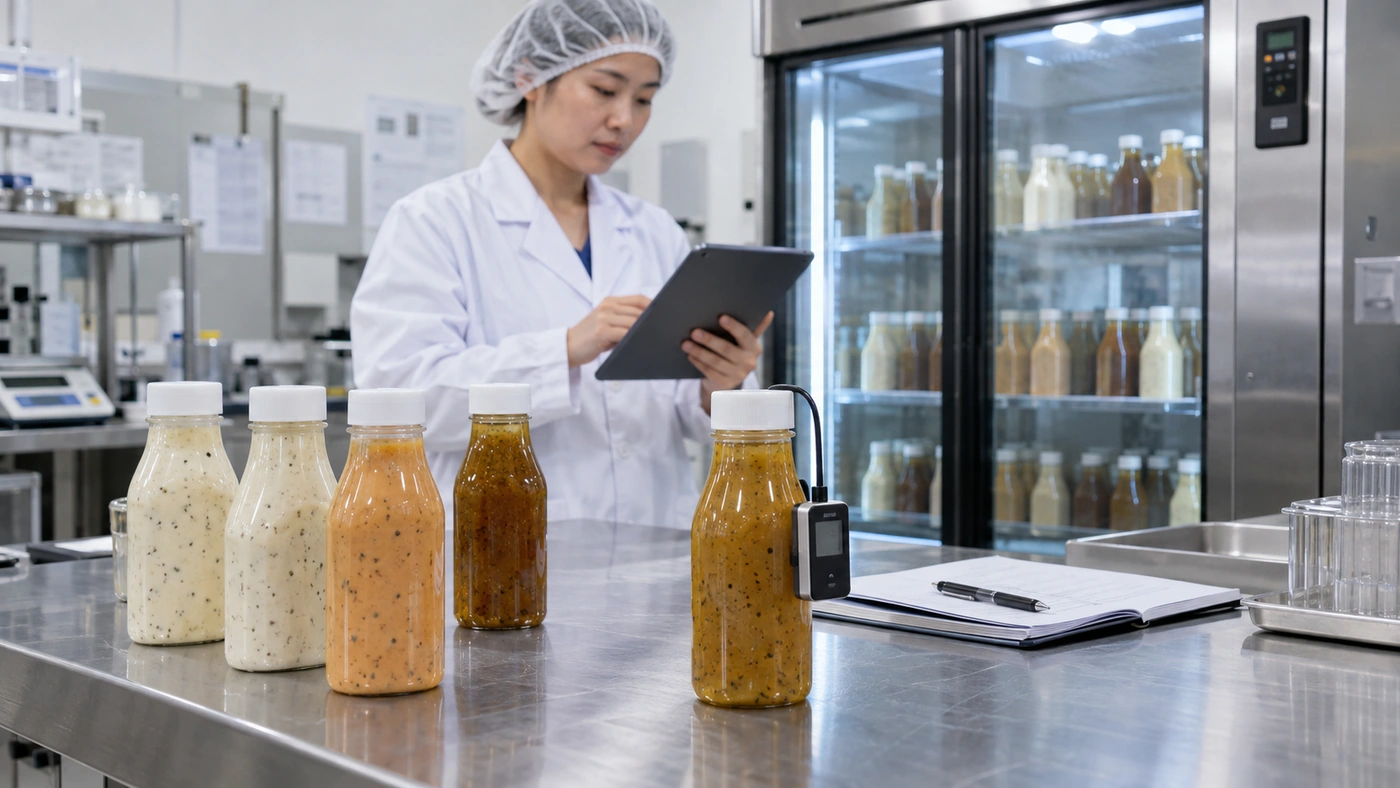
Refrigerated probiotic dressing packaging is validated only when three outcomes are demonstrated separately: the distribution system keeps the product within the brand's approved temperature profile, the bottle-and-closure assembly remains functional after conditioning and transport, and the probiotic count meets the product specification through the claimed shelf life. Passing a carton temperature study does not prove viable-cell retention, and a leak-free bottle does not prove that the cold chain protected the culture.
The test plan should begin with the actual strain, formula, filling process, package and route. A published temperature such as 2°C to 8°C may be appropriate for a particular product, but it is not a universal specification for probiotic dressings. The formula owner must define the acceptable product-temperature range, permitted excursion duration, target viable count, shelf-life endpoint and packaging acceptance limits before testing starts.
This article focuses on how to build that evidence chain. It does not repeat the broader material-selection, light-barrier or functional-dressing guidance already covered elsewhere.
| Validation question | Primary evidence | What a pass establishes | What it does not establish |
|---|---|---|---|
| Did the shipper maintain the approved thermal profile? | Calibrated logger data from defined pack positions and route or chamber profiles | Thermal performance for the tested load, pack-out and conditions | Probiotic viability or package seal integrity |
| Did the bottle and closure remain functional? | Leak, torque or retention, seal, drop, vibration and visual results after conditioning | Mechanical package performance under the stated protocol | Microbiological safety or end-of-life CFU |
| Did the culture remain within specification? | Validated microbiological enumeration at scheduled time points | Viable count for the tested strain, formula, package and storage history | Performance after an untested route or formulation change |
Freeze the Product and Package Specification Before Testing
A useful protocol starts with controlled inputs. Record the probiotic strain or strain blend, inoculation stage, initial target count, minimum count at the stated endpoint, pH, titratable acidity, oil phase, water activity when relevant, viscosity method and temperature, particle size, fill temperature, headspace target, storage orientation and declared shelf life. The recent review of probiotic viability in foods identifies the food matrix, processing temperature and dissolved oxygen among the factors that can affect survival; those variables must therefore be treated as test inputs rather than background details.
Freeze the packaging bill of materials at the same time: bottle drawing and revision, resin and color route, nominal and overflow capacity, bottle weight, closure drawing, liner or valve, tamper feature, application setting, label or sleeve coverage, carton count, divider and refrigerated shipper configuration. A result cannot be transferred confidently to a new cap, wall weight, colorant or pack-out unless the effect of that change is assessed.
Avoid using Design Qualification, Operational Qualification and Performance Qualification as decorative labels. A staged DQ/OQ/PQ structure can help a company organize approval when it is already part of its quality system, but the stage names do not create evidence. The protocol still needs defined inputs, calibrated measurements, acceptance criteria, deviations and an approved conclusion.
- Product specification: strain, formula revision, viable-count requirement, fill and storage conditions.
- Primary package: bottle, closure, liner or valve, decoration and application settings.
- Distribution package: carton, dividers, insulation, refrigerant and loading pattern.
- Route definition: handling steps, dwell points, seasonal risks and maximum shipment duration.
- Change control: which material, process or route changes require review or requalification.
Build a Sample Matrix That Can Isolate Failure Causes
Testing only one candidate package at one temperature gives a result but rarely explains it. Use enough independent production-representative units to compare the proposed package with controls while allowing scheduled destructive microbiological measurements. The quality or statistical owner should set sample counts from method variability, lot risk and the decision the study must support rather than copying a generic number of runs.
At minimum, include time-zero samples, the proposed refrigerated package, a justified control package or baseline, and samples exposed to the approved worst-case thermal profile. If light exposure, oxygen ingress or repeated opening is a stated risk, add those challenges as separate arms. Do not combine several uncontrolled stresses into every group; a failed CFU result then cannot be attributed to temperature, oxygen, closure damage or natural storage decline.
Use production-representative dressing. Water-filled packages can help set up leak or transport equipment, but they do not reproduce emulsion wetting, oil interaction, headspace chemistry, particles, product-on-seal contamination or culture behavior.
| Study arm | Purpose | Typical measurements |
|---|---|---|
| Time zero | Establish the starting product and package condition | CFU, product temperature, pH, headspace or dissolved oxygen where relevant, torque and visual condition |
| Approved refrigerated profile | Confirm routine storage and distribution performance | Logger trace, package integrity and scheduled CFU |
| Defined excursion | Measure the effect of a credible delay or warm event | Peak temperature, time above limit, cumulative exposure and recovery |
| Package control | Separate package contribution from normal viability decline | Matched formula and storage with a justified comparison package |
| Post-opening simulation | Evaluate repeated consumer use when it is part of the claim | Opening schedule, oxygen trend, leakage, dispensing and CFU |
Map Product Temperature, Not Only Chamber Air
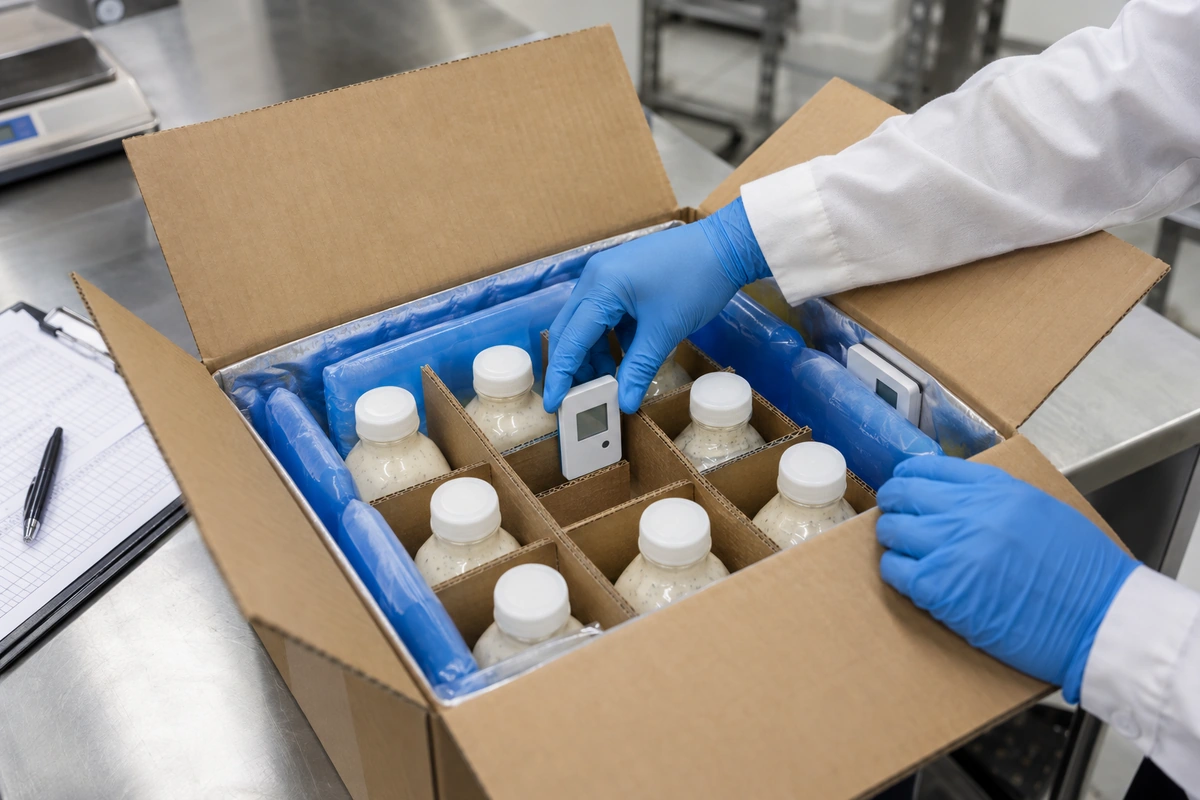
A chamber display or vehicle set point is not the product temperature. Place calibrated loggers at pack locations expected to warm or cool differently, such as the outer corner, top layer, geometric center and positions next to refrigerant. Use additional probes during development to understand how bottle size, dressing thermal mass, headspace, carton density and refrigerant placement affect the result.
Define the sampling interval before the run. It must be short enough to capture door openings, handoffs and brief excursions that matter to the product specification. Document logger identity, calibration status, start time, clock synchronization, placement diagram, pack-out photographs, conditioning history and any missing data. Report both the air environment and product response when both are measured.
ISTA 7E thermal transport testing provides heat and cold profiles for evaluating insulated shipping containers, but the product owner must still select a justified profile and acceptance rule for the actual route. A laboratory profile can qualify a defined pack-out; field shipments with loggers then test whether handling, dwell time and lane variability match the development assumptions.
Define Excursions From Product Evidence
A useful excursion challenge states the starting condition, temperature profile, duration, recovery step and reason the profile is credible. Examples can come from loading observations, route logger history, warehouse dwell, last-mile delivery or a documented equipment failure. A single high-temperature exposure chosen without route or product evidence can be either too mild to inform the decision or so extreme that it produces an irrelevant failure.
Evaluate exposure as a time-temperature history rather than only a maximum reading. Two shipments can reach the same peak while exposing the product for very different durations. Report time outside the approved range, area-under-the-curve or another predefined cumulative metric alongside peak temperature and recovery time.
The disposition rule should be written before results are reviewed. It may require the package to remain intact, the product to return to the approved range within a stated time, and viable count and quality attributes to remain above their limits at specified follow-up points. Packaging cannot establish whether an excursion is microbiologically safe; that judgment belongs to the product's validated food-safety and shelf-life program.
Challenge the Bottle and Closure After Cold Conditioning
Cold conditioning can change bottle stiffness, liner compression, cap removal behavior, label adhesion and condensation at interfaces. Measure the package in the condition in which it will be handled, rather than allowing every sample to return to room temperature before inspection. Record application torque or force at pack-off and use the approved removal-torque or retention method after conditioning.
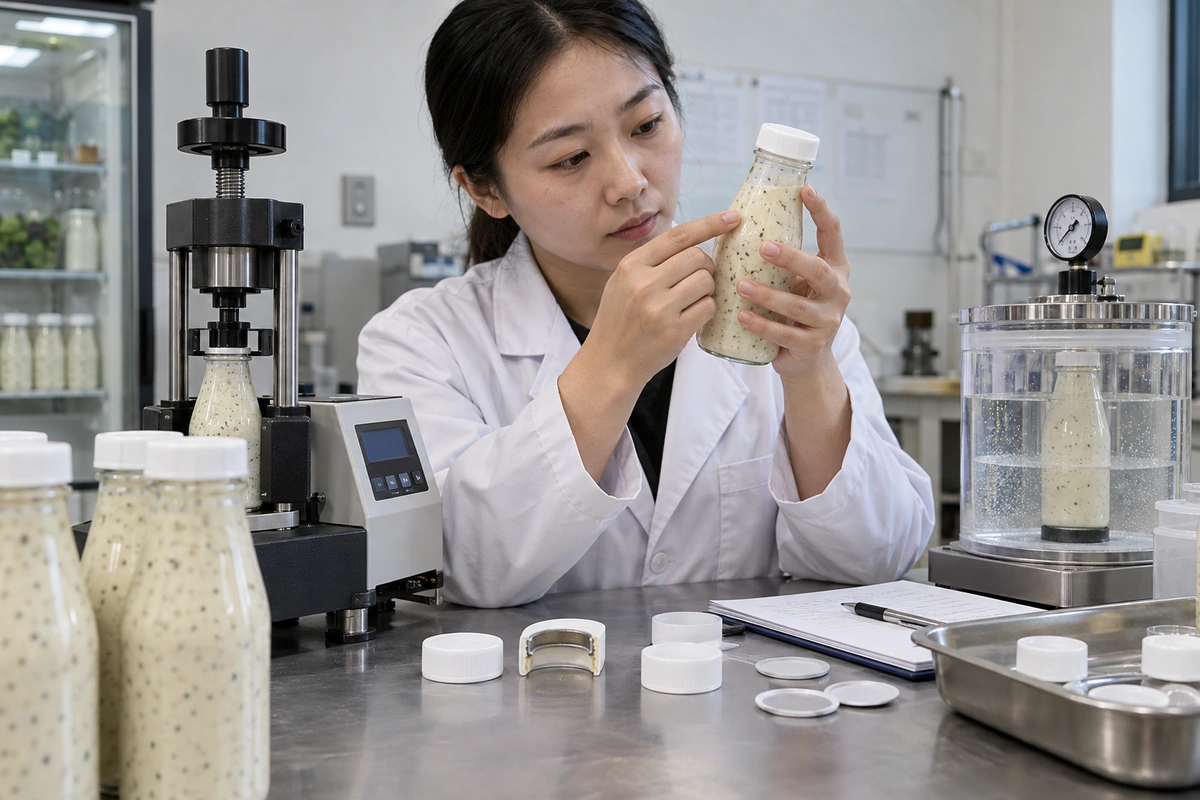
Inspect the bottle sealing land, thread or snap interface, liner or valve, tamper band and cap skirt. Include upright and relevant side or inverted storage checks using the real dressing. A visible leak test can screen gross failures, but a quiet bottle does not by itself establish oxygen barrier or microbial integrity. When a quantitative leak limit is needed, the method, equipment, detection capability and maximum allowable leakage must be justified for this food package rather than borrowed from a pharmaceutical container specification.
Combine package inspection with the mechanical distribution sequence. Cold bottles may see case compression, vibration, drops and pressure changes during transport. Check for cap back-off, cracked closures, paneling, permanent bottle deformation, liner movement, product at the sealing land and loss of tamper evidence after the complete sequence.
Track Oxygen Without Treating It as a Proxy for CFU
Oxygen can enter the product from the initial dissolved load, the filled headspace, bottle and closure transmission, seal defects and air drawn back during repeated dispensing. Oxygen-sensitive strains may respond differently, and the dressing matrix can consume or redistribute oxygen. Measure the oxygen variable that is relevant to the hypothesis instead of assuming that a dark or high-barrier bottle automatically protects the culture.
At time zero, document fill level, headspace and any deaeration or gas-flush step. During storage, pair oxygen measurements with CFU and product-quality results at the same time points where practical. For a squeeze package, a post-opening arm can use a controlled dispensing schedule and bottle orientation to evaluate air return, but it should remain separate from the unopened shelf-life arm.
Use oxygen results diagnostically. A rapid increase associated with a particular closure condition may justify seal or headspace work. Stable oxygen with declining CFU suggests that temperature, acidity, strain behavior, processing stress or another matrix factor may be more important. The package supplier should not convert one oxygen reading into a shelf-life promise.
Measure Viability With a Qualified Microbiology Plan
Define the viable-count method, reporting unit, limit of quantification, replicate structure and acceptance criterion before the study. The laboratory method must be appropriate for the declared organism and dressing matrix. Selective recovery conditions, sample preparation and interference from herbs, oil or background flora can affect the count, so the brand's microbiology lead or qualified laboratory should own the method.
Schedule enough points to show the shape of decline, not only time zero and the final day. Include measurements after filling, after the transport challenge and through real-time storage. Accelerated or elevated-temperature screening may compare candidates, but it does not automatically predict live-culture survival at the labeled endpoint. Real-time results in the marketed package remain the basis for the final claim.
Report both absolute CFU and change from baseline. A package should not be credited for a high final count if the starting overage, formula lot or enumeration method differed from the control. Record deviations, outliers and missing units without silently replacing them.
| Measurement point | Question answered | Common interpretation error |
|---|---|---|
| Before or immediately after filling | What viable count entered the package and whether filling caused an immediate loss | Treating supplier culture potency as the filled-product baseline |
| After thermal and transport challenge | Whether the distribution sequence created an acute change | Attributing all change to the bottle without a matched control |
| Intermediate real-time storage | How quickly viability changes and whether groups diverge | Assuming a linear decline from two points |
| Declared shelf-life endpoint | Whether the tested product-package system meets the approved specification | Extending the result to a new strain, formula or storage range |
Use Predetermined Acceptance Criteria and a Deviation Rule
The approval record should state the required viable count, thermal boundaries, permitted excursion metric, leak criterion, closure range, visual defect limit and any sensory or physical requirements. Criteria need units, test timing and method references. Phrases such as no significant loss, leak-proof or cold-chain compliant are not auditable until they are translated into measurable limits.
Create a deviation rule before testing. A failed logger, damaged control, delayed microbiology sample, chamber interruption or incorrect cap setting can invalidate part of the study. The protocol should identify who evaluates deviations, whether the affected result can be used, and when a repeat is required.
Approve only the tested boundary. The conclusion should name the formula revision, strain, package configuration, pack-out, thermal profile, route duration and shelf-life period supported. It should also list open risks and changes that require requalification.
Separate Supplier Evidence From Brand-Owned Validation
A bottle supplier can provide controlled component samples, drawings, material and color references, dimensional records, closure-fit support, packing information and production-lot identification. Those inputs help the brand and co-packer keep the packaging variable stable during a study. The supplier can also compare stock bottle-and-cap combinations before custom tooling is considered.
The brand, formula owner and co-packer retain responsibility for the food process, probiotic specification, cold-chain limits, microbiology method, regulatory claims and finished-product shelf life. An ISO certificate, resin declaration or empty-bottle leak check does not transfer those responsibilities to the packaging factory.
Gracepack's documented capabilities include bottle and closure sample preparation, drawing review, dimensional and appearance inspection, leak checks, packing references and material-specific food-contact documentation where applicable. For a refrigerated probiotic dressing project, those capabilities are useful only when they are connected to the exact bottle, closure and controlled test lot; they are not evidence that a particular formula will retain its probiotic count.
Cold-Chain Validation Report Checklist
A decision-ready report should let another reviewer reconstruct what was tested and why. Keep raw logger files, microbiology reports, package inspection records, photographs, equipment identification, calibration status, deviations and approval signatures with the final summary.
Present the evidence in parallel tracks: thermal performance, mechanical package performance, oxygen or other quality indicators and probiotic viability. Then state where the tracks agree or diverge. This structure prevents a successful carton study from being misreported as a probiotic shelf-life validation.
- Objective, scope, responsibilities and predefined decision rule.
- Product, strain, formula, filling process and package revision identifiers.
- Sample matrix, control groups, lot information and sample accountability.
- Conditioning, chamber or route profiles and logger placement diagram.
- Bottle, closure, seal, torque or retention and distribution-test results.
- CFU method, raw results, uncertainty or variability and real-time trend.
- Deviations, investigation, retest rationale and unresolved limitations.
- Approved boundary and requalification triggers.
FAQ About Refrigerated Probiotic Dressing Packaging Validation
Is 2°C to 8°C the correct range for every probiotic dressing?
No. It is a common refrigerated range in some contexts, but the acceptable range and excursion allowance must come from the specific strain, formula, process and shelf-life evidence.
Does a leak-free bottle prove probiotic stability?
No. Leak testing evaluates a defined package-integrity risk. Probiotic stability requires microbiological enumeration through the planned storage period.
Can accelerated storage replace real-time CFU testing?
Not automatically. Accelerated conditions can screen candidates, but temperature may change survival mechanisms and may not predict the marketed refrigerated condition. Use real-time testing for the final shelf-life conclusion.
Should every project use vacuum-decay testing?
No. Select the leak or integrity method from the package geometry, expected defect, product, equipment capability and required detection limit. A method developed for another package class may not answer the food-bottle question.
How many data loggers are required?
There is no universal count. Use thermal mapping to identify meaningful hot and cold positions, then choose enough calibrated loggers to characterize the actual shipper, pallet or route with the required confidence.
When must the package be requalified?
Review changes to the strain, formula, fill process, bottle resin or weight, color, closure, liner or valve, application setting, label coverage, carton, refrigerant, route or shelf-life claim. Requalify when the change may affect the approved evidence boundary.
Prepare a Testable Refrigerated Dressing Brief
Before requesting bottle samples, prepare the product temperature range, maximum planned shipment time, credible excursion scenarios, bottle capacity, fill volume, dressing viscosity and particles, closure preference, tamper requirement, storage orientation and destination market. Add the probiotic strain, time-zero target, end-of-life specification and planned microbiology schedule under appropriate confidentiality controls.
Request production-representative bottle and closure samples with revision identity rather than an untracked assortment. The first goal is to create a controlled package set that the brand and co-packer can test. A new mold, barrier structure or specialized closure should follow only when the validated requirement cannot be met by a suitable existing platform.


