
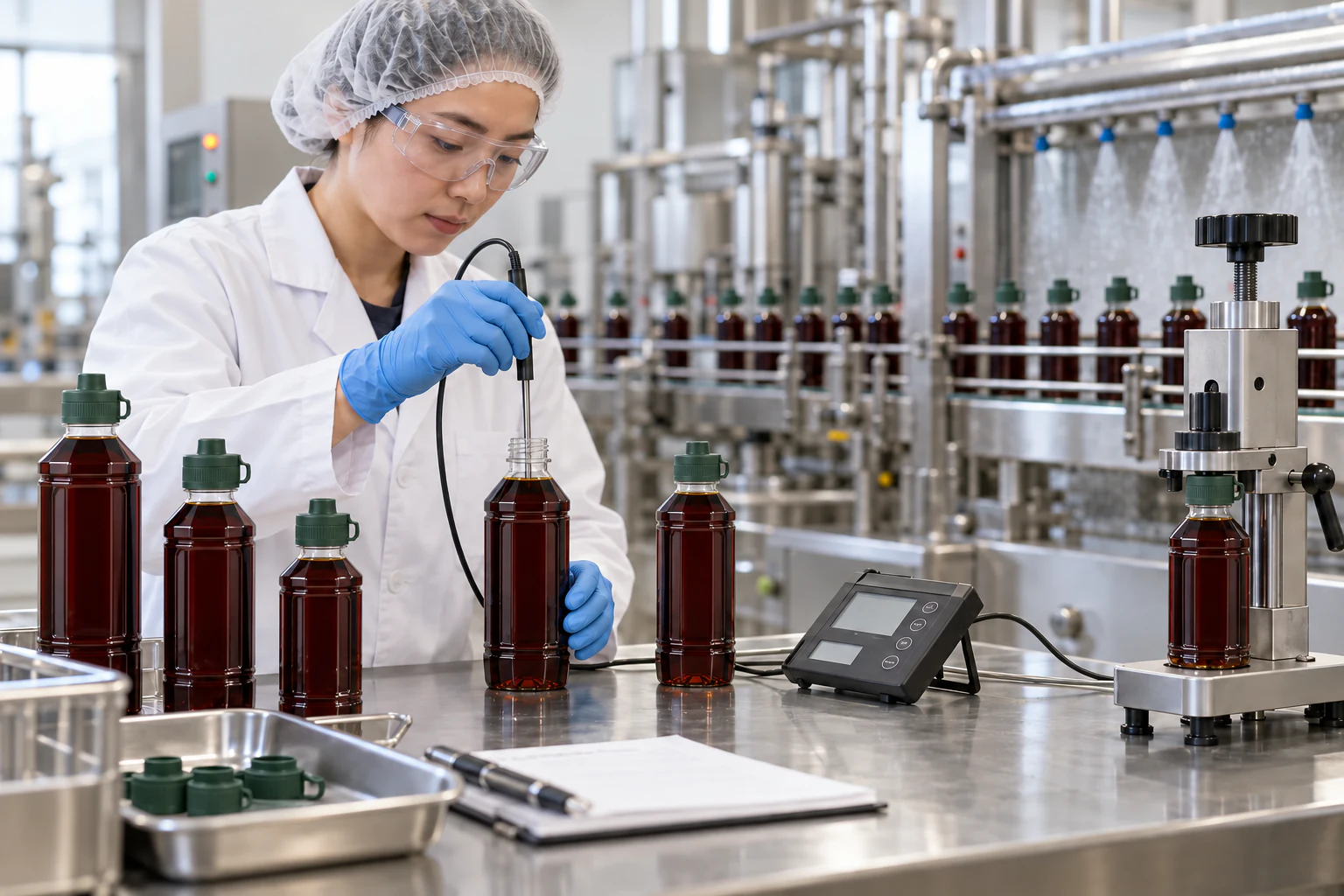
Plastic soy sauce bottles can be hot-filled, but the word plastic does not identify a safe temperature window. Standard PET, heat-set PET and selected PP constructions respond differently to heat, capping load and cool-down vacuum. The commercial bottle, finish, closure, liner or seal, pour insert and filling line must be qualified as one system.
A resin data sheet or a supplier's maximum temperature is only a screening input. Bottle geometry, wall distribution, preform history, neck treatment, colorants, recycled content and process variation can change the result. Approval should be based on the highest and lowest product temperatures actually seen at the filler, the time before capping, any hold or inversion step, and the complete cooling curve.
Soy sauce deserves its own validation plan. Its low viscosity can reach the bottle threads and sealing land quickly, salt-rich residue can remain at interfaces, and a small loss of neck roundness can disturb an orifice reducer or induction seal. The package may look acceptable while warm and develop paneling, base movement or slow leakage only after cooling.
| Decision question | Evidence needed | Reason |
|---|---|---|
| What thermal process will the bottle experience? | Measured product temperatures, dwell times, cap timing and cooling curve | The label hot fill is too broad for engineering approval |
| Will the bottle retain critical dimensions? | Warm, cooled and conditioned measurements at the finish, body and base | Distortion can affect sealing, labeling, conveyance and shelf appearance |
| Will the closure remain sealed? | Applied and removal torque, liner or seal inspection, leakage and reclosing checks | The bottle wall can pass while the finish or insert fails |
| Can the line repeat the approved result? | Start-up, steady-run, restart and planned-stop samples | Worst-case exposure often occurs outside stable production |
| Will the product remain acceptable? | Filled-package storage with color, aroma, taste and package checks | Package survival alone does not establish soy sauce shelf life |
1. Define Ambient Fill, Warm Fill, Hot Fill and Post-Fill Heating
Start with the scheduled process rather than a material choice. Record the soy sauce temperature at the filler bowl and at the first, middle and last container in a run. Add the delay from filling to capping, any inversion or hold step, the time before cooling starts, cooling-water conditions and the temperature at discharge. A set point on the heater does not describe the exposure received by the bottle.
Ambient filling introduces little intentional thermal load. Warm filling raises product temperature for handling or process reasons but may stay below a true hot-fill schedule. Hot filling relies on a defined product temperature and contact time, while post-fill pasteurization exposes the already closed package to an additional heating cycle. These routes can impose different loads even when their peak temperatures look similar.
For food-contact documentation, temperature and time also define the intended condition of use. The FDA food-contact conditions of use distinguish hot filling or pasteurization above 150°F from hot filling or pasteurization below 150°F and from room-temperature filling and storage. Those categories help scope compliance evidence; they do not certify that a particular bottle will retain its dimensions or seal on a production line.
| Process route | Define before bottle selection | Main packaging concern |
|---|---|---|
| Ambient fill | Product and room temperature, cap timing and storage | Ordinary mechanical, barrier and closure performance |
| Warm fill | Actual product range and time before cooling | Early shrinkage, label-panel movement and cap fit |
| Hot fill | Minimum and maximum fill temperature, hold or inversion and cooling curve | Body shrinkage, finish stability, seal response and cool-down vacuum |
| Post-fill heating | Closed-package heating medium, come-up time, hold and cooling | Combined pressure, vacuum, thermal shock and seal exposure |
2. Why Soy Sauce Creates a Distinct Package Challenge
Soy sauce is much less viscous than ketchup or many barbecue sauces. It transfers heat to the bottle wall quickly, moves through small gaps readily and wets the finish during splashing or overfill. Tests developed for a thick sauce can miss thread contamination, insert bypass and low-rate leakage that occur with soy sauce.
The finish must be evaluated with the actual cap and dispensing components. Controlled-pour inserts add fit diameters, air-return paths and thin features that can change during thermal cycling. Tamper bands and liners can soften, relax or seat differently while warm. An induction seal may also depend on finish flatness, clean sealing lands and a controlled time between filling, capping and sealing.
Heat can affect the product as well as the package. Color and aroma changes depend on the soy sauce formulation, oxygen exposure and storage conditions. A controlled soy sauce packaging and storage study illustrates why container material and storage temperature should be evaluated with product-quality measurements rather than inferred from bottle appearance alone.
- Use the commercial soy sauce whenever practical, including its salt level and suspended material.
- Record foaming, splashing and residue on the sealing land during filling.
- Measure the real headspace and fill mass instead of relying only on nominal capacity.
- Include the commercial pour insert, liner, induction foil and tamper feature in thermal trials.
- Separate unopened shelf-life testing from repeated opening and dispensing cycles.
3. Select the Material Route by Conditions, Not by Polymer Name
Standard cold-fill PET should not be assumed to tolerate a hot-fill schedule. Heat can produce body shrinkage, shoulder distortion, loss of label-panel flatness, base movement and finish ovality. A heavier bottle is not automatically a hot-fill bottle because extra material does not replace the controlled molecular orientation, thermal history and geometry needed for dimensional stability.
Heat-set PET is manufactured to improve thermal stability and is often paired with features that manage cool-down vacuum. Its capability still belongs to a defined bottle and process window. Preform design, stretch ratios, mold temperature, wall distribution, neck finish and cooling conditions all require control. A generic temperature claim for heat-set PET cannot release a new bottle shape.
Selected PP constructions can be useful when higher-temperature resistance and flexibility suit the product and line. The trade-offs may include lower clarity, different stiffness, dimensional behavior, decoration requirements and closure fit. PP itself is not an automatic approval: the exact resin grade, bottle process, wall distribution, cap system and food-contact condition must match the project.
Glass can provide dimensional stability and a strong gas barrier, but it introduces thermal-shock, breakage, weight and line-handling questions. It remains a useful control in some trials. The correct choice is the route that meets product safety, package integrity, line performance, shelf life and commercial requirements together.
| Route | Use as a candidate when | Qualification focus |
|---|---|---|
| Standard PET | The measured process remains within the approved cold- or warm-fill window | Shrinkage, finish dimensions and declared condition of use |
| Heat-set PET | Clarity and PET processing are required for a defined hot-fill schedule | Bottle-specific thermal window, vacuum response and neck stability |
| Selected PP | The grade and bottle process suit the required heat exposure | Stiffness, clarity, dimensional repeatability, decoration and cap fit |
| Glass | Barrier and rigid geometry outweigh weight and breakage costs | Thermal shock, closure, line handling and protective transit packaging |
4. Measure the Bottle During Heating and After Cooling
Create a drawing-based measurement plan before the trial. Critical points normally include finish outside diameter, thread and sealing-land condition, neck ovality, overall height, shoulder width, label-panel width, base push-up and standing-ring flatness. Add any conveyor guide, labeler or cartoning dimension that can stop the line even when the bottle still holds liquid.
Measure samples before filling, while warm when safe and practical, immediately after the defined cooling cycle, after 24 hours and after the agreed conditioning period. Use matched locations and identified cavities or production heads. Report actual values and direction of change rather than a single statement that the bottle passed.
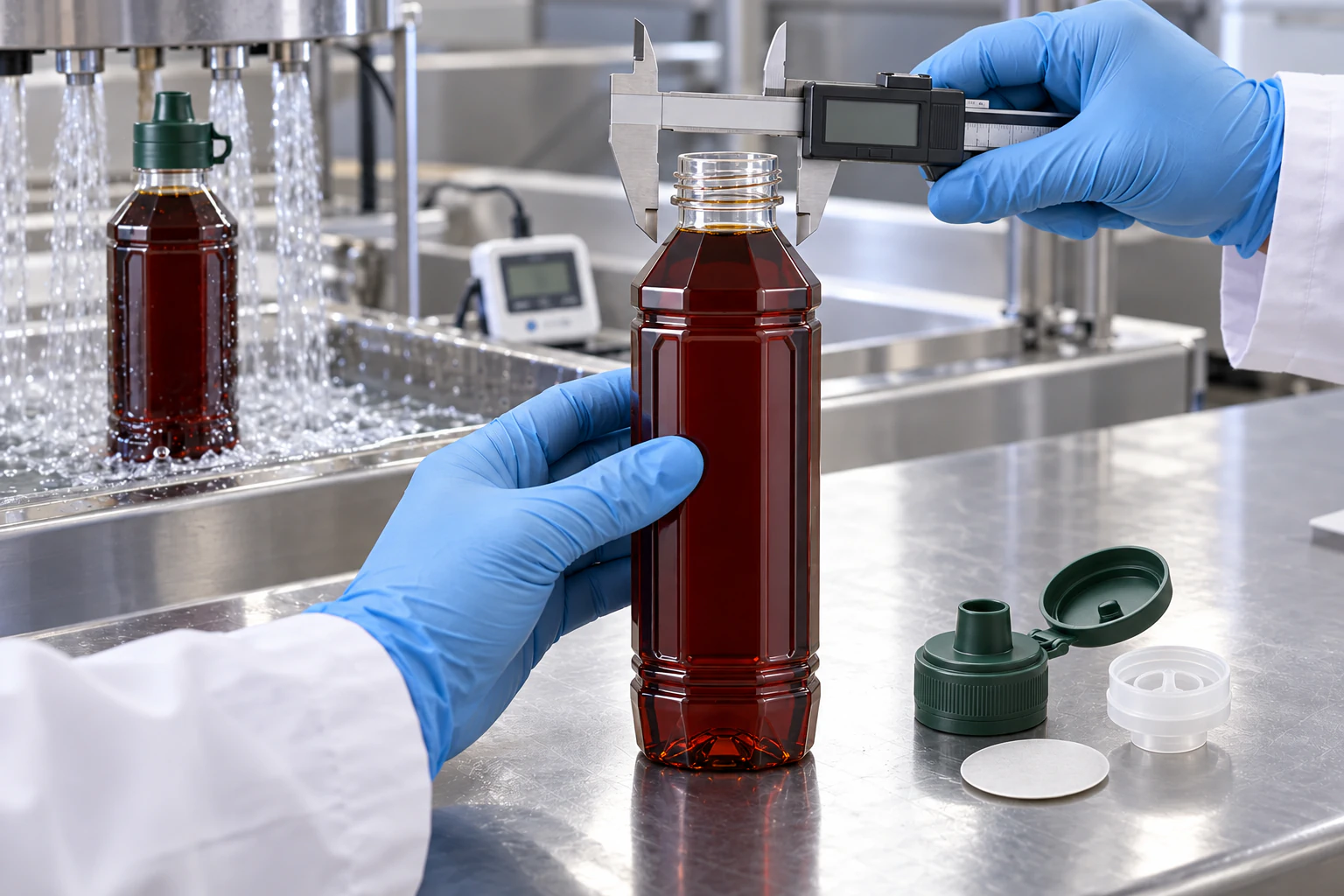
Cool-down vacuum must be managed intentionally. A rigid panel may move unpredictably, while a qualified vacuum feature deforms in a controlled way. Excessive or uneven cooling can create its own stress and appearance defects. Observe shoulder pull-in, sidewall paneling, base rocking, label wrinkles and residual deformation under the lowest and highest intended fill volumes.
- Identify each bottle by trial, resin lot, mold cavity or production head where possible.
- Use calibrated gauges and repeatable measurement locations.
- Check base stability on the intended shelf or conveyor surface.
- Evaluate label-panel geometry with the actual label construction.
- Retain unfilled controls from the same production lot.
5. Validate the Closure, Liner, Seal and Pour Insert
Thermal qualification must use the complete commercial closure system. Record cap and bottle revision, liner or induction-seal construction, pour-insert design, tamper feature, application torque, sealing settings and the temperature at capping. The same bottle can produce different results with a different cap resin, liner thickness or insert interference fit.
Inspect the sealing land for soy sauce residue and confirm whether the production filler can keep it clean. Measure application and removal torque at defined times, then check cap back-off, tamper-band engagement, liner compression, induction-seal continuity and insert retention. Repeat the checks after cooling, side-lay or inversion exposure and distribution conditioning.
Use leakage methods that can detect the relevant failure. A short visual inversion check can find gross leakage, but it may not reveal a slow path at the thread or insert. Combine controlled orientation, time and temperature with mass loss, absorbent detection, vacuum or pressure methods when justified. Define the acceptance limit and test sensitivity before the trial.
| Interface | Check before trial | Check after thermal cycle |
|---|---|---|
| Bottle finish | Roundness, thread, sealing land and contamination | Ovality, distortion, stress and sealing-land change |
| Screw cap | Resin, dimensions and application torque window | Back-off, removal torque, cracking and thread engagement |
| Liner or induction seal | Compatibility and sealing parameters | Continuity, adhesion, channel leaks and removal behavior |
| Pour insert | Fit, orientation and air-return design | Retention, bypass leakage, flow and reclosure |
| Tamper feature | Band, bridge or membrane engagement | Breakage, relaxation and visible evidence of opening |
6. Run an Instrumented Line Trial
A laboratory bath can screen bottle concepts, but production release requires line evidence. Instrument the pilot so the temperature history belongs to bottles rather than equipment set points. Record fill temperature, fill mass, headspace, cap delay, capper settings, inversion or hold time, cooling-zone temperatures, conveyor speed and bottle temperature at discharge.
Sample the first bottles after start-up, stable production, planned speed changes, a short stop and restart, and the end of the run. A stopped hot product column or delayed cap can create the worst exposure. Include the maximum and minimum intended fill volumes because headspace and thermal mass affect pressure changes during cooling.
Set project-specific acceptance criteria before testing. Dimensional change, leakage, removal torque, base stability and appearance limits should come from the bottle drawing, line tolerances, closure requirements and brand standard. Do not import a universal deformation percentage, vacuum level, top-load value or drop height from a different bottle family.
| Trial stage | Samples to retain | Purpose |
|---|---|---|
| Start-up | First stable fill plus deliberately identified transition units | Captures heating and setting stabilization |
| Steady run | Samples across cavities, heads and time intervals | Confirms repeatability under normal operation |
| Speed change | Before and after the change | Checks altered exposure and cooling residence time |
| Short stop and restart | Last bottle before stop and first bottles after restart | Challenges the likely maximum dwell or temperature deviation |
| End of run | Final production samples and retained controls | Confirms the process did not drift |
7. Confirm Food-Contact and Product-Quality Evidence
Food-contact evidence must match the exact product-contact materials and the intended temperature-time condition. Review the bottle resin, colorant, cap, liner, induction-seal layer and pour insert separately where they use different materials. A report for one PET bottle does not automatically cover a PP cap, elastomeric valve or adhesive layer.
Keep two questions separate. Migration or regulatory documentation addresses whether materials are suitable for an identified use, while thermal validation shows whether the package retains its dimensions and function. A compliant resin can still form an unsuitable bottle, and a dimensionally stable bottle can still lack the correct documentation for the destination market.
Run filled-product storage with the approved process. Track leakage, panel shape, seal condition and dispensing alongside color, aroma and taste. Accelerated screening can compare weak and strong candidates, but real-time samples at the intended storage condition should support the commercial shelf-life decision.
- Match every document to the named material, supplier and component revision.
- Confirm that the reported food type and condition of use cover the real soy sauce process.
- Reopen the review after any resin, color, closure, liner, insert or process change.
- Keep production samples and processing records traceable to each test result.
- Have the food processor and qualified process authority establish the thermal process.
8. Release the Package With a Controlled Validation File
Begin with engineering samples, then run an instrumented pilot using production-equivalent bottles and closures. Inspect immediately after cooling, at 24 hours and after defined distribution and storage conditioning. A signed reference sample should represent the accepted finish, cap fit, panel shape, base stability and appearance.
The release file should contain the bottle and closure drawings, resin and component identities, food-contact evidence, fill-and-cool profile, capper and sealing settings, dimensional data, leak and torque results, line observations, filled-product study plan and approved limits. Record which deviations require requalification so that routine purchasing changes do not silently invalidate the work.
Gracepack operates blow-molding and injection-molding equipment, automatic production lines and a large existing mold library that can support bottle-and-closure screening before custom development. For a hot-fill soy sauce project, the useful output is a matched component set, traceable samples and an agreed validation plan. Final thermal-process approval and specialized analytical testing should remain with the food processor and qualified laboratories or process authorities.
| Release item | Minimum content | Revalidate when |
|---|---|---|
| Approved package | Bottle, cap, liner or seal, insert and decoration revisions | Any component or geometry changes |
| Thermal window | Actual fill, hold, inversion and cooling conditions | Temperature, time or line configuration changes |
| Mechanical evidence | Dimensions, torque, leakage, base and line-handling results | Tooling, resin or capping changes |
| Compliance file | Component-level evidence for market and condition of use | Supplier, formulation or destination changes |
| Product evidence | Defined color, aroma, taste and package endpoints | Soy sauce formulation or shelf-life target changes |
Frequently Asked Questions
Can a standard PET soy sauce bottle be hot-filled? Not on the basis of the PET name alone. A standard cold-fill bottle may shrink, distort or lose finish roundness under heat. Use a bottle-specific thermal window and validate the complete fill, cap, hold and cooling cycle.
Does heat-set PET automatically make a soy sauce bottle suitable for hot fill? No. Heat-set processing improves thermal stability, but bottle geometry, wall distribution, finish, closure, vacuum response and line conditions still require qualification.
Is PP always better than PET for hot-filled soy sauce? No. A selected PP grade may offer a useful heat-resistant route, but clarity, stiffness, dimensional repeatability, decoration and closure fit may favor another construction. Test the exact bottle and component set.
Why test the closure again after cooling? Cooling changes internal pressure and can alter cap torque, liner compression, insert retention and finish dimensions. Some slow leaks appear only after the package reaches room temperature.
Can water replace soy sauce in a hot-fill trial? Water is useful for early thermal screening, but it may not reproduce soy sauce wetting, salt residue, foaming, density, color or product-package interactions. Final package approval should use the commercial product or a justified challenge fluid followed by product confirmation.
What information is needed to review a hot-fill soy sauce bottle? Provide the soy sauce type, actual minimum and maximum product temperature at filling, cap delay, hold or inversion step, cooling curve, capacity, fill volume, headspace, bottle and finish, closure and liner or insert, line speed, destination market, expected quantity and any current failure symptoms.


