
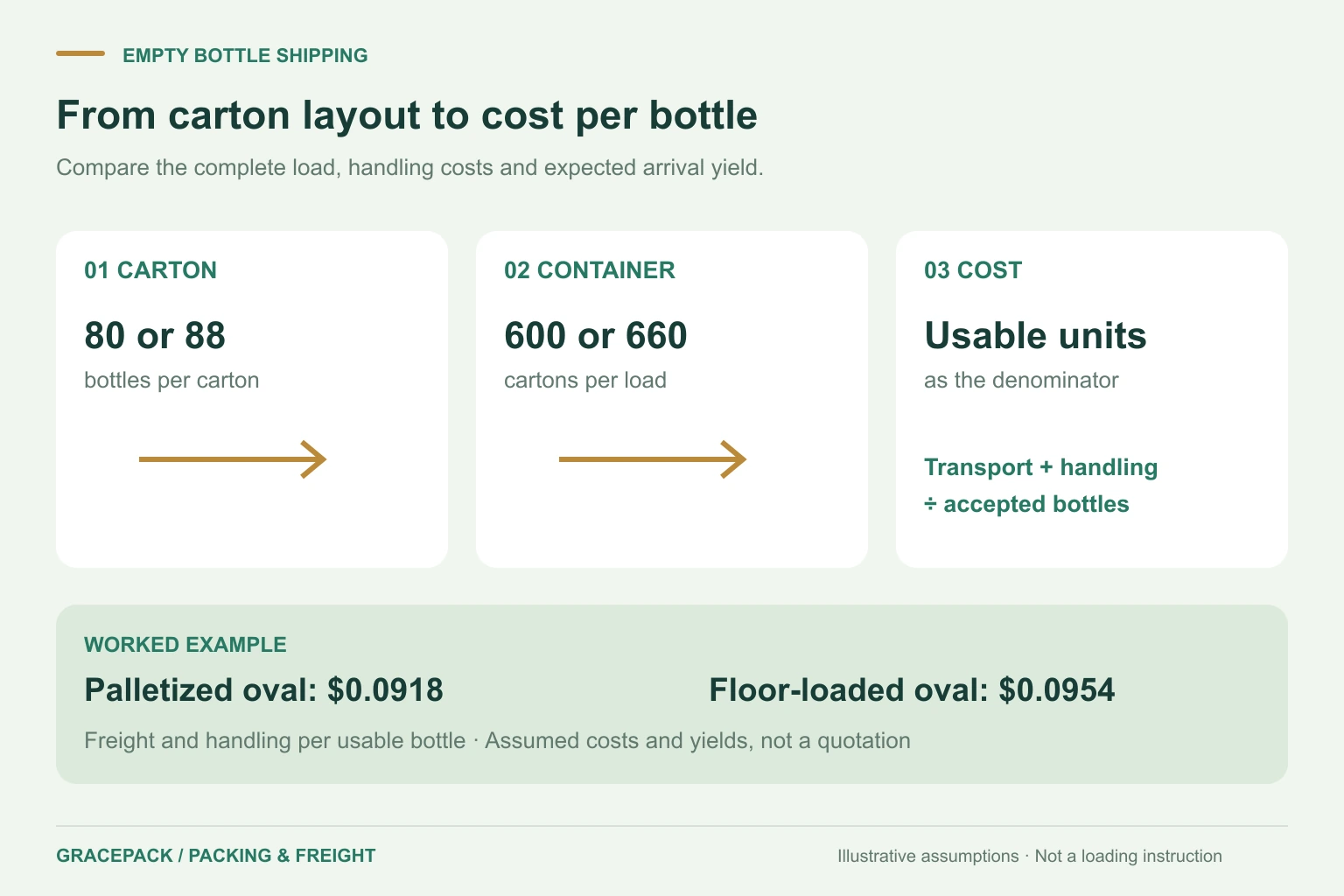
To compare shipping options for empty salad dressing bottles, calculate the approved count per carton, build a dimensioned container load plan, and divide the same scope of transport and handling costs by the number of bottles expected to arrive usable. A denser carton or a floor-loaded container is only an improvement if the receiving operation, protection level and total shipment cost support it.
| Decision | Measure | Common calculation error |
|---|---|---|
| Bottle layout | Complete packed envelope and actual count | Using nominal capacity or body diameter alone |
| Carton plan | Usable inside dimensions and finished outside dimensions | Using internal carton volume for freight |
| Container plan | Cartons, pallets, height limits and access clearance | Treating total cubic capacity as a guaranteed load |
| Cost comparison | Same transport scope divided by usable units | Omitting unloading charges, caps or arrival rejects |
Separate Ocean Capacity From Freight Billing
Empty plastic bottles often run out of usable space before reaching the container’s payload limit. This makes carton dimensions important, but it does not mean every transport mode applies a parcel-style dimensional-weight formula. Start the comparison with the actual service and the quoted charge basis.
For full container load (FCL), compare the quoted container service, included local charges and the number of complete bottle sets that fit. For less-than-container load (LCL), check the forwarder’s weight-or-measure basis, minimums and handling charges. Maersk’s LCL terms, for example, define a weight-and-measure comparison using one cubic meter against 1,000 kg (about 2,205 lb). Use the actual tariff for the shipment rather than treating that example as a universal quote.
Parcel and air services may use their own dimensional-weight divisors. North American less-than-truckload freight can involve freight classification, density, handling and carrier rules. Neither a truck freight class nor a 53-foot trailer pallet count establishes the capacity or price of an ocean container. Keep those calculations outside the ocean comparison unless the booked inland leg requires them.
Measure the Bottle and Carton at Two Different Boundaries
For clear salad dressing bottles, record the maximum body width, shoulder projection, neck and closure dimensions, and the surface protection required. Include caps if they ship fitted. If caps travel separately, include their cartons in both the space calculation and the complete-set count.
Use the carton’s available internal dimensions to develop the bottle layout. Allow for liners, cells, layer pads, bottle variation and clearance for packing and removal. Use the finished external dimensions—including any bulge—to calculate shipment cube and pallet fit. A catalog bottle diameter and an empty carton drawing are insufficient to release a packing specification.
For a simple upright rectangular arrangement, bottles per carton = columns × rows × layers. Round each axis count down after allowing for the protection and clearance already defined. For oval bottles, evaluate both orientations. Mixed or staggered arrangements need a drawing or physical trial; multiplying three rounded-down numbers does not solve every packing pattern.
Compare shipment volume in consistent units: carton CBM = outside length × outside width × outside height in meters. Do not confuse a bottle’s liquid capacity with its shipping envelope. A 300 mL fill volume says little about the space required by the shoulder, neck, closure and protective pack.
Worked Carton Comparison: Round Versus Oval
The following is an illustrative planning exercise, not a Gracepack product specification or a measured saving. Assume two hypothetical 300 mL (10.1 US fl oz) bottle-and-cap designs have already met the same dispensing and filling requirements. Both use a carton with 580 × 380 × 380 mm of usable internal space (22.83 × 14.96 × 14.96 in) and 600 × 400 × 400 mm finished outside dimensions (23.62 × 15.75 × 15.75 in).
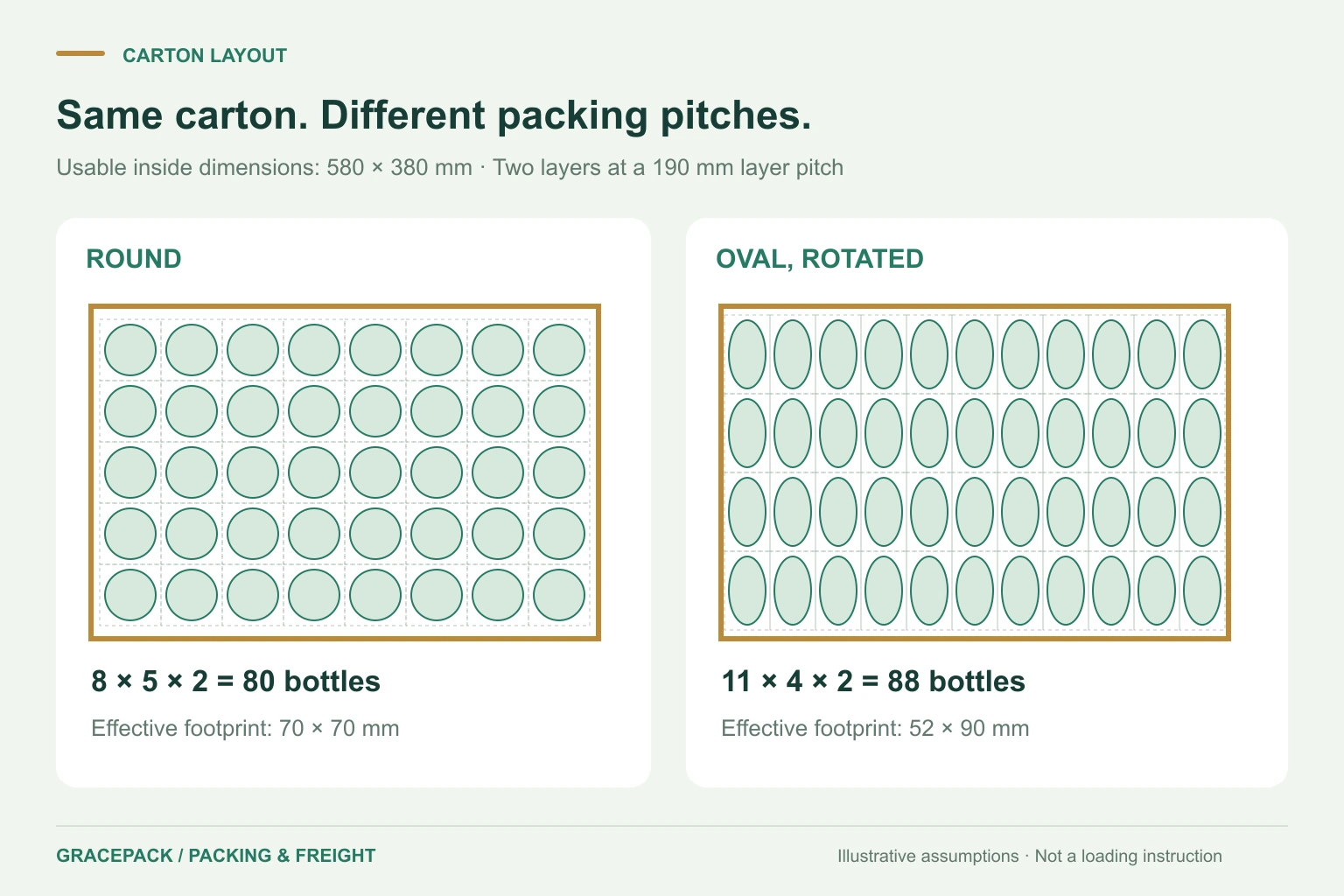
The effective packing pitches below include the allocated clearance and protection. The round design uses a 70 × 70 mm footprint (2.76 × 2.76 in); the oval design uses 90 × 52 mm (3.54 × 2.05 in). Both use a 190 mm layer pitch (7.48 in), allowing two layers. These assumptions must be replaced by a sample pack before they become an order quantity.
| Candidate arrangement | Count per layer | Layers | Bottles per carton |
|---|---|---|---|
| Round: 70 mm along both axes | 8 × 5 = 40 | 2 | 80 |
| Oval: 90 mm along the carton length | 6 × 7 = 42 | 2 | 84 |
| Oval rotated: 52 mm along the carton length | 11 × 4 = 44 | 2 | 88 |
Why a Higher Count Can Fail at the Next Packing Stage
The rotated oval arrangement gives 10% more bottles per carton in this example: 88 ÷ 80 − 1. That is a result of these assumed dimensions, not a general advantage of oval bottles. Another shoulder, cap or carton size can reverse the result. The rectangular layouts also do not establish the global optimum among every staggered or mixed pattern.
For vinaigrette pour bottles, a broad shoulder or a projecting dispensing closure may determine the packing pitch instead of the main body. Enlarging a carton to add one bottle row can reduce cartons per pallet layer. Removing a separator can improve the spreadsheet count while increasing scuffing or deformation. Follow the change through carton, pallet and container before assigning a saving.
Use “alternating orientation” for neck-to-base arrangements and “staggered packing” for offset rows. Do not assume a finished narrow-neck bottle can nest inside another bottle. Actual nesting requires a suitable design and an approved separation method; compressing or baling empty bottles is unsuitable for new bottles intended to retain their shape for filling.
A reshipper carton is intended for a subsequent shipment, commonly after filling. It is not another name for a nested carton. Compare its purchase price and reuse benefit with the bulk pack’s handling requirements, using the customer’s actual filling and distribution process.
Build a Dimensioned 40HC Load Plan
Use the booked equipment specification as the starting envelope. Hapag-Lloyd’s 40-foot high-cube specification lists approximately 76.3 m³ (2,694 ft³) of internal capacity and a door opening smaller than the internal height, and notes that equipment varies. That published volume is not a promise that the same volume of boxed bottles can be loaded.
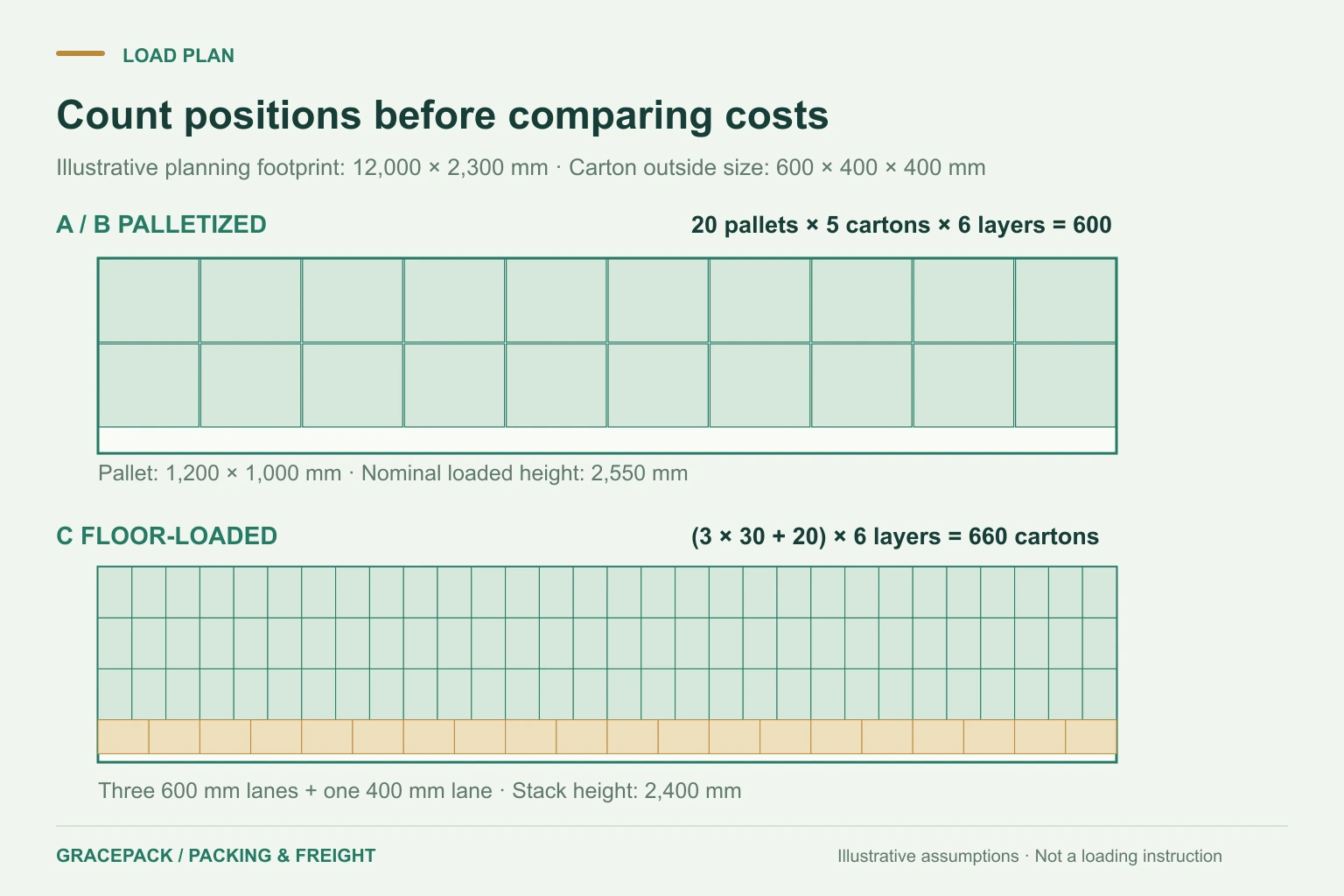
For the worked example, assume a clear planning footprint of 12,000 × 2,300 mm (39.37 × 7.55 ft). Pallets are 1,200 × 1,000 mm (47.24 × 39.37 in) and 150 mm high (5.91 in). A carton layer uses three cartons oriented 400 × 600 mm beside two oriented 600 × 400 mm, forming a 1,200 × 1,000 mm footprint. Five cartons per layer × six layers × 20 pallet positions gives 600 cartons.
The nominal pallet height is 2,550 mm (100.39 in): six 400 mm carton layers plus the 150 mm pallet. Confirm the final wrapped dimensions, top protection, door clearance and lifting method. The nominal two-across, ten-along pallet arrangement is a geometric screening layout; overhang, wrapping, tolerances or required securing space can reduce its count.
For the floor-loaded alternative, use three 600 mm-wide lanes, each containing 30 cartons at a 400 mm longitudinal pitch, plus one 400 mm-wide lane containing 20 cartons at a 600 mm pitch. The footprint is 12,000 × 2,200 mm (39.37 × 7.22 ft), giving 110 cartons per layer. At six layers, that is 660 cartons and a 2,400 mm stack height (94.49 in). This is a feasible rectangular arrangement on paper, not a certified loading instruction or a claim of maximum capacity.
Both alternatives remain conditional on the approved stack strength, gross mass, restraint plan and receiving method. Deduct any positions lost to actual clearance requirements, cap cartons or loading equipment. For the example below, caps are already included in the assumed bottle envelopes; there are no separate cap cartons.
Include Separately Packed Caps in Complete-Set Capacity
A bottle-only container count can overstate the number of usable packaging sets. Calculate the space needed for matching caps, liners or other separately shipped components before comparing an assembled pack with a split pack.
For example, assume 250 bottle bodies per 0.12 m³ carton and 1,000 caps per 0.10 m³ carton. Every 1,000 complete sets then require four bottle cartons plus one cap carton: 4 × 0.12 + 0.10 = 0.58 m³ (about 20.48 ft³). The body-only calculation would count only 0.48 m³ and omit the cap shipment entirely.
This separate example is a cube screen, not a load plan. Different bottle and cap carton dimensions may leave unusable gaps even when their total CBM is below the container’s internal volume. Model both carton types in the actual arrangement and include any liners or fitments in the same bill of materials.
Compare Freight Cost per Shipped and Usable Bottle
The next table uses the hypothetical layouts above. Every dollar amount and arrival yield is an illustrative assumption, not a current freight quote, historical Gracepack result or promised saving. Hold the route, currency, service scope and quote date constant when replacing these inputs with real offers.
The assumed common transport charge is $4,200 per container for the same defined route and services. Add $600 of loading and unloading costs to either palletized option, or $1,200 to the floor-loaded option. These costs exclude bottle purchase, packing materials, duties, financing and extraordinary delays. Include those separately when making a full procurement decision.
| Metric | A: Round, palletized | B: Oval, palletized | C: Oval, floor-loaded |
|---|---|---|---|
| Bottles per carton | 80 | 88 | 88 |
| Cartons per container | 600 | 600 | 660 |
| Bottles shipped | 48,000 | 52,800 | 58,080 |
| Transport plus loading/unloading | $4,800 | $4,800 | $5,400 |
| Freight/handling per shipped bottle | $0.1000 | $0.0909 | $0.0930 |
| Assumed arrival usable yield | 99% | 99% | 97.5% |
| Expected usable bottles | 47,520 | 52,272 | 56,628 |
| Freight/handling per usable bottle | $0.1010 | $0.0918 | $0.0954 |
Calculate the Unloading Break-Even Point
Calculate usable bottles as shipped bottles × arrival usable yield. Divide transport and loading/unloading costs by that usable count. Here, option B has the lowest transport cost per usable bottle. Option C carries more bottles, but its additional handling cost and lower assumed usable yield outweigh that advantage.
At option B’s exact cost per usable bottle, option C could spend up to $5,200 in total transport and handling costs: $4,800 × 56,628 ÷ 52,272. That leaves a $400 premium over B before the freight-per-usable-bottle advantage disappears. The assumed C cost is $5,400, so it exceeds the break-even total by $200.
Recalculate that threshold with measured arrival yields and the warehouse’s unloading quote. Also compare the order quantity actually needed: a larger theoretical capacity has no benefit if the order will not fill it. A higher transport cost per bottle may still be acceptable for service or inventory reasons, but it should be a deliberate choice.
Keep the accounting boundary clear. This ratio allocates freight to usable units; it does not value the scrapped packaging itself or include later filling losses. For those items and inventory costs, use the separate wholesale squeeze bottle total-cost guide. Do not add the same freight loss twice.
Approve the Pack and Receiving Method Before Booking
For salad dressing squeeze bottles, verify that handling and sustained stacking preserve the bottle’s intended shape and function. The existing ocean freight packaging guide covers compression, moisture, restraint and arrival inspection in detail. Use those checks to qualify the proposed count; extra bottle positions are not a substitute for packaging approval.
A practical release sequence keeps the calculation tied to a repeatable physical pack:
- Confirm the exact bottle, cap and protection specification. Record whether each dimension is measured, quoted or assumed.
- Pack a trial carton and measure its finished external dimensions, gross weight and actual count. Check closure clearance and unloading from the carton.
- Build the pallet or floor-load drawing. Verify approved stack height, door access, gross load, restraint space and any component cartons.
- Obtain the receiving warehouse’s approval for pallet type or floor unloading, labor, appointment duration, equipment and clean staging space.
- Price the same transport scope for each option. Confirm waiting-time and container-return terms rather than assuming all delay charges are included.
- Check loaded quantities against the packing list and retain loading photos. Compare arrival condition and accepted quantities with the approved reference.
FAQ
Do oval salad dressing bottles always reduce freight costs?
No. The result depends on the complete bottle envelope, carton arrangement, pallet footprint, stack limit and handling costs. Use matched capacity and functionality, then compare actual pack-out data.
Can container volume divided by carton volume predict the final load?
It is a rough upper-bound screen for that carton volume, not a packing solution. Orientation, clearances, pallets, weight, access and load securing can all reduce the count.
Is floor loading always cheaper than palletizing?
No. It may increase carton count, but unloading labor, receiving restrictions and damage can outweigh the space benefit. Compare costs per usable bottle within the same service scope.
Should bottle caps ship fitted or separately?
Compare both complete configurations. Include cap cartons, assembly work, cleanliness, tamper-evident features and the approved protection method. Do not compare bottle-only cube with a complete fitted set.
Can I use the example freight rates for a purchase order?
No. The figures demonstrate the calculation only. Replace them with dated quotations for the actual route, equipment, handling method and order quantity.
Request a Matched Bottle and Pack-Out Comparison
Gracepack’s export planning process records the bottle and cap configuration, carton quantity, outside dimensions, packing method and pallet requirements together. Separate bottle and cap packing is assessed as a complete set, and loading records can include the empty container, container number, loading progress, completed load and seal. These records make it easier to reconcile the planned quantity with the shipped configuration.
Send the bottle drawing or sample, required capacity, cap, intended order quantity, current carton details, destination and warehouse receiving rules. Include whether the warehouse accepts floor-loaded cartons and whether caps must arrive fitted. We can review the existing bottle and packing route before a new shape or custom carton is proposed.
The useful comparison is a dimensioned pack-out with explicit assumptions and a matched transport quote. Approve its count, protection and receiving method together, then retain the same configuration for repeat orders.


