
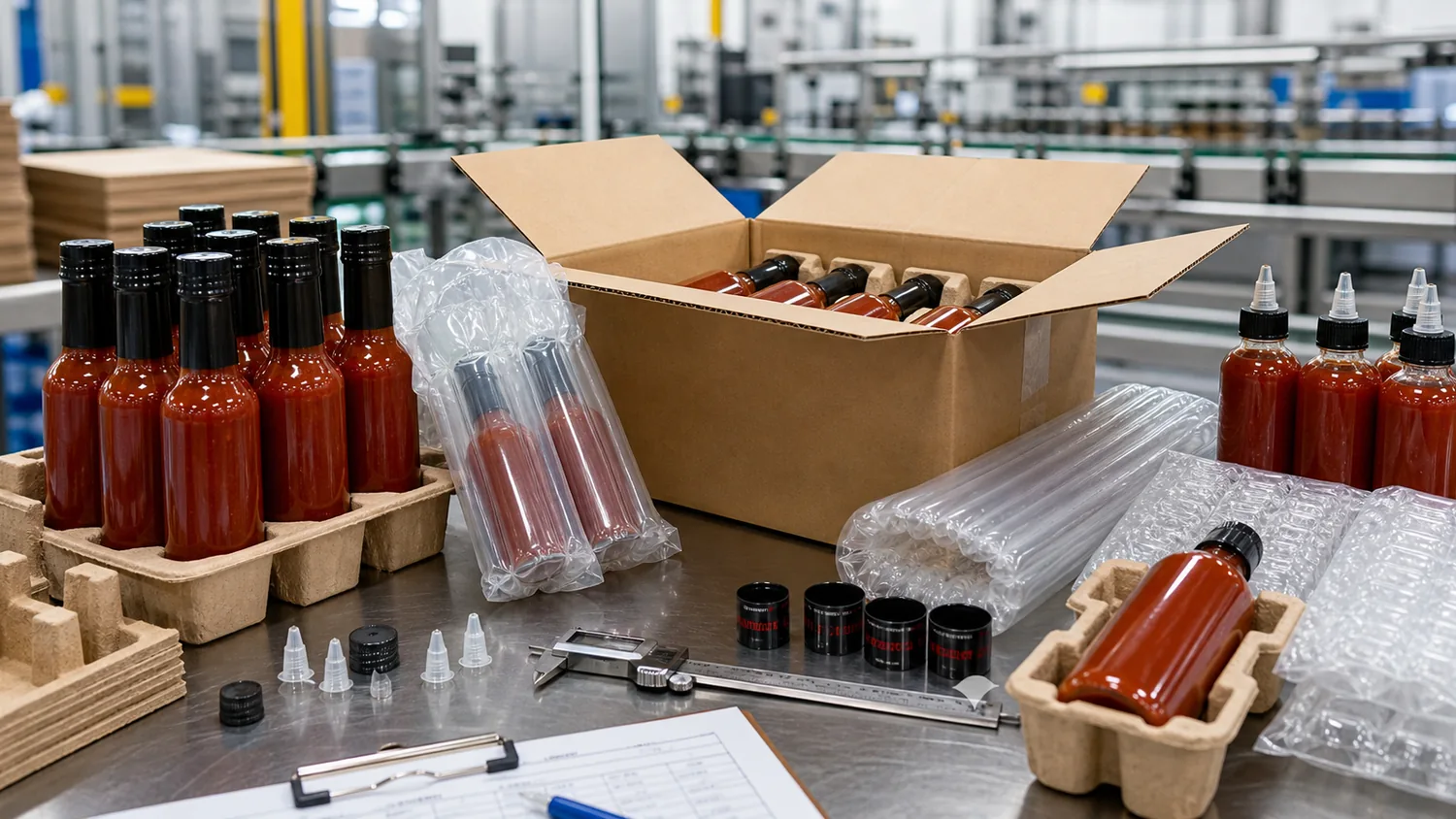
Reducing hot sauce bottle breakage in e-commerce shipping starts with complete immobilization: the bottle must not strike another bottle, the closure must not loosen under vibration, and the inner pack must absorb corner, edge and face impacts before the glass or plastic body takes the load. A parcel pack that passes retail pallet handling can still fail in DTC delivery because small parcels face drops, rotation, conveyor impacts, temperature swings and mixed-item compression.
The strongest route is not always a heavier bottle. For glass, protection comes from shoulder strength, neck support, cell separation and enough cushioning around the cap. For PET or HDPE Hot Sauce Bottles, damage control shifts toward cap torque, panel stiffness, stress whitening, leak testing and carton cube efficiency. The practical goal is cost per delivered sellable unit, not the lowest empty-bottle cost.
| Package Layer | Primary Failure Mode | Better Design Route | Validation Target |
|---|---|---|---|
| Bottle body | Glass fracture, PET denting, HDPE panel collapse or shoulder stress. | Match material, wall distribution, base design and label panel geometry to parcel handling. | No cracks, permanent deformation, label damage or standing instability after filled-pack testing. |
| Neck and closure | Cap backoff, liner leakage, reducer movement or cracked neck finish. | Use matched cap thread, liner compression, induction seal or shrink neck band where needed. | No seepage after inversion, vibration, temperature cycling and drop orientation review. |
| Inner protection | Glass-to-glass impact, cap scuffing, body abrasion or free movement inside the carton. | Use molded pulp, corrugated cells, air-column sleeves or bubble pouches sized to the bottle. | Bottle stays fixed when the carton is shaken and does not contact another hard surface. |
| Outer box | Corner crush, edge split, sidewall puncture or tape failure. | Use parcel-grade corrugated, correct box size, void fill and reinforced sealing. | Box remains closed and protective materials stay in position through the transit simulation. |
| Fulfillment method | Wrong orientation, loose multipacks, mixed-item pressure or inconsistent packing labor. | Use a repeatable pack-out SOP with orientation, void-fill amount and final shake check. | New staff can pack the SKU consistently without changing protection level. |
The Pain of Leaks and Broken Glass in DTC Parcel Delivery
A broken hot sauce bottle rarely creates a simple replacement order. Red sauce stains the shipper, contaminates nearby items, triggers refund requests, and can turn a good product review into a packaging complaint. For Amazon, Shopify, subscription boxes and marketplace fulfillment, one failed parcel can also consume support time, replacement freight, disposal handling and lost customer trust.
Leakage can be just as costly as visible glass breakage. A cap that backs off by a fraction of a turn, a reducer that does not seat fully, or a liner that loses compression during temperature changes can leave the package looking unsafe even when the bottle body survives. Oil-rich chili sauces add another risk because low-viscosity oil phases can creep past weak sealing surfaces more easily than a uniform tomato or vinegar sauce.
A useful cost model looks at delivered success, not warehouse dispatch. If a brand ships 10,000 direct-to-consumer orders and damage claims reach 2 percent, 200 orders require some combination of replacement goods, freight, service labor and reputation recovery. Even a small packaging upgrade can pay for itself when it removes repeat failures on high-margin multi-bottle packs.
| Damage Type | Common Customer-Facing Result | Root Package Cause | Prevention Focus |
|---|---|---|---|
| Glass fracture | Broken bottle, stained carton and full refund request. | Bottle-to-bottle contact, insufficient cushioning or weak corner protection. | Cell separation, molded pulp, air columns, stronger carton and drop orientation testing. |
| Cap leakage | Sticky bottle, sauce odor, loose cap or stained label. | Poor torque, liner mismatch, cap backoff or pressure change during transit. | Torque window, liner selection, induction seal, shrink band and filled inversion checks. |
| Scuffed presentation | Bottle looks used or retail-unready on arrival. | Loose inner pack, cap rubbing or poor bulk protection inside the shipper. | Tighter bottle immobilization, sleeve protection and clean divider layout. |
| Dented plastic bottle | Panel collapse, label wrinkle or poor shelf appearance. | Thin unsupported wall, carton compression or hot warehouse temperature. | Rib geometry, panel stiffness, top-load review and destination temperature planning. |
Drop-Test Standards for E-Commerce Hot Sauce Packaging: ISTA 3A and ASTM D5276
E-commerce packs need a test plan that resembles parcel handling. ISTA 3A is commonly used for packaged products moving through parcel delivery systems, while ASTM D5276 describes free-fall drop testing for loaded boxes and containers. These references help packaging teams define repeatable face, edge and corner drops instead of relying on a single informal warehouse drop.
The standard is only the starting point. A hot sauce brand still needs to test the actual filled bottle, cap, reducer, label, headspace, inner protection, carton size and closure torque. Water-filled samples can check weight and impact behavior, but they do not show oil creep, cap staining, viscosity-related leakage or real label contamination.
A parcel pack should be evaluated in the direction it actually ships. Upright packing uses the vertical strength of many bottles and helps keep sauce away from some closure interfaces. Horizontal packing may save cube in some gift sets, but it places liquid against the cap for the entire journey and should be tested more aggressively for leakage.
| Test Reference | What It Helps Evaluate | Hot Sauce-Specific Detail to Add | Pass Condition |
|---|---|---|---|
| ISTA 3A-style parcel distribution testing | Small-parcel drop, compression and vibration risk. | Test the final e-commerce shipper with inner protection, cap torque and bottle orientation. | No breakage, no leakage, no cap loosening and no sellable-unit cosmetic failure. |
| ASTM D5276 free-fall drop method | Controlled face, edge and corner drop procedure for loaded containers. | Use filled bottles and record impact orientation, carton condition and post-drop leakage. | Package integrity remains acceptable after the planned drop sequence. |
| Vibration and handling checks | Cap backoff, scuffing, divider movement and bottle migration. | Include oil-rich or low-viscosity formulas because seepage can appear after vibration. | No movement severe enough to create glass contact, cap rubbing or leakage. |
| Temperature cycling | Pressure change, liner recovery and plastic panel response. | Review warm warehouses, cold trucks and air-shipment pressure changes where relevant. | No panel collapse, cap seepage, label lifting or shrink band failure. |
Glass, PET and HDPE: Choosing the Primary Bottle for Impact Risk
Glass gives hot sauce a premium retail feel and strong flavor protection, but its failure mode is severe: once glass breaks, the order is unsellable and the parcel is messy to handle. Glass hot sauce bottles with reducer caps can still work well for e-commerce when the body is isolated in molded pulp, corrugated cells or air-column sleeves and the vulnerable neck area is protected from side impact.
PET reduces the shattering risk and lowers shipping weight, which makes it attractive for multi-bottle DTC packs, foodservice refill items and brands that receive damage complaints from glass parcels. The trade-off is that PET must be matched to filling temperature, sauce chemistry, wall stiffness and cap route. A bottle that looks good empty can dent or panel under a filled drop if the wall distribution is too light.
HDPE and LDPE squeeze bottles can absorb impact better than rigid glass and provide a softer grip for thicker sauces, but opacity, oxygen barrier limits and label-panel behavior need review. If the sauce is sold as a premium shelf product, glass may still be preferred. If the priority is repeat delivery survival, lower package weight and reduced breakage claims, a validated plastic route can be more practical.
| Bottle Route | Transit Strength | Main Risk | Best E-Commerce Use |
|---|---|---|---|
| Glass woozy or round hot sauce bottle | Rigid, premium, strong flavor protection. | Breakage, neck impact and higher freight weight. | Gift sets, premium SKUs and brands that can afford molded protection. |
| PET hot sauce bottle | Shatter-resistant and lighter than glass. | Denting, heat sensitivity and cap-seal validation. | DTC multi-packs, lower breakage programs and clear product visibility. |
| HDPE or LDPE squeeze bottle | High impact toughness and good hand squeeze. | Lower clarity and possible panel distortion if too light. | Thicker chili sauces, foodservice refills, outdoor packs and high-repeat shipping. |
| Hybrid material portfolio | Lets each SKU use the right risk profile. | More component validation and inventory planning. | Premium glass flagship plus plastic e-commerce or foodservice variants. |
Lightweighting While Maintaining Impact Strength
Lightweighting only works when material is removed from low-stress areas and kept where the bottle carries impact, capping load and stacking force. The shoulder, neck support, heel, base ring and grip zones often need more careful wall distribution than the center of a large flat label panel. Removing too much resin from these areas can create squeeze collapse, stress whitening, base rocking or leakage after a drop.
For squeeze bottles, rib geometry matters because ribs convert thin walls into a more stable structure without making the whole bottle heavy. Vertical ribs can improve grip and sidewall recovery. Circumferential ribs can resist panel collapse. A reinforced base or controlled push-up can help the bottle stand after impact and reduce conveyor or pack-out tipping.
Cap weight and neck geometry also affect impact performance. A tall nozzle cap or heavy closure moves the center of gravity upward and can make a bottle more likely to land on the neck during a drop. When that closure is essential for dispensing, the shipper needs enough cap clearance and cushioning above the closure.
| Design Zone | Common Weak Point | Engineering Adjustment | Transit Benefit |
|---|---|---|---|
| Neck and shoulder | Side impact cracking, cap leakage or thread distortion. | Stronger shoulder radius, controlled neck finish and cap clearance inside the pack. | Protects the closure interface during corner and edge drops. |
| Label panel | Denting, wrinkle or pressure collapse. | Avoid large unsupported flat panels unless wall thickness and vacuum behavior are proven. | Keeps the bottle sellable and label readable after parcel handling. |
| Grip ribs | Hand feel becomes soft but unstable. | Use ribs to support squeeze recovery without making the body too stiff. | Improves impact recovery and consumer dispensing comfort. |
| Base ring | Rocking, heel denting or bottom stress. | Add stable standing ring, base reinforcement or controlled push-up. | Improves upright packing, warehouse handling and post-drop standing quality. |
| Closure clearance | Cap scuffing, nozzle bending or top impact. | Leave headroom and cushioning above tall closures. | Reduces leaks and broken cap complaints. |
Closure, Neck and Seal Weak Points in Parcel Shipping
Many hot sauce transit failures begin at the closure, not the bottle wall. A cap that seals well at the filling line can loosen after vibration if the thread fit, liner compression and applied torque are not matched. Condiment Caps and Closures should be tested as a component set: bottle neck finish, cap material, liner, reducer, induction seal, shrink band and carton orientation.
Induction seals can add leak protection and tamper evidence when the bottle and cap system supports them. Shrink neck bands can show first-opening proof and add visible protection around the cap area, but they do not replace a real liquid seal. Tamper-evident hot sauce bottles should still pass inversion, vibration and drop checks with the actual sauce.
Reducer inserts and nozzle caps need separate review. Thin vinegar-based sauces can weep through a poorly fitted reducer after vibration, while chunky chili sauces can hold particles against the orifice and prevent clean closing. For oil-rich sauces, liner material and cap thread design become especially important because oil phases migrate easily.
| Closure Component | Parcel Risk | Validation Check | Practical Fix |
|---|---|---|---|
| Continuous-thread cap | Cap backoff and liner relaxation. | Torque measurement before and after vibration. | Define application torque, removal torque and cap material route. |
| Induction seal liner | Incomplete foil bond or sauce seepage at rim. | Peel observation, inversion storage and temperature cycling. | Match liner to bottle material, rim finish and filling condition. |
| Orifice reducer | Insert movement, weeping or clogging. | Filled shake test with real viscosity and particles. | Adjust reducer bore, fit depth or switch to nozzle or squeeze valve route. |
| Shrink neck band | Loose, wrinkled or torn band after packing. | Transit abrasion and heat-shrink consistency check. | Set band size, shrink temperature and cap-clearance allowance. |
| Nozzle or flip cap | Top impact, hinge fatigue or tip leakage. | Cap-down storage, drop orientation and closure cycling. | Protect cap height inside the inner pack and validate squeeze force. |
Pairing Squeeze Bottles with Bubble Pouches and Outer Shipping Boxes
The inner pack has one job: keep the filled bottle from moving. Air-column sleeves, bubble pouches, molded pulp trays and corrugated dividers each work differently, but all of them fail when the shipper has empty space that lets bottles migrate. After closing the carton, a quick shake check should not reveal bottle movement or hard contact.
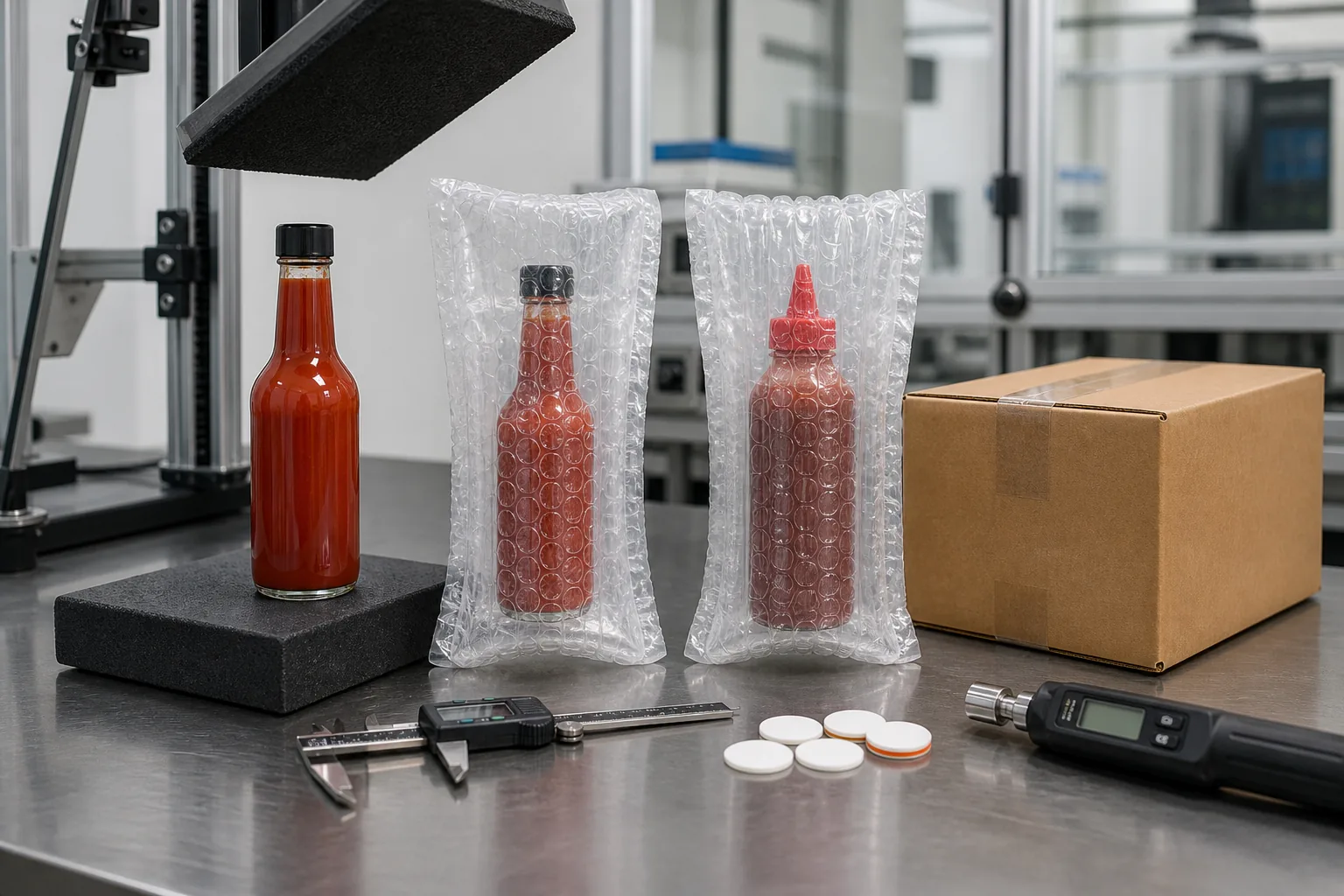
For single-bottle parcels, a fitted bubble pouch or air-column sleeve can protect both body and closure while keeping labor simple. For multi-bottle hot sauce sets, molded pulp or die-cut corrugated cells usually create better repeatability because every bottle has its own cavity. A double-wall outer box is often safer for heavy glass multipacks or gift sets that travel through long parcel networks.
Outer cartons should be selected by actual filled weight, not bottle count alone. Many parcel programs use 32 ECT or 200 lb test boxes as a starting point, then adjust board grade, flute, box dimensions and tape after testing. Water-activated reinforced tape can help maintain carton closure when liquid weight stresses the bottom seam.
| Protection Method | Protection Level | Material Cost | Packing Labor | Best Fit |
|---|---|---|---|---|
| Air-column sleeve | Very high body cushioning when correctly inflated. | Medium to high. | Fast once stocked. | Single bottles, premium glass and mixed DTC orders. |
| Molded pulp tray | High immobilization and clean presentation. | Medium. | Very fast. | Multi-bottle packs, subscription boxes and gift sets. |
| Die-cut corrugated divider | Medium to high depending on fit and board grade. | Medium. | Medium. | Bulk multipacks and cartonized bottle sets. |
| Bubble pouch | Good for light parcels when sized tightly. | Low to medium. | Fast. | Small e-commerce runs and plastic or glass single-bottle orders. |
| Loose void fill only | Low if the bottle can migrate. | Low. | Variable. | Use only as secondary void control, not as the main bottle separator. |
Gracepack Transit-Damage Review for E-Commerce Hot Sauce Programs
Gracepack supports hot sauce brands from a food-grade packaging manufacturing base with 500+ owned molds, 5,000+ standard bottle designs, 15 automatic injection molding machines, 13 automatic blow molding machines, 9 fully automatic production lines, 3 labeling machines and 5 printing machines. That matters for e-commerce because the bottle, cap, reducer, tamper-evident route and carton packing can be reviewed together before the order moves into repeat production.
For glass routes, the review usually starts with bottle weight, neck finish, reducer fit, cap liner, shrink band and divider packing. For plastic routes, the review shifts toward material selection, wall-thickness distribution, squeeze recovery, cap torque, induction-seal compatibility, carton cube and scuff protection. Available food-contact support can include PET FDA and BPA-related routes, EU food-contact routes for PET, PP, PE and silicone components, HDPE and LDPE migration support, ISO 22000 documentation and enterprise standards for food-grade plastic bottles and caps.
A strong e-commerce sample review should include filled bottles, not only empty pieces. The sample pack can compare glass and PET alternatives, cap and liner combinations, reducer or nozzle options, neck-band direction, bubble pouch fit, carton count and pallet or parcel packing before a larger order is placed.
| Review Area | What Gracepack Can Check | Why It Matters for Parcel Delivery |
|---|---|---|
| Bottle route | Glass, PET, HDPE or LDPE options by capacity, shape and sauce type. | Reduces the mismatch between premium appearance, breakage risk and freight cost. |
| Closure fit | Cap thread, liner, reducer, nozzle, induction seal and tamper evidence. | Prevents leakage that appears after vibration, inversion or temperature cycling. |
| Bottle structure | Wall distribution, rib layout, base stability and neck support. | Improves impact resistance without unnecessary material weight. |
| Packing plan | Divider, molded tray, air-column, bubble pouch, carton count and CBM. | Controls movement and reduces breakage before final freight quotes are compared. |
| Documentation path | Material and component document matching by destination market. | Keeps the bottle, cap, liner and silicone parts aligned with compliance review. |
E-Commerce Hot Sauce Packaging Evaluation Checklist
Before approving an e-commerce hot sauce bottle pack, run the decision through the actual product and delivery route. A premium glass SKU, a spicy mayo squeeze bottle and a bulk refill pouch replacement all need different risk controls.
- [ ] Confirm bottle material, filled weight, capacity, headspace and destination temperature range.
- [ ] Test the actual cap, liner, reducer, nozzle or valve with the real sauce viscosity and oil level.
- [ ] Define application torque and check removal torque after vibration and temperature cycling.
- [ ] Decide whether induction seals, shrink neck bands or tamper-evident caps are required.
- [ ] Choose air-column sleeves, molded pulp, corrugated cells or bubble pouches based on bottle count and fragility.
- [ ] Use a carton size that eliminates movement without crushing the closure.
- [ ] Run filled-pack drop testing across face, edge and corner orientations.
- [ ] Check labels, caps and bottles for scuffing after transit simulation.
- [ ] Calculate cost per delivered sellable unit, including replacements and customer-service time.
- [ ] Keep a written pack-out SOP so fulfillment teams repeat the same protection level.
FAQ About E-Commerce Hot Sauce Bottle Breakage and Transit Damage
How do you reduce hot sauce bottle breakage in e-commerce shipping?
Prevent movement first. Use a bottle material suited to the product, isolate each bottle with molded pulp, corrugated cells, air-column sleeves or tight bubble pouches, protect the cap and neck, and test the filled shipper through face, edge and corner drops.
Are PET bottles better than glass for DTC hot sauce shipping?
PET removes the shattering failure mode and can reduce freight weight, but it still needs cap, seal, wall stiffness, fill-temperature and sauce-chemistry validation. Glass may be better for premium shelf positioning when the inner pack is strong enough.
What is the best protection for glass hot sauce bottle multipacks?
Molded pulp trays or die-cut corrugated cells usually give more repeatable separation than loose void fill. The pack should prevent glass-to-glass contact, protect the neck and cap, and keep bottles fixed when the carton is shaken.
Should hot sauce brands use ISTA 3A or ASTM D5276 for parcel testing?
ISTA 3A-style parcel testing is useful for distribution simulation, while ASTM D5276 is useful for controlled free-fall drop procedures. The chosen plan should use the final filled bottle, closure, inner protection and carton.
Can a shrink neck band stop hot sauce leaks during shipping?
A shrink neck band shows first-opening evidence and can help protect the cap area visually, but it is not the primary liquid seal. Leak prevention depends on cap torque, liner compression, induction-seal compatibility, reducer fit and filled-package testing.
What should I send for an e-commerce hot sauce bottle sample review?
Send sauce type, viscosity, oil level, particles, filling temperature, bottle size, current package, shipping destination, bottle count per carton, damage symptoms, cap route, tamper-evident requirement and target order quantity.
Request an E-Commerce Hot Sauce Bottle Sample Review
If your hot sauce parcels are arriving broken, sticky, dented or scuffed, the next step is a filled-package review rather than another loose bottle quote. Gracepack can compare glass and plastic bottle routes, cap and liner combinations, reducer or nozzle options, tamper-evident systems and parcel pack-out methods against your delivery channel.
Share your current bottle, sauce viscosity, oil or particle content, closure type, carton count, destination market and the damage pattern you see most often. The practical output can include bottle and closure sample options, bubble pouch or divider direction, carton packing notes and a validation checklist before bulk production.


