
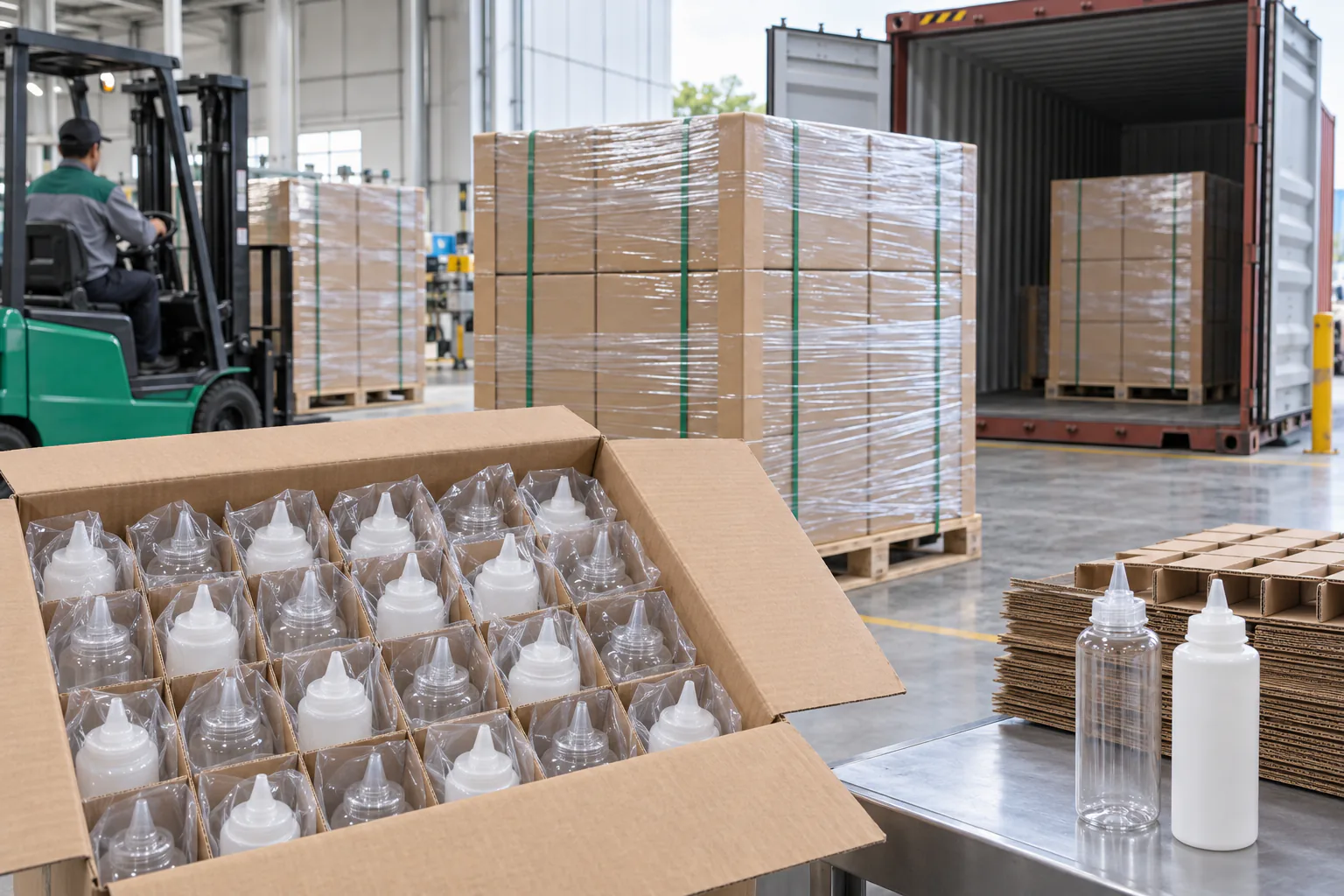
Reliable ocean freight packaging for empty sauce bottles combines a bottle-specific inner pack, compression-rated cartons, a stable pallet load and route-appropriate moisture control. The pack must stop bottle-to-bottle contact and unintended nesting while carrying weeks of static load without allowing sidewalls, neck finishes or carton columns to deform.
A good pack-out is approved as a system rather than as separate materials. Bottle geometry, resin stiffness, carton count, layer pads, pallet pattern, stretch-wrap containment, container blocking and seasonal humidity all change the result, so the final configuration should be tested at the intended stack height and inspected again after arrival.
| Transit Risk | Failure Mechanism | Primary Control | Approval Evidence |
|---|---|---|---|
| Surface scuffing | Bottle-to-bottle rubbing under vibration | Bags, cells, layer pads or controlled bulk density | Appearance check after vibration and handling |
| Neck or sidewall deformation | Long-duration compression and unintended nesting | Load-bearing carton structure and geometry-specific separation | Dimensional checks at top, middle and bottom layers |
| Carton collapse | Humidity reduces corrugated compression strength | Conditioned compression validation and moisture plan | Carton condition and stack-height record |
| Pallet shift | Insufficient containment or unblocked voids | Corner boards, top frame, stretch wrap and container blocking | Loading photos and arrival lean measurement |
| Condensation damage | Container surfaces cool below the dew point | Dry loading, desiccants, top protection and wall clearance | Humidity evidence and dry-carton arrival inspection |
Why Empty-Bottle Ocean Freight Is a Different Packaging Problem
An empty plastic bottle is light, but it is not mechanically neutral. The filled product that would normally support the sidewall is absent, so a long static stack can ovalize a clear PET body, crease a flexible HDPE or LDPE panel, or push one tapered bottle into another. Small dimensional changes can later affect label application, conveyor stability, fill height and closure alignment.
The shipment also spends far longer under load than a parcel-drop test suggests. Port dwell, vessel motion, transshipment and inland handling combine low-amplitude vibration with sustained compression. In LCL service, extra warehouse transfers and mixed freight add handling interfaces; in FCL service, fewer transfers help, but a poorly blocked load can still move inside the container during braking, pitching and rolling.
Pack design must therefore protect both appearance and function. A bottle can arrive without a crack yet still be commercially unacceptable because the label panel is rubbed, the base rocks, the neck is tilted or the squeeze wall has taken a permanent set. Arrival criteria should name these defects before the purchase order is released.
Container Moisture: Dew Point, Condensation, and Corrugated Strength
A sealed container moves through changing daytime, nighttime and ocean temperatures. When moist internal air meets steel that has cooled below its dew point, water can condense on the roof and walls. The resulting droplets, often called container rain, can wet cartons even when no seawater enters the container.
Corrugated board is especially important because its compression performance changes with moisture. A carton specification that works in a dry warehouse may lose the margin needed for a multiweek stack after prolonged humid exposure. Board grade, flute combination, paper quality, carton dimensions and seam construction should therefore be evaluated in conditioned compression tests rather than selected by thickness alone.
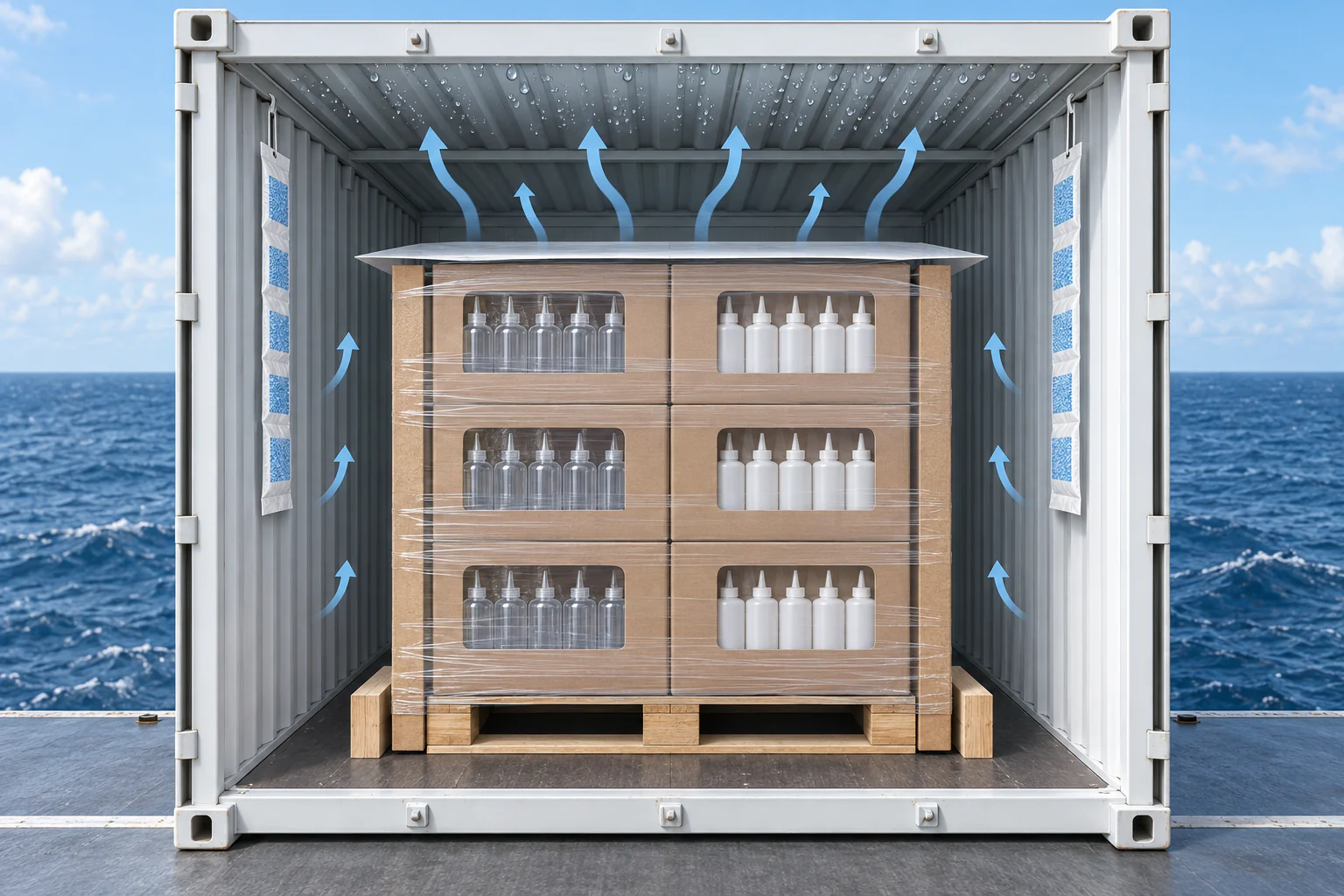
Moisture control starts before the doors close. Bottles and cartons should be dry, pallets should not introduce avoidable moisture, and loading should not take place in active rain. A top sheet can intercept roof droplets, wall clearance reduces direct wetting, and container desiccants can manage water vapor. Desiccant quantity is not a universal dose; it depends on route, season, container size, transit duration, cargo moisture and the adsorption capacity of the selected product.
Pallet Compression: From Carton Load to Bottle Buckling
The cartons at the bottom of a pallet carry the mass of every layer above them. A first estimate of vertical force is the mass above multiplied by 9.81 m/s2, but this static value is only the starting point. Corrugated creep, high humidity, pallet deck gaps, load eccentricity, forklift impacts and dynamic vessel movement require an additional safety margin.
ASTM D642 provides a recognized method for comparing the compressive resistance of shipping containers, components and unit loads. For empty bottle programs, compression work should reproduce the intended carton count, stacking pattern, pallet support and environmental conditioning. Testing one empty carton in a dry room does not represent a humid, fully stacked export load.
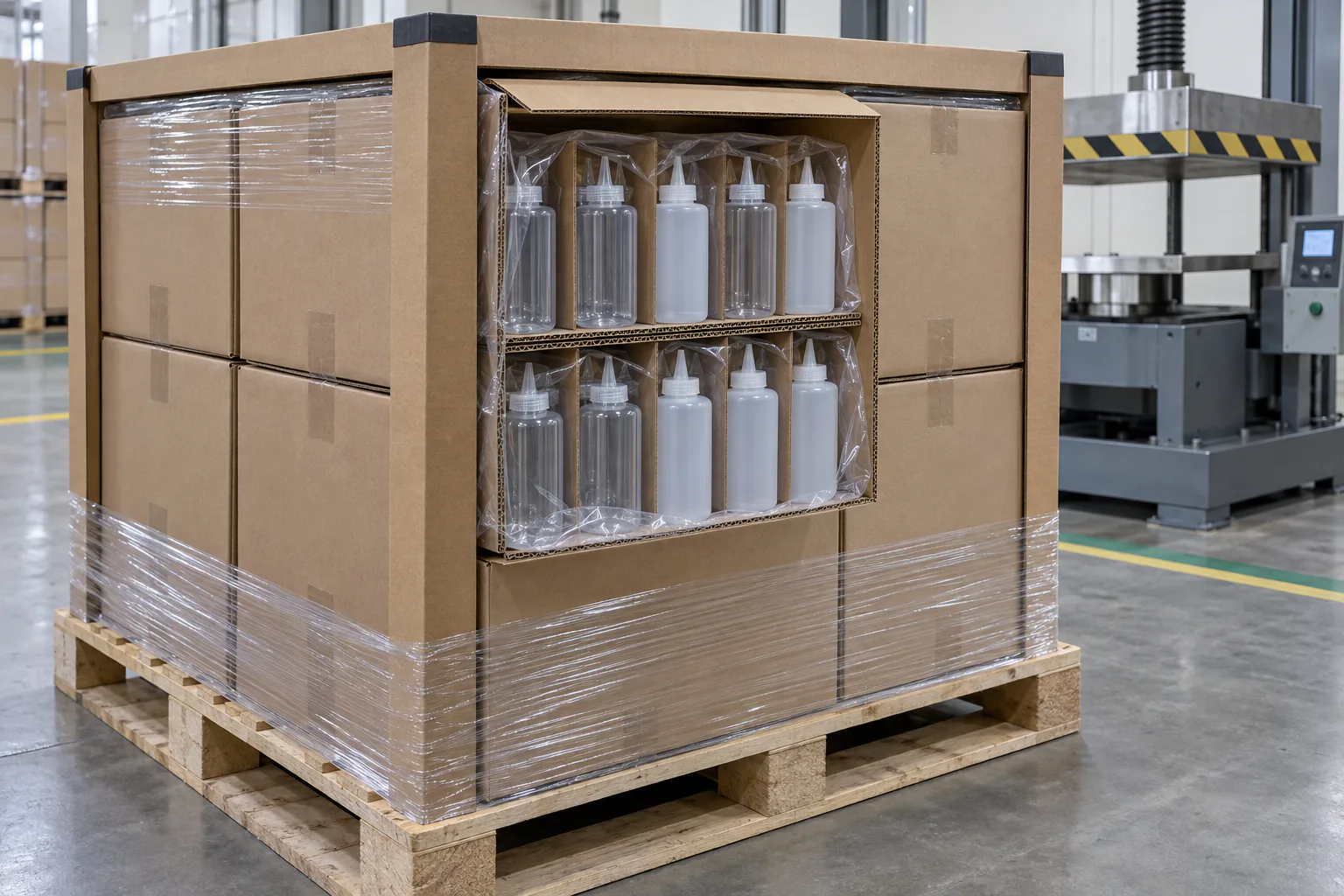
The bottle and carton must share the load deliberately. In a cell pack, vertical partitions can carry compression while preventing lateral contact. In a tray-and-layer-pad pack, the pad distributes force and keeps bottle rows aligned. In a loose bulk pack, the carton may carry most of the load, but uncontrolled bottle nesting can create local columns that transfer force into shoulders, nozzles or thin label panels.
| Compression Variable | What to Define | Typical Failure Signal |
|---|---|---|
| Stack height | Cartons per layer and total pallet layers | Bottom cartons bulge or lose height |
| Pallet support | Deck-board spacing, carton overhang and load footprint | Localized carton indentation above pallet gaps |
| Bottle orientation | Upright, inverted, nested or separated | Neck tilt, panel crease or base distortion |
| Humidity condition | Expected route and storage exposure | Board softening and progressive stack lean |
| Load duration | Port dwell, ocean transit and warehouse time | Creep damage that is absent in a short test |
Choose the Pack Format: Bulk Carton, Layer Pad, Tray, or Individual Cell
The best inner pack is the least material-intensive format that still protects the bottle's critical surfaces and dimensions. Straight-sided, opaque utility bottles may tolerate a controlled poly-bag bulk pack. Clear retail bottles with large label panels usually need stronger scuff control. Tall nozzles, decorative shoulders, thin bases and tapered bodies often require trays, partitions or shaped supports.
Packing density also affects landed cost. More separation material protects the bottle but consumes cube, adds labor and can reduce units per container. The commercial comparison should use delivered acceptable bottles per cubic meter, not only packaging cost per carton. A denser pack that creates a high reject rate is not economical, while an overengineered cell pack can spend freight on unnecessary air and board.
| Pack Format | Best Fit | Main Advantage | Main Limitation |
|---|---|---|---|
| Controlled bulk carton | Robust, simple and scuff-tolerant bottles | High packing density and fast packing | Greater contact, nesting and cosmetic risk |
| Poly-bag plus layer pads | Bottle families needing dust and moderate scuff control | Balanced cube use and row alignment | Pads may shift if carton fill is loose |
| Corrugated tray pack | Tall, tapered or orientation-sensitive bottles | Controls rows and distributes vertical load | More board, labor and carton cube |
| Individual cell partitions | Clear, decorated or easily marked bottles | Strong contact isolation and neck alignment | Lower density and higher material cost |
| Molded support | High-value shapes with fragile features | Geometry-specific restraint | Tooling, storage and recycling considerations |
Prevent Nesting, Neck Distortion, and Surface Scuffing
Nesting is useful only when the bottle was engineered for it and the extraction force is controlled. Accidental nesting can lock tapered bottles together, distort sidewalls or create stress whitening when operators pull them apart. A defined offset, separator or alternating orientation can prevent one bottle from entering the next beyond the approved depth.
Neck finishes and dispensing tips need their own protection. Caps can be fitted before shipment when they help preserve neck geometry and cleanliness, or packed separately when assembled height would reduce density or load the closure. Either route needs a sealed inner bag, traceable carton quantity and a packing method that prevents caps from abrading clear bottle walls.
Scuffing should be evaluated under the final surface condition. Clear PET, color masterbatch, matte textures, screen printing and pressure-sensitive labels do not have the same cosmetic tolerance. Sample packs should be vibrated and handled with the intended bags, partitions and layer pads, then inspected under normal retail lighting before the pack-out is approved.
Build a Stable Pallet and Container Load
Cartons should remain inside the pallet footprint with no unsupported overhang. Column stacking usually gives the cleanest vertical load path through aligned carton corners, while interlocking can improve lateral stability but may reduce compression efficiency for some carton designs. The correct pattern depends on carton proportions, board strength and the restraint supplied by corner boards, a top frame and stretch wrap.
Stretch film should provide enough containment force to hold the load without crushing upper cartons or pulling lightweight cases inward. Edge protectors spread strap or film pressure, anti-slip sheets reduce layer movement, and a rigid top frame protects the upper tier. Load photos should show the pallet footprint, corner protection, wrap anchoring, labels and final height before container loading.
Inside the container, fore-aft and lateral voids must be blocked so the cargo cannot gain momentum. Dunnage and blocking should be selected for the actual gap and load mass, not used as decoration around an already unstable pallet. Solid wood pallets, blocks and bracing used in international trade must follow ISPM 15 treatment and marking requirements where the standard applies.
Arrival-Condition Validation Plan
The approval plan should connect pre-shipment testing with receiving inspection. Record the approved bottle, cap, inner pack, carton specification, case count, pallet pattern, wrap settings and container-loading method. Without this reference, an arrival complaint cannot reliably separate bottle variation from a changed carton, higher stack or different loading practice.
At destination, sample cartons from the top, middle and bottom of the pallet and from different container zones when access allows. Check carton moisture or softening, stack lean, bottle count, dust, scuffing, nesting force, neck dimensions, total height, base stability and label-panel distortion. Functional bottles should then be trialed on the filler, capper and labeler rather than accepted by appearance alone.
Acceptance limits should be measurable. Examples include maximum carton height loss, maximum pallet lean, critical neck dimensions, bottle rocking, scuff severity and the percentage of bottles that can be denested without permanent deformation. The limits belong on the purchase specification and inspection form, not only in email discussions after damage occurs.
| Validation Stage | Evidence to Retain | Decision |
|---|---|---|
| Pack-out trial | Photos, carton drawing, case count and bottle orientation | Can the pack be repeated by production operators? |
| Conditioned compression | Load curve, dwell, humidity and failure mode | Does the pallet retain a practical stack margin? |
| Vibration or handling trial | Scuff, nesting and movement observations | Are bottle contact and restraint controlled? |
| Container loading | Pallet positions, void blocking and moisture controls | Is the load stable and dry before door closure? |
| Arrival inspection | Layer-based samples, photos and dimensional results | Did the shipped configuration preserve usable bottles? |
Gracepack Export Pack-Out Controls
Gracepack develops the export pack around the selected bottle rather than applying one carton rule to every shape. With more than 500 owned molds and over 5,000 standard bottle designs available for evaluation, we can compare bottle geometry, material, nesting risk, cap packing, case count and pallet utilization before a new pack-out is released.
For an approved route, the working specification can include bottle and cap references, inner-bag direction, partitions or layer pads, carton dimensions, gross weight, pallet pattern, total pallet height, loading photos and retained samples. This gives production, quality control, freight partners and the receiving warehouse the same physical reference.
The useful factory trial is the one that reflects the actual order. Clear PET appearance, flexible-wall recovery, neck-finish protection and cap separation are checked against the planned carton and stack, then the arrival feedback is used to adjust the next shipment when necessary.
Ocean Freight Packaging Audit Checklist
Before approving a bulk shipment of empty sauce bottles, confirm that the commercial quote and packing specification describe the same physical load.
- Define bottle resin, weight, dimensions, neck finish, surface standard and permitted nesting depth.
- Approve the inner bag, layer pad, tray or cell-partition arrangement with the real bottle geometry.
- Record carton construction, case count, dimensions, gross weight and closure method.
- Validate compression at the intended stack height and representative humidity condition.
- Keep every carton within the pallet footprint and document the pallet pattern.
- Set corner-board, top-frame, stretch-wrap and anti-slip requirements without crushing the load.
- Choose moisture controls from the route, season, dwell time and cargo moisture rather than a generic dose.
- Specify container void blocking, pallet restraint and compliant wood packaging where used.
- Inspect arrival samples across pallet layers for scuffing, nesting, distortion and neck variation.
- Retain approved bottle, cap, carton and pack-out references for repeat orders.
FAQ About Ocean Freight Packaging for Empty Sauce Bottles
What is the best packaging for empty plastic sauce bottles?
The best format is the lowest-cube pack that prevents unacceptable contact, nesting and deformation for the specific bottle. Robust utility bottles may use controlled bulk cartons, while clear, tapered or decorative bottles often need layer pads, trays or individual cells.
Do empty PET sauce bottles always need individual partitions?
No. Partition need depends on wall stiffness, bottle shape, surface standard, packing density, route and stack. A vibration and conditioned compression trial can determine whether bags and layer pads are sufficient or individual cells are justified.
How can container rain be reduced?
Load dry cartons and pallets, protect the pallet top from roof droplets, maintain appropriate wall clearance and size desiccants for the route, season, duration and cargo moisture. Moisture-sensitive corrugated should be validated after environmental conditioning.
Is a double-wall carton automatically strong enough for ocean freight?
No. Wall construction alone does not establish stacking performance. Carton dimensions, paper grade, flute, seams, humidity, pallet support and load duration all affect compression resistance.
What should be checked when empty bottles arrive?
Inspect cartons and pallets first, then sample bottles from different layers for scuffing, dust, nesting, neck dimensions, bottle height, base stability and panel distortion. Run representative bottles through filling, capping and labeling equipment before releasing the shipment.
Request an Ocean Freight Pack-Out Review
Send the bottle drawing or sample, material, unit weight, surface requirement, cap-packing route, order quantity, destination port and planned FCL or LCL method. Include any current scuffing, nesting, carton collapse, pallet lean or moisture problem.
Gracepack can review the bottle, inner pack, carton count, pallet pattern and arrival checks as one export system, then prepare a sample pack-out for approval before bulk production.


