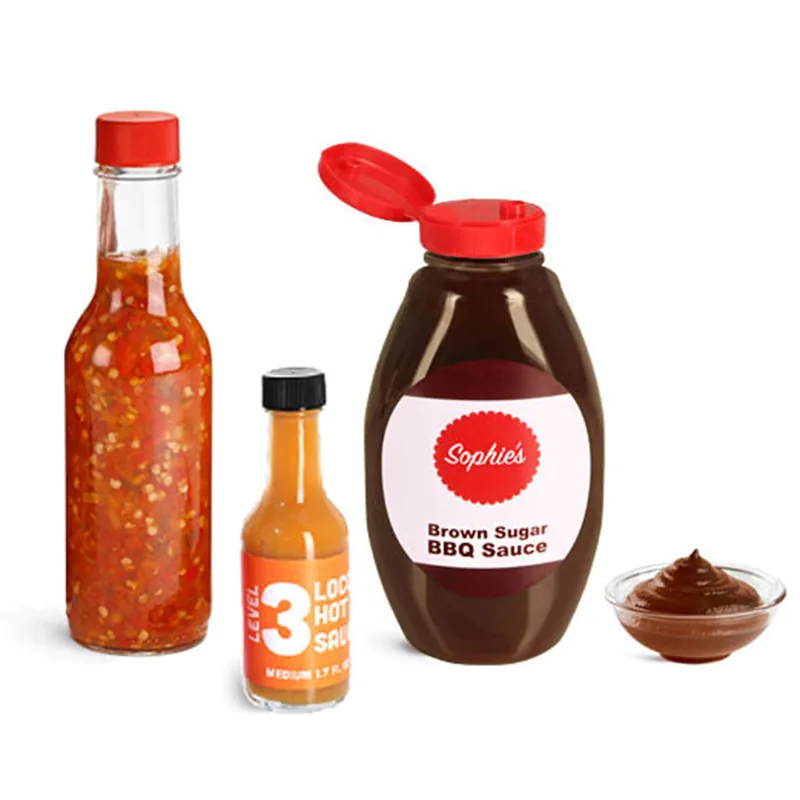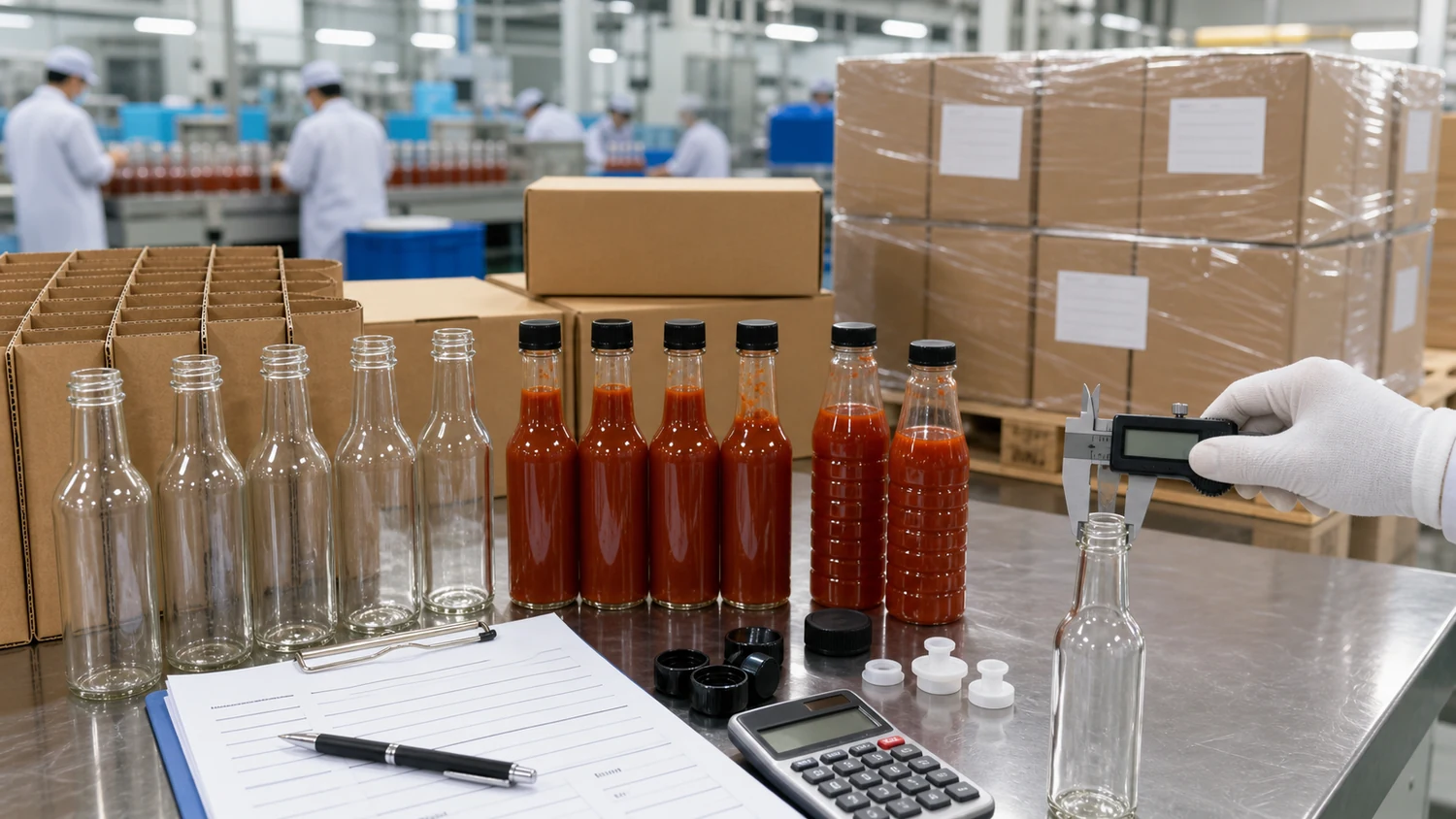
To source hot sauce bottles from China, compare the full package scope first: bottle body, cap, orifice reducer, liner or tamper-evident route, MOQ, carton packing, Incoterm, freight, duty, customs cost and warehouse receiving. A low EXW or FOB price can become expensive if caps are quoted separately, carton cube is poor, glass breakage is underplanned or the order misses the filling schedule.
For standard 5 oz (about 148 ml) hot sauce woozy bottles, many projects begin around 5,000 pieces for stock bottle routes, while custom colors, special printing, matched cap colors or new tooling usually need higher planning quantities. The practical decision is landed cost per usable bottle, not the lowest line item on a quote.
| Sourcing Variable | Typical Planning Range | How It Affects Your Order | How to Keep the Cost Clear |
|---|---|---|---|
| Stock hot sauce bottle MOQ | Often around 5,000 pcs for many standard routes; trial availability depends on mold, material and stock. | Lower tooling risk and faster sample approval. | Use one agreed spec for bottle size, material, neck finish, cap route and carton quantity. |
| Custom color or printing | Often planned from 10,000 pcs or higher depending on color, decoration and setup. | Adds setup cost, approval time and reorder discipline. | Keep Pantone target, cap color, label route, print method and sample approval in the same quote. |
| Custom mold or tooling | Simple bottle tooling may start near USD 1,300; cap or multi-cavity closure tooling can be several thousand USD depending on design. | Tooling changes cash timing and break-even volume. | Define the 3D drawing, capacity, weight target, neck finish, cap fit and mold ownership early. |
| EXW vs FOB quote | EXW excludes China-side delivery and export handling; FOB includes delivery to named China port under agreed scope. | Changes which logistics costs sit inside the factory quote and which move to your freight side. | Use a named port, carton dimensions, gross weight, CBM, pallet method and export document scope. |
| Duties and tariffs | Project dependent by HS code, material, country of origin, destination and current trade rules. | Can materially change landed inventory value. | Use broker-confirmed classification and current duty assumptions before the purchase order. |
| Production and shipping lead time | Standard routes can move faster; custom color, printing, tooling and ocean freight add calendar risk. | Late bottles can stop filling or force emergency local buying. | Put sample date, production slot, inspection timing, sailing schedule and receiving date into the timeline. |
How MOQ Works for China Hot Sauce Bottle Orders
MOQ is not a single number because the bottle body, cap, reducer, liner, color and decoration can each have a different production threshold. A factory may be able to run a standard bottle body at one quantity, while a custom cap color, printed carton, shrink sleeve or new reducer insert pushes the practical project MOQ higher.
For early hot sauce brands, the safest path is often to validate with a standard bottle family first. Hot Sauce Bottles in common 5 oz, 8 oz, 10 oz, 12 oz, 16 oz and 32 oz routes let the formula, cap flow, label fit and carton plan be tested before a private mold is funded. Once annual demand is repeatable, tooling and custom decoration become easier to justify.
For co-packers and distributors, MOQ works best when it matches line usage and reorder timing. A 5,000-piece trial may prove the bottle, but it may not protect a busy production schedule. A 50,000-piece order can lower factory handling cost, but it can also create cash and storage pressure if the SKU is not moving.
| Bottle Program | MOQ Pattern | Main Cost Driver | Good Starting Route |
|---|---|---|---|
| Stock 5 oz woozy hot sauce bottle | Useful for launch, validation and repeat retail SKUs. | Cap set, reducer, carton, divider and freight often matter as much as bottle price. | A 24 mm neck finish with matched cap liner and reducer is usually the first sample route. |
| PET or HDPE squeeze hot sauce bottle | Useful for foodservice, delivery, thicker sauces and lower breakage risk. | Material weight, cap flow and carton cube drive cost. | Filled samples show squeeze recovery, cap torque, leakage and label panel stability. |
| Custom cap color or tamper evidence | Usually needs a higher planning quantity than plain black or white stock caps. | Color setup, cap MOQ and rejected color batches can add cost. | Final bottle color, sauce color and cap color need to be viewed together. |
| Custom bottle mold | Best after demand, label system and filling route are stable. | Tooling, sample loops, mold modification and amortization change the model. | Break-even depends on annual volume, stock bottle margin and the value of the proprietary shape. |
| Bulk hot sauce bottles | Useful for back-of-house, refills, foodservice and distributor packs. | Container cube, pallet height and cap protection dominate landed cost. | Carton count and warehouse receiving cost often decide the better pack size. |
Pricing: EXW, FOB and What a Complete Hot Sauce Bottle Quote Includes
When you compare hot sauce bottle pricing from China, the number that matters is the finished package ready to ship, not a loose bottle body price. A clear quote puts the bottle material, capacity, neck finish, cap style, reducer or liner, carton packing, gross weight, CBM, trade term, sample cost, mold cost if any and production lead time in one place.
EXW can work when your team already controls China-side pickup and export handling. FOB is usually easier for international comparison because the factory prepares the goods to the named China port, and your freight team can price ocean shipping separately. CIF, DAP and DDP can reduce handoffs, but the quote still needs to show what logistics work is included and where risk transfers.
Glass hot sauce bottles may look inexpensive at the factory gate, then become heavier in the landed-cost model because of dividers, breakage protection and freight weight. Plastic hot sauce bottles may cost differently at the unit level, but they can reduce breakage, carton weight and e-commerce damage. For a commercial program, compare the cost per usable bottle after packing, freight, receiving and filling-line performance.
| Part of the Quote | Details Included | Why It Changes the Real Cost |
|---|---|---|
| Bottle body | Material, capacity, weight range, neck finish and sample reference. | Small changes in weight, neck finish or wall thickness can affect freight, cap fit and line performance. |
| Cap and reducer | Cap material, liner, reducer bore, color, packing method and MOQ. | Caps quoted separately can change both price and production timing. |
| Decoration | Label, sleeve, direct printing, cap color or carton printing scope. | Artwork setup and color approval can add MOQ, sample time and reorder complexity. |
| Carton packing | Pieces per carton, divider use, gross weight, CBM and pallet option. | Carton cube often changes freight cost more than the bottle price suggests. |
| Trade term | EXW, FOB, CIF, DAP or DDP with a named port or destination. | The handoff point decides which side pays export, freight and local delivery costs. |
| Payment and inspection | Deposit, balance timing, QC photos, packing photos and document sequence. | Clear checkpoints reduce payment uncertainty and help finance release the order on time. |
Landed Cost Formula for Hot Sauce Bottles
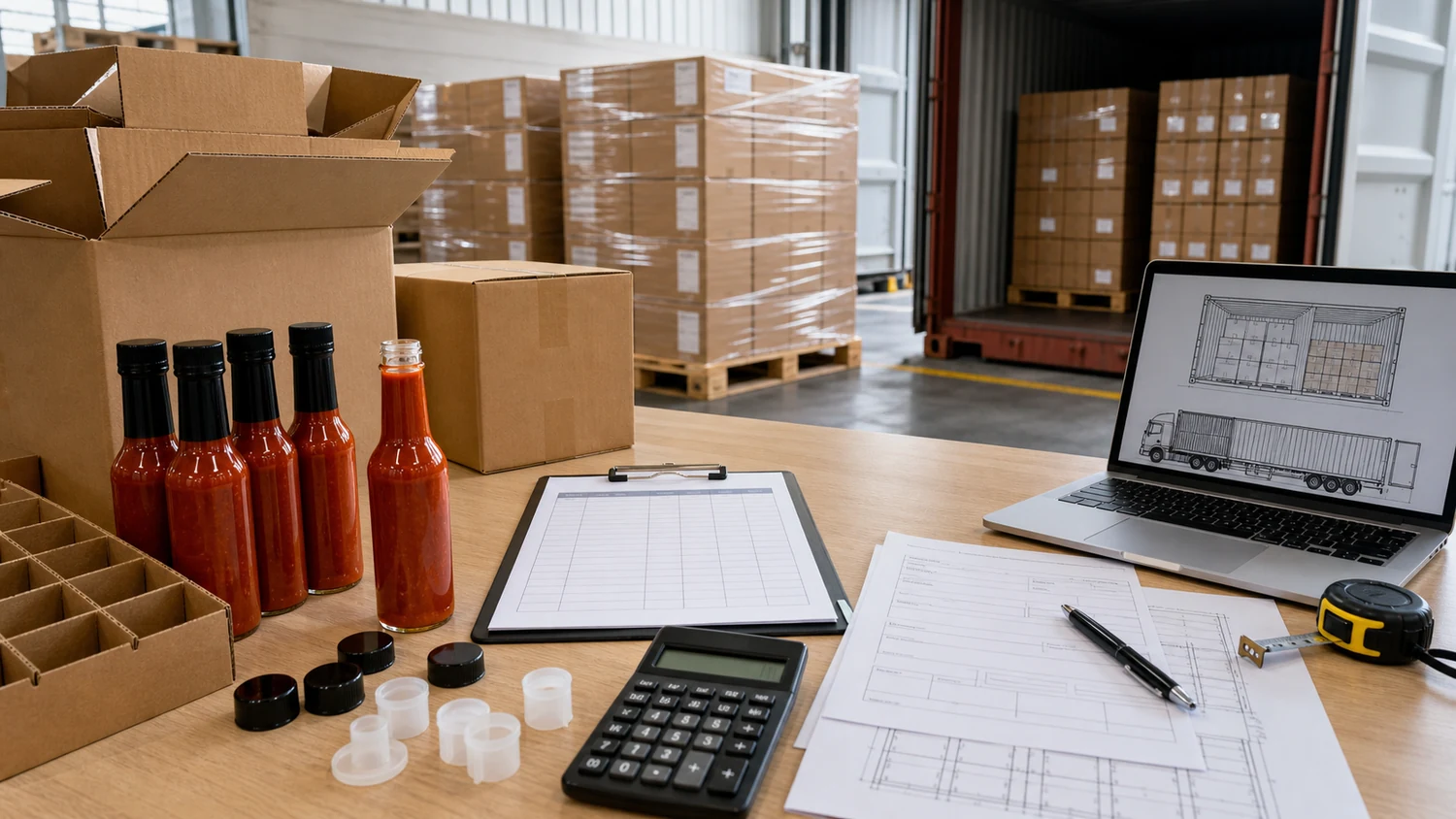
Landed cost becomes useful before the order is placed because several major cost layers are invisible in a simple unit quote. The working model is: landed cost per usable bottle = factory package cost + inland/export cost + freight + insurance + duty/tax + customs/brokerage + destination delivery + warehouse handling + expected loss or rework.
For hot sauce bottles, the expected loss factor matters. Glass can need dividers, stronger cartons and a breakage allowance. Plastic can need cap protection and deformation checks. If the bottle arrives scuffed, warped, leaking or mismatched to the capper, the cheaper quoted unit becomes a higher-cost usable bottle.
A simplified 10,000-piece landed-cost model separates the bottle price from cap set, export carton, freight and customs assumptions. A 5 oz bottle quoted at USD 0.15 EXW is not a USD 0.15 delivered bottle. Once caps, reducers, cartons, freight, duties, brokerage and local delivery are added, the delivered cost can move sharply depending on destination and shipment size.
| Cost Layer | Example Scope | What Changes the Number | How to Keep It Predictable |
|---|---|---|---|
| Factory package cost | Bottle, cap, reducer, liner, carton and decoration. | Material, gram weight, cap style, mold, color and MOQ. | The quote covers the complete pack, not only the bottle body. |
| China-side logistics | Factory pickup, local drayage, export handling and port charges. | EXW vs FOB, carton volume and named port. | FOB Ningbo or another named port keeps international comparisons cleaner. |
| Ocean or air freight | Main international transport. | CBM, gross weight, route, season, LCL vs FCL and pallet use. | Carton dimensions and loading estimates make freight pricing more reliable. |
| Duties and tariffs | Customs duty, trade remedies and taxes at destination. | HS code, material, country of origin and current local rules. | Broker-confirmed classification keeps the duty model realistic. |
| Destination costs | Brokerage, port handling, drayage, warehouse receiving and storage. | Container release timing, local trucking and inventory volume. | Warehouse date and reorder point protect the filling schedule. |
| Quality loss allowance | Breakage, cap mismatch, scuffing, deformation, rework or rejects. | Packing method, QC discipline and transit route. | Approved samples, QC photos and retention samples keep quality assumptions visible. |
Glass vs PET vs HDPE in China Sourcing
Glass remains strong for premium hot sauce, high-acid vinegar formulas and classic 5 oz woozy shelf identity. It gives excellent flavor neutrality and heat stability, but freight and breakage protection must be priced honestly. If a quote does not show carton divider logic, pallet method and gross weight, the landed-cost model is incomplete.
PET hot sauce bottles are useful when the brand wants product visibility with lower weight than glass. PET can reduce breakage risk and improve e-commerce handling, but the filling temperature, neck finish, label panel and cap torque need approval with the actual sauce. Standard PET is not a universal hot-fill solution.
HDPE and flexible polyolefin routes are practical for squeeze formats, foodservice packs, thick chili sauces and bulk applications. They are less transparent than PET or glass, but they can improve drop resistance and handling. For thick or pulpy sauces, cap bore and reducer choice can be more important than bottle material alone.
| Bottle Route | Best Fit | Main Sourcing Advantage | Cost Detail to Price Honestly |
|---|---|---|---|
| Glass woozy bottle | Premium retail hot sauce, vinegar-based formulas and classic table use. | Familiar shelf format and strong flavor protection. | Weight, breakage allowance, dividers and tariff classification. |
| PET hot sauce bottle | Clear retail bottles where visibility and lower weight matter. | Lighter than glass and more drop resistant. | Heat deformation, neck ovality, cap torque and food-contact scope. |
| HDPE squeeze bottle | Foodservice, outdoor, refill and thick sauce formats. | Impact resistance and squeeze usability. | Opacity, label presentation, squeeze recovery and carton cube. |
| Bulk condiment bottle | Back-of-house, distributors, refill programs and co-packers. | Lower packaging cost per ml and fewer replenishment touches. | Pallet height, cap seal, filling access and warehouse handling. |
Custom Tooling, Color and Decoration Costs
Custom tooling makes sense when the bottle shape, capacity, grip, neck finish or dispensing function creates value that a stock bottle cannot deliver. A simple bottle mold may start near USD 1,300, while cap tooling or multi-cavity closure molds can move into several thousand dollars depending on cavity count, hinge or tamper feature, resin and finish requirement.
The tooling cost is recovered through repeat volume and package performance. If a custom bottle saves USD 0.02 per unit but the tooling and sample work cost USD 5,000, the project needs enough repeat volume to recover that cost. If the bottle creates a proprietary shelf shape, improves filling stability or prevents leakage, the value may be larger than unit saving alone.
Decoration also changes cost early in the project. Custom cap color may need a higher MOQ than plain stock caps. Shrink sleeves add artwork approval, sleeve fit and heat exposure testing. Direct printing can look clean but may add setup cost and be less flexible for flavor changes. Labels are usually the easiest route for fast launch, but curved bottle surfaces and chilled storage can affect adhesion.
| Customization | When It Helps | Cost Driver | Approval Route |
|---|---|---|---|
| Custom bottle mold | Stable annual volume, owned bottle shape or special filling/dispensing requirement. | Mold complexity, cavity count, sample loops and modification time. | CAD, 3D/SLA sample, filled test and cap fit approval. |
| Custom cap or reducer | Unique flow control, cap color, tamper evidence or brand system. | Tooling, resin, color, liner and assembly complexity. | Torque, leakage, reducer clearance and consumer opening test. |
| Bottle color | UV control, brand identity, PCR tint control or product positioning. | Color matching, masterbatch MOQ and batch control. | Filled appearance under retail light and cap color review. |
| Printing or sleeve | Shelf-blocking and multi-flavor branding. | Artwork setup, print registration, sleeve shrink and scrap allowance. | Barcode, label panel, scuff test and carton abrasion review. |
Factory Capability and Food-Contact Documents

A reliable China hot sauce bottle program depends on manufacturing control, not photos alone. The factory conversation needs to cover bottle material, cap material, neck finish, reducer fit, liner route, sample approval, carton packing, retention sample practice and food-contact document scope. If the cap and liner are not defined, the quote is not yet a finished package quote.
Food-contact documentation works by actual material and component set. A PET bottle report does not cover a PP cap, PE liner, silicone valve or separate reducer. Hot sauce adds acid, salt, pigment and sometimes oil, so the component list needs to be clear before the document path is selected.
Gracepack supports hot sauce bottle programs from a food-grade packaging manufacturing base with 500+ owned molds, 5,000+ standard bottle designs, 15 automatic injection molding machines, 13 automatic blow molding machines, 9 fully automatic production lines, 3 labeling machines and 5 printing machines. Available support includes PET FDA and BPA-related routes, EU food-contact routes for PET/PP/PE/silicone components, HDPE and LDPE migration support, ISO 22000 documentation and enterprise standards for food-grade plastic bottles and caps.
| Factory Capability | What It Means for Your Order | Why It Matters |
|---|---|---|
| Manufacturing scope | Bottle, cap, closure matching, labeling and export packing can be coordinated. | Reduces handoff errors between separate suppliers. |
| Mold resources | Standard molds are available before new tooling is proposed. | Protects launch cost and shortens sample validation. |
| Food-contact document matching | Documents are tied to PET, HDPE, PP, PE, silicone or glass component routes. | Prevents generic food-grade claims from replacing component review. |
| QC before shipment | Bottle dimensions, cap fit, packing photos and batch records are available. | Reduces receiving surprises and payment risk. |
| Export support | Carton count, CBM, Incoterm, invoice and packing list are consistent. | Helps customs, finance and warehouse teams work from one set of assumptions. |
Lead Time and Payment Planning
A realistic China sourcing calendar has four clocks: sample approval, production, international freight and destination release. Standard bottles can move faster when the mold, cap and carton are already defined. Custom color, printing, new tooling or unusual caps add sample and approval time before production even begins.
Payment planning works best when it matches the project risk. Many factory-direct orders use deposit before production and balance before shipment. Larger first-cooperation projects may discuss LC routes when both sides can handle bank documents carefully. The purpose is not to make payment complicated; it is to connect money release to sample approval, production proof, QC photos and shipment documents.
For hot sauce brands, the most expensive delay is often not ocean freight. It is an unfinished specification: cap not approved, reducer too tight, label size wrong, carton count missing or food-contact documents requested after goods are finished. A clean RFQ removes those late surprises.
| Timeline Stage | What It Covers | How to Keep the Schedule Stable |
|---|---|---|
| Sample stage | Bottle, cap, reducer, label, color, filled test and document route. | Physical samples come before deposit or production slot. |
| Production stage | Material ordering, molding, decoration, QC and packing. | A fixed PI scope and production photos keep the balance-payment stage clear. |
| Freight stage | China pickup, export, sailing, arrival and port handling. | Early booking and LCL/FCL comparison reduce late freight surprises. |
| Receiving stage | Customs, drayage, warehouse receiving and release to filling line. | Reorder timing works better when it uses actual transit and consumption data. |
Details That Make a China Hot Sauce Bottle Quote Accurate
An accurate quote starts with the package you actually plan to use. Bottle, cap, packing and document requirements need to be priced together so the comparison reflects delivered usability rather than one attractive unit number.
When demand is still uncertain, a stock-mold sample path usually keeps the first order lighter. When annual volume is stable, Gracepack can compare stock bottle, custom color, decoration and tooling routes side by side. The goal is not the cheapest container; it is a bottle system that protects cost, filling performance and reorder timing.
- Bottle size: 5 oz, 8 oz, 10 oz, 12 oz, 16 oz, 32 oz or custom volume.
- Material route: glass, PET, HDPE, LDPE, PP or another specified structure.
- Neck finish and cap: 24-414, 28-400, reducer, screw cap, flip-top, nozzle or tamper-evident route.
- Sauce details: viscosity, particle size, acidity, oil content, filling temperature and storage orientation.
- Decoration: label, sleeve, direct printing, cap color or carton printing.
- Order plan: first order quantity, annual forecast, reorder frequency and launch date.
- Trade term: EXW, FOB, CIF, DAP, DDP or preferred freight forwarder route.
- Destination: country, port, warehouse location and customs broker contact if available.
- Documents: food-contact reports, ISO support, invoice, packing list, QC photos and any retailer file request.
FAQ About Sourcing Hot Sauce Bottles from China
What is the MOQ for hot sauce bottles from China?
Many standard hot sauce bottle routes begin around 5,000 pcs, but the practical MOQ depends on bottle material, mold availability, cap route, reducer, liner, color, decoration and packing method. Custom colors, printing and new tooling usually require higher planning quantities.
How much does a 5 oz hot sauce bottle from China cost?
A standard 5 oz bottle can be quoted in broad project-dependent ranges, but the number is only useful after cap, reducer, carton, Incoterm, freight, duty and receiving cost are included. Treat any unit price without packing and cap scope as incomplete.
Should I choose glass or plastic hot sauce bottles for importing?
Glass fits premium retail and high-acid classic hot sauce positioning, while PET and HDPE can reduce weight, breakage and handling risk. The right choice depends on filling temperature, sauce chemistry, cap flow, label design, shipping route and landed cost.
Is FOB better than EXW for hot sauce bottle sourcing?
FOB is often easier for international comparison because it includes delivery to the named China port under agreed scope. EXW can work well when your logistics team already handles China-side pickup and export work.
What documents are useful before ordering hot sauce bottles?
A complete order file usually includes component-matched food-contact support for the bottle, cap, liner, reducer or valve, plus ISO 22000 support if relevant, commercial invoice, packing list, carton specifications, QC photos and shipment records.
How can Gracepack help with a China hot sauce bottle project?
Gracepack can compare standard molds, bottle materials, cap and reducer routes, carton loading, sample testing, food-contact document scope, Incoterm assumptions and landed-cost details before mass production.
Get a Hot Sauce Bottle Sample and Cost Review
If you are comparing hot sauce bottle options from China, send the target bottle size, material, cap route, sauce viscosity, filling temperature, first order quantity, annual forecast, destination market, preferred Incoterm and any custom color or decoration target. Gracepack can return a practical sample and quotation path instead of a loose unit-price answer.
For established programs, include your current bottle photos, carton count, landed-cost problem, defect history and reorder schedule. Gracepack can review whether a stock hot sauce bottle, glass woozy bottle, PET or HDPE squeeze route, bulk bottle or custom tooling path gives the best technical and financial fit.