
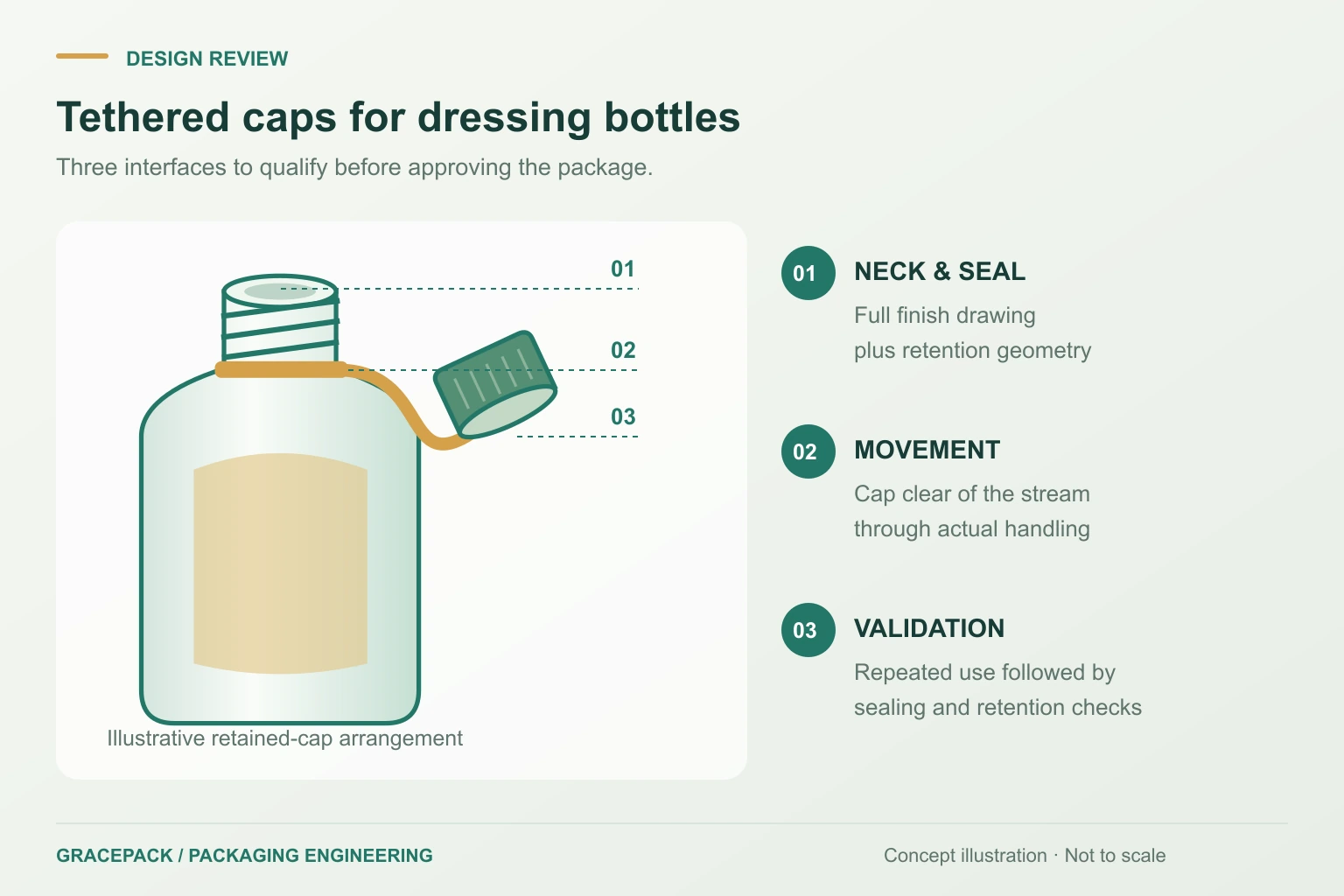
Tethered caps for salad dressing bottles need a matched neck and retention interface, enough clearance for the actual pour or squeeze motion, and validation after repeated opening and resealing. A shared “38 mm” size or a successful beverage application does not establish compatibility with a dressing bottle.
| Decision | What to check | Evidence needed before approval |
|---|---|---|
| Neck compatibility | Threads, seal, retaining feature and shoulder clearance | Revision-controlled bottle and closure drawings plus assembled samples |
| Opening clearance | Cap position throughout dispensing and wiping | Trials with the actual dressing, grip and bottle orientation |
| Repeated use | Tether, retaining band and resealed closure | Documented use-cycle sequence followed by retention and leak checks |
| Line compatibility | Feeding, capping, sealing and inspection | Pilot run with recorded settings, rejects and representative samples |
Define the Attachment Before Choosing the Bottle
A tethered screw cap normally moves away from the mouth after unthreading while an attachment keeps it connected to the package. A hinged dispensing lid opens on a cap base instead. Both can keep a lid nearby, but their retention paths, opening motions and sealing interfaces differ; a familiar flip-top appearance alone does not establish compliance with a particular attachment requirement.
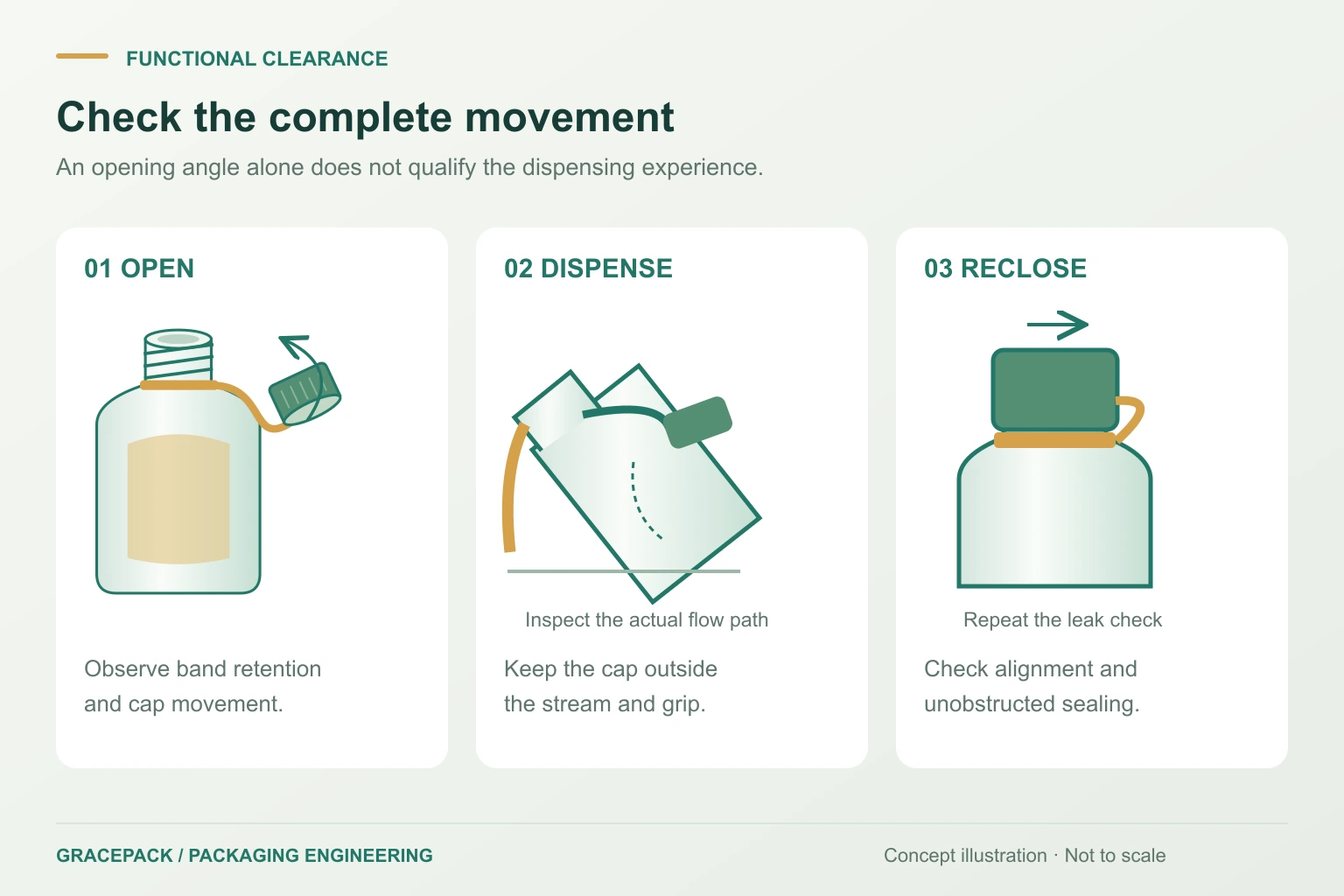
For dressing, map the entire sequence: first opening, removal of any membrane, shaking if instructed, dispensing, wiping, reclosing and storage. Check whether the user must hold the cap aside or whether it stays clear by itself. A design that works for a smooth liquid may behave differently with a refrigerated emulsion, herb pieces or an oily film on the grip surface.
Keep the legal scope separate from the design brief. Article 6 of the EU Single-Use Plastics Directive addresses attached plastic caps and lids on the beverage containers specified in Annex Part C, with capacities up to three liters (about 101 US fl oz). It does not automatically make ordinary salad dressing bottles subject to that beverage requirement. For a dressing project, establish the applicable market requirements and the brand’s voluntary attachment objective before defining a compliance claim.
Neck-Finish Compatibility: More Than a Nominal Diameter
Ask for the complete finish designation and both suppliers’ controlled drawings. A 38-400 finish, a 38-410 finish and a 38 mm beverage finish are not interchangeable simply because their nominal diameters match. Thread starts, pitch, profile, sealing geometry and retention features can differ. Confirm the specified tolerances and their combined effect at the limits, rather than approving one hand-tightened sample.
For clear salad dressing bottles, examine the finish together with the intended cap, liner or plug seal. T and E describe the outside thread and neck diameters; their difference helps describe radial thread geometry, but it does not establish sealing compression. I is the bore diameter and matters for filling-tube clearance and any internal sealing or dispensing component.
S locates the first thread relative to the top of the finish. It does not by itself guarantee the final direction of the hinge. Thread start position, lead, cap geometry, sealing travel and applied torque all affect the assembled orientation. H describes finish height; separately dimension the retaining bead, band engagement and clearance to the shoulder. A bottle’s handling support ring is not automatically the feature that retains a tethered closure.
| Interface | Drawing review | Assembled check |
|---|---|---|
| Thread and seal | Finish code, starts, pitch, T/E/I, sealing land and tolerances | Full engagement without cross-threading; seal contact at the agreed setting |
| Retention | Specified bead or other retaining feature, undercut and band geometry | Band remains captured through opening and the selected load directions |
| Movement envelope | Strap length, hinge position, shoulder and lid sweep | No binding, snagging or interference during opening and reclosure |
| Orientation | Thread relationship and any controlled indexing feature | Cap stays in a usable position across actual assembly variation |
Opening Clearance: Follow the Product Stream
For vinaigrette pour bottles, assess where the stream travels as the bottle tilts and the fill level falls. For a squeeze format, include hand compression, flow start and stop, bottle rebound and any required air return. The important clearance is between the moving cap, the product stream and the user’s hand—not a single opening angle measured on an empty upright bottle.
A positive hold-open feature can help, but neither a 180-degree opening nor an audible click is a universal requirement. A flexible strap may move the cap well aside without a fixed stop; a hinged design may hold a repeatable position but still place its rim in the pour path. Evaluate both with the intended recipe and normal handling, including a user rotating the bottle to read the label.
Film the trial from the side and above. Note contact between dressing and the cap interior, rebound into the stream, obstruction of a wiping motion and difficulty guiding the cap back onto the thread. Include full, partly used and near-empty bottles, the labeled serving temperature and realistic left- and right-handed grips. Set acceptable dispensing and cleanliness criteria before comparing candidates.
Diagnose Tether Failures Separately From Seal Failures
A stronger strap cannot compensate for a band that rides over its retaining feature. Likewise, a cap that remains attached can still leak if the strap pulls it sideways during reclosure or trapped product prevents the seal from seating. Record the failure location and the use stage so the corrective action addresses the cause.
Look for whitening, cracks or permanent deformation at hinge roots and cut transitions. Repeated bending concentrates strain in these areas; molding variation, slit quality and local section thickness can change the result. Keep destructive retention tests on dedicated samples so a damaged tether does not contaminate the interpretation of a normal-use leak trial.
| Observed problem | Possible mechanism | Next check |
|---|---|---|
| Band lifts off the neck | Insufficient capture or an unfavorable tolerance combination | Retaining geometry and band deformation under defined load directions |
| Lid swings into the dressing | Unstable hold-open position or excessive free movement | Cap trajectory under tilt, squeeze and hand rotation |
| Hinge cracks after use | Repeated local strain, a notch or inconsistent molding/slitting | Failure location, cavity or lot pattern, and conditioned repeat-cycle samples |
| Closure leaks after reclosing | Misalignment, strap interference, contamination or poor seal seating | Compare used assemblies with clean controls and inspect the seal contact |
| Feeder jams or band damage | New outside geometry catches guides or capping tooling | Damage before and after each handling station at planned line settings |
Choose the Attachment Route Around the Dispensing Task
A guided hinge or parallel tether arrangement can constrain sideways movement; that control must be balanced against opening force and the room needed beside the bottle. A longer flexible connection can offer more freedom, but the loose cap may contact the hand or package. Prototype the motion before committing to a bottle shoulder, cap color or decorative finish.
For salad dressing squeeze bottles, evaluate the tether together with the selected dispensing opening or valve. The attachment should not obstruct the outlet or air-return path, and the closed package must suit its intended storage position. A result from an upright pour bottle does not qualify an inverted squeeze package.
Ask the closure supplier how the attachment is formed. A molded bridge and a post-molding slit route can require different tooling and process controls. Agree who controls slit position or bridge geometry, how damaged connections are detected, and which changes trigger revalidation. Confirm feasibility on the exact finish before describing a design as a drop-in replacement.
Requalify the Line When the Closure Geometry Changes
Assess the cap bowl or sorter, chute, transfer point, capping head and downstream inspection. A tethered design can change the outside envelope or the stiffness of a band even when the thread remains familiar. Establish where the tooling contacts the cap and whether it loads a delicate attachment area.
Run the proposed bottle and closure on the intended equipment at documented trial settings, including startup and restart conditions. Inspect samples before and after capping to separate incoming damage from line-induced damage. Record cap orientation, seating, removal torque, band condition and rejects across the run. If an induction seal is used, include membrane sealing and first-opening access in the trial.
The existing guide to validating salad dressing bottle closures covers the broader thread, torque and seal checks. Add the tether-specific controls here to that baseline rather than replacing the package’s existing release requirements.
Build a Validation Sequence That Represents Repeated Use
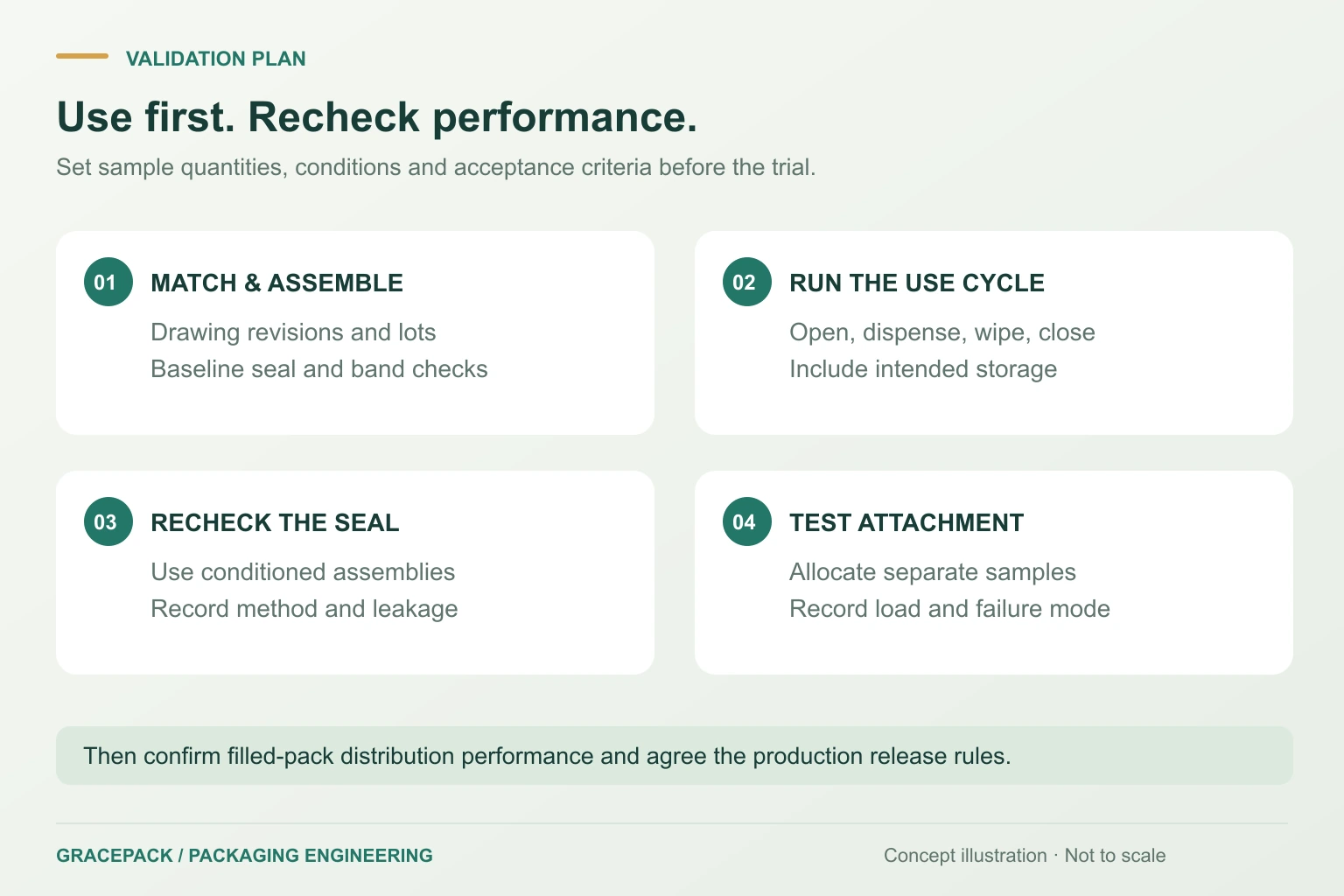
Agree a written protocol with the bottle supplier, closure supplier and co-packer before testing. Use traceable bottle and cap lots, document conditioning and application settings, and select sample quantities according to project risk and the required confidence. Include representative production variation rather than relying entirely on development samples.
BS EN 17665:2022+A1:2023 addresses attachment strength, reliability and safety for specified single-use beverage containers; its stated scope does not cover the complete closure system. Where that standard is relevant, obtain the full method and confirm applicability. A pull-force value or a cycle count copied from a beverage product page is not a complete acceptance specification for a multi-use dressing bottle.
For the dressing protocol, define the expected number of uses and the opening, dispensing, wiping and closing actions in each cycle. Include the intended storage intervals and temperatures, then repeat sealing checks after use. Product exposure must reflect the actual recipe and material grade: a generic elevated-temperature soak can introduce a different failure mechanism and cannot automatically predict shelf life.
| Sequence | Record | Define before testing |
|---|---|---|
| 1. Assemble and inspect | Component lots, drawing revisions, settings and baseline leakage | Sample plan, tolerances and acceptable assembly condition |
| 2. First opening and dispensing | Opening effort, membrane access, cap position and product contact | Usability and dispensing criteria for the intended consumer |
| 3. Repeat intended use | Cycles, storage conditions, hinge condition and reclosure behavior | Use-life target and acceptable functional changes |
| 4. Recheck sealing | Leak location and method-specific observations after reclosure | Orientation, duration, temperature and leak acceptance method |
| 5. Test attachment on allocated samples | Load direction, rate, fixture and failure location | Applicable standard or project-specific retention criteria |
| 6. Confirm filled-pack distribution performance | Damage and functionality after the agreed transit sequence | Distribution route, test severity and release rules |
Keep Leakage, Product Compatibility and Recycling Claims Distinct
An inversion check can reveal liquid leakage under its stated conditions. It does not establish oxygen-barrier performance, food-contact compliance or the full shelf life of an oil-based dressing. Investigate seal wetting, material changes and time-dependent deformation separately; do not assume that every vinegar or oil formulation causes the same stress-cracking response.
Attachment performance also does not establish recyclability. Assess the complete bottle, cap, liner, valve and label in the intended collection and recycling system. A PET body with a suitable PP or PE closure is not automatically an incompatible combination, and an all-PET description alone is not evidence of recyclability. For the Australian market, use the separate APCO and ARL packaging assessment guide to address that question.
FAQ
Can an existing 38 mm dressing bottle take a tethered cap?
Possibly, but the full finish, seal and retention geometry must match. Obtain drawings and assembled samples; nominal diameter alone is insufficient.
Must a tethered dressing cap open to 180 degrees?
No universal angle qualifies every dressing package. Validate clearance throughout pouring or squeezing, including the cap’s stability and the user’s grip.
Is a flip-top lid the same as a tethered screw cap?
No. A hinged lid and a retained screw cap have different opening motions and retention paths. Evaluate the complete design against the intended function and any applicable requirements.
How many opening cycles should a dressing bottle pass?
Set the target from the intended servings and use pattern, with an agreed validation margin. A beverage closure’s published minimum does not by itself establish the useful life of a dressing package.
Prepare a Drawing and Sample Brief for Gracepack
Gracepack’s packaging review starts with the bottle application, capacity, material, cap style and filling conditions, then checks whether an existing bottle, preform or cap mold can support the project. For a proposed tethered system, the exact closure source, retention interface and tooling route need confirmation before sample or production commitments.
Send the current bottle and closure drawings or physical samples, dressing formulation characteristics, serving and storage conditions, filling process, line details, destination market and expected volume. Add the proposed tether design and the failure criteria that matter most: retention, clean dispensing, easy reclosure or line handling. Match food-contact documentation to the final components and intended use.
Ask for the drawing revisions, sample configuration and agreed validation plan to be recorded together. That gives the bottle supplier, closure supplier and filling team a common basis for deciding whether to retain the existing finish, modify the attachment geometry or develop a different package.


