
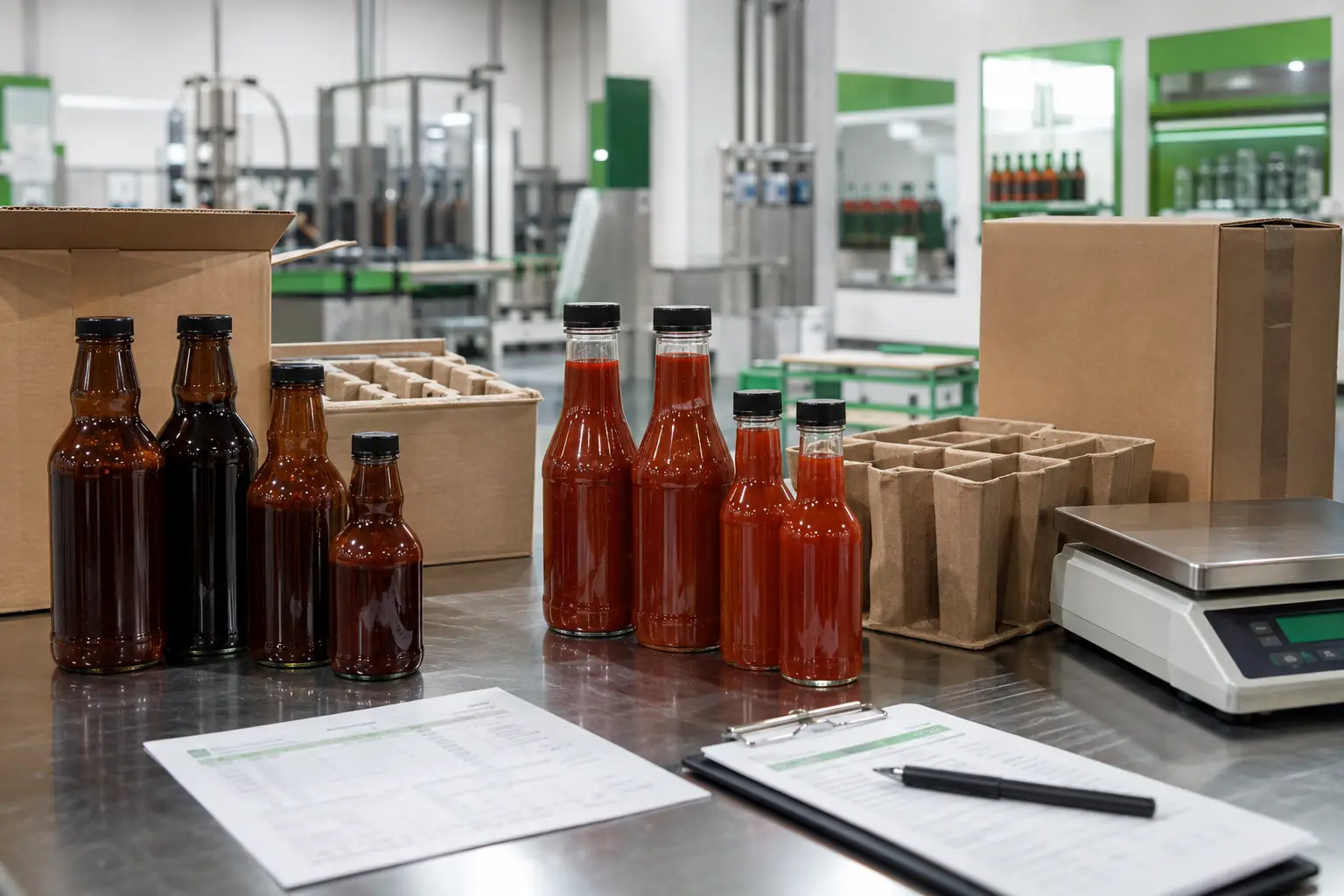
A glass to PET transition helps sauce brands reduce freight cost and breakage risk when the filled package no longer needs glass for heat, flavor or positioning reasons. PET is not simply a cheaper bottle body; it changes pallet weight, carton design, parcel survivability, warehouse handling, cap torque behavior and the total landed cost per sellable unit.
Glass still has real advantages: premium feel, high temperature tolerance, excellent oxygen and moisture barrier, and strong consumer familiarity for hot sauce, BBQ sauce and specialty condiments. The hidden cost appears when heavy bottles travel through LCL ocean freight, distributor warehouses, e-commerce parcel carriers or high-volume retail replenishment. One broken glass bottle can contaminate nearby cartons, trigger disposal labor and turn a small packaging failure into a pallet-level claim.
PET reduces the mass and shatter pathway. A well-engineered PET sauce bottle can preserve clear shelf visibility, create a thicker base impression, copy familiar ringneck or stout silhouettes, and remove most glass-to-glass impact failure. The switch works best when bottle geometry, wall distribution, neck finish, cap liner, label panel and filling process are reviewed together instead of replacing only the material name.
| Decision Factor | Glass Bottle Baseline | PET Transition Route | Operational Impact |
|---|---|---|---|
| Empty package weight | Often a major share of outbound dead weight, especially for 5 oz to 16 oz sauce bottles. | Typical planning target is 60%+ bottle-weight reduction versus comparable glass silhouettes, depending on gram weight and shape. | Lower freight weight, easier carton handling and more sauce per shipment weight allowance. |
| Breakage mode | Cracking, neck fracture, sidewall impact and glass-to-glass contact can destroy nearby saleable units. | PET flexes under impact and avoids shattering under normal parcel or pallet handling conditions. | Lower replacement cost, fewer leakage cleanups and reduced damage-claim administration. |
| Secondary packaging | Often needs dividers, padded cells, bubble sleeves or stronger corrugated protection. | Can use lighter divider logic when cap seal, label scuffing and bottle deformation are controlled. | Lower packing material use and faster pack-out for e-commerce and distributor orders. |
| Shelf perception | Premium weight, optical clarity and traditional sauce format. | High-clarity PET, thick-base geometry, defined shoulders and label design can approach glass-style shelf presence. | Brands can cut logistics risk without moving to a low-value commodity appearance. |
| Filling window | Handles many hot-fill and thermal processes well. | Standard PET is strongest for cold-fill or validated warm-fill programs; heat-set PET or other routes may be needed for high hot-fill temperatures. | Avoids deformation, vacuum paneling and shrinkage surprises during scale-up. |
| Landed cost logic | Factory price may look attractive while freight, duty basis, breakage allowance and cartons add cost. | Unit price, mold cost, gram weight, carton count and freight savings must be calculated together. | The correct comparison is cost per sellable filled unit, not bottle price alone. |
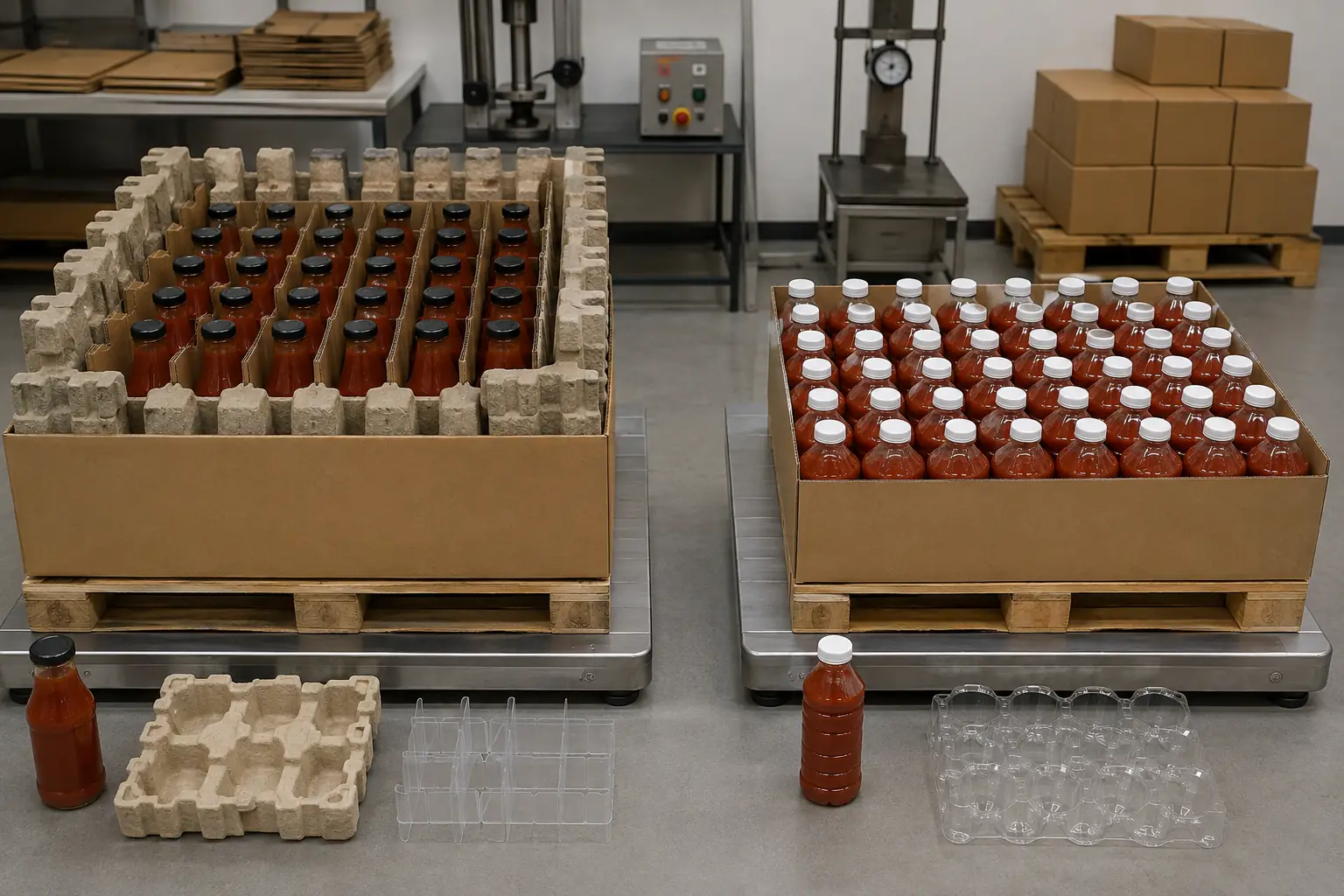
Shelf Perception Parity: High-Clarity PET for Glass-Style Sauce Bottles
The strongest objection to PET is usually not technical; it is visual. Sauce brands worry that a plastic bottle will look cheaper than a glass woozy, stout, ringneck or BBQ sauce bottle. Modern PET can reduce that risk when the design is built around shelf perception from the beginning: high-clarity resin, clean shoulder transitions, a controlled label panel, a heavier-looking push-up base and a cap route that matches the existing brand language.
PET can recreate many glass cues without copying glass weight. A thick visual base can make the bottle feel more substantial on the shelf. A ringed shoulder can preserve traditional hot sauce cues. A straight label panel can keep front labels flat and avoid wrinkles. Clear PET also keeps sauce color visible, which matters for chili red, smoky BBQ, honey hot sauce and premium condiment lines.
The trade-off is temperature and barrier. PET is not a universal replacement for every hot-fill glass bottle. Standard PET must be validated against filling temperature, cooling behavior, oxygen sensitivity, oil content, chili pigment stability and storage orientation. If the sauce depends on high-temperature hot fill or very long ambient shelf life, the transition may require heat-set PET, a different resin route, a liner strategy, color protection or a hybrid launch that keeps selected SKUs in glass.
| Glass Feature to Preserve | PET Engineering Response | Validation Check |
|---|---|---|
| Heavy premium base | Thicker base impression, push-up geometry or controlled foot ring. | Filled drop orientation, shelf stability, base rocking and optical distortion. |
| Clear product visibility | High-clarity PET with controlled haze and scuff protection. | Sauce color visibility after filling, label contrast and carton-rub review. |
| Traditional hot sauce silhouette | Woozy-style, ringneck-style or slim cylindrical PET geometry. | Hand feel, pour angle, reducer compatibility and label wrap fit. |
| Retail label quality | Smooth label panel with controlled taper and rib placement. | Label bubbling, edge lift, wrap alignment and barcode readability. |
| Food-contact confidence | Material and component route matched to sauce acidity, oil, pigment and destination market. | PET bottle, PP/PE cap, liner and reducer documents reviewed as one component set. |
Direct Factory Custom Mold Tooling for Glass-to-PET Conversion
A glass-to-PET conversion becomes more persuasive when the new bottle does not look like an unrelated stock container. Gracepack can support this process from existing mold screening through 3D modeling, sample review and custom tooling when the target shape, volume and brand geometry cannot be achieved with a standard bottle.
The practical starting point is usually a benchmark bottle: current glass sample, fill volume, overflow capacity, neck finish, cap type, label dimensions, carton count and target gram weight. From there, the PET design can retain the shelf-facing silhouette while removing unnecessary glass mass. Wall thickness is distributed around functional zones rather than spread evenly across the body.
Gracepack's manufacturing base supports 500+ owned molds, 5,000+ standard bottle designs, 15 automatic injection molding machines, 13 automatic blow molding machines, 9 fully automatic production lines, 3 labeling machines and 5 printing machines. That range matters because the transition often involves more than the bottle body. Caps, reducers, liners, label panels, carton packing and export documentation have to be matched before the new PET route is ready for commercial filling.
| Development Step | What Is Reviewed | Why It Matters |
|---|---|---|
| Glass benchmark capture | Current bottle photos, dimensions, weight, capacity, label area, neck finish and carton pack. | Defines which brand cues must remain and where cost or damage can be removed. |
| Existing mold screening | Nearest PET stock shapes by capacity, shoulder style, base width and cap route. | Shortens sample timing when a standard route can satisfy the transition. |
| 3D contour development | Glass-like outline, grip area, label panel, base design and wall distribution. | Keeps shelf recognition while adapting the structure for blow molding. |
| Closure matching | Cap, liner, reducer, flip-top or nozzle compatibility with the selected neck. | Prevents a good bottle body from failing through leakage or poor dosing. |
| Filled-package validation | Real sauce, fill temperature, cap torque, carton packing and transit simulation. | Confirms that freight savings do not create new shelf, line or leakage failures. |
Weight, Cube and Breakage Math for a Real Transition Review
The best comparison is not glass price versus PET price. It is a landed-cost model per sellable filled unit. That model includes empty bottle cost, cap and liner cost, carton structure, divider or sleeve cost, pallet quantity, CBM, gross weight, inland freight, ocean or parcel freight, duties, breakage allowance and handling labor.
A common mistake is comparing an attractive glass unit price against a PET unit price without the logistics layer. Glass can remain competitive for short local routes, premium gifting, small retail batches or hot-fill recipes that strongly benefit from glass. PET becomes stronger when the route includes long-distance export, e-commerce parcels, high damage sensitivity, distributor handling or aggressive freight-weight targets.
Weight savings can also change carton ergonomics. A lighter PET pack may allow more filled units per master carton before handlers reach a practical lifting limit. In other cases, cube is the controlling factor and the advantage comes from tighter bottle geometry, smaller protective voids and better pallet layout. The calculation should identify whether the shipment weighs out, cubes out or fails through damage before the material decision is made.
| Cost Variable | Ask for This Data | Decision Signal |
|---|---|---|
| Bottle weight | Empty glass weight, target PET gram weight and filled net weight. | Shows how much dead weight can be removed. |
| Carton pack | Units per carton, carton dimensions, gross weight and divider method. | Shows whether carton count or handler weight improves. |
| Pallet plan | Cartons per layer, layers per pallet, pallet gross weight and CBM. | Shows whether the route is weight-limited or cube-limited. |
| Damage allowance | Breakage rate, leakage claims, replacement cost and repacking labor. | Shows whether PET savings come from fewer failures, not just lower freight. |
| Cap and liner | Neck finish, liner type, reducer or valve, torque range and seal test. | Shows whether the new bottle can survive parcel and pallet pressure. |
Closure, Label and Food-Contact Checks Before the Switch
The bottle body usually receives the most attention, but the weak points in a glass-to-PET transition are often the interfaces. A cap that sealed well on glass may behave differently on PET because the neck finish, thread profile, land surface, top-load response and torque retention can change. Reducers and liners also need to be checked with the actual sauce viscosity, acidity, oil content and storage orientation.
Labels require separate review. PET can flex more than glass, and a squeeze-format transition may introduce panel movement that affects label edges. Shrink sleeves can hide resin tint and create strong shelf blocking, but they must be planned around recyclability, perforation, distortion and barcode readability. Pressure-sensitive labels need a clean panel, stable radius and surface energy that supports adhesion after filling and carton transit.
Food-contact documentation should match the full component set. A PET bottle route may also include PP or PE caps, silicone valves, PE liners, induction seals, colorants or masterbatch. Gracepack can align the bottle material, closure route and documentation path for FDA, EU food-contact, BPA-related PET review, HDPE or LDPE migration support and ISO 22000-linked food safety management expectations.
| Interface | Failure Risk | Review Method |
|---|---|---|
| Neck finish | Cap cross-threading, loose torque or leakage after vibration. | Check finish code, thread engagement, sealing land and applied torque. |
| Reducer or dispensing insert | Over-pour, clogging, weeping or poor consumer control. | Test with real sauce viscosity, particles and usage angle. |
| Liner or induction seal | Oxygen ingress, leakage, poor peel or seal lift. | Match liner material to PET rim, sauce chemistry and sealing equipment. |
| Label panel | Wrinkling, edge lift, scuffing or distortion. | Review panel flatness, label size, adhesive and carton-rub performance. |
| Carton packing | Denting, cap scuffing, collapsed bottles or label damage. | Validate partition, layer pad, case strength and pallet compression. |
Glass-to-PET Decision Matrix for Sauce Brands
A switch to PET is strongest when the current glass package is losing money through freight, breakage, secondary packaging or parcel failures, and when the sauce formula can be filled and stored safely in a validated PET route. It is weaker when glass is central to the product's premium identity, when the process depends on high hot-fill temperature, or when the formula needs glass-level barrier performance without a tested alternative.
For many brands, the right answer is phased. Keep premium hero SKUs or thermal-process SKUs in glass, move e-commerce multipacks or foodservice refill formats to PET, then validate custom PET tooling after the demand pattern is stable. This protects brand identity while reducing the most expensive logistics failures first.
| Scenario | Better Starting Route | Reason |
|---|---|---|
| DTC hot sauce multipacks with frequent glass breakage | PET or hybrid PET launch | Removes shatter risk and reduces protective packing pressure. |
| Premium gift sets sold in specialty retail | Glass or heavy-look PET trial | Shelf weight and premium ritual may be part of the value proposition. |
| Cold-filled BBQ sauce shipping long distance | High-clarity PET or squeezable PET/PE route | Freight, carton weight and parcel durability often improve. |
| Hot-filled acidic sauce at high temperature | Glass, heat-set PET or validated heat-resistant route | Standard PET may deform or panel without thermal design. |
| Established brand with recognizable glass silhouette | Custom PET mold after sample approval | Preserves shelf memory while reducing mass and breakage. |
Decision Audit Checklist
- [ ] Measure the current glass bottle weight, overflow capacity, neck finish, label panel and carton pack.
- [ ] Calculate landed cost per sellable filled unit, including freight, dividers, damage allowance and replacement shipments.
- [ ] Define whether the new package must replicate a woozy, stout, ringneck, BBQ or custom glass silhouette.
- [ ] Confirm filling temperature, cooling method, pH, oil content, pigments, viscosity and shelf-life target before selecting PET.
- [ ] Test cap torque, reducer fit, liner compression and leakage after vibration and storage orientation.
- [ ] Compare label appearance on clear PET, tinted PET and shrink-sleeve routes.
- [ ] Validate carton compression, parcel handling, pallet stacking and scuff protection with filled samples.
- [ ] Confirm food-contact documentation for the bottle, cap, liner, reducer, colorant and any valve component.
- [ ] Decide whether an existing PET mold is enough or whether custom tooling is justified by volume, shelf identity and logistics savings.
FAQ About Glass to PET Sauce Bottle Transitions
Why do sauce brands switch from glass to PET bottles?
Sauce brands switch from glass to PET bottles to reduce empty package weight, breakage risk, secondary packing, freight dead weight, e-commerce damage and pallet-level cleanup losses. The change should still be validated against filling temperature, sauce chemistry, shelf-life target and cap seal performance.
Can PET sauce bottles look premium like glass?
Yes, high-clarity PET with a controlled shoulder, thicker base impression, clean label panel and glass-style silhouette can preserve much of the shelf presence of glass. Physical samples are important because grip feel, gloss, haze and label behavior decide whether the package feels right in hand.
Is PET always cheaper than glass after freight?
Not always. PET can reduce freight and damage cost, but the final answer depends on mold cost, gram weight, cap and liner set, carton count, pallet density, duties, filling process and damage allowance.
Can PET replace glass for hot-fill sauce?
Standard PET may deform, shrink or panel at elevated hot-fill temperatures, so it should not be treated as a direct glass replacement without validation. Hot-fill programs may need glass, heat-set PET, PP, HDPE with design controls, vacuum panels or a different process route.
What should I send for a glass-to-PET transition review?
Send current bottle photos or drawings, capacity, empty weight, neck finish, cap and liner type, label size, fill temperature, sauce viscosity, pH if available, oil content, carton method, shipment route, annual volume and current damage history.
Request a Glass-to-PET Bottle Transition Review
A practical transition review starts with the package already selling today, then identifies where weight, breakage, carton protection and handling cost can be removed without weakening shelf presence or food-contact confidence. Gracepack can compare existing PET molds, glass-style PET samples and custom mold routes against your sauce formula, filling process, cap system and export route.
Share the current glass bottle specification, target volume, fill temperature, cap type, carton pack, destination market and annual volume range. The review can return a sample direction, closure path, carton packing recommendation, documentation map and custom tooling option when a standard PET bottle cannot protect the brand shape.


