
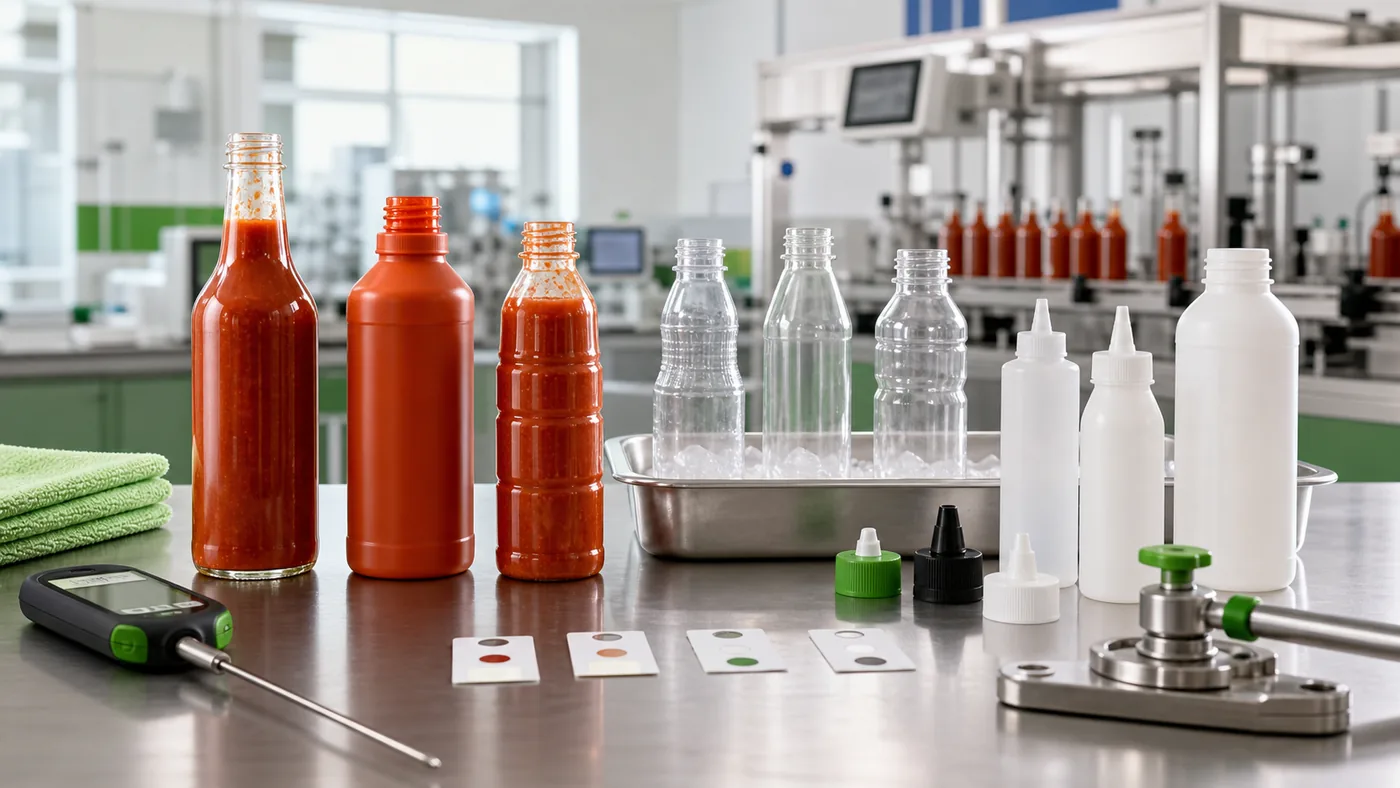
Hot Fill vs Cold Fill: Direct Bottle Selection Answer
Hot fill vs cold fill determines the hot sauce bottle because the package must survive the actual product temperature, capping moment and cooling load. Hot fill normally needs glass, heat-set PET, heavier HDPE, selected PP or a controlled vacuum-panel structure; cold fill can often use standard PET, HDPE or LDPE when sanitation, acidity and shelf-life controls are already validated.
The practical decision starts with the temperature at the bottle, not the kettle setpoint. A hot sauce filled at 180-200 F (82-93 C) can sterilize package contact surfaces but may create shrinkage, vacuum paneling, neck distortion and closure torque drift, while a cold-filled sauce avoids thermal deformation but depends more heavily on bottle sanitation, pH control, preservatives, refrigeration, aseptic filling or other process controls.
| Decision Factor | Hot Fill Route | Cold Fill Route | Bottle Choice Impact |
|---|---|---|---|
| Typical sauce temperature | Often 180-200 F (82-93 C), depending on process validation. | Room temperature or chilled product, commonly below 100 F (38 C). | Higher temperature narrows the material window and increases structural requirements. |
| Primary preservation logic | Thermal kill step plus immediate sealing and controlled cooling. | Sanitized container, controlled filling environment, low pH, preservatives, refrigeration, HPP or aseptic route. | Hot fill shifts risk toward bottle deformation; cold fill shifts risk toward hygiene and shelf-life validation. |
| Material shortlist | Glass, heat-set PET, crystallized-neck PET, heavier HDPE, selected PP. | Standard PET, HDPE, LDPE, PP or glass depending on clarity and squeeze needs. | Do not approve plastic by resin name alone; test filled samples at the real process temperature. |
| Common failure mode | Paneling, shoulder shrinkage, oval neck finish, cap back-off, liner compression loss. | Microbial-control gap, cap sanitation issue, oxygen ingress, leakage, poor squeeze recovery. | The cap, liner, neck finish and cooling plan matter as much as the bottle body. |
| Best validation method | Filled hot-sauce trial, cap torque check, cooling curve, leak test and carton review. | Sanitation SOP review, filled storage, leakage, oxygen sensitivity and dispensing test. | Choose the bottle after process data and physical samples agree. |
Process Fundamentals: What Hot Fill and Cold Fill Do to the Package
The first decision is the filling process. Hot-fill uses sauce temperature as part of the preservation and microbial-control strategy. Cold-fill relies on controlled formulation, clean or sterile handling, chilled ingredients, preservatives, HPP, aseptic filling or other process controls depending on the product. The bottle has to fit that production reality.
For US-oriented foodservice or retail sauce programs, the plant's sanitation, cooling and holding procedures should also be checked against the FDA Food Code 2022 and the processor's own scheduled process. Packaging selection does not replace process validation; it only gives the validated process a container that can survive it.
For packaging engineers, the useful dividing line is not the marketing phrase hot-fill or cold-fill. The useful inputs are actual product temperature at the bottle, time before capping, cap application torque, cooling method, target shelf life, acidity, oil content and whether the bottle is expected to flex inward safely as the contents cool.
We normally begin with this matrix before recommending samples.
| Filling Route | Typical Bottle Priority | Material Direction | Engineering Risk |
|---|---|---|---|
| Cold-fill sauce | Clarity, squeeze feel, cap fit, aseptic or clean-line compatibility. | Standard PET for clear retail bottles, HDPE or LDPE for squeeze formats, PP for selected caps. | Microbial control depends on process discipline rather than bottle heat exposure. |
| Warm-fill sauce | Moderate thermal stability plus cap and liner compatibility. | HDPE, LDPE, selected PET or PP route after filled sample review. | Borderline temperatures can deform necks, soften panels or change cap torque. |
| Hot-fill sauce | Thermal resistance, neck finish stability, vacuum management and cooling behavior. | Heat-set or crystallized PET, heavier HDPE, selected PP or glass depending on product and shelf target. | Shrinkage, paneling, oval necks, liner lift, label wrinkles and carton distortion. |
| Post-fill sterilization | Package must survive the sterilization condition, not only the fill step. | PP and selected heat-resistant systems are commonly evaluated first. | Standard PET and many soft squeeze routes can deform under final sterilization heat. |
Failure Analysis: Heat Distortion Vacuum Paneling and Closure Drift
Plastic thermal resistance depends on polymer family, molecular orientation, wall thickness, part geometry and processing history. PET vs HDPE sauce bottles is a useful comparison, but the final answer changes when a sauce is filled hot, capped immediately and cooled in the bottle.
Standard amorphous PET gives excellent clarity and shelf presence for cold-fill products, but it is not designed for high-temperature hot filling. Its glass transition temperature, $T_g$, is commonly around 70-80 C (158-176 F), so a sauce entering the bottle near 82-93 C (180-200 F) can push thin shoulders, label panels and neck finishes into a softening range unless the PET structure has been heat-set and validated.
HDT, or heat deflection temperature, also matters because a bottle is not only exposed to heat; it is loaded by its own filled weight, cap torque, conveyor handling and vacuum after sealing. Heat-set PET changes the picture by increasing crystallinity through controlled thermal treatment and stretch-blow processing. Higher crystallinity improves dimensional stability at elevated fill temperatures and helps the bottle resist shrinkage.
The neck finish deserves special attention. A bottle body can look acceptable while the neck moves enough to weaken the cap seal. Crystallized or heat-stabilized neck finishes are used when PET packaging must hold closure torque after hot filling. The technical goal is not only to keep the bottle standing. It is to keep the sealing land flat, the thread engagement repeatable and the cap removal force inside a usable range.
Cooling creates a pressure problem described by the ideal gas relationship $PV=nRT$: as the temperature of the sealed headspace drops, internal pressure falls and the package sees inward vacuum force. HDPE and LDPE are more forgiving for squeeze and impact performance, but heat can still drive paneling, stress whitening, shape memory changes or bottle ovality. PP offers stronger heat resistance than many common sauce bottle materials and is often considered for high-temperature or sterilization-related projects, but PP clarity, squeeze feel and decoration choices differ from PET.
| Material Route | Cold-Fill Strength | Hot-Fill Consideration | Gracepack Review Focus |
|---|---|---|---|
| Standard PET | High clarity, gloss and retail shelf visibility. | Can warp or shrink if exposed above its practical heat window. | Use for cold-fill or carefully reviewed warm-fill projects. |
| Heat-set or crystallized PET | Keeps PET clarity direction while improving heat stability. | Needs the right preform, blow process, neck finish and bottle geometry. | Review crystallization, shoulder stability and cap torque retention. |
| HDPE | Tough, opaque or natural squeeze bottle route. | May need heavier gram weight or vacuum panels for hot-fill cooling. | Review wall thickness, paneling, cap timing and label panel flatness. |
| LDPE | Soft squeeze feel and rebound for table condiments. | Lower stiffness can increase deformation risk at elevated temperature. | Review squeeze recovery, thermal cycling and cap-down storage. |
| PP | Good cap, hinge and selected bottle heat-resistance route. | Less glass-like clarity and different squeeze feel than PET or LDPE. | Review heat exposure, sterilization condition and closure compatibility. |
Engineered Solutions: Material Structure and Vacuum Control
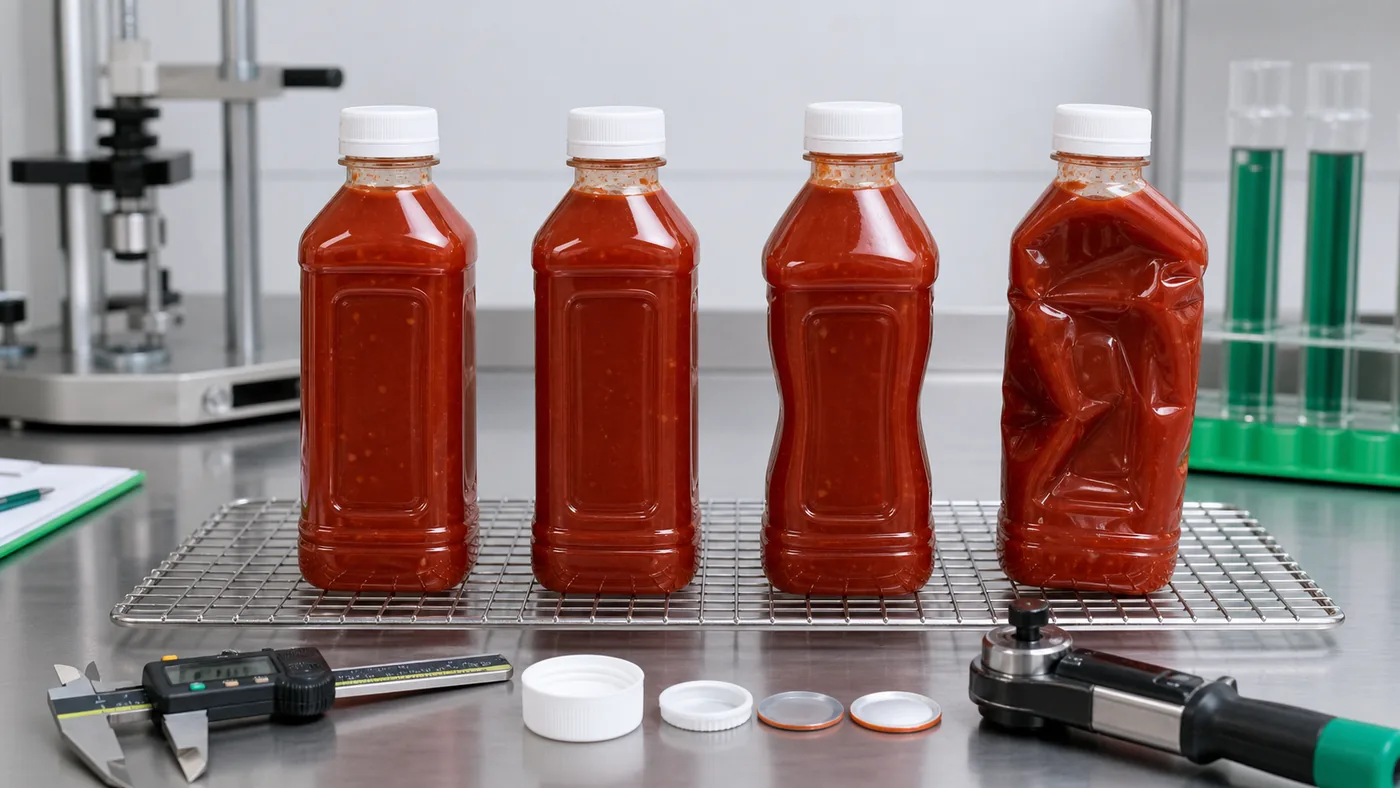
Hot-filled sauce creates a second mechanical event after the cap is applied. As the filled product cools, the internal volume contracts. If the package is sealed while hot, that contraction pulls the bottle inward. A cold-fill bottle usually does not face the same vacuum load after sealing, so it can often use a simpler sidewall.
Good hot-fill bottle design gives the vacuum somewhere to go. Vacuum panels, rib geometry, shoulder structure and base support are used to absorb inward movement without random collapse. A bottle that has no controlled flex zone may still move, but it will move at the weakest area: a label panel, shoulder, corner, grip point or thin wall spot.
This is where empty-bottle inspection can mislead a sourcing team. A bottle may look straight before filling and fail only after hot product, immediate capping, cooling and carton pressure. The US Hot-Fill HDPE Sauce Bottle case shows the practical version of this problem: a lighter 16 oz HDPE bottle showed paneling after 170-185 F hot filling, while a heavier HDPE sample direction and adjusted capping sequence created a clearer test path.
- Vacuum panels should flex predictably rather than creating random dents.
- Round bottles can feel simple, but panel placement and gram weight still matter under hot-fill vacuum.
- Square or multi-sided bottles may improve label presence but need corner and shoulder stress review.
- Immediate cap tightening can intensify vacuum load if the cooling process is not planned.
- Label panels should be reviewed after thermal cycling, not only before filling.
Factory and Co-Packer SOP: Line Calibration Before Bulk Production
We produce sauce bottle programs as matched components: bottle body, neck finish, cap, liner, valve, label panel and export carton. For hot-fill and cold-fill projects, our QC review focuses on whether the approved sample can repeat in production, not only whether one sample looks acceptable on a desk.
Gracepack's production base supports injection molding, blow molding, labeling, printing and export packing coordination through 9 fully automatic production lines, 15 automatic injection molding machines, 13 automatic blow molding machines, 3 labeling machines and 5 printing machines. That matters for thermal projects because bottle structure, cap fit, decoration and carton protection have to stay aligned after the filling process is confirmed.
Food-contact document support can be matched to the selected material route. Common condiment packaging materials such as PET, PP, PE, HDPE, LDPE and silicone-related components can be reviewed with ISO 22000 food-safety system documentation and FDA, EU migration, BPA and enterprise-standard support by component. One PET report should not be treated as proof for every cap, liner or silicone valve, so the document set is matched after the final bottle and closure route is selected.
For a hot-fill inquiry, our engineering review asks for the exact filling temperature, whether the product is capped immediately, whether it is cooled naturally or with water, whether final sterilization is involved, and whether the sauce is acidic, oily, particulate or high-viscosity. Those answers decide whether a clear PET route, crystallized PET route, heavier HDPE route, PP route or glass alternative should be tested.
| QC Check | Why It Matters | What We Review |
|---|---|---|
| Neck finish measurement | Hot-fill heat can move the sealing land or thread geometry. | Rim flatness, ovality, cap engagement and removal torque. |
| Wall-thickness control | Local thin areas become collapse points during vacuum cooling. | Shoulder, label panel, grip area, base and vacuum panel distribution. |
| Filled thermal cycling | Real sauce stresses the package differently from water. | Fill temperature, cooling curve, sauce residue, label behavior and cap fit. |
| Cap and liner compatibility | Heat can change liner compression and closure torque. | Cap material, liner route, torque window and leakage after cooling. |
| Packing review | Hot-fill bottles can deform if cartons load pressure into caps or panels. | Carton count, dividers, orientation, pallet plan and shipment photos. |
Engineering Sourcing Advisory: Match the Bottle to the Real Fill Window
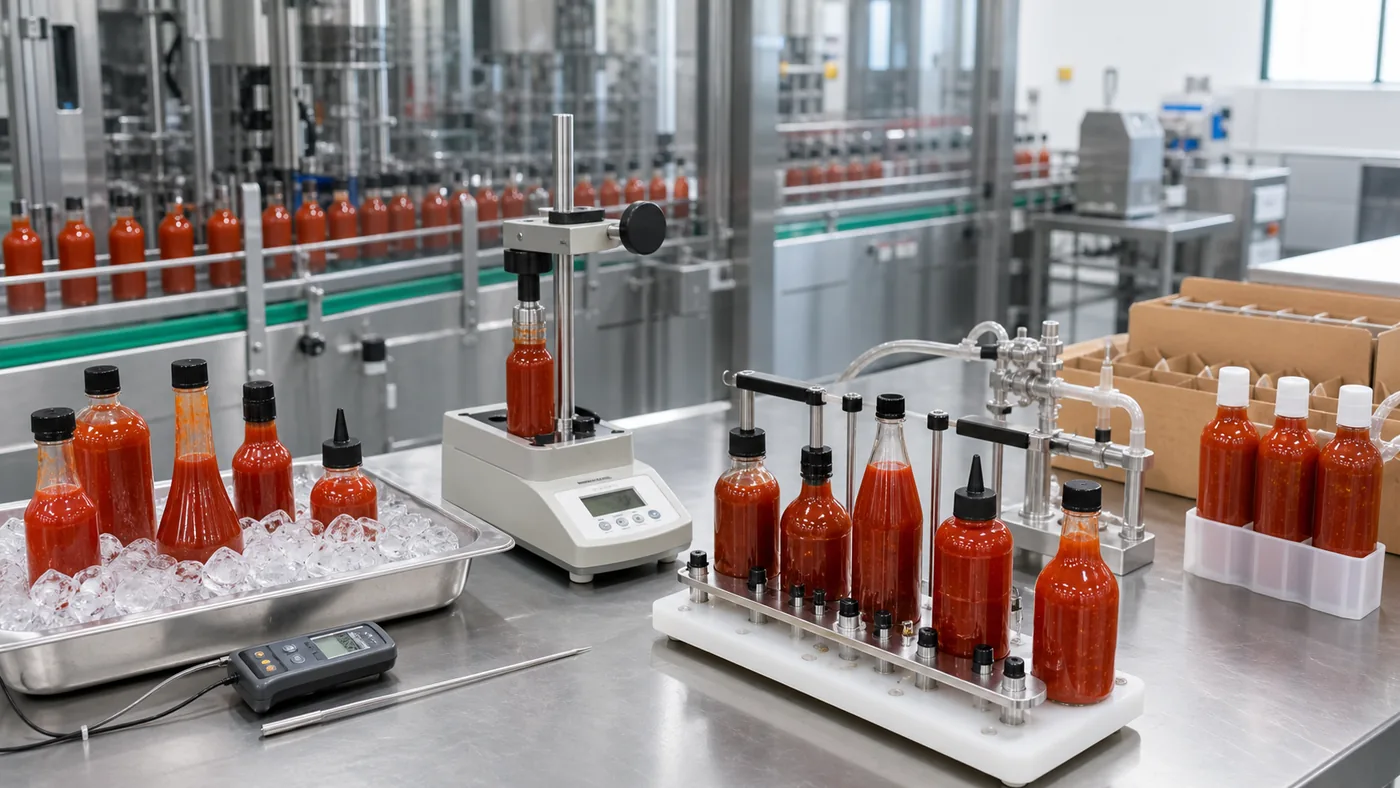
Procurement teams often ask for a bottle price before the filling process is fully defined. We can quote faster when the inquiry includes the commercial basics, but hot-fill and cold-fill sauce packaging also needs process data. A small temperature change can move a project from standard PET to heat-set PET, from soft LDPE to heavier HDPE, or from a clear bottle concept to a PP or glass discussion.
For co-packers, the bottle must also run on the line. Neck finish, body stiffness, conveyor stability, filling nozzle clearance, cap feeding, torque repeatability and label application all affect production speed. A bottle that survives heat but tips on the line is not production-ready. A bottle that fills cleanly but fails after cooling is not export-ready.
For distributors and food brands, SKU consolidation matters. One bottle family may cover ketchup, barbecue sauce and dressing when the products are cold-filled. The same family may not be safe for a hot-filled chili sauce unless the bottle weight, panel geometry, closure route and testing plan are changed. We normally recommend testing the highest-risk formula first, then building the family around the approved thermal boundary.
- Share the real fill temperature at the bottle, not only kettle temperature.
- Define whether the sauce is hot-filled, warm-filled, cold-filled, aseptically filled, HPP treated or sterilized after filling.
- Send sauce viscosity, oil content, acidity, particle size and separation behavior.
- Confirm capacity, bottle shape, neck finish, cap type, liner, label area and desired shelf appearance.
- State the target market and document needs for FDA, EU, BPA, ISO 22000 or retailer review.
- Ask whether existing molds can support the first sample loop before opening custom tooling.
- Approve samples after filled thermal testing, cap torque review, leakage check and carton packing review.
Representative case logic for hot-fill HDPE paneling
A common hot-fill sauce project begins with a bottle that works during room-temperature handling but pulls inward after hot filling. In one US hot-fill sauce route, the customer was comparing HDPE bottles for a 170-185 F process. A lighter 16 oz HDPE round bottle showed vacuum paneling after immediate capping and room-temperature cooling.
The review did not jump directly to a new mold. We compared the lighter bottle with a heavier 45-50 g HDPE direction and focused the sample path around a 47 g bottle. The discussion also covered cap timing, existing 28 mm cap compatibility, label planning and whether the bottle shape should remain round or move toward a structure with better controlled panel response.
That type of project is why hot-fill packaging cannot be selected from resin alone. The material, gram weight, panel structure and capping sequence work together. When those variables are reviewed before bulk production, the production team gets a testable route instead of a surprise deformation claim after the first shipment.
| Issue Found | Packaging Cause | Sample Direction |
|---|---|---|
| Sidewall paneling after cooling | Vacuum contraction exceeded the lightweight wall structure. | Compare heavier HDPE and controlled panel design. |
| Cap route uncertainty | Heat and vacuum can change torque behavior. | Keep existing cap family where possible, then test removal torque. |
| Label risk | Paneling can wrinkle labels or distort shelf appearance. | Review label panel after filled cooling and carton pressure. |
| Tooling risk | New molds add cost before the thermal route is proven. | Test existing mold directions before opening a custom mold. |
FAQ
Can standard PET bottles be used for hot-fill sauce?
Standard PET is usually a cold-fill or carefully reviewed warm-fill route. High-temperature hot-fill sauce normally requires heat-set or crystallized PET, another heat-resistant plastic route, or a different package format after testing.
Why does PET crystallization matter in hot-fill packaging?
PET crystallization increases dimensional stability under heat. In sauce bottles, that helps the body, shoulder and neck finish resist shrinkage, warping and cap-seal deformation during filling and cooling.
Are PP bottles suitable for hot filling?
PP has stronger heat resistance than many common clear sauce bottle materials and is often evaluated for higher-temperature or sterilization-related projects. The final decision still depends on clarity needs, squeeze feel, closure design, sauce chemistry and test results.
Why do hot-fill bottles need vacuum panels?
Hot sauce contracts as it cools after sealing. Vacuum panels or controlled sidewall geometry absorb that inward movement so the bottle does not collapse randomly at the label panel, shoulder or grip area.
What information helps Gracepack recommend samples?
The useful brief includes filling temperature, capping timing, cooling method, sauce viscosity, acidity, oil content, particles, capacity, bottle shape, cap route, destination market, document requirements and target order quantity.
Request hot-fill or cold-fill sauce bottle samples
Hot-Fill Sauce Bottles, cold-fill sauce bottles and warm-fill condiment packages should be approved through material, geometry and filled-sample behavior together. The right route may be standard PET, heat-set PET, heavier HDPE, soft LDPE, selected PP or a different closure system depending on the real production process.
Gracepack can review your bottle capacity, fill temperature, sauce chemistry, cap and liner route, label target, carton plan and destination market before recommending samples. Share a current bottle photo, failure image, drawing or pilot sauce details to receive a practical sample or custom product consultation.
- Use standard PET mainly when clarity and cold-fill shelf presentation are the priority.
- Use heat-set or crystallized PET when PET clarity is required under higher thermal exposure.
- Use HDPE or LDPE when squeeze feel, toughness or opaque foodservice handling matters.
- Use PP or another heat-resistant route when sterilization or higher heat exposure drives the project.


