
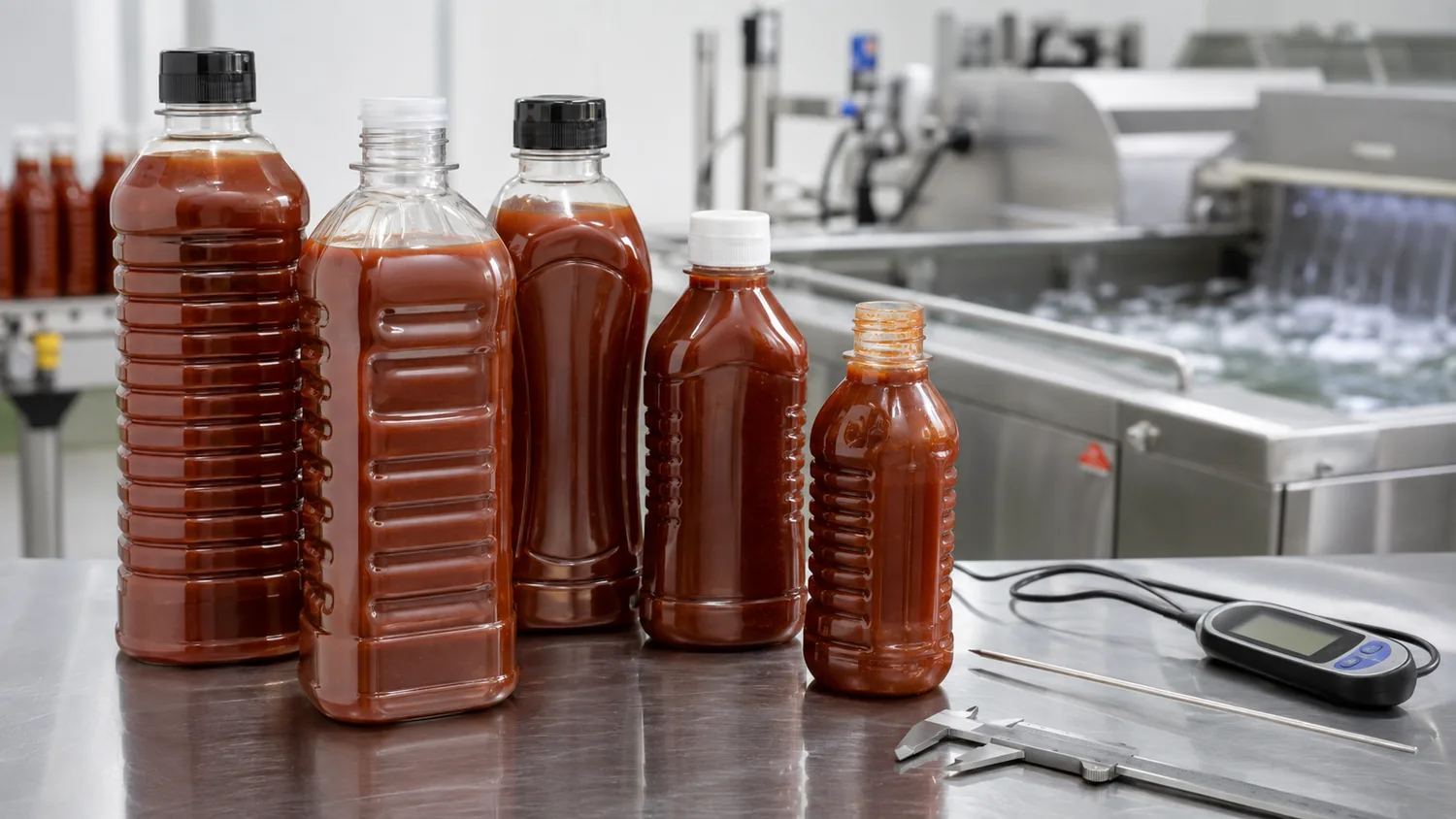
Hot-fill plastic BBQ sauce bottles must survive two stresses at the same time: the sauce enters the container hot enough to soften many plastics, then the sealed product cools and pulls the bottle inward under vacuum. A reliable package is built around the actual fill temperature, material route, neck finish, cap liner, wall-thickness map, vacuum panel geometry and cooling process.
For BBQ sauce, the risk is higher than it looks on an empty sample. Thick tomato-based sauce, sugar, salt, vinegar, spices and sometimes oil hold heat longer than water, so the shoulder, label panel and base can keep seeing thermal stress after the bottle leaves the filler. The useful decision is not simply PET vs PP or plastic vs glass. It is whether the whole bottle and closure system can pass a filled hot-fill trial at the real process window.
| Parameter | Recommended Planning Limit | Mechanical Impact | Validation Method |
|---|---|---|---|
| Fill temperature at bottle | Confirm the actual product temperature at filling, commonly 82-93 C (180-200 F) for hot-fill sauce programs. | Higher temperature increases shoulder shrinkage, label-panel sink, neck ovality and cap torque drift. | Measure temperature at the nozzle and inside filled bottles during the first trial. |
| Material route | Use glass, heat-set PET, selected PP or heavier engineered HDPE only after process review. | Standard clear PET and lightweight squeeze bottles can deform when heat and vacuum combine. | Run filled thermal cycling with the intended sauce, cap and cooling method. |
| Vacuum absorption | Use controlled panels, rib rings, shoulder support or base flex where sealed cooling creates negative pressure. | Without a designed flex zone, the weakest wall area collapses randomly. | Inspect sidewall movement, base rock, label flatness and filled appearance after cooling. |
| Neck finish and cap | Confirm thread engagement, sealing land, liner route and removal torque after heat exposure. | A straight body can still fail if the neck finish moves enough to weaken the seal. | Check cap torque, inversion leakage, liner compression and reducer or valve fit after cooling. |
| Carton and storage | Review carton count, dividers, upright orientation and warm-warehouse risk. | Post-fill deformation can continue under cap pressure, carton load or pallet compression. | Combine filled-pack storage, compression checks and shipment packing review. |
Downtime and Scrap: Why Hot-Fill Deformation Becomes Expensive Fast
A hot-fill bottle failure is rarely a cosmetic issue only. Paneling can wrinkle labels, tilt bottles on conveyors, loosen cap torque, create slow leaks or make a premium BBQ sauce look underfilled after cooling. If the line runs before the package is validated, the first sign may be rejected cartons, unstable pallets or a co-packer stop caused by bottles that no longer stand straight.
The financial loss comes from several small failures stacking together. The bottle may need to be scrapped, the filled sauce may be lost, labels and caps are consumed, labor has already touched the SKU, and the production slot may need to be repeated. For export or private-label programs, a deformed bottle also creates approval delays because the brand, co-packer and packaging supplier may disagree on whether the issue came from resin, wall thickness, fill temperature, capping timing or cooling.
A practical sourcing brief should define the process before the quote is treated as final. Capacity, sauce viscosity, oil content, particle size, fill temperature, cap timing, cooling tunnel settings, bottle orientation and carton plan all change the risk profile for Hot-Fill Sauce Bottles.
| Failure Seen on Line | Likely Package Cause | Production Cost | Preventive Check |
|---|---|---|---|
| Bottle panels pull inward after cooling | Vacuum contraction exceeds the sidewall design. | Rejected filled units, label wrinkles and unstable shelf appearance. | Filled hot-fill trial with sidewall measurement after cooling. |
| Cap leaks after inversion or transit | Neck finish distortion, liner mismatch or torque drift. | Sauce loss, carton staining and customer complaints. | Torque window, liner route and post-cooling leak test. |
| Bottle tips on conveyor | Base deformation, high center of gravity or panel collapse. | Line stoppage and manual rework. | Base flatness, standing-ring inspection and filled conveyor trial. |
| Labels bubble or crease | Panel movement, heat exposure or curved label zone. | Artwork waste and retail appearance failure. | Apply labels after thermal cycling and review label panel stability. |
The Physics of Hot-Fill BBQ Sauce at 82-93 C
Hot filling uses product temperature as part of the microbial-control and shelf-stability strategy. For many sauce lines, the useful planning range is about 82-93 C (180-200 F), but the bottle sees the temperature differently from the kettle. Heat is lost through hoses, nozzles, filler bowls, headspace and bottle walls, so the critical number is the temperature at the container during filling and capping.
BBQ sauce holds heat because it is viscous and often contains sugar, tomato solids, starches, spice particles and oil phases. Compared with water, it can cool less uniformly. The outside surface may seem stable while the liquid mass near the center keeps the package warm. This delayed cooling can keep softening the shoulder and upper body while the cap is already locked in place.
Once the bottle is capped, cooling creates contraction. Liquid volume drops, headspace temperature drops, and internal pressure falls. The pressure-volume-temperature relationship is often simplified as $PV=nRT$: when temperature falls in a sealed headspace and volume cannot freely expand, pressure drops. That negative pressure pulls flexible plastic inward.
| Thermal Event | What Happens | Bottle Area at Risk | Engineering Response |
|---|---|---|---|
| Hot product enters bottle | Polymer stiffness drops as temperature rises. | Shoulder, neck finish, upper sidewall and label panel. | Use suitable resin, thicker local walls and controlled process window. |
| Cap is applied | Thread, liner and sealing land are compressed while the package is warm. | Neck finish, cap skirt, liner and reducer. | Validate cap torque after cooling, not only at the capper. |
| Sauce cools | Product and headspace contract and create inward vacuum. | Flat walls, grip panels, base and unsupported label zones. | Add vacuum panels, rib rings, base flex or adjusted capping sequence. |
| Cartons are packed | Residual heat and pallet load can continue stressing the bottle. | Caps, shoulders, panels and standing ring. | Review carton count, dividers, cooling completion and stacking load. |
PET vs Heat-Set PET vs PP for Hot-Fill Plastic BBQ Sauce Bottles
Standard PET is attractive because it is clear, glossy and light, but it should not be assumed suitable for hot-fill BBQ sauce. Amorphous PET has a glass transition range commonly discussed around 70-80 C (158-176 F). When a thick sauce enters near or above that range, unqualified PET can shrink, ovalize at the neck, sink at the shoulder or lose label-panel flatness.
Heat-set PET changes the structure by increasing crystallinity during stretch blow molding against heated mold surfaces. Higher crystallinity improves dimensional stability, which is why heat-set PET is used when brands want PET-like clarity with stronger thermal resistance. The bottle still needs the correct preform, blow process, crystallized neck finish, vacuum geometry and cap validation. A heat-set label on the material is not enough by itself.
PP has stronger heat resistance than many common clear bottle materials and is often part of the discussion for hotter sauce routes, caps, flip-tops and functional components. It can be a strong direction when heat exposure is the main risk, but it behaves differently from PET in clarity, stiffness, squeeze feel and decoration. HDPE can work for some hot-fill sauce routes when the bottle weight, panel design and capping sequence are engineered, but lightweight HDPE can panel heavily under vacuum.
For US projects, PET routes may be reviewed against relevant PET food-contact requirements such as FDA 21 CFR 177.1630, while PP and PE components are commonly reviewed against olefin polymer requirements such as FDA 21 CFR 177.1520. EU projects may require component-level review under EU Regulation 10/2011. The bottle, cap, liner, valve and colorant should be matched to the final use condition instead of covered by one generic document.
| Material Route | Best Fit | Hot-Fill Risk | Use It When |
|---|---|---|---|
| Standard PET | Clear cold-fill BBQ sauce, dressing or condiment display. | Shrinkage, shoulder sink and neck distortion at higher fill temperatures. | The process is cold-fill or carefully reviewed warm-fill. |
| Heat-set PET | Clear hot-fill or warm-fill projects where shelf color and gloss matter. | Needs crystallized neck, controlled wall distribution and vacuum management. | The brand needs clear plastic appearance plus filled thermal validation. |
| HDPE | Opaque or natural squeeze bottles with strong impact resistance. | Can panel or dent if lightweight under sealed cooling vacuum. | Squeeze feel, durability and foodservice handling are more important than full clarity. |
| PP | Higher-temperature bottle or closure routes and heat-resistant components. | Different clarity, stiffness and decoration profile from PET. | Thermal resistance is the main requirement and filled samples confirm usability. |
| Glass alternative | Premium hot-fill sauces needing strong thermal tolerance and flavor neutrality. | Breakage and freight weight. | Hot-fill stability matters more than lower package weight. |
Vacuum Absorption Geometry: Panels, Ribs, Shoulders and Bases
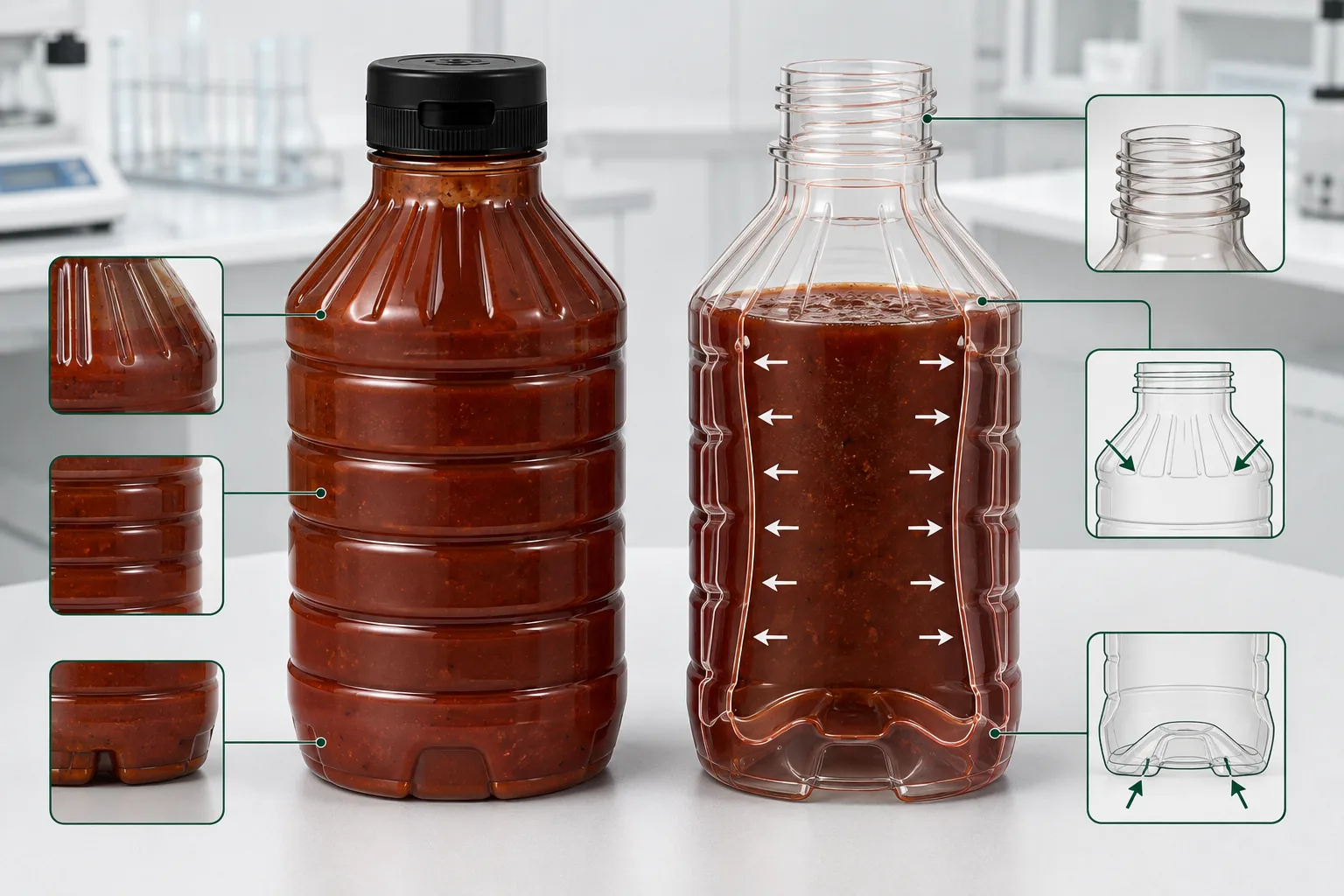
Vacuum panel engineering gives the bottle a planned place to move. Recessed side panels can flex inward symmetrically as the BBQ sauce cools. Horizontal rib rings work like load-bearing hoops, helping the body keep its roundness and preventing uncontrolled ovalization. Reinforced shoulders protect the transition between the neck and body, where heat, cap torque and filled weight often concentrate stress.
A smooth bottle without visible panels can still be made for certain processes, but it needs another way to manage vacuum. Some formats rely on stronger wall thickness, base movement, liquid nitrogen dosing or delayed capping, depending on the process. Those choices must be matched to the filling line. A bottle built for a cold-filled shelf sample can look more premium, but the same clean wall may become the failure point in hot-fill production.
For label planning, the panel cannot be treated as empty decoration space. If the label crosses a moving vacuum zone, it may wrinkle, bridge or lift after cooling. Label panel flatness should be checked on filled and cooled bottles before artwork dimensions are approved.
| Geometry Feature | Mechanical Function | What to Validate |
|---|---|---|
| Recessed vacuum panels | Absorb inward movement during cooling. | Panel movement is symmetrical and does not wrinkle the label. |
| Horizontal rib rings | Hold hoop strength and reduce body ovalization. | Bottle remains stable through cooling, conveying and carton packing. |
| Reinforced shoulder | Protects the high-stress transition below the neck. | No shoulder sink, stress whitening or cap alignment drift. |
| Standing ring and push-up base | Keeps the filled bottle upright after heat exposure. | No rocking, base bulge or conveyor tipping. |
| Neck finish support | Preserves sealing land and thread geometry. | Cap torque and leak resistance remain stable after cooling. |
Capping, Torque and Cooling Sequence
The cap does more than close the bottle. It locks the headspace condition that will become the vacuum load after cooling. If a bottle is capped immediately while the product is hot, the internal pressure can drop sharply as the sauce cools. If the cap is applied too loosely, leakage can appear. If it is applied too tightly while the neck is warm, thread stress or liner deformation can increase.
Closure selection must also match sauce texture. Smooth BBQ sauce can work with flip-top caps, nozzle caps or squeeze dispensing routes, while seeded or pulpy sauces may need a wider orifice. Heat-resistant PP bottles and PP caps may be part of the same project, but each component has its own thermal and food-contact behavior.
Cooling method changes the result. Natural cooling, water cooling, tunnel cooling and ambient warehouse cooling can produce different sidewall and cap behavior. A validation trial should record the fill temperature, cap application timing, cap torque at application, cap torque after cooling, leakage, panel movement, base flatness and label condition.
| Line Variable | If Too Aggressive | If Too Weak | QC Check |
|---|---|---|---|
| Fill temperature | Bottle softening, shrinkage and neck distortion. | Insufficient process lethality if the formula depends on thermal control. | Record actual bottle-entry temperature. |
| Cap torque | Thread stress, liner over-compression and difficult opening. | Leakage, cap backoff and poor seal compression. | Measure applied and post-cooling torque. |
| Cooling speed | Thermal shock or uneven wall stress in some packages. | Long heat exposure and continued deformation. | Track cooling curve and final bottle geometry. |
| Headspace | Higher vacuum effect if poorly controlled. | Underfill appearance or inconsistent package pressure. | Confirm fill height and headspace repeatability. |
| Cap liner route | Poor recovery after heat if mismatched. | Weak oxygen or leak barrier if under-specified. | Run inversion, vibration and storage checks. |
Gracepack Direct Manufacturing Solutions for Hot-Fill BBQ Sauce Projects
Gracepack supports hot-fill BBQ sauce packaging as a matched bottle and closure program rather than a single empty-bottle quotation. The review can cover existing mold selection, bottle weight direction, cap and liner compatibility, label panel layout, carton packing and export documentation before bulk production.
The production base includes 500+ owned molds, 5,000+ standard bottle designs, 15 automatic injection molding machines, 13 automatic blow molding machines, 9 fully automatic production lines, 3 labeling machines and 5 printing machines. For a thermal sauce project, this helps align the bottle body, cap, label and packing method through one sample loop instead of separating responsibility across unrelated suppliers.
Available material and document support can include PET FDA and BPA-related routes, EU food-contact support for PET, PP, PE and silicone-related components, HDPE and LDPE migration review, ISO 22000 food-safety system documentation and enterprise standards for food-grade plastic bottles and caps. The final document set is selected by bottle material, cap material, liner route, sauce chemistry and destination market.
For hot-fill BBQ sauce bottles, the most useful sample path normally compares the current bottle or target shape against one or more existing mold routes. New tooling is considered after the heat window, shrinkage behavior, vacuum response, cap fit and label plan are clear.
| Factory Capability | How It Helps Hot-Fill BBQ Sauce | Sample Decision Output |
|---|---|---|
| Existing mold library | Reduces the need to open tooling before thermal risk is understood. | Shortlist bottle shapes with suitable shoulders, ribs, base and label areas. |
| Injection and blow molding coordination | Keeps cap, closure and bottle-body review connected. | Match neck finish, PP cap, liner and bottle route before quote approval. |
| Filled-sample review | Shows heat, vacuum and sauce behavior that empty samples cannot show. | Approve material route, bottle weight, cooling process and cap timing. |
| Labeling and printing support | Checks decoration after thermal movement, not only on empty bottles. | Prevent label wrinkles, sleeve distortion and panel-coverage mistakes. |
| Export packing review | Protects bottles after they pass filling tests. | Confirm carton count, dividers, pallet plan and shipment photo requirements. |
Engineering Audit Checklist Before You Approve Bulk Production
Before a hot-fill BBQ sauce bottle moves from sample approval to bulk production, the package should be checked as a filled system. The list below is designed for packaging engineers, co-packers and procurement teams reviewing Squeezable BBQ Sauce Bottles, squeeze sauce bottles for thick condiments or foodservice sauce containers under thermal exposure.
- [ ] Record actual fill temperature at the bottle, not only kettle temperature.
- [ ] Confirm hold time, cap timing, cooling method and whether the bottle is inverted after filling.
- [ ] Test the real sauce or a close pilot batch with matching viscosity, sugar, oil and particle content.
- [ ] Compare PET, heat-set PET, HDPE, LDPE, PP or glass based on heat, squeeze and shelf needs.
- [ ] Measure neck finish, sealing land, thread engagement and cap torque after cooling.
- [ ] Inspect sidewall paneling, shoulder sink, base rock, label flatness and filled appearance.
- [ ] Run inversion, vibration, carton compression and warm-storage checks with final caps and liners.
- [ ] Confirm FDA, EU, BPA, ISO 22000 or retailer document scope by component.
- [ ] Approve carton count, divider use, pallet stack and export packing before mass production.
FAQ
Can standard PET be used for hot-fill BBQ sauce bottles?
Standard PET should be treated as a cold-fill or carefully reviewed warm-fill route. Higher hot-fill temperatures normally require heat-set PET, selected PP, heavier engineered HDPE, glass or another validated package system.
Why do hot-fill plastic BBQ sauce bottles shrink or collapse?
Hot sauce heats the polymer wall, then cooling inside a sealed bottle creates negative pressure. If the bottle has no suitable vacuum panels, rib support, base geometry or wall-thickness distribution, the sidewall or shoulder can collapse randomly.
Are PP bottles better than PET for hot-fill BBQ sauce?
PP generally offers stronger heat resistance than standard PET, but PET offers better clarity and shelf gloss. The better route depends on fill temperature, sauce chemistry, squeeze feel, decoration needs, cap fit and filled-sample results.
What are vacuum panels on sauce bottles?
Vacuum panels are controlled recessed areas that flex inward as hot-filled sauce cools. They absorb volume contraction while helping the bottle keep its intended shelf shape.
What information helps Gracepack recommend hot-fill BBQ sauce bottle samples?
Send the target capacity, fill temperature, cap timing, cooling method, sauce viscosity, oil content, particle size, desired material, cap type, label area, destination market, document needs and estimated order quantity.
Request Hot-Fill BBQ Sauce Bottle Sample Review
A hot-fill BBQ sauce package should be approved through a filled thermal trial before tooling, carton planning or bulk ordering. The right route may be heat-set PET, selected PP, heavier HDPE, glass, a modified cap and liner set, or an existing molded bottle with stronger vacuum geometry.
Gracepack can review your fill window, sauce behavior, bottle size, cap system, label plan and destination market before recommending samples. Share photos of the current bottle, deformation issues if any, and the real process temperature so the sample set can focus on the highest-risk variables first.
- Use existing molds first when the priority is fast sample validation.
- Use custom tooling only after the material, shrinkage and vacuum route are proven.
- Review cap, liner and neck finish together with the bottle body.
- Approve the carton and pallet method after filled bottles finish cooling.


