
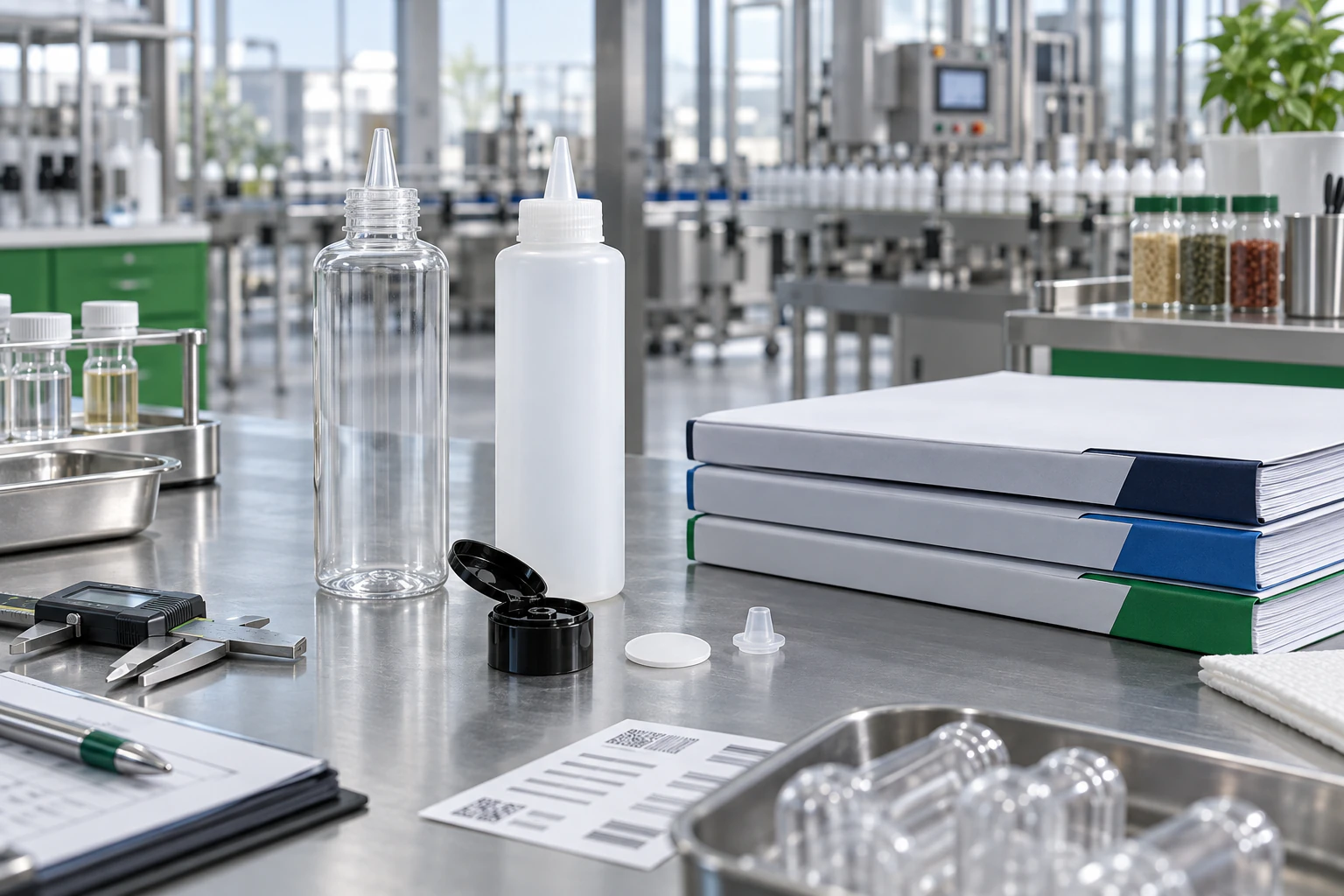
No single certificate proves that a complete condiment package is suitable for the United States, European Union and Australia. A defensible file connects every food-contact component to its material, supplier, intended food, contact time, filling and storage temperature, regulatory basis, test conditions, sample identity and production change controls.
The three markets use different legal mechanisms. U.S. review follows the regulatory status and intended use of each substance, EU plastic packaging relies on a written Declaration of Compliance supported by composition and migration evidence, and Australia places a fit-for-intended-purpose obligation on the food business while allowing several forms of supplier assurance. A useful document package therefore changes by market, even when the physical bottle and closure do not.
| Market | Core compliance logic | Most useful supplier evidence | Not sufficient on its own |
|---|---|---|---|
| United States | Every substance must have a lawful food-contact basis for the intended conditions of use. | Regulatory-status statement or Letter of Guaranty, supporting formulation information and applicable test evidence. | A generic FDA certificate, resin trade name or laboratory report with no intended-use match. |
| European Union | The finished plastic material or article must meet framework, GMP, composition and migration requirements. | Declaration of Compliance with supporting overall and specific migration information for the stated use conditions. | A migration report for a different material, color, component, simulant or temperature. |
| Australia | Packaging must be fit for its intended use and must not contaminate food or make it unsafe. | Supplier assurance, specifications, relevant test reports, traceability records and a documented risk assessment. | A certificate title that does not identify the supplied item or the intended condiment use. |
Start With the Finished Package Bill of Materials
Compliance begins with the package bill of materials, not the bottle drawing alone. A clear PET body may use a PP flip-top cap, a PE liner and a silicone slit valve. Each component has a different composition, manufacturing source and contact pattern. The bottle wall may contact sauce for the full shelf life, while a valve or liner may contact it intermittently or continuously when the pack is stored cap-down.
The bill of materials should identify the commercial item code, polymer family, color or masterbatch, recycled-content route where applicable, closure insert, liner construction, adhesive or coating, supplier and revision. If one of those items changes after testing, the compliance team needs enough information to decide whether the existing evidence still applies.
| Package component | Typical material route | Evidence to match | Common mismatch |
|---|---|---|---|
| Bottle body | PET, HDPE, LDPE, PP or multilayer structure | Material composition, intended use, migration or extraction basis, color/additive route and item identity. | A clear PET report is attached to an opaque HDPE production item. |
| Cap | PP or PE | Resin/additive basis, color route, liner or valve configuration and closure item code. | The cap report covers an unlined closure while the order uses a liner. |
| Liner or induction seal | PE foam, pulp/foil laminate or heat-seal structure | Layer construction, sealant compatibility, intended substrate and food-contact status. | The seal is approved for PET but production switches to HDPE or glass. |
| Reducer or valve | PE, PP or silicone | Component-specific composition, migration basis, dimensions and actual contact condition. | A cap report is assumed to include a separately sourced silicone valve. |
| Decoration | Ink, coating, label and adhesive | Set-off risk, placement, curing and direct-contact exclusion where applicable. | Printing enters the sealing land or an unplanned contact area. |
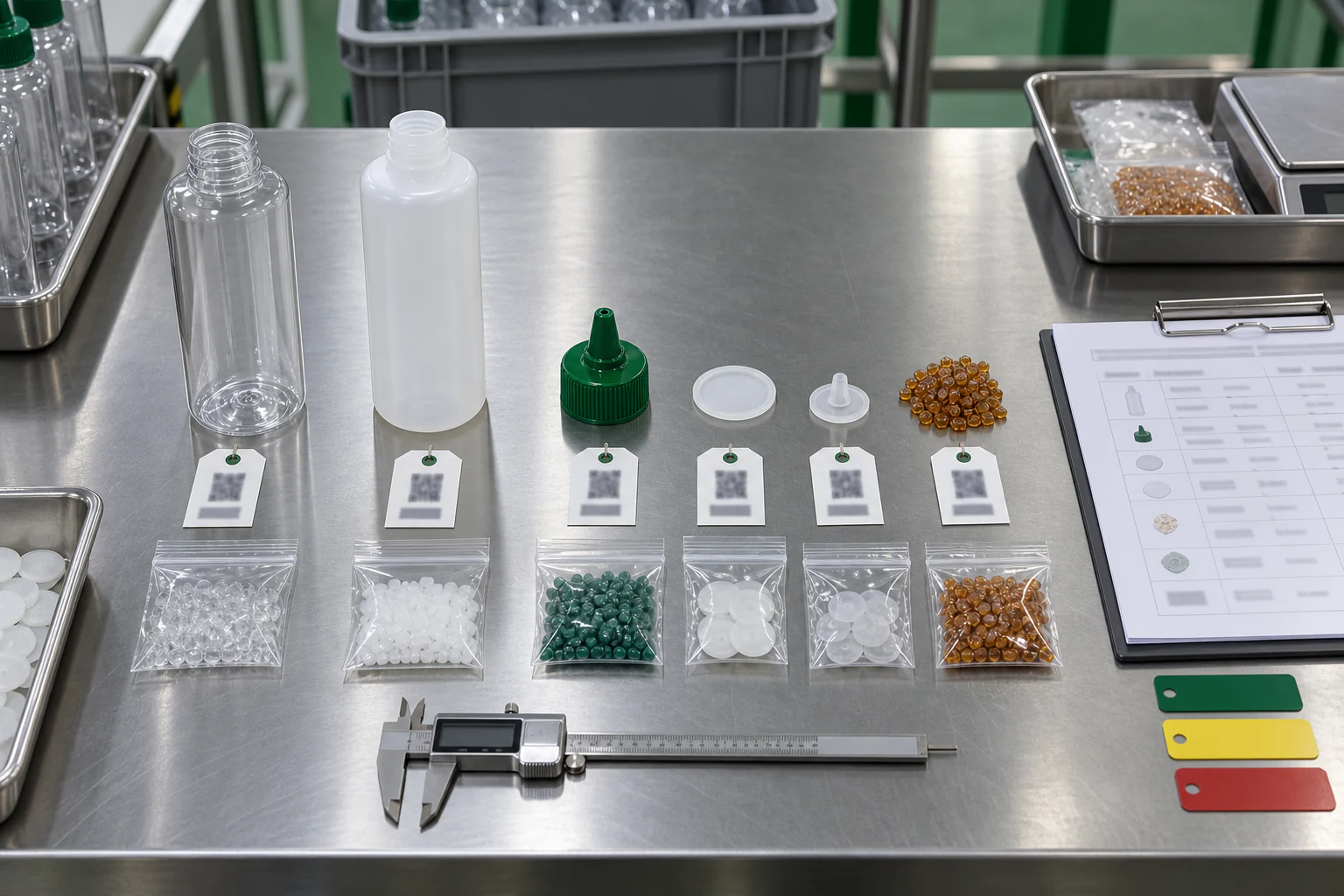
U.S. FDA: Regulatory Basis, Intended Use and Letters of Guaranty
The FDA food-contact regulatory status framework starts with substances, not with a universal approval certificate for a finished bottle. Each resin, additive, colorant, coating and processing aid needs an applicable legal basis, such as a regulation in 21 CFR Parts 174 through 179, an effective Food Contact Notification, a prior sanction, a Threshold of Regulation exemption or another lawful route. The permitted use may be limited by food type, temperature, contact time or manufacturer.
A supplier Letter of Guaranty can be valuable because it states that the supplied article complies with the Federal Food, Drug, and Cosmetic Act under identified conditions. It should name the product or item family, the regulatory basis, any limitations and the issuing legal entity. It is not strengthened by an FDA-style logo, and it should not be represented as a government-issued certificate.
Material-specific extraction reports can support the file when they fit the actual polymer and use condition. For example, 21 CFR 177.1630 addresses polyethylene phthalate polymers; it is not a blanket legal basis for PP caps, PE liners or silicone valves. The finished package review must still connect every component to its own route and account for the acidic, aqueous, fatty or alcoholic character of the condiment.
| U.S. file element | What to verify | Why it matters |
|---|---|---|
| Regulatory-status statement | Specific material, additives, applicable citation or notification, and intended use. | Confirms the legal basis rather than relying on a marketing claim. |
| Letter of Guaranty | Issuer, covered item, conditions and date or revision. | Connects supplier responsibility to the commercial component. |
| Supporting test report | Sample identity, method, extraction media, time and temperature. | Shows whether the physical sample and intended condition match. |
| Food and use conditions | Acidic, fatty, aqueous or alcoholic food; hot fill, refrigerated or ambient storage. | A lawful use at one condition does not automatically cover every condition. |
| Change notification | Resin, additive, pigment, source or process changes. | Protects the approved file from silent production drift. |
European Union: Declaration of Compliance and Migration Support
EU food-contact materials legislation combines the general safety framework with good manufacturing practice and material-specific rules. Plastic condiment packaging is commonly reviewed against Regulation (EC) No 1935/2004, Regulation (EC) No 2023/2006 on GMP and the current consolidated Plastics Regulation (EU) No 10/2011, including applicable amendments at the time the declaration is issued.
For plastic materials and articles, the Declaration of Compliance is a supply-chain document with defined information. It identifies the business operator, material or article, date, relevant legislation, adequate information on restricted substances, dual-use additives where relevant, and specifications for use such as food type, time and temperature. Supporting documents must be available to competent authorities on request; they can include composition data, calculations, migration tests, worst-case reasoning and other safety evidence.
Migration testing is not meaningful without its conditions. Overall migration controls the total non-volatile transfer under defined conditions, while specific migration limits apply to named substances. The chosen simulant and test duration should represent the sauce and its foreseeable worst-case contact. A 10-day test at 40 degrees C may support certain long-term room-temperature uses, but it should not be copied into a file without checking the regulation's migration-testing tables and the actual process.
| EU document layer | Expected content | Audit question |
|---|---|---|
| Declaration of Compliance | Identity, issuer, regulatory references, restrictions and intended-use specifications. | Does it identify the exact material or article supplied? |
| Composition support | Authorized substances and restrictions relevant to the material formulation. | Does the declaration cover the selected color and additive package? |
| Overall migration | Total migration result under stated simulant, time and temperature. | Do the test conditions represent the condiment and shelf-life route? |
| Specific migration | Results, calculations or compliance reasoning for restricted substances. | Are relevant SMLs and analytical limits addressed? |
| GMP and traceability | Controlled manufacturing, batch identity and supply-chain records. | Can the tested sample be linked to the production item and lot? |
Australia: Fit-for-Intended-Use Evidence Under FSANZ
Australia does not mirror the EU plastics regime with one universal Declaration of Compliance format for every general packaging polymer. Under the Australia New Zealand Food Standards Code, the food business must use packaging that is fit for its intended use, is unlikely to contaminate food and does not create contamination during packaging. The business therefore remains responsible for assessing the pack rather than simply filing a supplier certificate.
A practical Australian technical file can combine a supplier specification, Certificate of Conformance, material declaration, relevant migration or extraction reports, batch traceability and a packaging risk assessment. Overseas evidence can be useful when its scope is transparent, but an EU DoC or U.S. letter does not automatically become an Australian approval. The Australian business still needs to show that the evidence is relevant to its sauce, process, distribution and storage conditions.
For acidic or oil-containing condiments, review direct versus indirect contact, long storage, elevated temperature, cap-down orientation, recycled content, print and adhesive placement, and the possibility of flavor or odor transfer. Retailer specifications may add requirements beyond the Food Standards Code, so the document list should be confirmed before the commercial sample is locked.
| Australian evidence | Useful role | Limit to understand |
|---|---|---|
| Supplier declaration or CoC | Identifies the product and states conformance to agreed specifications. | Only useful when the specification and intended use are clear. |
| Migration or extraction report | Provides test evidence for a selected material and contact condition. | Must match the actual item and a relevant test scenario. |
| Risk assessment | Connects food chemistry, process, storage and packaging construction. | Cannot rely on generic statements without package data. |
| Retailer or customer standard | Adds commercial acceptance criteria and document format. | May be stricter than the baseline legal obligation. |
| Traceability and change control | Links the approved file to production lots and later revisions. | A historic report cannot cover an uncontrolled material change. |
DoC, Letter of Guaranty, CoC, COA, TDS and SDS: What Each File Proves
Document names are often treated as interchangeable during sourcing, but they answer different questions. The most common audit error is accepting a technical data sheet or safety data sheet as proof that a finished food-contact component complies with the destination market. A strong file uses each document for its intended purpose and closes the gaps between them.
| Document | Primary purpose | What it can support | What it cannot prove alone |
|---|---|---|---|
| EU Declaration of Compliance (DoC) | Formal supply-chain compliance statement for covered materials or articles. | Regulatory basis, restrictions, intended-use conditions and responsible issuer. | That an unrelated production item or changed formulation remains covered. |
| U.S. Letter of Guaranty | Supplier assurance for compliance under stated U.S. conditions. | Commercial item, legal basis, limitations and supplier responsibility. | Universal FDA approval for every food and temperature. |
| Certificate of Conformance (CoC) | Confirms a lot or item conforms to agreed specifications. | Identity, production checks and contractual specifications. | A complete legal food-contact assessment unless the cited specification provides it. |
| Certificate of Analysis (COA) | Reports measured lot-level values for resin or production material. | Batch identity, selected quality values and traceability. | Finished-package compliance or suitability for every market. |
| Technical Data Sheet (TDS) | Describes typical material and performance properties. | Density, melt flow, mechanical or thermal guidance and processing window. | Legal authorization, migration compliance or a guaranteed lot result. |
| Safety Data Sheet (SDS/MSDS) | Communicates workplace hazards, handling and emergency information. | Occupational safety and transport handling for substances or mixtures. | Food-contact suitability of a bottle, cap, liner or valve. |
| Laboratory test report | Records results for an identified sample under stated methods and conditions. | Migration, extraction, restricted-substance or sensory evidence. | Coverage of items, colors, sources or uses outside the report scope. |
Match Test Conditions to Acidic, Oily and Hot-Fill Condiments
Condiment chemistry changes the migration question. Vinegar-based hot sauce emphasizes acidic contact; mayonnaise-style sauces and oil-rich dressings add fatty-food considerations; fermented sauces may contain salt, organic acids and flavor-active compounds; hot filling increases diffusion while the polymer is warm. The review should describe the complete contact history from filling through the stated shelf life.
Food simulants are controlled test media, not substitutes chosen by color resemblance. Their selection follows the applicable market rules and the food's chemical behavior. Time and temperature are equally important because migration generally increases with warmer and longer contact. When a bottle is sold for several formulas, the test plan should cover the worst relevant case or clearly limit the approved applications.
Closures deserve the same attention as the body. Cap-down packs keep sauce against the valve, liner and sealing land for long periods. Inverted storage, hot cap application, torque, induction sealing and post-fill cooling can change both migration exposure and seal integrity, so the technical file should reflect the final orientation and process.
| Use condition | Risk to examine | Evidence direction |
|---|---|---|
| Acidic sauce | Migration under low-pH contact and possible metal or additive restrictions. | Use the applicable acidic-food simulant and matching time-temperature condition. |
| Oil-rich or emulsified sauce | Fat-soluble constituent transfer, swelling, flavor scalping or liner interaction. | Select the applicable fatty-food route, reduction factors and component set. |
| Hot fill | Higher diffusion, bottle deformation and longer warm contact during cooling. | Match the maximum fill temperature, dwell and cooling profile to the material route. |
| Ambient long shelf life | Cumulative migration, oxygen exposure and organoleptic change. | Use a justified accelerated or equivalent long-term test condition. |
| Cap-down storage | Continuous contact with valve, liner, cap and sealing land. | Include the complete closure assembly in orientation and migration review. |
| Multiple sauce formulas | One formula may be more acidic, fatty or alcoholic than the others. | Qualify the worst relevant case or state clear application limits. |
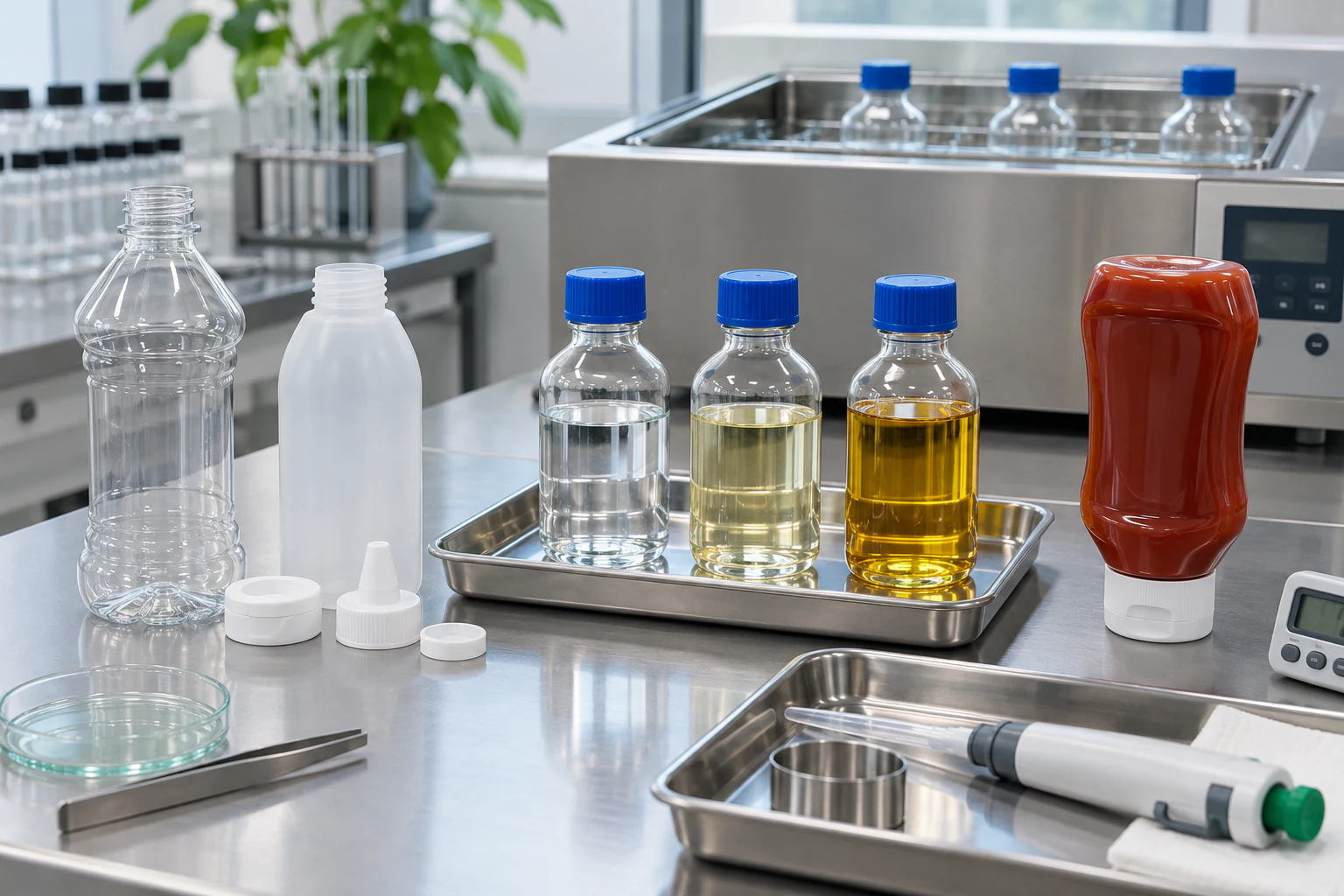
Gracepack Component-Level Evidence Map
Gracepack organizes food-contact support around the selected component route. For clear PET projects such as Clear Condiment Squeeze Bottles, available records can include U.S. extraction-based and EU migration-related evidence for selected items. For HDPE or LDPE routes such as soft-touch squeeze condiment bottles, the file is matched separately to the opaque or flexible bottle body rather than borrowed from PET.
The same component rule applies to Condiment Caps and Closures. Selected PP and PE cap or liner routes have their own material and migration support, while silicone valve caps require evidence for the silicone component and should not be treated as covered by the outer PP closure. Some selected third-party test routes include acidic and aqueous simulants, oil-representative conditions where applicable, and extended contact such as 10 days at 40 degrees C; the final scope is checked against the ordered item and intended use before it is presented as project evidence.
Factory-system certificates and enterprise standards provide useful manufacturing context, but they do not replace product-specific food-contact support. An ISO 22000:2018 system certificate may help a customer assess the scope of food-packaging controls, while the final compliance decision still depends on the actual resin, component, sauce condition, destination and current document revision.
| Gracepack review layer | Project output | Control point |
|---|---|---|
| Component map | Bottle, cap, liner, reducer, valve and decoration listed separately. | No report is allowed to silently cover a different component. |
| Available evidence map | Existing declarations, reports and material statements matched to candidate items. | Gaps are identified before commercial sample approval. |
| Use-condition check | Sauce type, oil content, fill temperature, storage time and orientation recorded. | The evidence is not detached from the actual application. |
| Sample and report identity | Item code, sample description, material, color and supplier route compared. | The approved sample can be traced to the supporting file. |
| Change control | Reassessment trigger for material, color, source or process changes. | Repeat orders do not rely on obsolete assumptions. |
Supplier Audit: How to Detect a Document-Product Mismatch
A polished report can still be irrelevant. The quickest audit is to compare the document's sample description with the approved bill of materials, then follow the evidence through material, color, component, intended use and date. Any unexplained difference should be closed in writing before the purchase order is released.
The document should also be readable as a chain. The commercial item maps to a production specification; the specification maps to the declared material and supplier; the supporting test maps to an identifiable sample; and the intended use maps to the selected food simulant, time and temperature. A broken link in that chain is more important than the visual appearance of the certificate.
- Compare the report sample name, photo or item number with the exact quotation and approved sample.
- Confirm whether the tested material includes the production colorant, recycled content and additive package.
- Check whether the cap report includes the liner, reducer or valve actually supplied.
- Verify that the laboratory, report number, issue date, page count and test method are complete and internally consistent.
- Compare simulant, contact time and temperature with the condiment and filling process.
- Ask whether the report applies to one supplier, one formulation or a broader controlled family.
- Record what manufacturing change would trigger document review or retesting.
Document Change Control After Sample Approval
Compliance is not finished when the first sample is signed. A new resin grade, pigment, recycled-content percentage, cap supplier, liner laminate, silicone formulation, molding site or processing aid can change the basis of the approved file. The purchase specification should require notification before a controlled food-contact input is changed.
For repeat orders, keep the approved bottle and closure item codes, signed sample, bill of materials revision, current declarations, key reports, supplier statements and batch records together. Review document expiry or update status according to the issuing document and customer procedure; regulations can also be amended, so a historic citation should be checked when a product is relaunched or its intended use changes.
A compact approval record is often more useful than a large unindexed folder. It should show which files cover which components, what uses were evaluated, what remains outside scope, who approved the package and what event triggers reassessment.
| Change | Reassessment question | Typical action |
|---|---|---|
| Resin or additive supplier | Does the new formulation have the same lawful basis and restrictions? | Obtain updated supplier evidence and review testing need. |
| Color or masterbatch | Are colorants and carrier resin covered? | Update composition statement and migration assessment where needed. |
| Closure, liner or valve | Does the new component change contact materials or seal exposure? | Update the bill of materials and component evidence. |
| Higher fill temperature | Do the existing use conditions cover the new thermal profile? | Reassess migration, deformation and closure performance. |
| New destination market | Does the current file meet that market's legal and customer format? | Create a market-specific gap list before shipment. |
| PCR content introduction | Is the recycled-content process and food-contact route supported? | Review source, decontamination basis, variability and final item evidence. |
FAQ About Condiment Packaging Compliance Documents
Does the FDA issue a certificate for every food-contact condiment bottle?
No. The FDA regulates the substances and intended uses through applicable regulations, effective notifications and other lawful routes. A supplier may provide a Letter of Guaranty or regulatory-status statement, but that is not a universal government-issued certificate for the finished package.
Is an EU migration test report the same as a Declaration of Compliance?
No. A laboratory report records results for an identified sample under stated conditions. The Declaration of Compliance is the formal supply-chain statement required for covered plastic materials and articles and is supported by test data, composition information, calculations or other evidence.
What packaging documents are useful for Australia?
A practical file can include supplier specifications, a Certificate of Conformance, material statements, relevant migration or extraction reports, batch traceability and a risk assessment that shows the packaging is fit for the intended food and process.
Can one report cover the bottle, cap, liner and silicone valve?
Only when the scope clearly identifies and evaluates every component. In most projects, different materials and suppliers require separate evidence that is assembled into one package-level compliance map.
Is an SDS or MSDS proof of food-contact compliance?
No. A safety data sheet is primarily for workplace hazards and handling. It does not by itself establish that a finished bottle or closure is suitable for food contact under the intended market and use conditions.
What should I send for a cross-market document review?
Send the destination markets, bottle and closure item codes, material and color, liner or valve construction, sauce type, pH if available, oil content, fill temperature, shelf life, storage orientation, artwork method and any retailer-specific document list.
Request a Cross-Market Food-Contact Document Review
If your condiment package will be sold in the United States, European Union or Australia, send Gracepack the intended markets and the complete component list before the commercial sample is locked. We can map available evidence to the selected bottle, cap, liner, reducer and valve, identify missing support and define which questions need confirmation from the material supplier or an independent laboratory.
The first review does not require a finished regulatory dossier. A bottle photo or drawing, capacity, material, color, cap route, sauce chemistry, filling temperature, shelf-life target and destination are enough to establish the document path and prepare a relevant sample set.


