
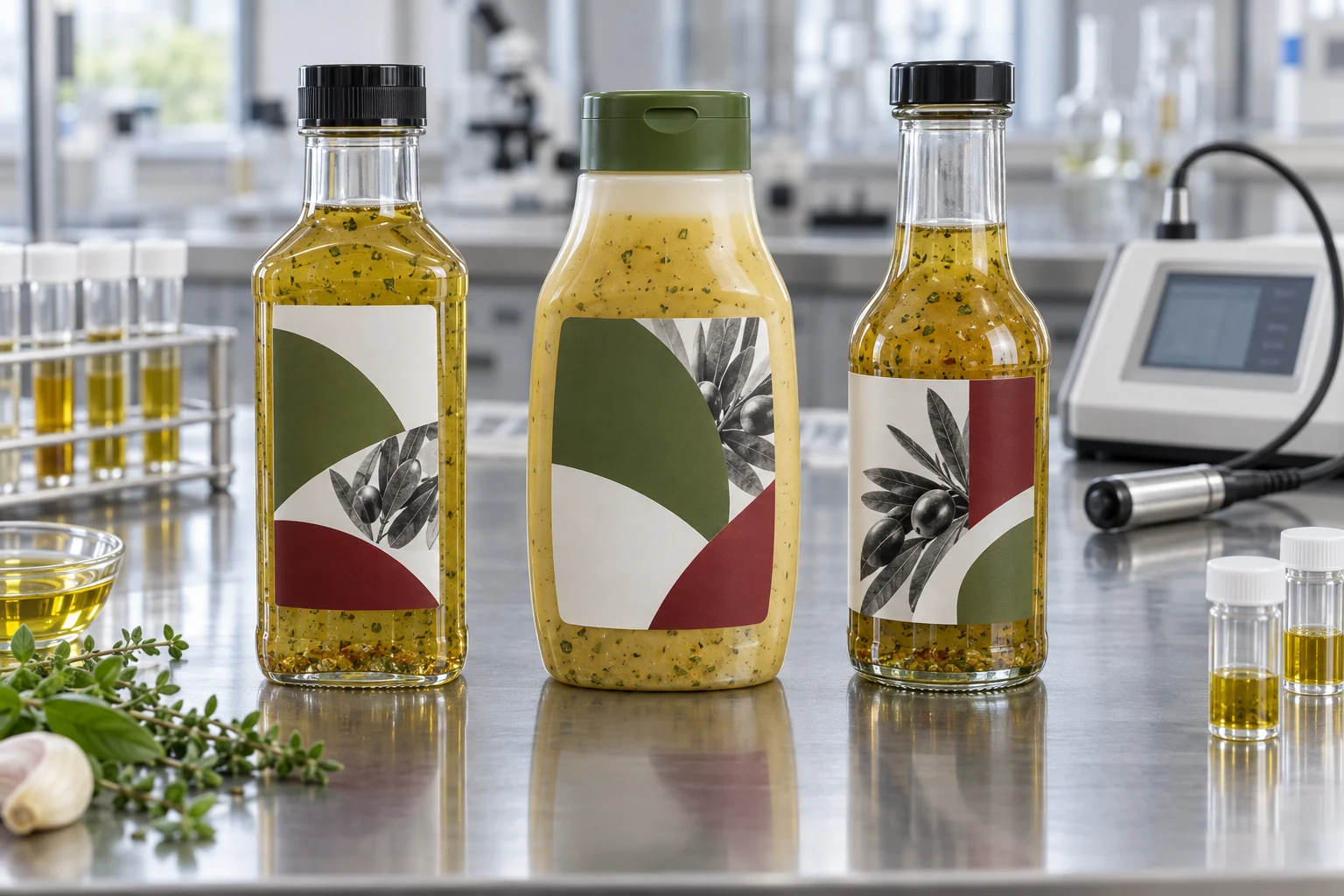
An EVOH bottle can reduce oxygen entering through the container wall, but it cannot remove oxygen already dissolved in the dressing, trapped in the headspace or leaking through the closure. Shelf life improves only when those four oxygen sources are treated as one package system. For an oxidation-sensitive vinaigrette, the strongest bottle wall can still be defeated by foamy filling, excessive headspace, an incomplete induction seal or a dispensing cap that leaks after opening.
Oil-based dressings are especially sensitive because unsaturated fatty acids react with oxygen to form hydroperoxides. Those primary products can then break down into aldehydes, ketones and other compounds associated with rancid odor, stale flavor and loss of delicate herb notes. Light, heat, trace metals and repeated oxygen exposure after opening can accelerate the same pathway.
The first engineering task is therefore to establish an oxygen budget for the finished package, then assign a measurable control to each source. Bottle-wall barrier is one line in that budget, not the entire answer.
| Oxygen Source | How It Enters the System | Useful Control | Verification |
|---|---|---|---|
| Dissolved oxygen | Air incorporated during mixing, pumping and filling | Low-aeration processing and controlled transfer | Dissolved oxygen at filling and after process holds |
| Headspace oxygen | Air remaining above the fill after capping | Fill-height control and validated inert-gas displacement | Headspace oxygen immediately after sealing and during storage |
| Bottle-wall ingress | Oxygen permeation through the container over time | Monolayer PET, coated PET or multilayer EVOH route matched to the target | Container OTR at stated temperature and relative humidity |
| Closure ingress | Leak paths through the finish, liner, valve or cap interface | Matched neck finish, liner, torque and seal process | Seal inspection, leak testing and package oxygen trend |
Why Oil-in-Water Dressings Can Oxidize Before the Oil Looks Spoiled
A salad dressing does not behave like a bottle of neat oil. In an oil-in-water emulsion, the oil is divided into droplets with a large total interfacial area. Pro-oxidant metals, acids, proteins, spices and antioxidants may concentrate in different phases or at the droplet interface, so oxidation behavior depends on the complete recipe and process rather than oil percentage alone.
Olive, canola, sunflower and other unsaturated oils have different fatty-acid profiles and starting oxidation histories. Garlic, herbs, pepper, citrus and natural flavors add volatile compounds that may be lost or altered before a consumer notices a major color change. A creamy dressing can also hide visual oxidation, making sensory and chemical checkpoints more important than appearance alone.
Package selection should begin with the actual formula, initial oil quality, mixing shear, thermal history and desired shelf life. A bottle change cannot recover shelf life already consumed by oxidized incoming oil or excessive air incorporation upstream.
Build an Oxygen Budget Before Specifying EVOH
A practical oxygen budget combines the oxygen present at pack-off with the oxygen expected to enter during distribution. The starting load includes dissolved oxygen in the dressing and oxygen in the sealed headspace. The storage load includes transmission through the bottle wall and closure, plus any leakage introduced by an imperfect seal. Each term must use the same time basis and the same production-representative package.
Container oxygen transmission data must state the test temperature, relative humidity, package area or volume basis and whether the result applies to a flat film, preform or finished bottle. ASTM D3985 is a recognized method for films, sheets, laminates and coextrusions, but a film value should not be presented as a finished-container guarantee. Bottle geometry, wall distribution, closure area and humidity exposure can change the package result.
Set the allowable oxygen exposure from product evidence, not from a generic packaging target. A dressing made with refined oil and robust antioxidants may tolerate a different package from a cold-pressed oil dressing with fresh herbs and a clean-label formula.
| Input Needed | Why It Changes the Decision | Minimum Useful Record |
|---|---|---|
| Oil type and percentage | Changes oxidative sensitivity and fatty-food contact conditions | Approved formula range and incoming-oil specification |
| Initial dissolved oxygen | Defines oxidation load before package ingress begins | Measurement at filler bowl and sealed pack-off |
| Headspace volume | A larger air volume can add more available oxygen | Fill-height distribution and headspace oxygen |
| Target shelf life and climate | Time, temperature and humidity affect barrier demand | Distribution profile and real-time storage condition |
| Bottle and closure transmission | Identifies the package contribution over time | Test method, conditions, units and component version |
When a Multilayer EVOH Bottle Is the Right Route
A monolayer PET package may be adequate for a stable dressing with a short distribution cycle, controlled light exposure and modest oxidation sensitivity. A multilayer EVOH route becomes more relevant when the product contains oxidation-prone oils, natural herb or spice aromas, limited antioxidant protection, a long ambient shelf life or distribution through warm and humid markets.
EVOH is used as a buried gas-barrier layer because its oxygen barrier is much stronger than common structural polyolefins. It is normally protected between moisture-resistant structural layers, with tie resins bonding dissimilar polymers. The structural layers provide shape, squeeze response and impact performance; the EVOH layer manages gas transmission; the inner layer provides the intended food-contact surface.
Barrier performance cannot be assigned from layer count alone. EVOH grade, ethylene content, layer thickness, wall distribution, moisture exposure, bottle geometry and conversion quality all matter. A five-layer bottle with poor wall distribution may be less reliable than a properly specified structure with verified container data. Delamination, pinholes and thin shoulder zones should be treated as package defects, not cosmetic variation.
| Package Route | Where It Can Fit | Main Limitation | Approval Evidence |
|---|---|---|---|
| Monolayer clear PET | Cold-filled dressings with validated moderate barrier demand | Wall ingress and full light exposure may limit shelf life | Finished-bottle OTR and filled-product study |
| Barrier-coated PET | Clear retail appearance with an enhanced wall barrier | Coating coverage, scuff resistance and process consistency | Container data before and after distribution conditioning |
| Multilayer EVOH bottle | Longer-life or more oxidation-sensitive dressing programs | Humidity sensitivity, layer distribution and recycling route | Section analysis, OTR conditions and filled-package stability |
| Tinted barrier bottle | Light- and oxygen-sensitive natural formulas | Reduced product visibility and color consistency | Spectral transmission, OTR and shelf presentation |
| Glass control | Benchmark for near-zero bottle-wall gas transmission | Breakage, weight and closure still remain | Matched fill, closure and shelf-life comparison |
Control Headspace Oxygen Before It Reaches the Barrier Wall
Headspace management starts before the cap is applied. A low-splash filler, stable product temperature, controlled nozzle immersion and short transfer path can reduce air entrainment and foam. Fill-height consistency matters because the same residual oxygen percentage represents a different oxygen quantity when headspace volume changes.
Nitrogen flushing can displace air immediately before sealing, but nozzle position, gas purity, flow, timing and the delay to cap application must be validated on the production line. Too little flow leaves oxygen behind; excessive flow can disturb the product surface, increase aroma loss or create inconsistent fill appearance. Liquid-nitrogen microdosing is a separate process that also changes internal pressure and requires purpose-designed dosing, capping and package-pressure validation. It should not be treated as a universal substitute for gaseous headspace flushing.
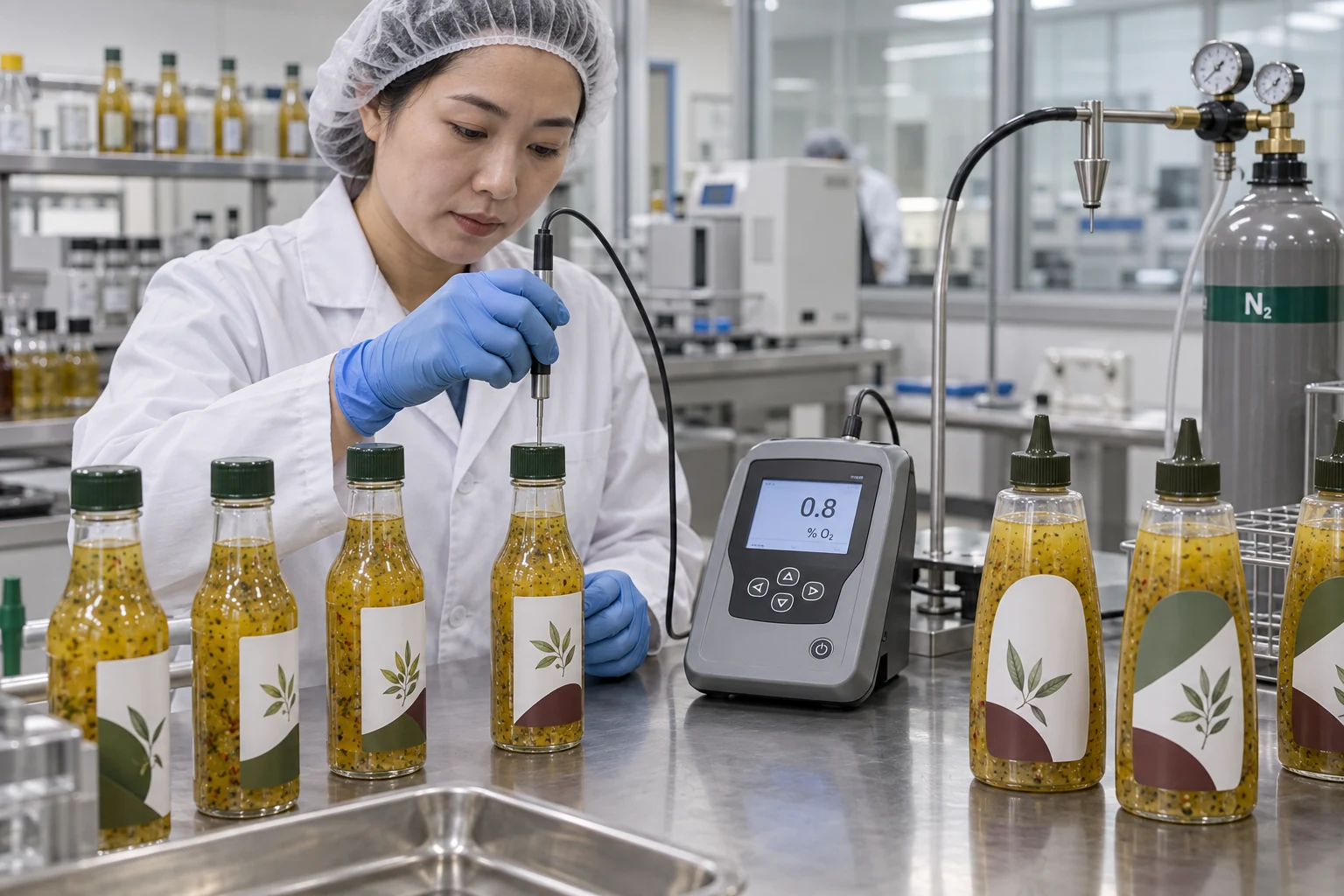
Measure headspace oxygen on freshly sealed packages across line start-up, steady state and planned speed changes. Repeat the measurement after defined storage intervals. A low pack-off value followed by a rapid increase points toward the closure or package barrier; a high initial value points back toward filling and gas displacement.
The Closure and Seal Complete the Oxygen Barrier
A high-barrier bottle needs a closure system with comparable integrity. The sealing land must be flat and undamaged, the cap thread must engage consistently, and the liner must match the bottle material, finish and filling process. Application torque that is too low can leave a leak path; excessive torque can distort the liner, finish or cap and produce a different failure.
An induction seal can provide a strong initial barrier and visible opening evidence when the foil heat-seal layer is compatible with the container and the sealing window is validated. It protects the unopened package only. After removal, the resealable cap, plug, valve or pour spout becomes the active oxygen and leak-control interface.
Inverted and squeeze formats keep dressing in continuous contact with the closure. Valve cleanliness, slit recovery, cap-well residue and oil exposure therefore belong in the aging study. For a thin vinaigrette, vinaigrette pour bottles also need controlled flow without an oversized air-return path that encourages glugging or leakage.
Design a Filled-Package Oxidation Study That Can Select a Bottle
The most useful shelf-life study compares complete packages while holding the formula and process constant. Prepare production-representative lots in the candidate monolayer bottle, the proposed high-barrier bottle and a glass control where practical. Use the same incoming dressing, fill temperature, headspace target, closure, liner and cap application settings unless the variable is deliberately part of the experiment.
Real-time storage at the intended market condition remains the primary evidence. Accelerated storage can expose differences sooner, but elevated temperature may change emulsion stability, reaction pathways, package permeability and closure behavior. It should be correlated with real-time results rather than converted into an unsupported shelf-life multiplier.
Sample enough bottles to separate package variation from laboratory variation. Record bottle lot, cavity or mold position where available, cap and liner lot, fill sequence, gas settings, torque and storage orientation. Without that traceability, a failed sample cannot be tied to a useful corrective action.
| Study Variable | Controlled Comparison | Checkpoint |
|---|---|---|
| Bottle barrier | Monolayer, proposed barrier and glass control | Container oxygen ingress and product oxidation trend |
| Headspace | Air pack-off versus validated inert-gas process | Initial and stored headspace oxygen |
| Closure | Matched liner, torque window and seal settings | Seal continuity, leak result and removal torque |
| Light | Defined dark and retail-light exposure | Color, aroma and oxidation markers |
| Orientation | Upright, side and cap-down where relevant | Closure contact, weeping, residue and oxygen trend |
| Temperature | Real-time plus justified accelerated condition | Chemical, sensory and package changes over time |
Use More Than One Oxidation Marker
Peroxide value measures primary oxidation products and is useful early in the reaction. Those hydroperoxides can later decompose, so a falling or stable peroxide value does not always mean the product remains fresh. The p-anisidine value addresses secondary aldehydic products, while headspace volatile analysis such as hexanal can help track specific rancid-aroma pathways when the formula and analytical method support it.
Strongly colored spices, natural pigments and emulsified matrices can interfere with some assays. The AOCS peroxide and p-anisidine methods are established oil-analysis references, but the laboratory still has to verify extraction, matrix interference, repeatability and reporting limits for the finished dressing. Sensory work should use a defined panel method and coded samples rather than informal tasting beside the filling line.
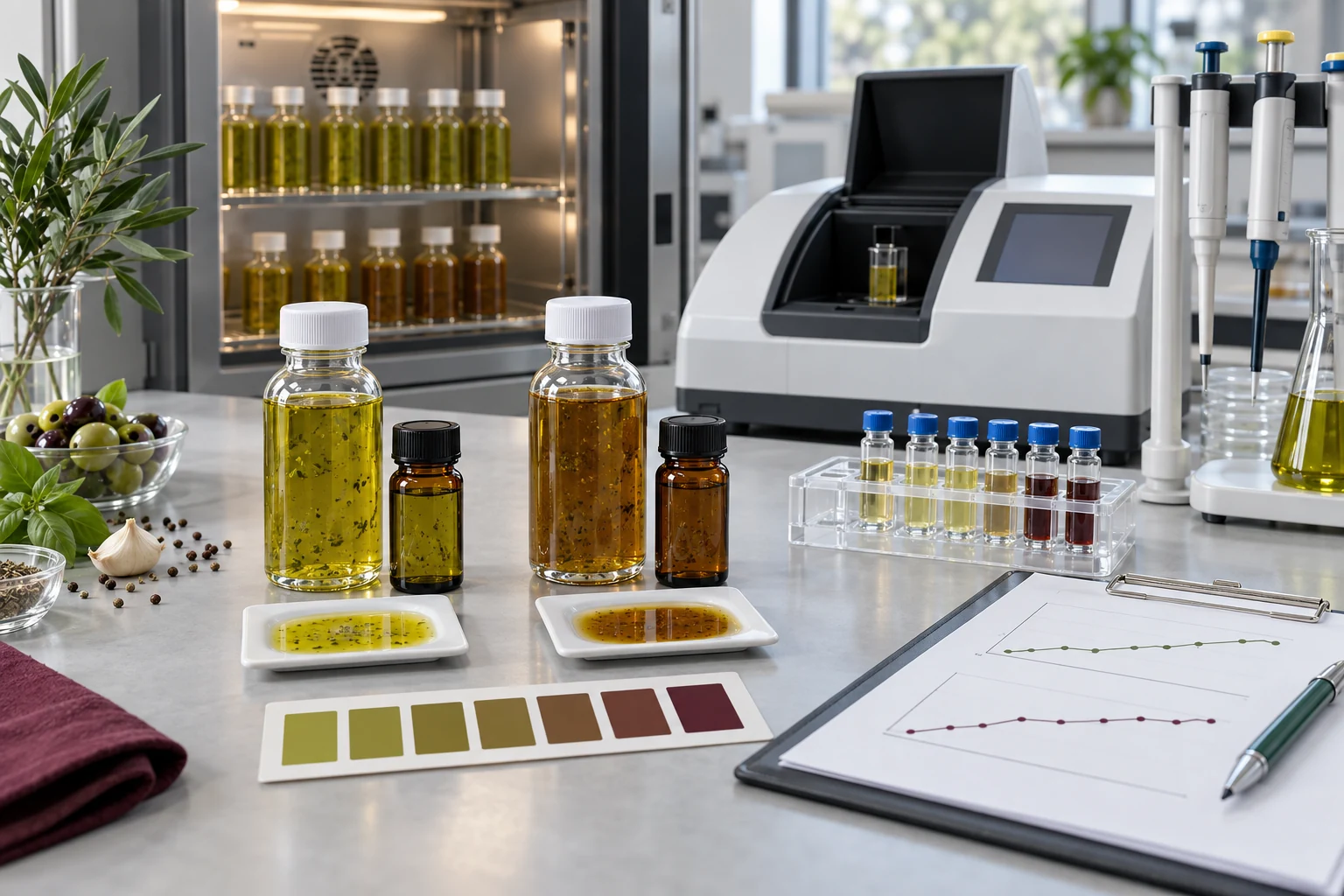
A robust decision combines chemical markers with sensory aroma and flavor, color data, emulsion stability, headspace oxygen, package integrity and a retained baseline. The acceptance limit should be tied to product quality and consumer perception, not chosen only because one candidate bottle produces the lowest number.
Match Food-Contact Evidence to the Actual Oil-Based Package
Food-contact evidence must match the bottle, colorant, cap, liner, valve and intended use conditions. An uncolored PET report does not automatically cover a new barrier resin, tie layer, masterbatch or silicone valve. Oil-and-vinegar dressings can require evidence that addresses both acidic and fatty contact, as well as the actual fill and long-term storage conditions.
For relevant Gracepack component routes, available third-party report families include PET testing under U.S. FDA 21 CFR 177.1630 and European overall-migration work for PET, PP and silicone components using aqueous, acidic and fatty-food simulant routes. The project file can also include ISO 22000 food-safety system documentation. These reports are starting evidence; the final document list is confirmed only after the exact material construction, additives, closure and destination market are fixed.
For a multilayer bottle, request the layer declaration, food-contact layer identity, intended-use limitations and any supporting migration work that covers the finished construction. If recycled content, an oxygen scavenger, UV additive or internal coating is added, the documentation review must be repeated for that version.
How Gracepack Structures a Barrier Bottle Sample Review
A barrier project begins with the dressing and process: oil type and percentage, pH, emulsion, antioxidants, particle size, fill temperature, light sensitivity, headspace target, storage orientation and required shelf life. Gracepack then screens existing bottle and closure geometries before a new mold is considered, identifies the missing barrier and food-contact evidence, and defines a production-representative sample matrix.
The production base includes 13 automatic blow-molding machines, 15 automatic injection-molding machines and 9 fully automatic production lines, supported by labeling and printing equipment. More than 500 owned mold resources and over 5,000 standard bottle types provide practical starting geometries for clear salad dressing bottles, barrier candidates and matched closures without assuming that every formula needs proprietary tooling.
The release gate is based on the approved package, not a resin label. Bottle weight and dimensions, neck finish, liner, torque, seal, fill height, squeeze or pour behavior, OTR evidence and filled-product oxidation results are kept together so the commercial order can reproduce the sample that passed.
Barrier Package Decision Audit
Before approving the bottle specification, confirm that every item below has a named owner, test method and acceptance limit.
- Define oil type, oil percentage, pH, emulsion structure, antioxidants and light-sensitive ingredients.
- Measure dissolved oxygen and headspace oxygen at production-representative pack-off.
- Compare finished-container barrier data at relevant temperature and humidity conditions.
- Verify layer structure, wall distribution and food-contact evidence for the exact bottle version.
- Validate cap, liner, induction seal, torque and post-opening closure performance.
- Run matched real-time samples and a justified accelerated study with a glass control where practical.
- Track primary oxidation, secondary oxidation, sensory change, color and package oxygen together.
- Approve the package only after the bottle, closure, process and shelf-life result meet written limits.
FAQ About Oxygen Barrier Packaging for Oil-Based Dressings
Does every oil-based salad dressing need an EVOH bottle?
No. The need depends on the oil system, antioxidants, initial oxygen, headspace, closure, light exposure, distribution climate and shelf-life target. A monolayer PET package can be sufficient when filled-product evidence supports it.
Can EVOH remove oxygen already inside the bottle?
No. EVOH slows oxygen transmission through the wall; it does not remove dissolved oxygen or headspace oxygen present at sealing.
Is the lowest OTR bottle automatically the best choice?
No. The OTR result must use relevant conditions and be evaluated with closure integrity, fill process, dispensing, food-contact evidence, recyclability, cost and filled-product shelf life.
Which oxidation tests are useful for salad dressing?
A study may combine peroxide value, a suitable secondary-oxidation method such as p-anisidine value, formula-relevant volatile analysis, sensory work, color, emulsion stability and package oxygen measurements.
Does an induction seal solve oxygen ingress after opening?
No. It protects the unopened package. Once removed, the cap, plug, spout or valve becomes the active resealing interface.
What information is needed for a barrier bottle sample review?
Provide the oil type and percentage, pH if available, emulsion and particles, fill temperature, bottle size, closure route, headspace target, storage orientation, destination climate, target shelf life and current oxidation symptoms.
Request an Oil-Based Dressing Barrier Package Review
Send the dressing profile, current package, process conditions and shelf-life target to compare a monolayer control with practical high-barrier bottle and closure routes. A useful review can define the sample matrix, headspace checks, document list and oxidation test checkpoints before artwork or bulk production is released.
Gracepack can coordinate production-representative bottles and closures around the real formula, then keep the approved component and test requirements together for repeat orders.


