
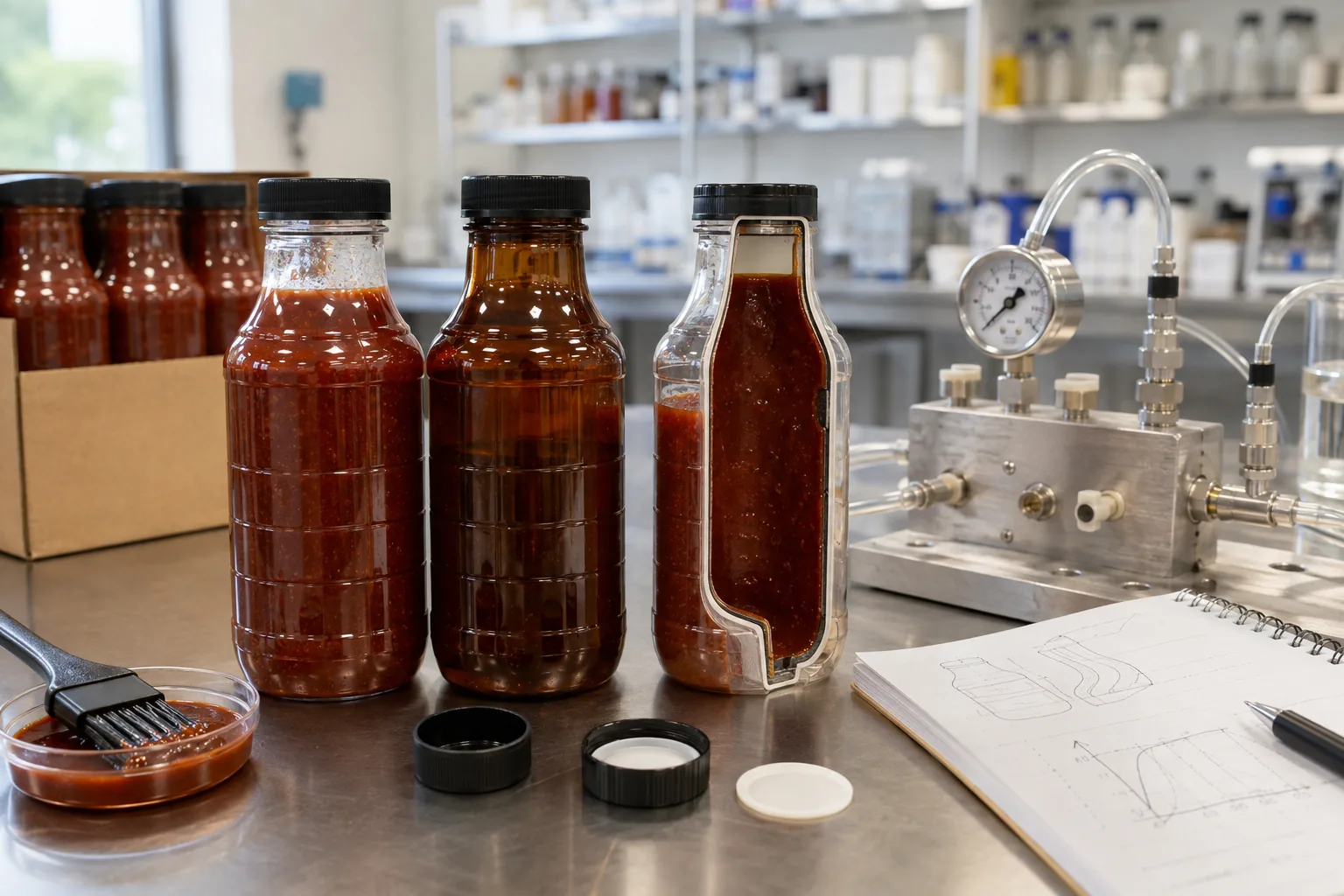
When BBQ Sauce Needs EVOH Barrier Packaging
Extended shelf-life packaging for BBQ sauces uses multilayer barrier technology to slow oxygen transmission, moisture drift, aroma loss and light-related color change. EVOH is typically used as a buried core layer between PP, HDPE, PE or other structural layers because it provides strong oxygen barrier performance while the outer and inner layers protect it from water, handling and direct sauce contact.
A standard monolayer bottle can work for stable, short-cycle BBQ sauce programs, but natural, tomato-rich, smoky, garlic-heavy or oil-containing sauces often need a higher-barrier bottle, liner and closure system. The right choice depends on fill temperature, pH, oil phase, sugar level, target shelf life, distribution temperature, cap seal and whether the package must remain squeezable.
| Packaging Route | Best Fit | Shelf-Life Strength | Engineering Watchpoint |
|---|---|---|---|
| Glass bottle | Premium BBQ sauces, high-acid recipes, hot-fill programs and formulas needing maximum barrier. | Near-total wall barrier against oxygen and moisture. | Heavy freight, breakage risk and higher secondary packaging cost. |
| Monolayer PET | Clear retail display, moderate shelf-life targets and cold-fill or validated warm-fill sauces. | Better gas barrier than many polyolefin squeeze bottles, with strong clarity. | May still allow oxygen ingress over long storage; heat and vacuum behavior must be checked. |
| Monolayer HDPE or LDPE | Squeeze BBQ sauce bottles where flexibility, impact resistance and cost matter most. | Good toughness and useful moisture resistance. | Weaker oxygen barrier can expose tomato, garlic, spice and smoky notes over time. |
| PP / EVOH / PP or PE / EVOH / PE multilayer | Extended shelf-life packaging for BBQ sauces with oxidation risk, hot-fill needs or premium sensory targets. | Strong oxygen barrier with bottle structure tuned for filling, squeezing and sealing. | EVOH layer must be protected from moisture and bonded correctly with tie layers. |
| Induction seal plus matched cap | Retail and export bottles where the mouth opening is a major oxygen or leakage path. | Improves pre-opening barrier and tamper evidence. | Rim finish, liner material, torque and sealing settings decide real performance. |
Why BBQ Sauce Loses Color, Aroma and Freshness
BBQ sauce is chemically active even when the recipe is shelf-stable. Tomato solids, chili pigments, paprika, garlic, onion, smoked flavor compounds, molasses, vinegar and spice oils can react with oxygen during ambient storage. The result is usually not one dramatic failure; it appears gradually as darkening, flatter smoke aroma, stale spice notes, oil-ring discoloration, viscosity drift or cap-area crusting.
Oxygen reaches the sauce through several paths. It can pass through the bottle wall, enter through headspace before capping, leak through a weak cap or liner, and move through microscopic imperfections around the sealing land. Moisture movement creates a separate problem. Water loss can thicken the sauce near the neck or change squeeze behavior, while moisture ingress can dilute surface flavor and encourage quality drift in poorly protected systems.
Light accelerates the same deterioration. Clear packaging sells sauce color well, but visible and UV light can push red and brown pigments toward duller tones. For BBQ sauce brands that rely on a bright tomato base or a clean smoky-red appearance, bottle color, UV blocker, label coverage and secondary carton exposure all belong in the shelf-life discussion.
How Multilayer EVOH Technology Works
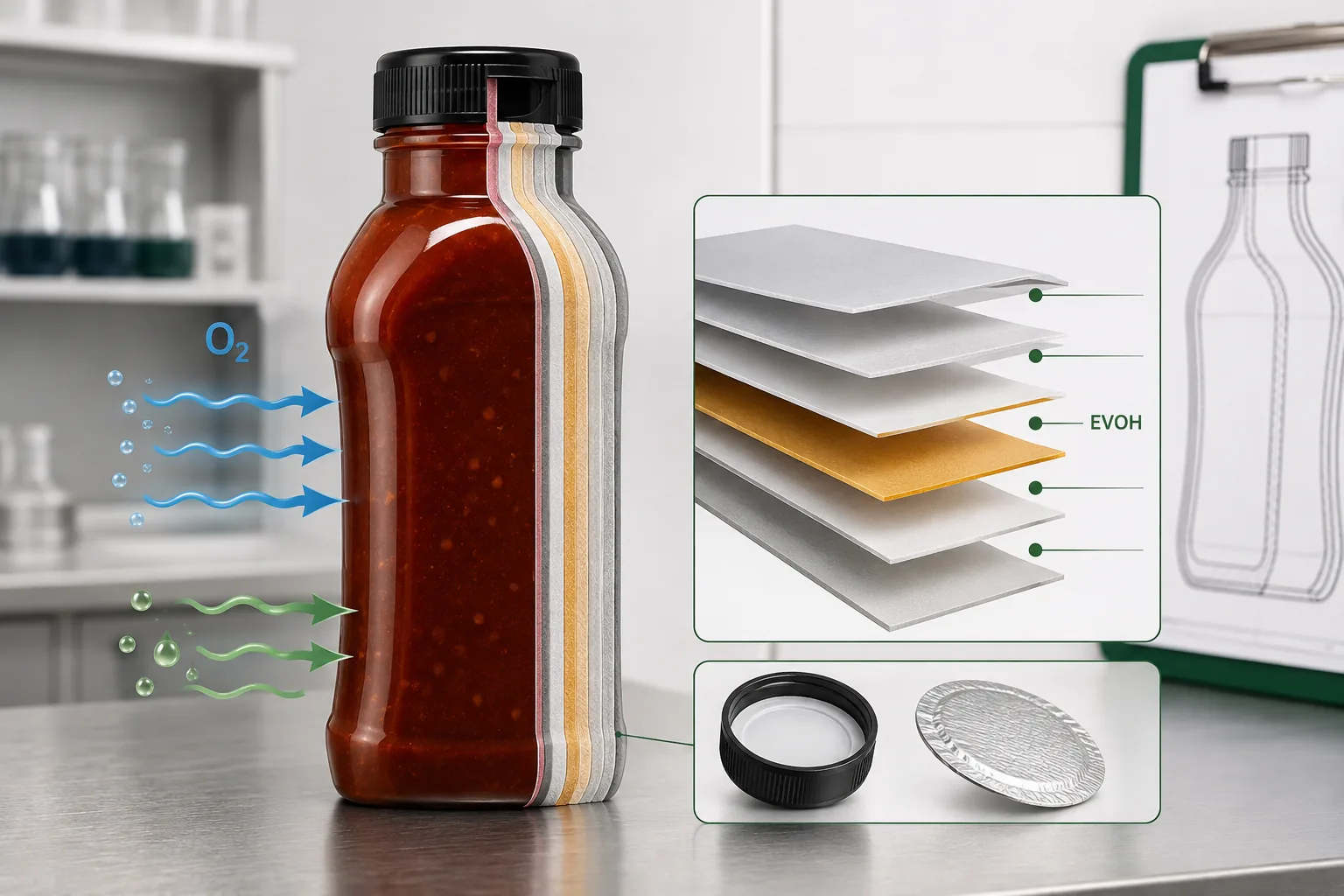
Multilayer barrier technology solves a specific limitation of single-resin plastic bottles. PET, HDPE, LDPE and PP can provide structure, clarity, squeeze feel, chemical resistance or heat tolerance, but none of them behaves like glass against oxygen over demanding shelf-life periods. EVOH adds a thin high-barrier layer inside the bottle wall, reducing oxygen movement before it reaches the sauce.
EVOH is moisture-sensitive, so it should not be treated as a simple exposed coating for water-rich BBQ sauce. The practical structure buries the EVOH between protective layers and uses tie resin to bond dissimilar materials. The outer layer provides stiffness, gloss, color, scuff resistance or heat performance. The inner layer provides the food-contact route, acid resistance and process compatibility. The tie layers keep the structure from delaminating under filling, cooling, squeezing and transit stress.
A typical rigid bottle wall may use a five-layer logic: structural outer layer / tie layer / EVOH barrier / tie layer / food-contact inner layer. Some projects use additional layers to tune recycled content, stiffness, color, hot-fill behavior or sealing compatibility. The exact stack should be selected by the sauce and process, not by the word EVOH alone.
| Layer Position | Typical Material Direction | Primary Function | BBQ Sauce Relevance |
|---|---|---|---|
| Outer layer | PP, HDPE, PET or compatible structural resin. | Appearance, stiffness, scuff control, hot-fill support or color. | Protects the barrier stack during filling, shipping and retail handling. |
| Tie layer | Adhesive resin matched to adjacent polymers. | Bonds the structural layer to EVOH. | Reduces delamination risk during cooling, squeezing and carton pressure. |
| Barrier core | EVOH at a project-dependent percentage and thickness. | Reduces oxygen transmission through the wall. | Protects tomato color, smoky aroma, garlic notes and spice freshness. |
| Tie layer | Second adhesive resin route. | Bonds EVOH to the food-contact inner layer. | Keeps the bottle wall stable under liquid contact and handling stress. |
| Inner layer | PP, HDPE, PE or another food-contact route. | Contacts the sauce and resists acidity, salt, oil and process temperature. | Must match migration documentation and the real BBQ sauce formula. |
OTR, MVTR and the Moisture Sensitivity of EVOH
Oxygen transmission rate, often discussed as OTR, measures how much oxygen passes through a material under defined conditions. Moisture vapor transmission rate, or MVTR, measures water vapor movement. These values are useful only when the test condition is close enough to the real package environment: bottle wall thickness, temperature, humidity, fill level, cap route and storage time all change the practical result.
EVOH is valuable because it can dramatically reduce oxygen movement compared with basic polyolefin structures. Its weakness is humidity. When EVOH absorbs moisture, its oxygen barrier performance can drop because water plasticizes the polymer network and increases molecular mobility. This is why EVOH is usually buried between hydrophobic protective layers instead of sitting directly against a high-water BBQ sauce.
For BBQ sauces, OTR is not the only shelf-life variable. Headspace oxygen, cap liner selection, induction sealing, bottle color, light exposure, carton storage and fill temperature can outweigh small differences in wall barrier. ASTM D3985 is often referenced for oxygen transmission testing of plastic films and sheeting, but a bottle project still needs filled-package shelf-life validation because a rigid container has closures, ribs, shoulders and a mouth finish that a flat film test does not represent.
| Variable | What It Measures | Why It Matters for BBQ Sauce | Validation Direction |
|---|---|---|---|
| OTR | Oxygen movement through the package structure. | Oxygen can darken tomato solids, dull spice notes and flatten smoky aroma. | Compare wall material, cap seal and filled-package aging together. |
| MVTR | Water vapor movement through the package. | Moisture loss can thicken sauce or create neck-area residue. | Check weight loss, viscosity, cap crusting and storage orientation. |
| Headspace oxygen | Oxygen trapped above the sauce at capping. | A high-barrier wall cannot remove oxygen already sealed inside. | Control fill height, deaeration, cap timing and nitrogen option if used. |
| Light exposure | Visible and UV energy reaching the sauce. | Can accelerate color drift in tomato, chili and paprika-based sauces. | Review tint, UV blocker, label coverage and carton exposure. |
| Closure path | Oxygen or moisture movement through cap, liner and seal. | The mouth can become the weakest barrier path. | Validate torque, induction seal, liner compression and leakage. |
Hot-Fill BBQ Sauce and Multilayer Bottle Mechanics
Many BBQ sauces are filled hot to support microbial control and shelf stability. Typical hot-fill planning can sit around 82-92 deg C (180-198 deg F), although the exact process belongs to the sauce producer and food safety team. A multilayer bottle for this environment must survive the fill temperature, cap application, hold time, cooling curve and the vacuum load that develops after sealing.
The pressure change is easy to underestimate. When a hot-filled bottle is capped, the headspace cools and pressure drops. The simplified gas relationship $PV=nRT$ explains the direction: if volume is constrained and temperature falls, internal pressure falls. The filled sauce also contracts as it cools. If the bottle wall and base cannot absorb that negative pressure, the package can panel, ovalize, wrinkle labels or pull the base upward.
PP-based structures are often considered when heat resistance is more important than glass-like clarity. PET-based structures may be better for visual shelf appeal but need careful validation if the fill temperature is high. HDPE or LDPE can help squeeze feel and impact strength but usually need EVOH or another barrier strategy when oxygen-sensitive shelf life is the main requirement.
| Process Condition | Risk in Weak Bottle Design | Barrier-Bottle Response |
|---|---|---|
| 82-92 deg C (180-198 deg F) hot fill | Softening, shrinkage, shoulder distortion or label-panel deformation. | Use heat-capable resin route, heavier neck/shoulder design and controlled cooling trials. |
| Cooling after cap application | Vacuum paneling, ovalization or base deformation. | Use ribs, vacuum panels, flex base or controlled headspace strategy. |
| High viscosity and spice solids | Slow heat release and uneven local stress. | Validate with real BBQ sauce, not water-only samples. |
| Cap torque while warm | Thread stress, liner over-compression or later cap back-off. | Define torque range after filled samples and cooling checks. |
| EVOH multilayer stack | Delamination or barrier loss if bonding and moisture shielding are weak. | Use tie-layer compatibility checks and filled storage validation. |
Bottle, Closure and Seal Must Work as One Barrier System
A high-barrier bottle wall does not guarantee extended shelf life if the closure path is weak. BBQ sauce can leave oil, sugar, spice and tomato residue on the rim during filling. That residue can interfere with induction sealing or liner compression. Cap torque can also drift after warm filling, vibration, pallet compression or e-commerce handling.
Induction seals can improve pre-opening oxygen and moisture protection because the foil layer closes the bottle mouth until the consumer removes it. The seal still needs the right liner construction, sealing land, cap pressure and dwell setting. If the rim is warped, wet or poorly matched to the liner, the seal may look acceptable while leaving weak spots around the mouth.
Tamper-evident caps, neck bands and reducer inserts can all be part of the system, but they should not be selected only for appearance. A reducer can improve dosing for thinner BBQ sauces, while a wide flip-top or nozzle may work better for thick sauces with spice particles. The closure has to match viscosity, particle size, storage orientation and the level of oxygen protection required before first opening.
| Package Element | Shelf-Life Risk | Engineering Check |
|---|---|---|
| Bottle wall | Oxygen ingress, moisture drift, light exposure or thermal deformation. | Review material stack, color, wall distribution, hot-fill fit and barrier target. |
| Neck finish | Leakage, poor seal pressure or cap mismatch. | Check finish code, sealing land flatness, thread engagement and neck ovality. |
| Liner or induction seal | Oxygen path through the mouth before opening. | Validate liner route, foil seal, dwell time, peel quality and rim cleanliness. |
| Cap torque | Cap back-off, liner damage or squeeze leakage. | Test applied torque, removal torque and retention after cooling and vibration. |
| Reducer or valve | Clogging, residue, weeping or oxygen path after use. | Test with final sauce viscosity, particles and storage orientation. |
Gracepack Factory Support for EVOH BBQ Sauce Bottle Projects
Gracepack supports BBQ sauce and condiment projects from bottle selection through cap matching, sample review, documentation mapping and export packing. For extended shelf-life packaging, the useful conversation begins with the formula and process: sauce type, pH if available, oil level, solids, viscosity, fill temperature, target shelf life, package size, cap route and destination market.
The manufacturing base includes 500+ owned molds, 5,000+ standard bottle designs, 15 automatic injection molding machines, 13 automatic blow molding machines, 9 fully automatic production lines, 3 labeling machines and 5 printing machines. That range helps compare stock bottle options against custom mold development when a brand needs a specific BBQ sauce silhouette, squeeze feel, label panel or barrier structure.
Food-contact support can be matched by component route, including PET FDA and BPA-related documentation, EU food-contact routes for PET, PP, PE and silicone components, HDPE and LDPE migration support, ISO 22000 documentation and enterprise standards for food-grade plastic bottles and caps. The final document set should match the actual bottle, cap, liner, reducer, valve, colorant and intended market.
| Project Input | Gracepack Review Direction | Commercial Value |
|---|---|---|
| BBQ sauce formula profile | Acidity, oil, color, spice solids, viscosity and filling temperature. | Avoids choosing barrier material from a generic sauce name. |
| Bottle size and dispensing style | Squeeze bottle, table bottle, bulk bottle, nozzle, reducer or flip-top route. | Keeps shelf-life protection aligned with consumer use. |
| Barrier target | Monolayer PET, HDPE, LDPE, PP, EVOH multilayer or glass benchmark. | Controls cost by matching barrier level to real shelf-life risk. |
| Cap and seal system | Liner, induction seal, torque, tamper evidence and storage orientation. | Prevents closure leakage from defeating the bottle-wall barrier. |
| Export and carton plan | Carton dimensions, CBM, gross weight, pallet plan and retention samples. | Connects shelf-life validation with shipment reality. |
Factory and Co-Packer SOP for Barrier Bottle Validation
A multilayer EVOH bottle should be approved through filled-package testing, not only an empty bottle photo. The first trial should use the intended sauce or a close pilot batch with similar acidity, oil, solids and viscosity. Water-only tests can confirm basic leakage, but they cannot represent tomato pigment oxidation, spice oil interaction, residue behavior or hot-fill cooling stress.
For hot-fill BBQ sauce, record the sauce temperature at filler discharge and at bottle entry, the time between filling and capping, applied cap torque, induction-seal settings if used, cooling bath or tunnel condition, final bottle shape and removal torque after cooling. For cold-fill or warm-fill routes, record sanitation method, fill temperature, cap torque, headspace, storage orientation and early leakage checks.
Retention samples should be stored under realistic conditions. At minimum, compare upright and inverted or side-loaded samples when the package may ship through parcel or distributor handling. Review color, odor, sauce separation, weight loss, cap residue, liner condition, label lift, panel shape and removal torque over the planned checkpoint schedule.
| Validation Step | What to Record | Failure It Catches |
|---|---|---|
| Incoming sample inspection | Bottle weight, dimensions, neck finish, wall distribution and visual defects. | Batch variation before filling. |
| Filled hot or warm trial | Real fill temperature, cap timing, torque and cooling profile. | Thermal shrinkage, paneling, seal distortion and cap back-off. |
| Barrier aging check | Color, aroma, oxidation signs, weight loss and sauce separation. | OTR, MVTR, light exposure and headspace weakness. |
| Closure check | Seal peel, liner compression, removal torque and leak orientation. | Mouth leakage and oxygen ingress through the closure. |
| Transit simulation | Carton compression, vibration, drop orientation and pallet condition. | Damage that only appears after shipping stress. |
Decision Checklist for EVOH Multilayer BBQ Sauce Bottles
- [ ] Define the target shelf life, destination market and expected storage temperature before selecting the bottle material.
- [ ] Confirm whether the BBQ sauce contains tomato solids, paprika, garlic, onion, smoked flavors, oil, spice particles or natural colorants that are sensitive to oxygen or light.
- [ ] Record the filling route: cold fill, warm fill, hot fill, aseptic support or another validated process.
- [ ] Compare glass, monolayer PET, HDPE/LDPE squeeze routes, PP and EVOH multilayer structures by actual shelf-life risk, not only unit price.
- [ ] Check whether the EVOH layer is protected from moisture by the surrounding structure and bonded with suitable tie layers.
- [ ] Validate cap torque, liner compression, induction seal quality and storage orientation with filled samples.
- [ ] Review label panel movement, sleeve distortion, bottle color and UV exposure for retail shelf appearance.
- [ ] Match food-contact documentation to every component: bottle, cap, liner, reducer, valve, pigment and masterbatch.
- [ ] Keep retention samples from the approved production run so repeat orders can be compared against the same benchmark.
FAQ About EVOH Multilayer BBQ Sauce Bottles
What is extended shelf-life packaging for BBQ sauces?
Extended shelf-life packaging for BBQ sauces is a bottle, cap, liner and seal system designed to reduce oxygen ingress, moisture movement, light exposure and closure leakage so the sauce keeps its color, aroma, viscosity and flavor profile for the intended shelf-life period.
Why is EVOH used in multilayer BBQ sauce bottles?
EVOH is used because it provides strong oxygen barrier performance inside a plastic bottle wall. It is normally buried between protective PP, PE, HDPE or PET-related layers because its barrier performance can drop when exposed to moisture.
Do all BBQ sauces need EVOH barrier bottles?
No. Stable short-cycle BBQ sauces may work in monolayer PET, HDPE or LDPE bottles when the cap and storage conditions are acceptable. EVOH becomes more relevant when the sauce is oxygen-sensitive, premium-positioned, natural, oil-containing, tomato-rich, hot-filled or shipped through long export routes.
Can EVOH multilayer bottles be used for hot-fill BBQ sauce?
They can be used when the full resin structure is designed for the actual fill temperature and cooling load. The bottle should be tested with the real BBQ sauce, cap torque, induction seal if used and cooling process before production approval.
What should I send for an EVOH BBQ sauce bottle sample review?
Send the target capacity, sauce viscosity, pH if available, oil content, largest particle size, fill temperature, target shelf life, desired bottle appearance, cap or seal route, destination market and estimated annual quantity.
Request an EVOH BBQ Sauce Bottle Sample Review
A useful barrier review starts with the sauce and the process, then selects the bottle. Gracepack can compare monolayer PET, HDPE, LDPE, PP, glass benchmark and EVOH multilayer directions against your BBQ sauce formula, filling condition, closure route, shelf-life target and export plan.
Send the formula risk profile, fill temperature, target capacity, closure preference, label requirement, destination market and quantity range. The practical output can include a sample direction, cap and liner route, barrier validation checklist, food-contact document map and custom tooling path when the existing mold range cannot meet the required shelf-life or shelf-appearance target.


