
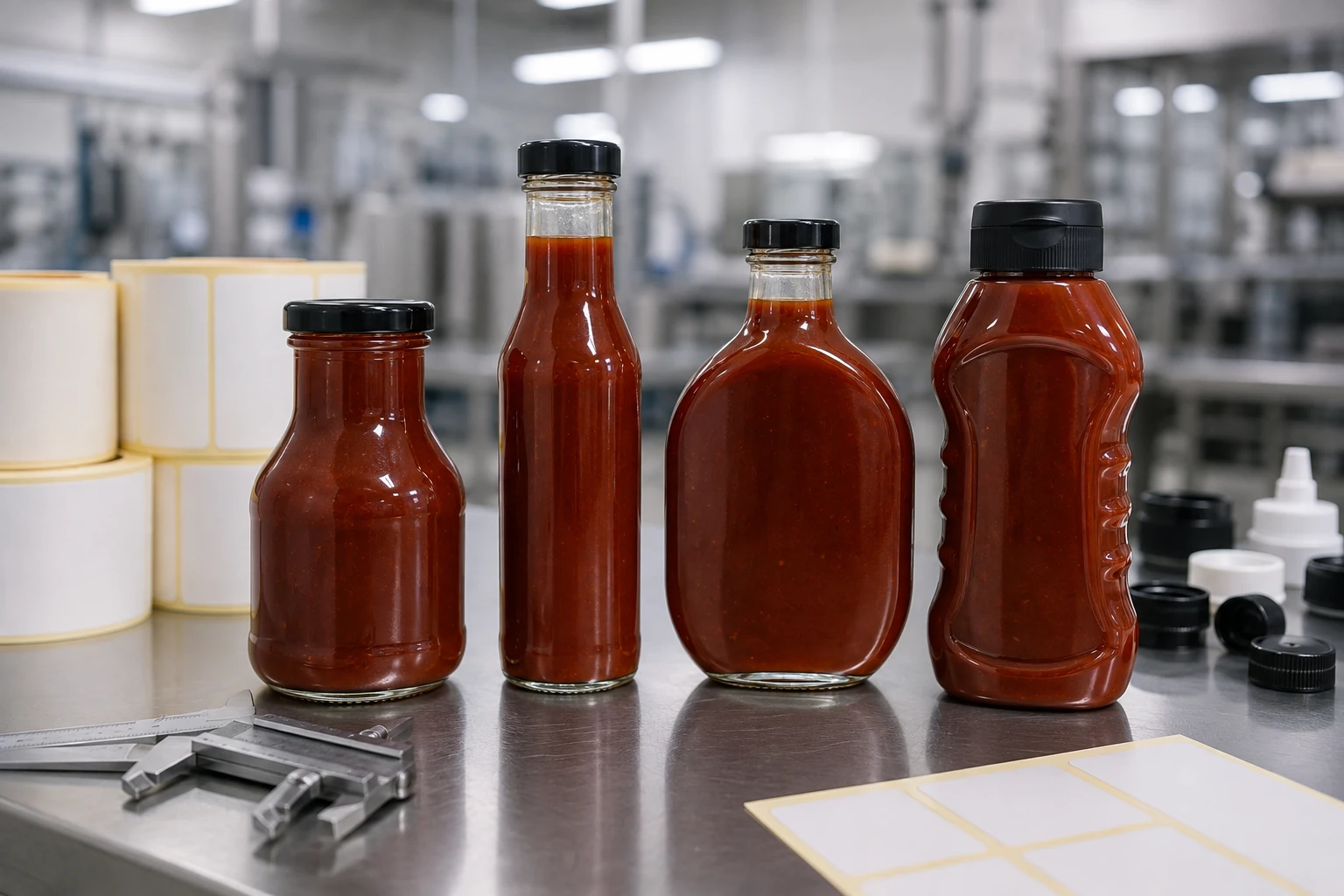
Choosing a BBQ Sauce Bottle Shape by Function, Not Only Appearance
The best commercial BBQ sauce bottle shape depends on sauce viscosity, fill process, label strategy, shelf footprint, cap route and handling risk. Stout bottles support a premium heavy-hand feel, ringneck bottles preserve a familiar BBQ aisle signal, oval or flask bottles give large front-label space, and custom squeeze bottles improve controlled dispensing for thicker sauces and foodservice use.
A shape that looks strong on a shelf can still fail if it rocks on a conveyor, wrinkles a wrap label, traps sauce in the shoulder, leaks after capping or pushes freight cost too high. For retail, co-packer and distributor programs, bottle shape should be approved as a filled package: bottle body, neck finish, cap, label, carton and pallet pattern together.
| Bottle Shape | Common Size Direction | Material Route | Best Fit | Main Engineering Watchpoint |
|---|---|---|---|---|
| Stout | 12 oz (355 ml), 16 oz (473 ml) and premium specialty sizes. | Glass, PET or custom plastic route. | Craft BBQ sauce, thick marinades, premium table sauces and gift packs. | Wide shoulder, label height, filled weight, carton protection and cap torque. |
| Ringneck | 12 oz (355 ml), 16 oz (473 ml), 18 oz (532 ml) planning routes. | Glass benchmark, PET transition or rigid plastic route. | Classic BBQ sauce, pourable grill sauce and brands that want immediate category recognition. | Neck-ring accuracy, shoulder cooling, label wrap fit and capping stability. |
| Oval / flask | 15 oz (444 ml), 18 oz (532 ml) and wide-front retail formats. | PET, glass or HDPE depending on clarity and squeeze need. | Large label panels, grocery shelf facings and mainstream retail lines. | Body ovality, front-back label registration, sidewall stiffness and conveyor orientation. |
| Custom squeeze | 18 oz (532 ml), 20 oz (591 ml) and larger foodservice or retail formats. | Soft PET, HDPE, LDPE, PP or multilayer route. | Thick BBQ sauce, backyard use, cap-down dispensing and lower breakage risk. | Wall-thickness map, squeeze recovery, valve or nozzle fit and base stability. |
Why Bottle Shape Changes Cost, Shelf Impact and Line Performance
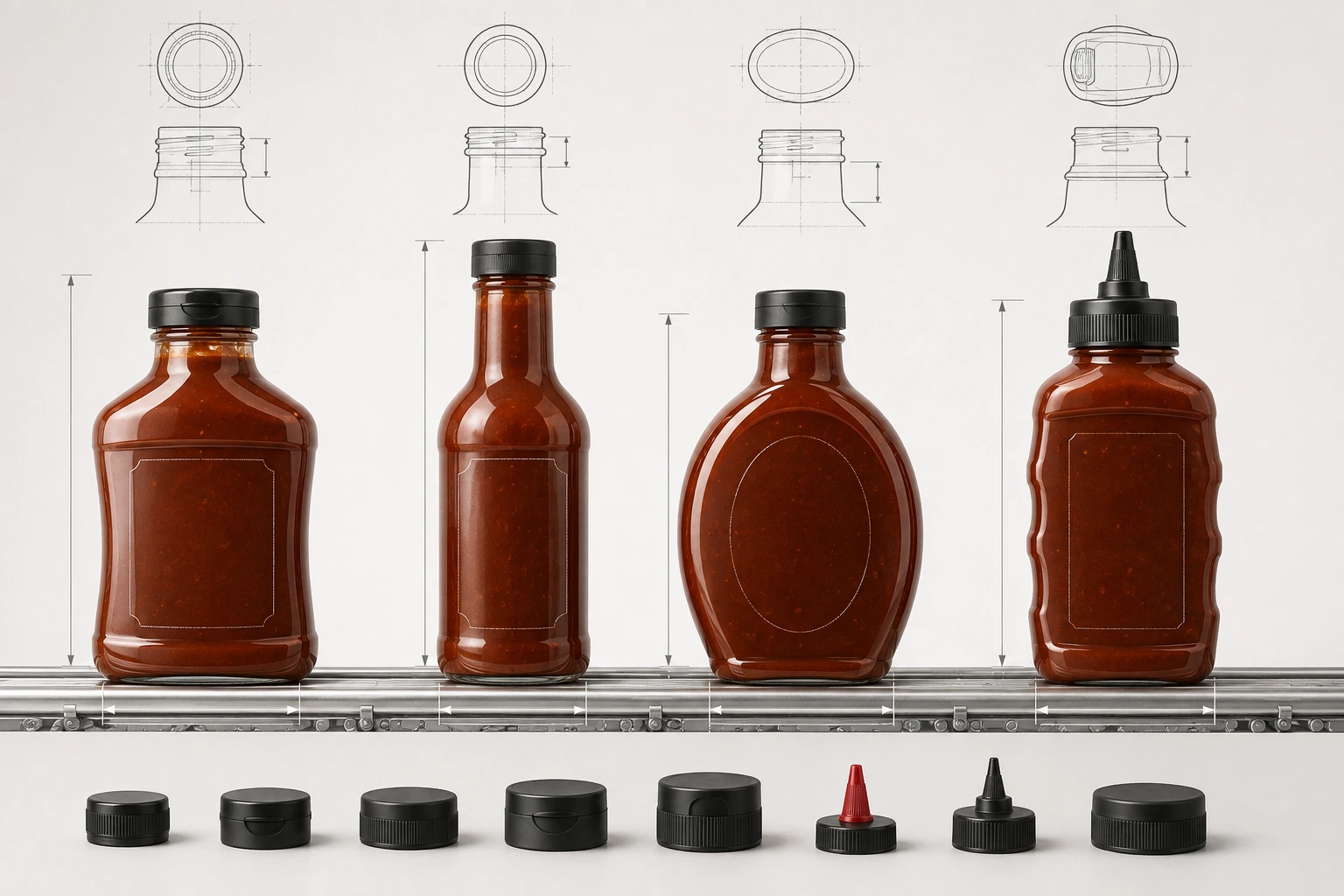
A BBQ sauce bottle is a structural component before it becomes a brand asset. Its body diameter controls carton count and pallet pattern. Its base width affects conveyor stability. Its shoulder angle decides how sauce drains during filling and consumer use. Its neck finish controls cap engagement, liner compression, reducer fit and leakage risk.
The financial impact appears in several places. A wide glass stout bottle may improve perceived value but can add empty weight, carton protection and breakage risk. A tall ringneck bottle may run cleanly on existing filling equipment but may limit label height. An oval bottle can win shelf visibility, yet it often needs tighter orientation control for front labels. A custom squeeze bottle can reduce breakage and improve dispensing, but the wall design must avoid permanent creasing and poor bounce-back.
For automated filling lines, the bottle should stand upright through unscrambling, rinsing, filling, capping, labeling and case packing. The filled center of gravity, base standing ring and rail-contact diameter matter as much as the front silhouette.
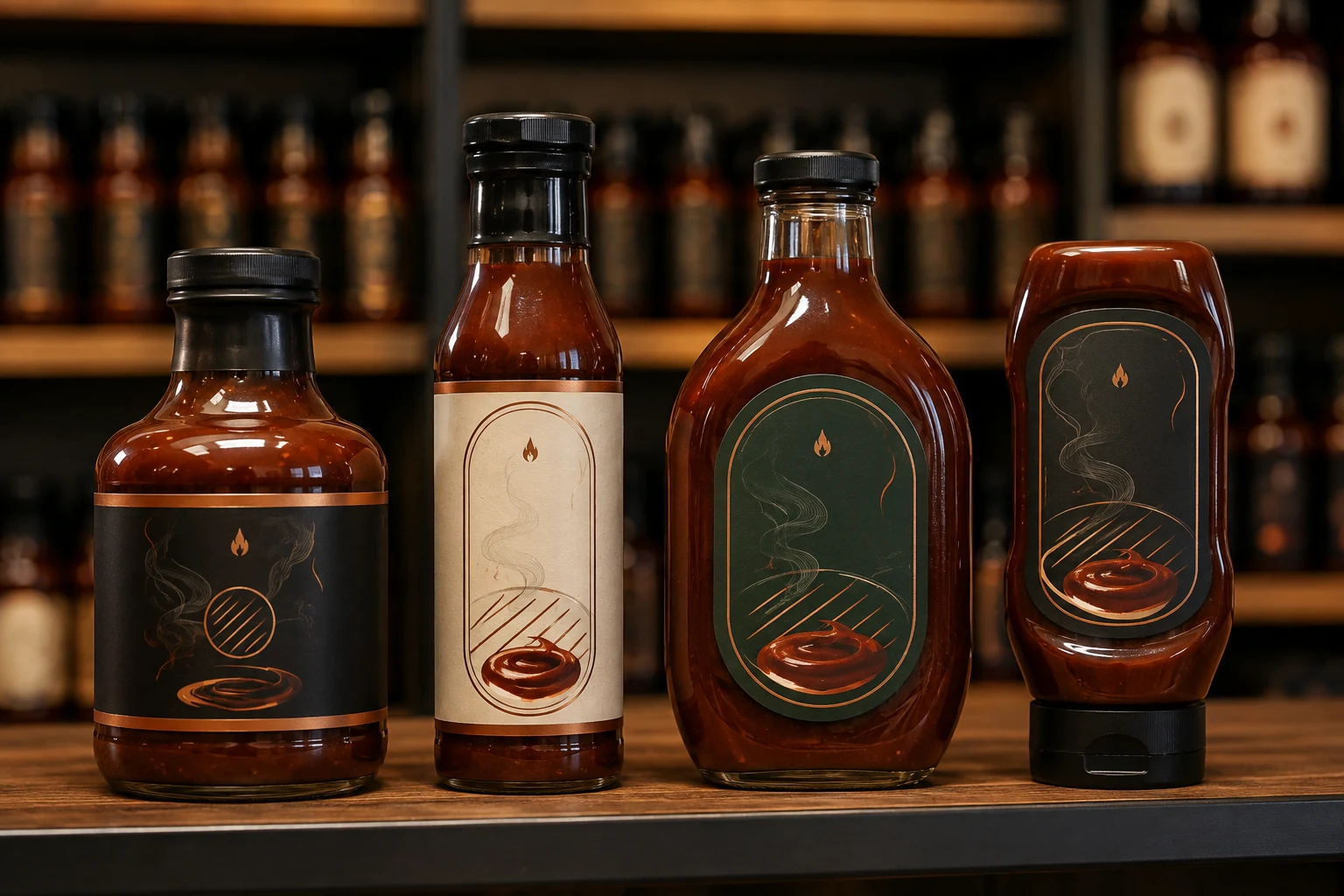
| Decision Area | Shape-Driven Variable | Possible Failure | Validation Method |
|---|---|---|---|
| Shelf blocking | Front width, height and shoulder profile. | Weak shelf presence or poor facing density. | Compare filled samples on shelf trays and shipper cartons. |
| Labeling | Flat panel size, curvature and shoulder taper. | Label lift, sleeve distortion, barcode curve or artwork misalignment. | Run label samples on filled bottles after cooling and storage. |
| Filling line | Base width, height, ovality and neck location. | Bottle tipping, rail rubbing, fill-nozzle misalignment or capping wobble. | Check conveyor trial, capper fit and filled center of gravity. |
| Freight | Empty weight, cube efficiency and secondary protection. | Higher landed cost, carton bulge or glass breakage. | Review carton count, CBM, pallet pattern and drop protection. |
| Consumer use | Grip area, squeeze stiffness, pour angle and residue path. | Hard squeeze, uncontrolled pour, sauce waste or messy cap. | Test with real BBQ sauce viscosity and cap route. |
Ringneck BBQ Sauce Bottles: Classic Category Recognition
Ringneck bottles are familiar in BBQ and table sauce aisles because the neck ring creates a traditional sauce-bottle profile without making the body overly complex. The ring can help the bottle feel recognizable in hand, and it can visually separate the closure from the body label. For brands moving from glass to PET, a ringneck-style PET bottle often keeps the shelf memory of a traditional BBQ sauce bottle while reducing freight weight and breakage risk.
The engineering challenge is precision around the neck and shoulder. A decorative ring should not interfere with capper chucks, shrink bands, tamper sleeves or label clearance. If the shoulder transition is too thin or cools unevenly, hot-fill or warm-fill programs can show shoulder sink, neck ovality or label-panel movement.
Ringneck is usually the safest starting point when the brand wants a classic BBQ shape, standard cap compatibility and efficient retail handling. It still needs physical sample approval for neck finish, label wrap, cap torque and carton pack-out.
Oval and Flask BBQ Sauce Bottles: More Front Panel, More Orientation Control
Oval and flask-style BBQ sauce bottles are selected when the front label needs more space than a round bottle can comfortably provide. The broad face supports larger product names, flavor cues, nutrition callouts and retail barcode placement. On crowded grocery shelves, the flat front can make the sauce easier to recognize from a short viewing distance.
The same geometry creates technical constraints. Oval bottles must control body ovality because small dimensional drift can affect rail spacing, label alignment and carton fit. If a labeler assumes consistent front-back orientation, the bottle may need flats, molded locating features, shoulder geometry or line controls that keep the label facing the correct direction.
Oval formats can work in glass or PET, but PET and HDPE versions need enough panel stiffness to resist vacuum, squeeze pressure and carton compression. The label panel should be tested after filling, cooling and transport simulation because wide flat faces reveal dents and label wrinkles more clearly than round bottles.
Custom Squeeze BBQ Sauce Bottles: Dispensing Control and Lower Breakage Risk
Custom squeeze bottles become attractive when the bottle must do more than sit on a shelf. Thick BBQ sauce, honey BBQ, smoky marinade, chili BBQ and basting sauces often need controlled lines, low residue, cap-down storage or a valve/nozzle closure. Squeezable BBQ Sauce Bottles and custom squeeze formats let the package act as a dispensing tool instead of a passive container.
The shape must be engineered around hand force and plastic memory. If the grip panel is too stiff, the user applies excessive force and the sauce may burst through the opening. If the wall is too soft, the bottle can crease, lose shelf shape or leak around the neck under squeeze pressure. The wall-thickness map should strengthen the neck, shoulder and base while keeping the grip zone responsive.
A custom squeeze route also changes the cap decision. Flip-top caps, silicone valves, nozzle caps and larger orifices all behave differently with real sauce viscosity, spice particles and oil content. Sample testing should use the final sauce or a close pilot batch, because water will not reveal flow cut-off, residue buildup or valve recovery.
| Squeeze Design Area | What to Control | Why It Matters |
|---|---|---|
| Grip panel | Planned wall thickness and ergonomic ribs or flats. | Controls hand force, bottle recovery and shelf appearance after use. |
| Neck finish | Thread engagement, sealing land and cap seat consistency. | Prevents leakage when squeeze pressure reaches the closure. |
| Base geometry | Standing ring, push-up depth and filled stability. | Keeps the bottle upright on conveyors, tables and retail shelves. |
| Closure route | Flip-top, nozzle, valve or reducer opening. | Matches sauce viscosity, particles and intended portion control. |
| Label zone | Flat or gently curved panel with stable dimensions. | Protects artwork, barcode readability and sleeve fit. |
Material Choice: Glass, PET, HDPE and PP by Shape
Glass is still useful for premium stout and classic ringneck BBQ sauce bottles where weight, clarity and heat resistance support the brand promise. The downside is freight mass, breakage and more protective secondary packaging. For e-commerce or export programs, the total cost should include damage claims and carton reinforcement, not only the unit bottle price.
PET is often chosen when the sauce needs high clarity, lower mass and a glass-like shelf impression. It can work for ringneck, oval and custom shapes when fill temperature, vacuum response and neck stability are validated. Standard PET should not be treated as a universal hot-fill solution; hot-fill or high-temperature sauce programs require a compatible route and filled-sample testing.
HDPE and LDPE support squeeze performance, impact resistance and opaque or semi-opaque designs. PP can help where higher temperature resistance or cap integration matters. For long shelf-life BBQ sauces, material choice should also consider oxygen barrier, UV exposure, liner selection and whether a multilayer route is needed.
| Material | Shape Fit | Strength | Watchpoint |
|---|---|---|---|
| Glass | Stout, ringneck, oval and premium bottle routes. | Premium feel, strong heat resistance and strong wall barrier. | Heavy freight, breakage and carton protection. |
| PET | Ringneck, oval, flask and glass-like custom bottles. | Clear shelf display with lower weight than glass. | Heat deformation, vacuum paneling and neck finish control. |
| HDPE / LDPE | Custom squeeze and foodservice BBQ sauce bottles. | Impact resistance, flexible hand feel and good squeeze function. | Lower transparency and weaker oxygen barrier than glass or EVOH routes. |
| PP | Selected hot-fill, cap and squeeze-related structures. | Higher heat tolerance than many common clear plastics. | Clarity, stiffness and decoration route need review. |
| Multilayer | Custom squeeze or long-shelf-life BBQ sauce formats. | Can combine structure, barrier and process needs. | Higher validation complexity and component-specific documentation. |
Label Panel, Cap Fit and Conveyor Stability Checks
Before artwork is finalized, the bottle drawing should define the usable label panel, label radius, shoulder clearance, cap overhang and barcode location. A round ringneck bottle can tolerate wrap labels well, while oval and flask bottles need more front-back control. Custom squeeze bottles need label zones that do not wrinkle when the grip panel flexes.
Cap fit should be reviewed with the selected neck finish, not only by nominal diameter. Common sauce and condiment projects may use 24 mm, 28 mm or 38 mm neck families depending on capacity and flow requirement. The final specification should include finish code, thread engagement, sealing land, liner route, cap material and applied torque range.
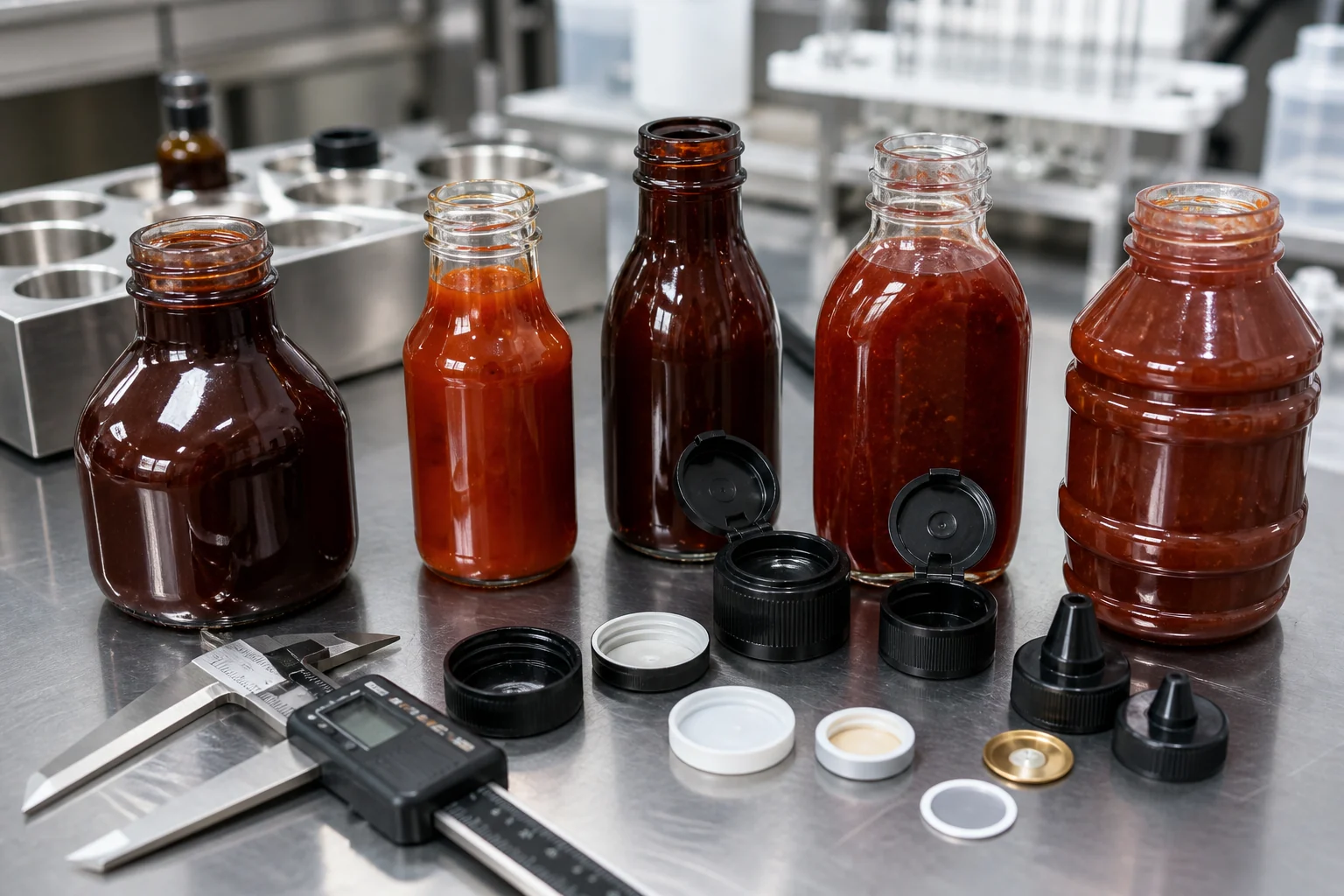
Conveyor stability comes from the full filled geometry. A tall narrow ringneck can look elegant but may tip if the base is too small for the filled height and line speed. A wide stout bottle may be stable but can create rail spacing and accumulation issues. Oval bottles need repeatable orientation if the line uses front-back labels or directional caps.
Gracepack Shape Development and Factory QC Route
Gracepack supports BBQ sauce bottle projects with stock mold selection, cap matching, sample review, custom mold feasibility and export packing planning. The useful starting point is practical: target capacity, sauce viscosity, filling temperature, cap type, label size, material preference, shelf positioning, destination market and estimated order volume.
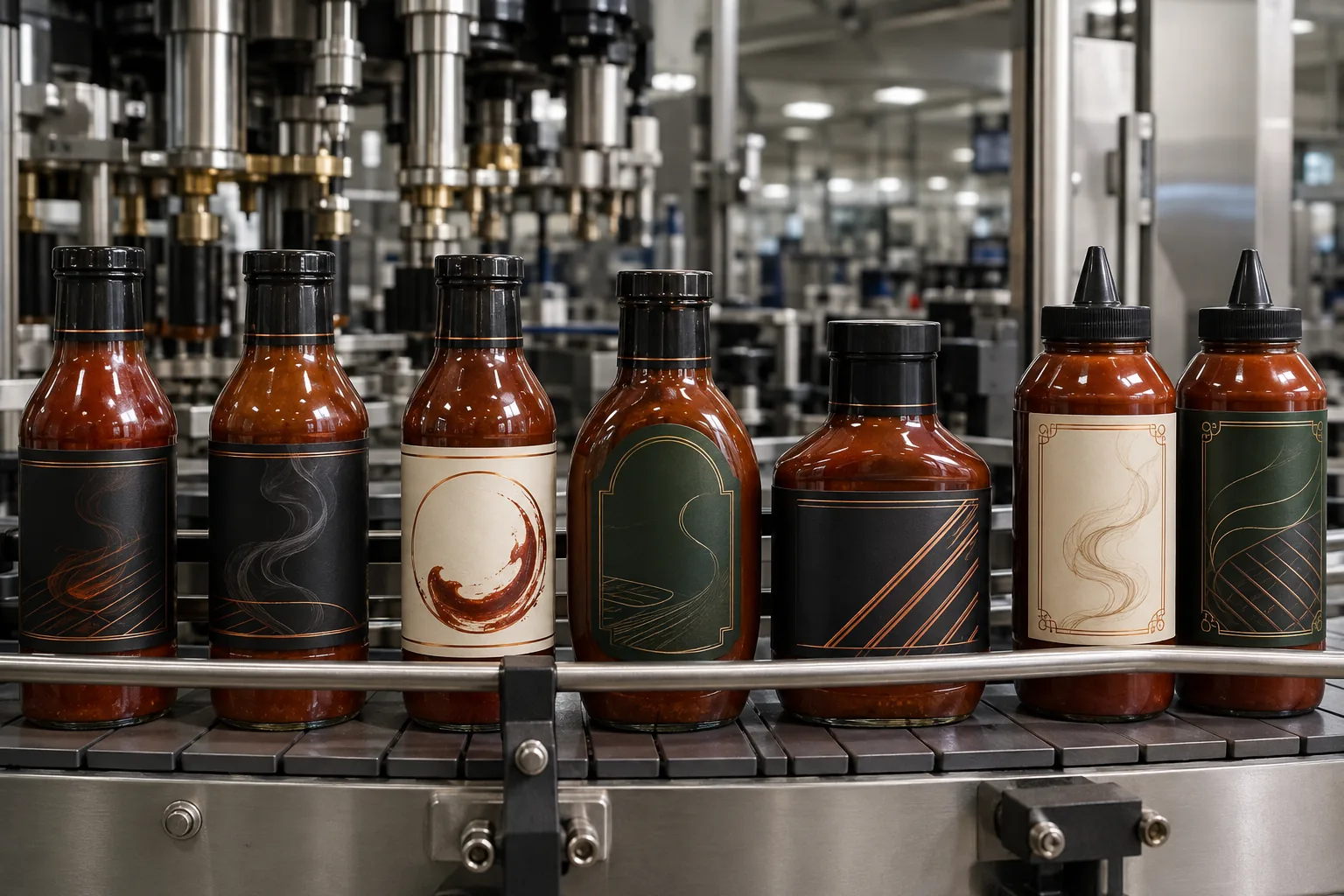
The factory base includes 500+ owned molds, 5,000+ standard bottle designs, 15 automatic injection molding machines, 13 automatic blow molding machines, 9 fully automatic production lines, 3 labeling machines and 5 printing machines. That range allows brands to compare stock stout, ringneck-style, oval, glass-like PET and custom squeeze directions before committing to new tooling.
For custom tooling, Gracepack can review bottle drawings, 3D concepts, neck finish targets, label-panel requirements, cap or valve fit and carton loading. Sample approval should cover filled appearance, cap torque, leakage, label fit, squeeze recovery if applicable, carton count and food-contact document scope for the selected bottle, cap, liner and closure materials.
| Review Step | What Gracepack Checks | Why It Protects the Project |
|---|---|---|
| Stock shape screening | Capacity, material, neck finish, cap route and label panel. | Finds a lower-risk existing mold before custom tooling is proposed. |
| Custom mold feasibility | Silhouette, draft angle, wall distribution, base and shoulder design. | Improves manufacturability before mold cost is committed. |
| Closure matching | Cap diameter, liner, valve, nozzle, reducer and torque range. | Prevents leakage and dispensing problems after filling. |
| Filled sample review | Sauce viscosity, squeeze force, label fit, cooling behavior and shelf appearance. | Approves the package under real product conditions. |
| Export packing | Carton count, dividers, pallet pattern, CBM and shipment photo route. | Connects bottle shape with landed cost and damage control. |
Decision Checklist for Commercial BBQ Sauce Bottle Shapes
- [ ] Define whether the product needs a premium glass impression, classic BBQ familiarity, large front label space or controlled squeeze dispensing.
- [ ] Match the shape to sauce viscosity, particle size, oil level, filling temperature and intended storage orientation.
- [ ] Confirm the neck finish, cap family, liner route, reducer, valve or nozzle before artwork approval.
- [ ] Measure usable label area on real samples, not only on renderings.
- [ ] Check base stability and filled center of gravity on conveyors, shelves and carton trays.
- [ ] Compare unit price together with carton count, CBM, breakage risk and pallet loading.
- [ ] Test glass-like PET or custom squeeze routes with the final sauce before replacing an existing glass format.
- [ ] Keep approved samples and drawings for repeat-order comparison.
FAQ About Commercial BBQ Sauce Bottle Shapes
Which BBQ sauce bottle shape is best for premium retail sauce?
A stout glass or glass-like PET bottle often works best when the brand wants a premium, heavy visual impression. The final choice should still confirm label fit, cap route, carton protection and freight cost.
Are ringneck bottles still a good choice for BBQ sauce?
Yes. Ringneck bottles remain useful because they look familiar in the BBQ sauce category and can support standard cap and label routes. They are a strong starting point for classic pourable sauces and glass-to-PET transition projects.
When should a BBQ sauce brand use an oval bottle?
Oval or flask bottles are useful when the front label needs strong shelf visibility and more design space. They require careful orientation, ovality control and label testing on the intended filling line.
When does a custom squeeze BBQ sauce bottle make sense?
Custom squeeze bottles make sense when the sauce is thick, used frequently, sold for foodservice or backyard grilling, or needs controlled dispensing with a flip-top, valve or nozzle cap. The key tests are squeeze force, recovery, leakage and cap compatibility.
What information helps Gracepack recommend the right BBQ sauce bottle shape?
Useful inputs include target capacity, sauce viscosity, fill temperature, current bottle shape if any, cap preference, label size, shelf positioning, destination market, order quantity and whether the project can use an existing mold or needs custom tooling.
Request BBQ Sauce Bottle Shape Samples
A useful bottle-shape review starts with the sauce and the commercial channel. Gracepack can compare stout, ringneck, oval, glass-like PET and custom squeeze bottle routes against your sauce viscosity, shelf target, label area, cap route, filling condition, carton plan and export market.
Send the target capacity, current bottle photo or drawing if available, sauce viscosity, fill temperature, cap preference, label size, estimated annual quantity and destination market. The practical output can include existing mold options, sample recommendations, cap matching, label-panel review, custom tooling direction and export packing notes.


