
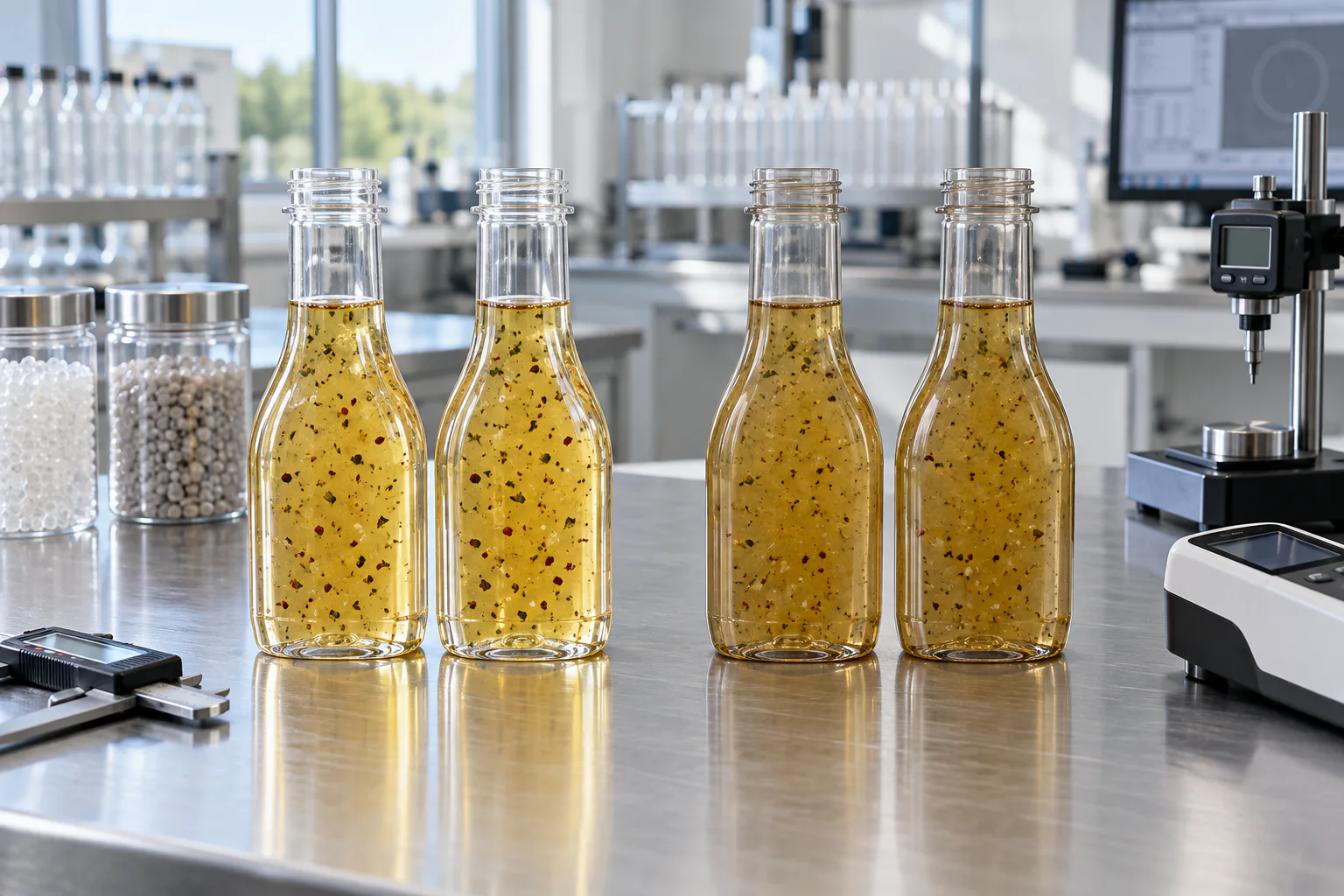
For clear retail salad dressing bottles, 30% rPET is often the easier starting point when the package needs glass-like clarity, a broad processing window and stable wall distribution. A 100% rPET bottle can also be commercially successful, but the higher recycled-content claim does not remove the need to qualify resin quality, preform processing, bottle geometry, closure sealing and the filled dressing as one system.
The useful comparison is not a generic claim that one percentage is always clearer or stronger. It is a controlled trial in the same bottle design, at the same nominal weight, with the same finish, cap, label, dressing and filling conditions. That trial shows whether higher recycled content changes color, haze, black-speck frequency, top load, drop performance, cap torque or line consistency enough to affect the product launch.
Treat 30%, 50% and 100% rPET as engineering options rather than sustainability grades. Select the highest level that repeatedly meets the agreed appearance, package performance, food-contact documentation and production-yield requirements for the actual SKU.
Compare the Same Bottle, Not Two Different Packages
A valid rPET comparison controls the variables that can hide or exaggerate a material effect. If the 30% bottle uses a different preform, gram weight, stretch ratio or mold from the 100% bottle, the test cannot show whether a result came from recycled content or from package design.
Start with one commercial geometry and one target capacity. Keep the neck finish, closure, liner, label panel, fill level and conditioning schedule unchanged. Record the resin lot, preform lot, cavity, bottle weight and molding settings for every sample. When a setting must change to produce the 100% rPET bottle, document that change because it becomes part of the repeatability risk that production must control.
For brands developing clear salad dressing bottles, this matched approach also prevents a visually impressive hand sample from being approved before its closure fit, filled appearance and line behavior are known.
| Keep Constant | Measure on Both Routes | Why It Matters |
|---|---|---|
| Bottle drawing, mold and target weight | Overall dimensions and wall distribution | Separates material behavior from geometry changes. |
| Neck finish and closure | Finish dimensions, torque retention and leakage | Protects the bottle-to-cap interface from hidden variation. |
| Dressing, fill level and temperature | Filled appearance, stress and storage performance | Tests the package under its real chemical and thermal load. |
| Label stock and application | Color shift, show-through, adhesion and wrinkling | Confirms shelf appearance, not only empty-bottle clarity. |
| Conditioning and test sequence | Drop, top load, side-lay and refrigerated-cycle results | Makes the comparison repeatable across trials and lots. |
Clarity Is a Filled-Package Decision
Empty-bottle transparency is only the first screen. Oil, vinegar, herbs, emulsified solids and the label background can make a small resin color difference either more visible or practically irrelevant. Inspect both rPET levels empty, filled and labeled under the store lighting expected for the launch.
The appearance review should separate haze from color. Haze diffuses light and can make herb particles or dressing layers look less distinct. A yellow or gray cast changes the perceived color of pale vinaigrettes and creamy dressings. Black specks are a separate contamination or sorting concern and should be counted by an agreed viewing method rather than folded into a general clarity score.
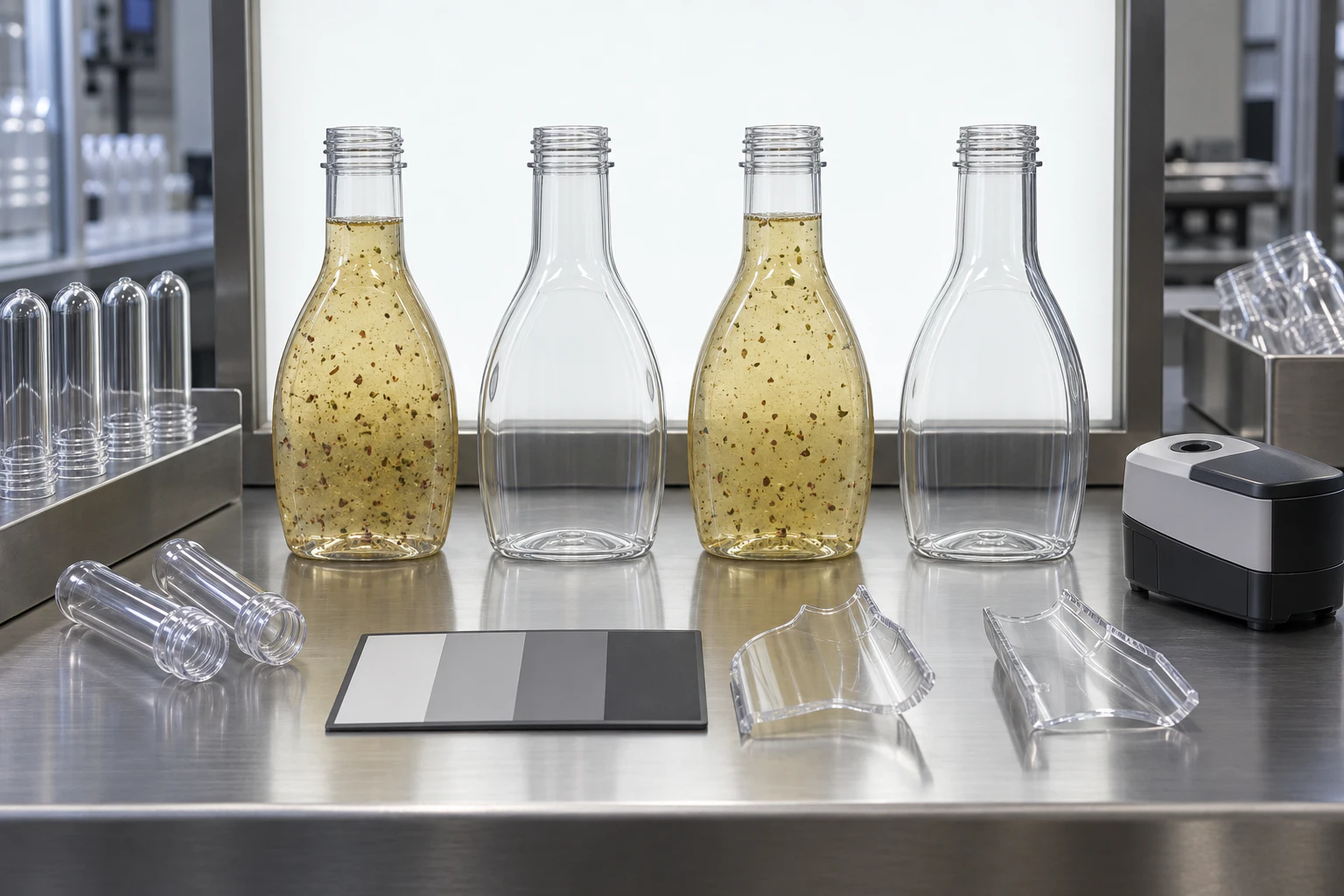
Use a retained virgin PET or approved production bottle as a visual control. Record instrument readings where practical, but keep a controlled visual standard because consumers see a filled pack at arm's length, not a resin plaque in a laboratory. Tinted labels, full-body sleeves or naturally dark dressings can widen the acceptable appearance window, while a clear minimalist label may make small batch differences more obvious.
| Appearance Check | Practical Method | Release Question |
|---|---|---|
| Haze | Instrument reading plus controlled visual comparison | Can the dressing, herbs and fill level still be seen as intended? |
| Yellow or gray cast | Color measurement against an approved control | Does the bottle alter the perceived dressing or label color? |
| Black specks | Defined inspection area, lighting and sample count | Is the visible-defect rate within the agreed lot limit? |
| Filled shelf appearance | Labeled samples under retail lighting | Does the complete pack remain consistent across resin lots? |
Mechanical Strength Depends on Resin Quality and Wall Distribution
Recycled content alone does not determine bottle strength. Intrinsic viscosity, moisture control, thermal history, preform quality, reheating profile and stretch ratio all influence how material reaches the shoulder, sidewall, heel and base. A well-controlled 100% rPET bottle can outperform a poorly processed lower-content bottle, while a weak high-stretch zone can fail even when the average wall thickness looks acceptable.
Map wall distribution by cavity and lot before interpreting a drop or top-load result. Pay particular attention to the shoulder transition, label-panel corners, heel and gate area. These regions often reveal process drift before the bottle's average weight changes. If the 100% route needs a different heating profile or blowing sequence, the approved process window should be recorded with the same discipline as the bottle drawing.
For pourable oil-and-vinegar products, test the filled bottle at ambient and refrigerated conditions. For salad dressing squeeze bottles, add repeated squeeze-and-recovery cycles at full, half-full and near-empty fill levels. The package should recover predictably without permanent panel creases, stress whitening, leaks or a large change in dispensing force.
| Test | What to Compare | Common Failure Signal |
|---|---|---|
| Bottle weight and wall map | Cavity-to-cavity distribution at 30% and 100% rPET | Thin shoulder, heel or base zones despite correct total weight. |
| Top load | Peak load and deformation at the intended storage condition | Early buckling or excessive permanent height loss. |
| Filled drop | Body, base and closure survival after conditioned drops | Cracking, gate failure, cap displacement or leakage. |
| Squeeze recovery | Force, recovery time and permanent set across use cycles | Slow recovery, panel creasing or dose drift. |
| Refrigerated cycling | Dimensions, stress whitening and leakage after cold-to-ambient cycles | Base rock, finish movement or sidewall distortion. |
Keep the Neck Finish and Closure in the Trial
A bottle can pass body-strength testing and still fail as a package if the finish changes during molding or storage. Measure the sealing land, thread profile, neck ovality and support ring on samples from multiple cavities. Then cap those bottles with the intended closure rather than a laboratory substitute.
Record application torque, immediate removal torque and aged removal torque after the defined storage period. Complete upright, side-lay and inverted leakage checks with the actual dressing. Oil can reveal seal paths that water misses, while vinegar, emulsifiers and retained product on the land can change wetting at the interface.
When the SKU uses a controlled-pour opening, evaluate vinaigrette pour bottles with the largest expected herb or spice particles. A material comparison is incomplete if the bottle body passes but the neck finish, liner or flow insert varies enough to affect sealing and dispensing.
Production Consistency Matters More Than the First Good Sample
A single clear, strong 100% rPET bottle proves that the design can work. It does not prove that incoming resin lots, preforms, cavities and production shifts will keep producing the same result. The release plan needs limits for incoming material and finished bottles that can be checked without relying on subjective descriptions such as clear enough or slightly yellow.
Useful incoming and in-process controls can include resin identity, lot traceability, intrinsic viscosity where specified, moisture after drying, color, contamination screening and preform dimensions. Finished-bottle controls can include weight, dimensions, capacity, haze, color, black-speck count, wall distribution and cavity identification. Odor checks may also be relevant for sensitive products, but the method and acceptance standard should be defined before the trial.

Retain approved samples from the initial trial and early production lots. If a later lot changes in color, drop performance or cap torque, the retained pack gives the factory and brand a physical reference for investigation rather than forcing both teams to reconstruct the original approval from photographs.
Use an Approval Ladder for 30%, 50% and 100% rPET
The most efficient development path increases recycled content only after the previous route establishes a stable control. This avoids changing resin, bottle weight, closure and line settings at the same time. It also makes the commercial decision clearer when appearance, yield or performance changes.
A 30% route is often a practical first step for a highly transparent retail SKU or a first conversion from virgin PET. A 50% route can reveal whether the process remains stable as recycled content becomes the larger share. A 100% route is appropriate when the brand's material commitment justifies the tighter resin and process controls and the complete package passes release criteria. These are planning positions, not universal rules; the actual results govern the decision.
| rPET Level | Typical Development Role | What Must Be Proven |
|---|---|---|
| 30% | Lower-risk entry for clear retail packs and initial line trials | Appearance parity, baseline strength, closure fit and stable molding. |
| 50% | Intermediate step for increasing recycled content | Repeatable color, process window, wall distribution and filled-package performance. |
| 100% | Maximum recycled-content route for qualified programs | Resin-lot control, consistent appearance, mechanical margin, sealing and production yield. |
| Selected level | Commercial release | Documented specification, approved control samples and repeat-lot verification. |
Food-Contact Documentation Must Match the Actual Resin Route
Food-grade suitability is not established by the percentage printed on a sustainability claim. The compliance file must identify the recycled resin route, intended food type, filling and storage conditions, bottle construction and destination market. The bottle, cap, liner, colorant and any functional additive should be reviewed as separate components of the final package.
The FDA guidance on recycled plastics in food packaging addresses source control, recycling process effectiveness, contaminant considerations and the proposed food-contact use. For European programs, EFSA recycled plastic food-contact materials information explains the assessment of recycling processes and their intended uses. The final document scope should therefore be matched after the exact resin supplier, process, formulation and use conditions are fixed.
Request current documents tied to the proposed production route, not a generic certificate for PET. A change in recycled resin source, decontamination process, additive package or intended fill condition can require a new review even when the bottle shape remains unchanged.
How Gracepack Structures an rPET Dressing Bottle Trial
Gracepack can begin with an existing salad dressing bottle mold or a controlled custom-bottle program, then compare candidate recycled-content routes against one approved geometry. With more than 500 owned mold resources and over 5,000 standard bottle designs, many projects can screen bottle shape, capacity and closure fit before deciding whether new tooling is necessary.
A practical trial uses an agreed control, such as the current virgin PET bottle or approved production sample, plus the proposed 30% and 100% rPET routes. Samples are identified by resin lot, preform lot and cavity. Bottle dimensions, capacity, weight, appearance, wall distribution, top load, drop performance and closure sealing are reviewed before filled samples move into conditioning and label evaluation.
Gracepack's 15 automatic injection molding machines, 13 automatic blow molding machines and 9 fully automatic production lines support bottle and closure coordination, but equipment capacity is not a substitute for project-specific approval. Available PET food-contact, BPA-related and ISO 22000 documentation can support the file review, while the final evidence package is matched to the selected resin, component set, intended use and destination market.
Production Release Checklist
Release the selected rPET percentage only after the specification connects appearance, package performance and process control. The approved sample should be a filled, closed and labeled pack whenever possible, not only an empty bottle.
- Approve the bottle drawing, finish drawing, closure and nominal bottle weight.
- Identify the recycled resin supplier, grade, lot controls and permitted change-notification route.
- Set measurable limits for haze, color, visible specks and filled shelf appearance.
- Record cavity-level bottle dimensions and wall-distribution results.
- Complete conditioned top-load, filled-drop, squeeze-recovery and base-stability tests as applicable.
- Verify application torque, aged removal torque, side-lay leakage and inversion leakage with the actual dressing.
- Confirm label adhesion, color show-through and appearance after refrigerated or thermal cycling.
- Match food-contact documents to the final resin, bottle, closure, liner, use conditions and destination market.
- Retain signed control samples and define the incoming-lot and production-lot inspection plan.
FAQ About 30% and 100% rPET Dressing Bottles
Is 100% rPET always less clear than 30% rPET?
No. Higher recycled content can increase the risk of haze, tint or visible contamination, but the result depends on feedstock quality, decontamination, color control and bottle processing. Approve the filled and labeled package across representative lots.
Does a 100% rPET bottle always need more material?
No. Added weight may compensate for a weak design, but it should not be assumed. First compare intrinsic viscosity, preform design, heating, stretch ratio and wall distribution, then set weight from measured package performance.
Which rPET level is best for a clear vinaigrette bottle?
Start with the highest level that preserves the intended product visibility and repeatedly passes drop, top-load, closure and line tests. A transparent label and pale dressing may require tighter color and haze limits than a dark dressing or full-body label.
Can food-grade rPET be used for salad dressing?
It can be considered when the recycled resin route and complete package are supported for the intended food type, temperature, storage time and market. Documentation must match the actual resin and manufacturing route.
What should an rPET bottle supplier report?
Ask for resin and preform lot traceability, bottle weight, dimensions, capacity, cavity identity, appearance data, wall distribution, mechanical and leak-test results, change notification and the relevant food-contact document set.
Should a brand qualify more than one resin lot?
Yes. One lot confirms feasibility; multiple representative lots provide evidence of color, contamination, processing and performance consistency before full release.
Request a 30% vs. 100% rPET Sample Comparison
Share the bottle capacity, dressing type, oil content, fill temperature, closure, label style, destination market, annual volume and recycled-content target. Gracepack can compare suitable PET salad dressing bottles or custom routes, define the matched sample plan and prepare a practical approval checklist before mass production.
For the most useful review, include the current bottle or drawing, an actual dressing sample, target shelf appearance and any known line, leakage or drop-test requirements. The response can then focus on the package evidence needed to choose a percentage, not a generic recommendation.


