
Inverted BBQ sauce bottles are squeeze bottles designed to stand cap-down, keeping thick sauce close to the valve so consumers can dispense without shaking or waiting. For retail shelves, the package must solve three problems at once: it must stand securely on the closure, keep the valve area clean, and release most of the sauce without trapping heavy residue in the shoulders.
The best design is not simply an upside-down version of a normal sauce bottle. BBQ sauce adds higher viscosity, sugar, tomato solids, spice particles, oil phases and sticky residues. Those properties affect cap footprint, valve slit geometry, squeeze-wall stiffness, internal shoulder shape, label placement and carton protection.
For retail-ready inverted BBQ sauce packaging, the working priorities are shelf facing, refrigerator-door stability, cap-down leakage risk, clean valve appearance and low-residue consumer use after repeated squeezes.
| Design Requirement | Engineering Target | Why It Matters | Validation Method |
|---|---|---|---|
| Cap-down stability | Broad flat cap face with stable diameter-to-bottle width ratio. | Prevents tipping on retail shelves, wire refrigerator racks and table-service surfaces. | Filled-bottle standing test, vibration check and shelf tray trial. |
| Valve cleanliness | Recessed silicone valve or controlled dispensing feature with clean cutoff. | Reduces drip tails, crusting, oxygen exposure and sticky cap complaints. | Repeated dispense, cap-down storage and wipe-free appearance review. |
| Low-residue dispensing | Smooth internal shoulders, flexible squeeze panels and sauce path toward the valve. | Helps consumers use more of the filled product before disposal. | Filled-use depletion test by weight after normal consumer-style squeezing. |
| Label durability | Label panel outside the main squeeze crease and away from cap contact zones. | Avoids label wrinkling, scuffing and barcode distortion after use. | Label adhesion and squeeze-cycle inspection. |
| Leak prevention | Matched neck finish, liner or valve seat, cap torque and closure material. | Protects cartons, retail shelves and e-commerce shipments. | Inverted storage, side-lay, warm-room and transport simulation checks. |
Why Inverted BBQ Bottles Are Different from Standard Condiment Squeeze Bottles
A standard upright squeeze bottle stores sauce away from the closure. When the consumer turns it over, thick BBQ sauce must move through the shoulder and neck before the first dose appears. In an inverted format, gravity preloads the sauce at the valve. That improves first-use dispensing, but it also means the closure becomes the standing base and the primary leak-control surface.
This format is strongest when the sauce is smooth enough to pass through a valve or nozzle, but viscous enough to benefit from cap-down storage. Honey BBQ, smoky BBQ, sweet chili BBQ, bourbon-style barbecue sauce, spicy glaze and thick grill sauce are common candidates. Very chunky sauces with large onion pieces, pepper skins or seeds may need a larger nozzle or wide-mouth route instead of a tight slit valve.
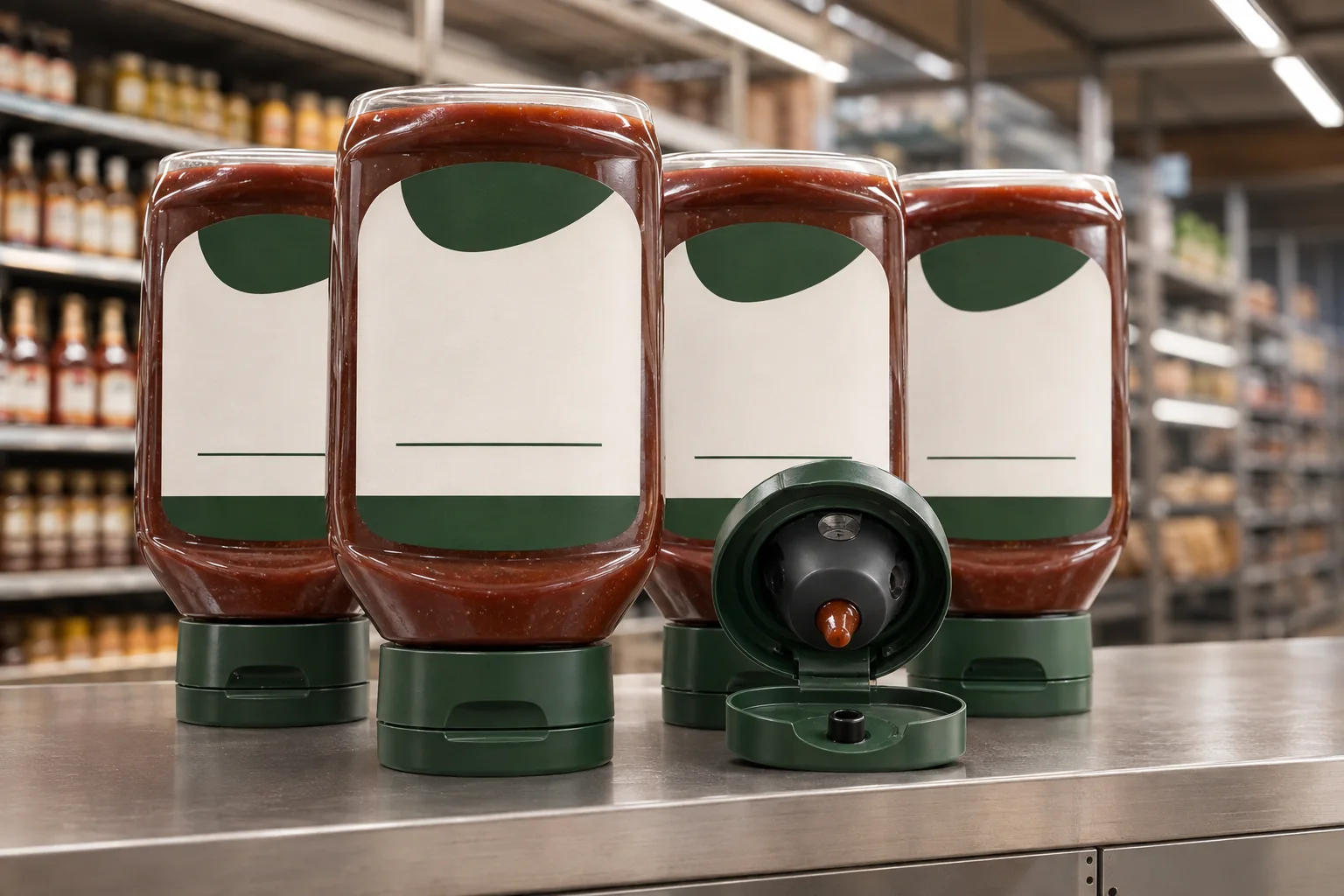
For retail brands, the inverted format can also improve shelf communication. The broad cap creates a stable bottom, the bottle body presents the label above the closure, and the consumer understands that the sauce is ready to squeeze. The risk is that any cap residue, wobble or leaking becomes highly visible because the bottle sits directly on the closure.
Cap-Down Stability: Closure Footprint, Center of Gravity, and Anti-Rocking Design
The closure on an inverted BBQ bottle performs as a base. If the cap is too narrow, too tall or slightly warped, the filled bottle can rock on shelf trays, refrigerator wire racks or restaurant tables. A stable design starts with a wide cap footprint, a flat contact face and a bottle body that keeps the filled center of gravity close to the vertical axis.
Cap diameter should be reviewed against filled bottle height, shoulder width and sauce density. A tall bottle with a small cap may pass an empty sample review but become unstable after filling. A broad cap with a slightly recessed center can reduce rocking caused by minor molding variation while keeping the perimeter ring in contact with the shelf.
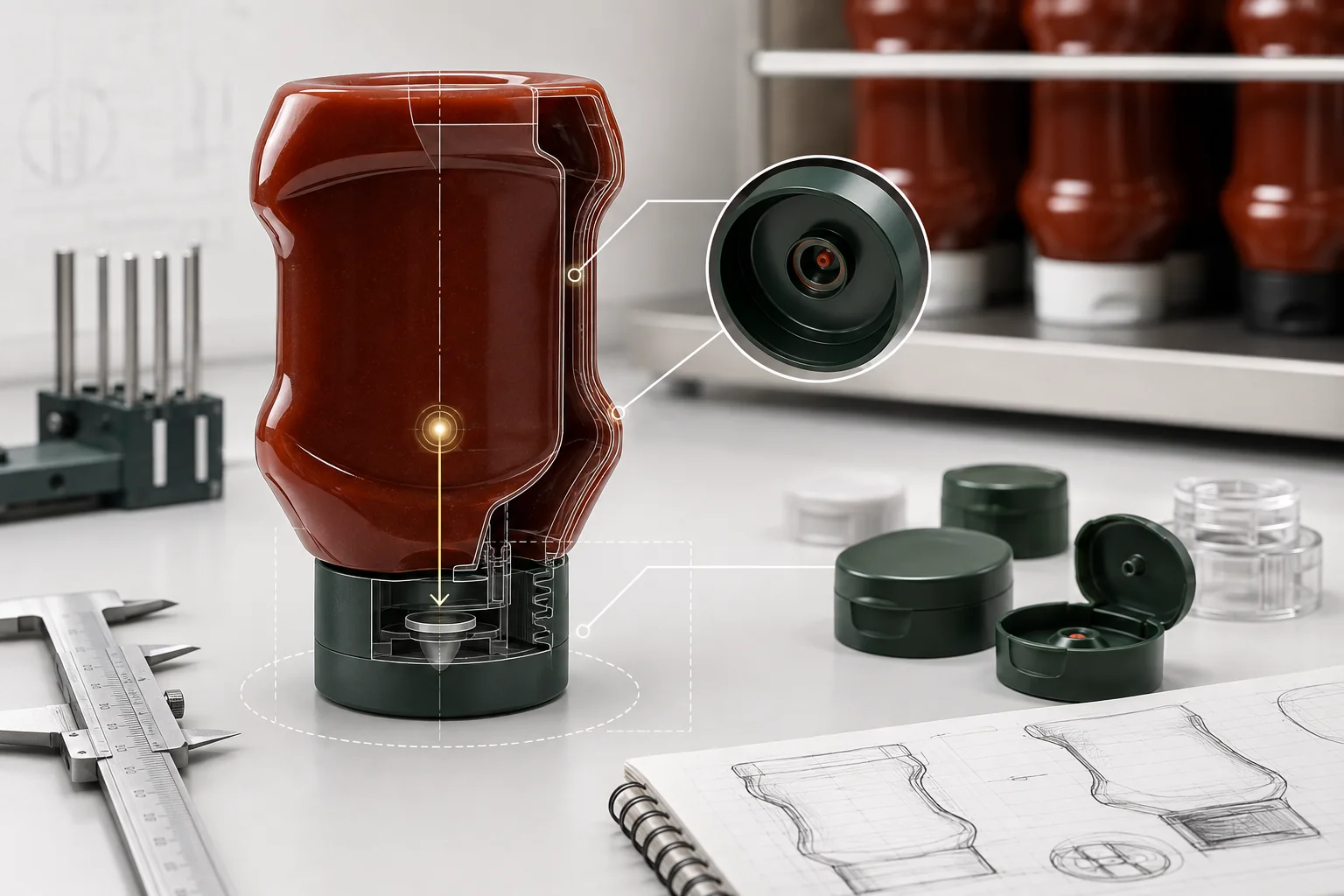
Retail vibration matters. Store shelves, pallet movement, delivery trucks and consumer handling all introduce small horizontal shocks. If the bottle tips easily, the brand loses shelf order and may create leakage complaints before the product is even purchased.
| Stability Variable | Good Design Direction | Failure Symptom |
|---|---|---|
| Cap footprint | Wide, flat flip-top or valve-cap base matched to bottle width. | Bottle rocks, tips or leans in shelf trays. |
| Cap face geometry | Flat perimeter contact or slight concavity with controlled molding shrinkage. | Unstable standing caused by warped or crowned cap surface. |
| Filled center of gravity | Bottle height, shoulder width and sauce fill level balanced around cap base. | Bottle falls during shelf vibration or refrigerator-door movement. |
| Shelf contact surface | Stable cap material and clean standing ring. | Residue buildup creates sticky, uneven cap-down contact. |
| Carton orientation | Packing plan protects cap face and valve during shipping. | Cap scuffs, valve deformation or leakage before retail stocking. |
Valve Cleanliness: Recessed Silicone Slits, Cutoff Quality, and Crust Control
BBQ sauce can dry at the dispensing point because sugars, tomato solids and spice particles remain near the air interface after each use. A clean inverted bottle therefore needs more than a valve that opens. It needs a valve that opens under reasonable hand pressure, cuts off without a long tail, and returns to a closed position before sauce creeps onto the cap face.
Silicone valve caps are useful when the sauce is smooth and medium-to-high viscosity. A cross-slit or shaped slit can stay closed at rest, open under squeeze pressure and snap back after release. The valve should sit in a shallow protective well so the dispensing surface is not scraped directly against the shelf when the cap is closed.
Valve cleanliness must be tested with the real sauce. Water, syrup or a thin ketchup substitute will not show spice-particle behavior, oil separation, sticky sugar residue or cap-down weeping. The same bottle can look excellent in a first squeeze and still develop crusting after several days of cap-down storage.
| Valve Issue | Likely Cause | Engineering Response |
|---|---|---|
| Drip tail | Valve slit too open, sauce stringing or insufficient elastic recovery. | Adjust slit geometry, valve hardness, cap well depth or sauce-compatible opening size. |
| Weeping during storage | Static sauce pressure against valve exceeds closure resistance. | Review valve preload, cap torque, bottle softness and cap-down storage time. |
| Crusting around outlet | Sauce residue exposed to air after dispensing. | Use cleaner cutoff, recessed orifice, cap seal review and repeated-use cleaning check. |
| Clogging | Pepper skin, seeds or spice particles exceed the flow path. | Move to larger nozzle, wider valve path or different bottle route. |
| Staining or odor | Oil, smoke flavor, chili pigment or spice extract interacts with valve material. | Review silicone and cap material compatibility with filled-sauce storage. |
Low-Residue Dispensing: Internal Shoulder Path and Squeeze-Wall Behavior
Low-residue dispensing starts inside the bottle. Thick BBQ sauce should slide toward the cap without collecting in sharp shoulders, deep corners or dead zones near the label panel. A smooth internal shoulder path and rounded transitions help gravity move sauce toward the dispensing point while the bottle stands cap-down.
The bottle wall still matters, but the approval point is specific to cap-down retail use. For inverted retail BBQ bottles, the question is whether the wall can deliver the last portions without collapsing the label panel, pushing air through the valve unpredictably or forcing consumers to hit the bottle against a table. Squeezable BBQ Sauce Bottles need enough flex for thick sauce, but enough structure to remain shelf-ready after use.
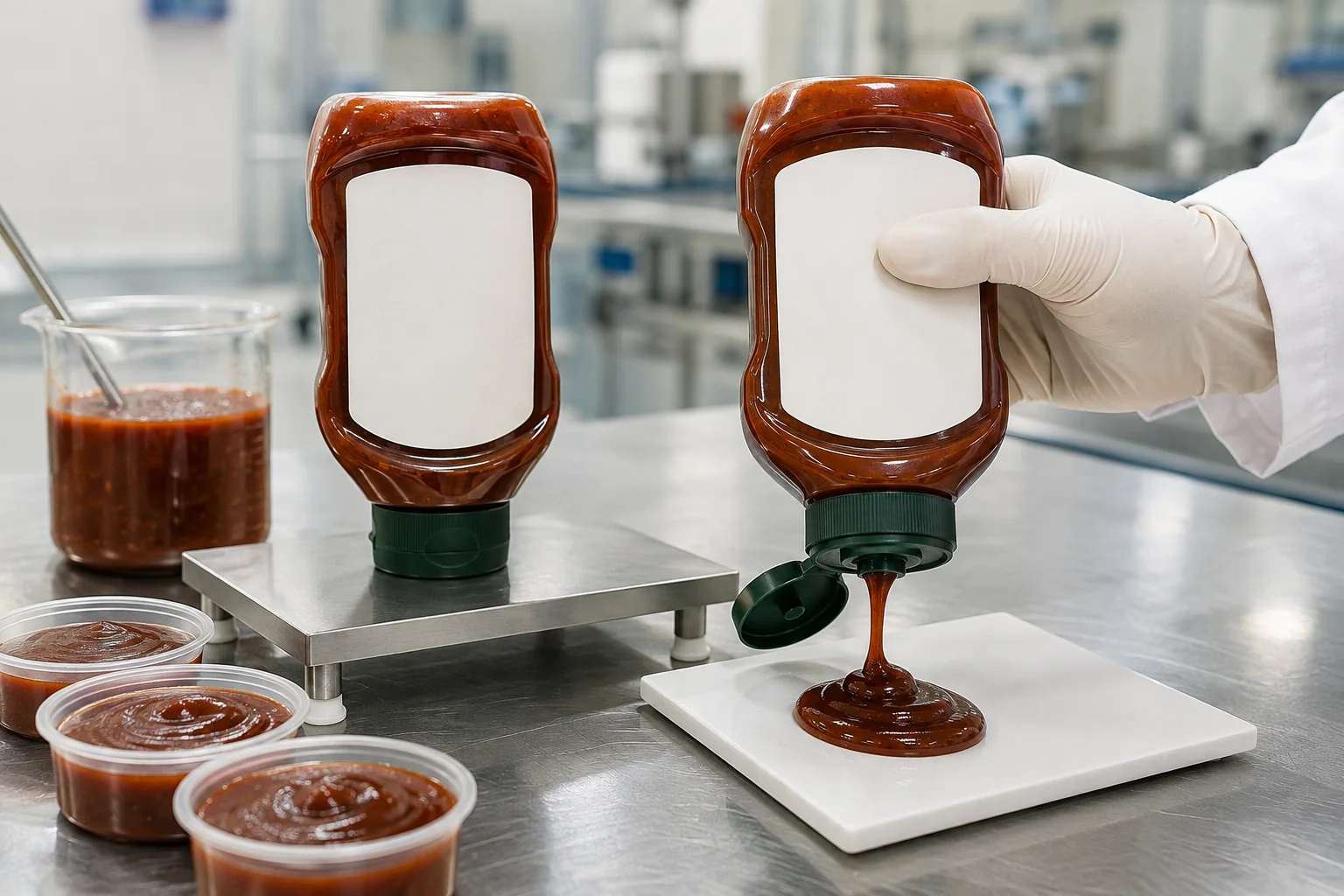
A practical depletion test is simple: weigh the filled bottle, dispense in normal consumer-style portions until the package becomes difficult to use, then weigh the remaining sauce. For premium retail programs, low-residue performance should be compared across bottle shape, valve type, fill level and storage temperature.
Material Selection for Retail Inverted BBQ Sauce Bottles
PET, HDPE, LDPE and PP can all appear in inverted sauce packaging, but they solve different problems. PET is useful when clarity and shelf appearance are important. HDPE and LDPE are useful when squeeze feel and impact resistance matter more than glass-like transparency. PP can support selected closure and higher-temperature requirements. Multilayer routes may be reviewed when oxygen barrier, sauce color or shelf-life targets are critical.
The material route should be selected after the sauce profile is clear: viscosity, oil content, acidity, particle size, fill temperature, storage orientation and target shelf life. Cap-down storage increases closure contact with sauce, so cap material, liner, valve and bottle body cannot be approved separately.
For barbecue sauces with tomato solids, vinegar, sugar, spices and smoke flavor, filled-sample storage is more reliable than a generic material statement. The final package should be checked for odor, staining, panel deformation, valve behavior, leakage and label appearance after warm storage and repeated use.
| Material Route | Best Use in Inverted BBQ Bottles | Watchpoint |
|---|---|---|
| Clear PET | Retail shelf visibility and glass-like appearance with lower breakage risk. | Fill temperature, vacuum response, squeeze stiffness and cap-down leakage. |
| HDPE | Durable squeeze packs, opaque or semi-opaque retail and foodservice formats. | Lower clarity and oxygen barrier compared with glass or high-barrier routes. |
| LDPE / soft squeeze route | Easy hand force and strong user comfort for thicker sauce. | Panel creasing, label distortion and long-term shelf shape. |
| PP | Selected hot-fill-compatible or closure-integrated systems. | Clarity, stiffness and decoration route must be verified. |
| Multilayer structure | Longer shelf-life targets or stronger barrier requirement. | Higher validation complexity and component-specific food-contact review. |
Retail Shelf, Refrigerator Door, and Table-Service Tests
A retail inverted BBQ bottle should be tested in the places where it will actually stand. A bottle may pass a flat stainless bench test but wobble on refrigerator wire racks, lean in shelf-ready trays or collect residue around the cap after table-service use. The test plan should include standing stability, cap cleanliness and low-residue dispensing together.
For shelf trials, place filled bottles cap-down in the intended tray or retail facing pattern and apply light vibration or repeated handling. For refrigerator testing, stand bottles on wire racks and door shelves after cold storage, then inspect cap residue and squeeze force. For table-service use, repeat opening, dosing and closing cycles to check whether guests would see a clean closure.
Transport testing is also important because the cap is now the base. If cartons press directly on the closure face, cap deformation can change valve preload or create leakage. Inner dividers, bottle orientation, cap protection and pallet compression should be approved before mass shipment.
| Test | Condition | Pass Criteria |
|---|---|---|
| Shelf standing test | Filled bottles cap-down on shelf tray or flat shelf. | No tipping, visible lean or cap-face rocking. |
| Refrigerator-door check | Cold storage on wire rack or door shelf. | Bottle stands without wobble and dispenses without excessive first-squeeze force. |
| Cap-down leakage test | Filled package stored inverted and side-laid. | No sauce creep past valve, liner or cap thread. |
| Repeated-use test | Open, squeeze, close and store repeatedly. | Valve remains clean, cap closes fully and label panel stays acceptable. |
| Carton compression review | Packed bottles under expected stack load. | No cap deformation, valve damage or bottle-panel creasing. |
Gracepack Validation Route for Inverted BBQ Sauce Bottle Projects
Gracepack supports inverted BBQ sauce bottle projects by matching bottle shape, material route, cap footprint, silicone valve caps, label panel, carton packing and food-contact document scope before bulk production. The practical review starts with the sauce, not the bottle photo: viscosity range, largest particle size, oil content, acidity, filling temperature, storage orientation, target capacity and destination market.
The factory base includes 500+ owned molds, 5,000+ standard bottle designs, 15 automatic injection molding machines, 13 automatic blow molding machines, 9 fully automatic production lines, 3 labeling machines and 5 printing machines. This makes it possible to compare stock inverted condiment formats, sweet-heat squeeze bottle routes, custom cap-down bases and new mold directions before tooling is proposed.
For retail brands, the most useful sample pack includes at least two bottle stiffness routes, two cap or valve options and the intended label or sleeve direction. Gracepack can help review filled-package stability, valve cleanliness, low-residue performance, cap torque, leakage, carton packing and component-level food-contact support for PET, HDPE, LDPE, PP, PE and silicone contact parts.
Inverted BBQ Sauce Bottle RFQ Checklist
A useful RFQ for inverted BBQ sauce bottles should define the package as a working dispensing system. Send the target fill volume, sauce viscosity or sample, visible particle size, oil percentage if known, fill temperature, cap-down storage requirement, desired cap color, label size, target shelf life, carton quantity and expected annual volume.
If the bottle will be used for retail shelves, include shelf tray dimensions and preferred facing count. If it will be used for table service or foodservice, include cleaning expectations and refill behavior. If it will ship by e-commerce, include drop and leakage requirements so cap protection can be reviewed with the carton.
- Confirm whether the sauce is smooth, seeded, pulpy or oil-rich.
- Define cap-down stability requirements for shelf, refrigerator and table use.
- Test valve cleanliness after repeated dispensing, not only after the first squeeze.
- Measure low-residue performance by remaining sauce weight after normal use.
- Review cap torque, liner or valve fit, carton compression and warm storage together.
Request an Inverted BBQ Sauce Bottle Sample Review
If your BBQ sauce needs a cap-down retail bottle, send the sauce type, viscosity range, particle profile, target fill volume, filling temperature, label direction and destination market. Gracepack can compare inverted bottle molds, cap footprints, valve routes, squeeze stiffness and carton packing before you commit to a production order.
For custom projects, the review can include stock mold screening, cap and valve matching, low-residue testing direction, shelf stability checks, label panel review and sample pack preparation for filled validation.


