
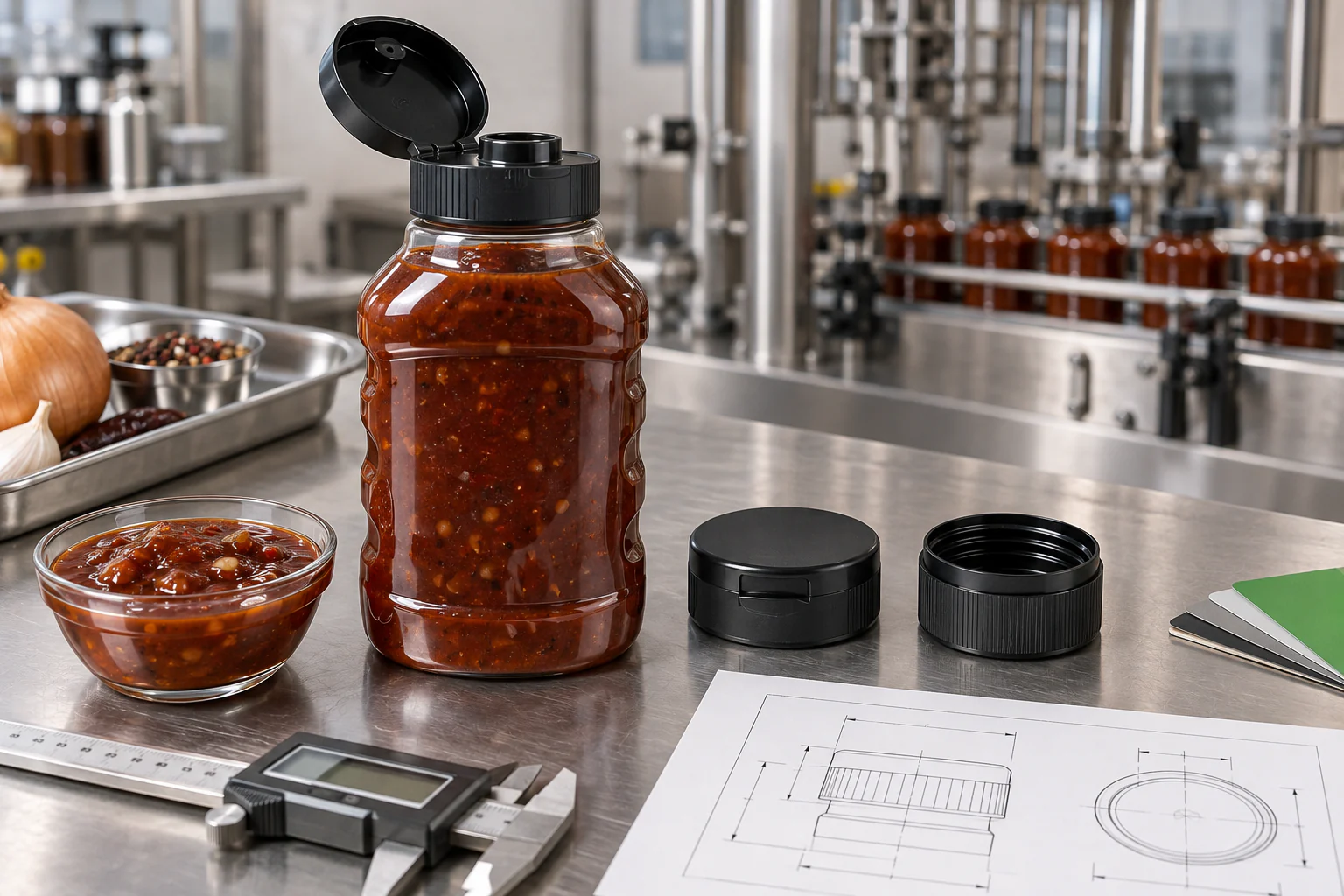
A 38-400 BBQ sauce cap should be selected around the sauce's largest repeatable particle, yield stress, refrigerated viscosity, required dose and storage orientation. For smooth-to-textured BBQ sauce, 9.5 mm (0.375 in) and 12.7 mm (0.500 in) openings are practical trial candidates; a 6.4 mm (0.250 in) opening is generally better reserved for smoother formulas that do not contain pieces likely to bridge at the outlet.
Those dimensions are screening points, not universal pass/fail limits. The finished bottle, cap, liner or induction seal, capping torque and real sauce must be tested together because two formulas with the same viscosity can dispense differently when one contains fibrous onion, pepper skin or irregular spice clusters.
| Sauce Condition | Opening Route to Trial | Main Risk | Approval Evidence |
|---|---|---|---|
| Smooth, thick BBQ sauce | 6.4-9.5 mm round opening or a validated valve route | High squeeze force, stringing or residue around the spud | Dose weight, cutoff and bottle recovery at room and refrigerated temperature |
| Fine spice specks below about 1 mm | 9.5 mm opening as an initial candidate | Settled solids collecting at the outlet | Repeated dispensing after upright and cap-down storage |
| Visible 1-3 mm onion, garlic or pepper pieces | 9.5-12.7 mm opening, subject to filled-sample trials | Particle bridging and intermittent sputter | Largest-particle screen, multi-dose test and cap-cleanliness inspection |
| Irregular pieces above about 3 mm | 12.7 mm opening or a less restrictive wide-mouth route | Multiple particles forming a bridge even when one piece fits | Worst-case batch test after chilling, settling and partial bottle use |
| Fibrous or very chunky sauce | Removable continuous-thread closure or wide-mouth package | Long fibers lodging in a flip-top flow path | Pour, spoon or pump trial using the production recipe |
Why Thick and Chunky BBQ Sauce Clogs an Otherwise Correct Cap
Thick BBQ sauce is usually non-Newtonian. It may resist movement until squeeze pressure exceeds its yield stress, then thin while flowing and regain body after the pressure stops. A closure that feels acceptable with water can therefore demand excessive hand force with the finished sauce, while a short wide opening may deliver a clean ribbon at the same bottle squeeze force.
Particles add a separate failure mode. One onion piece may pass through the outlet, but two or three irregular pieces can rotate, touch and form a bridge across the entrance. Pepper skins and fibrous herbs are especially troublesome because their longest dimension, not only their thickness, determines whether they fold through the opening or hang across it.
Temperature completes the problem. A sauce tested warm immediately after mixing may become much harder to dispense after 24 hours at 4-8 degrees C (39-46 degrees F). Approval testing should include the coldest expected consumer-use condition, settled product near the cap and the final third of the bottle, where air intake and bottle recovery can change the dose.
Size the Orifice Around the Largest Particle, Not Average Viscosity
The familiar rule that an opening should be at least twice the largest particle diameter is useful as an early screen, but it is not a guarantee against clogging. Particle shape, concentration, fiber length, sauce adhesion, outlet length and the transition into the orifice all affect bridging. A 3 mm cube and a 3 mm by 12 mm onion strip do not behave like the same particle.
Begin with a production-representative sauce sample and separate the largest particles through a simple sieve or image measurement. Record the largest recurring dimension rather than one unusual outlier, then keep that outlier for a worst-case trial. For concentrated solids or fibrous inclusions, move to a larger opening or a short, smoothly radiused flow path instead of relying on diameter alone.
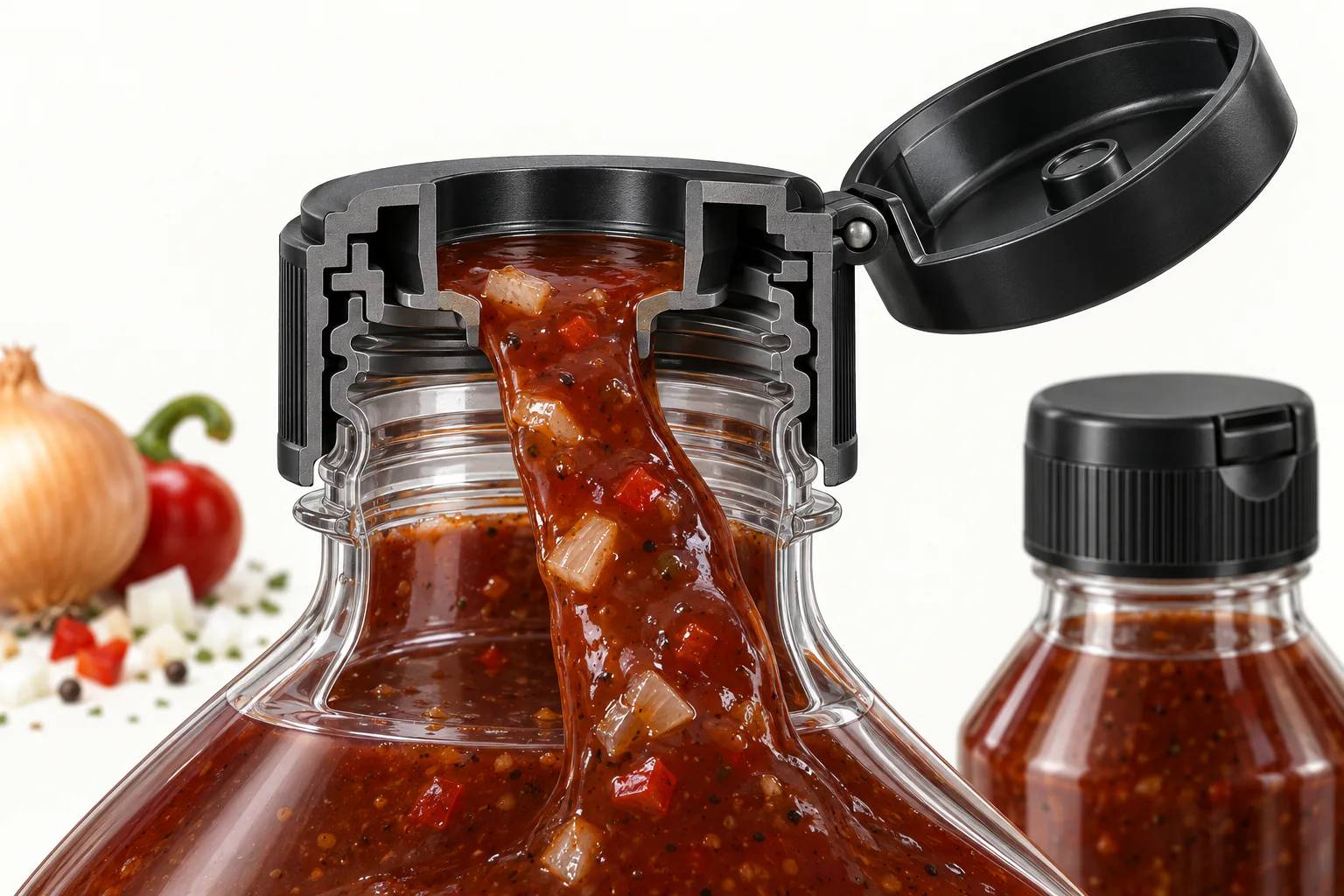
Commercial 38-400 food-dispensing families are available with several openings, including approximately 6.4, 9.5 and 12.7 mm. That range makes 38-400 useful for development, but the correct result is the smallest opening that passes the recipe repeatedly without excessive squeeze force, sputter or residual buildup. A larger opening is not automatically better because it can reduce portion control and release an unexpectedly heavy dose.
| Measurement | How to Check It | Why It Changes the Cap Decision |
|---|---|---|
| Largest recurring particle | Measure the longest dimension in multiple production-representative samples | Sets the first opening-size screen |
| Particle concentration | Compare pieces per 100 g or another consistent batch basis | Higher concentration increases multi-particle bridging risk |
| Cold viscosity | Measure or compare flow after planned refrigerated storage | Cold sauce can require more squeeze pressure and a larger effective flow area |
| Yield and cutoff | Record the force or squeeze needed to start flow and the tail after release | Separates a clean dose from a sudden surge or stringing residue |
| Outlet geometry | Review bore length, entry radius, plug or spud and recessed well | Two caps with the same nominal hole can dispense differently |
What 38-400 Means and Why 38-485 Is Not a Substitute
The 38 in 38-400 identifies the nominal finish diameter family, while 400 identifies a continuous-thread finish style. It does not mean every closure described as 38 mm will fit every 38 mm bottle. The bottle drawing and closure drawing still need to agree on thread outside diameter, neck outside diameter, finish height, bore, thread profile, sealing land and shoulder clearance.
A 38-485 finish may share the same nominal diameter but uses different finish geometry. Treating 38-400 and 38-485 as interchangeable can produce shallow engagement, cap stand-off, cross-threading, weak liner compression or a capping chuck that reaches its stop before the seal is formed. A physical fit that feels acceptable by hand is not enough for an automated line or an inverted package.
For 38-400 flip-top caps, request the bottle-neck drawing, closure drawing and compatible liner or induction-seal specification as one set. Then check the actual molded parts because neck ovality, parting-line mismatch, flash, sealing-land flatness and cap shrinkage can move a nominally correct design outside its working window.
| Interface Check | Bottle Feature | Closure Feature | Failure If Mismatched |
|---|---|---|---|
| Thread engagement | Thread diameter, lead and profile | Matching internal thread and start | Cross-threading, cap tilt or variable application torque |
| Top seal | Flat, smooth sealing land | Liner, crab-claw or plug-seal geometry | Leakage, sauce in the threads or weak induction sealing |
| Finish height | Neck height above shoulder | Skirt depth and internal stop | Visible gap or cap bottoming before seal compression |
| Bottle bore | Minimum inside diameter and roundness | Spud, plug, valve carrier or flow chimney | Interference, restricted flow or assembly damage |
| Line handling | Neck support and bottle geometry | Cap outside diameter, height and hinge orientation | Sorter, chute, chuck or conveyor interruptions |
Choose the Closure Architecture Before Choosing the Hole
A wide round opening is only one part of the dispensing system. Conventional 38-400 flip-top closures give familiar one-hand use and can provide 9.5 or 12.7 mm outlets for textured sauces. A lid with a correctly aligned plug or spud enters the opening when closed, helping displace wet residue and protect the bore from drying between uses. The plug must clear the sauce without trapping fibers or scraping the orifice out of shape.
Wide-orifice sauce caps with a short flow chimney are generally easier to clean than deep recessed wells. A shallow protected recess can reduce accidental contact, but a deep recess can hold a ring of sugary sauce that dries around the outlet. Hinge position also matters: the open lid should stay outside the sauce stream and should not spring back into the product during dispensing.
Silicone slit valves are valuable for smooth sauces that need clean cutoff and cap-down storage, but particles can lodge in the slit and prevent full recovery. Disc-top closures typically offer a smaller, longer pathway and are better suited to smooth products. Dual-flapper shaker caps are designed primarily for dry seasoning and should not be treated as a wet, chunky-sauce solution without a purpose-built design and validation.
For a sauce that remains too coarse for a controlled opening, the better package may be a removable 38-400 continuous-thread cap, a broader pour opening or a wide-mouth container. Squeezable BBQ Sauce Bottles can still be used, but the closure should not force a spoonable recipe through a geometry intended for a smooth condiment.
Sealing, Torque and Induction Liner Compatibility
Opening size controls dispensing; the sealing system controls leakage and shelf integrity. A flip-top lid may stop sauce at the dispensing orifice, while the threaded closure seals against the bottle finish through a liner, crab-claw feature, land seal or plug geometry. Both interfaces must work. Sauce in the thread area often points to finish mismatch, insufficient or excessive application torque, an unsuitable liner or a distorted neck rather than a problem with the flip lid itself.
Polypropylene is common for food-dispensing closures because it supports molded hinge performance and dimensional control. Food-contact review should match the actual cap resin, colorant, liner and valve rather than relying on the bottle report alone; FDA 21 CFR 177.1520 is one relevant U.S. regulatory reference for olefin polymers, but finished-package suitability still depends on the intended conditions of use.
Torque should be recorded at application and again after conditioning because polymer stress relaxation, warm filling, cooling and liner compression can change removal torque over time. ASTM D2063/D2063M provides a recognized method for measuring torque retention in packages with continuous-thread closures. Project limits still need to be established for the selected bottle, cap, liner, filling process and opening experience.
Induction liners can add tamper evidence and protect against leakage before first opening, but the foil structure, heat-seal layer, bottle resin and sealing land must be compatible. The induction window should be validated across line speed and cap torque so the seal bonds around the full circumference without scorching the liner, distorting the cap or leaving a weak edge.
Validate the Cap on the Filling and Capping Line
A cap that dispenses well in the lab can still create line losses if its outside diameter, hinge, skirt height or liner does not feed consistently through the cap sorter and chute. The closure should arrive at the chuck in a repeatable orientation, engage the bottle without cross-threading and reach the application-torque window without deforming the bottle shoulder or finish.
Thick sauce can contaminate the sealing land when the filling nozzle strings or drips after cutoff. The line trial should therefore evaluate nozzle withdrawal, fill height, headspace and the time between filling and capping. A wide 38 mm finish helps filling access, but it does not compensate for sauce left on the land before the cap is applied.
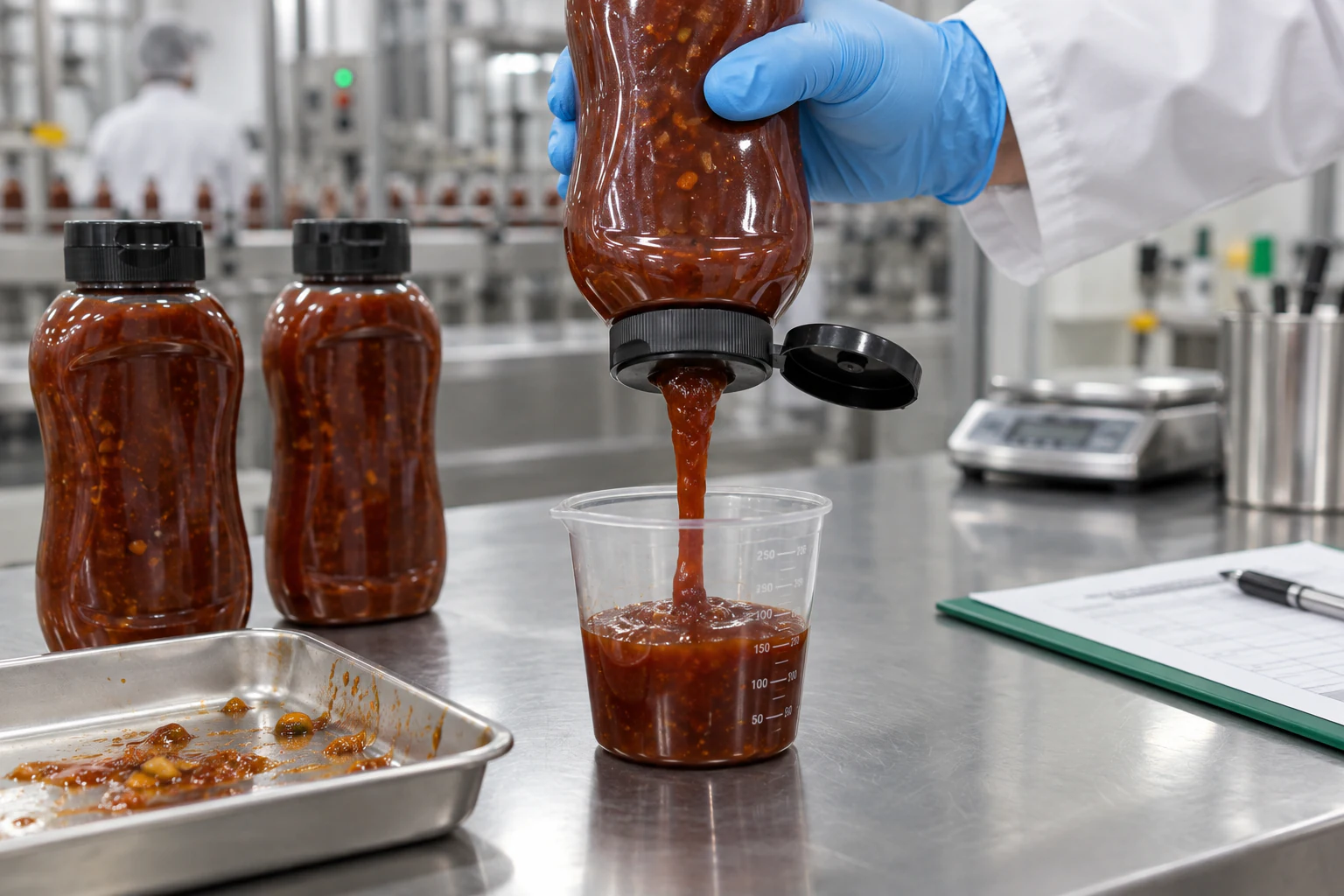
Use production-speed trials to watch cap pickup, thread start, applied torque, hinge damage, liner position and bottle stability. After capping, condition filled samples upright, on their side and cap-down, then inspect leakage and removal torque before beginning repeated dispensing tests.
| Trial Stage | Record | Reject or Investigate When |
|---|---|---|
| Cap feeding | Sorter output, chute orientation and cap pickup rate | Hinges catch, caps nest or orientation varies |
| Application | Applied torque, thread start and cap height | Cross-threading, cap tilt or bottle-neck distortion appears |
| Initial seal | Side, inverted and vibration leakage | Sauce reaches the thread, liner edge or carton |
| Conditioning | Removal torque after the agreed dwell and temperature cycle | Torque falls outside the project window or opening force becomes inconsistent |
| Dispensing | Dose weight, squeeze force, cutoff and number of clean cycles | Flow surges, sputters, strings or blocks |
| Residue | Buildup at the bore, spud, hinge and recess | Dried sauce obstructs the next dose or prevents lid closure |
Gracepack 38-400 Cap and Bottle Qualification
We coordinate the bottle body and injection-molded closure as one packaging system. Available manufacturing resources include automatic injection molding for PP and PE cap components, blow-molded bottle routes, more than 500 owned molds and more than 5,000 standard bottle designs. That allows the first review to compare an existing finish, cap and bottle combination before custom tooling is considered.
Production checks focus on a flat and clean bottle sealing land, smooth thread engagement, controlled flash and burrs, closure appearance, liner fit and leakage performance. Approved bottle, cap, liner and filled samples can be retained as references so repeat orders are compared with the same physical package rather than a generic 38 mm description.
Food-contact support can be matched by component, including PET, PP, PE and silicone routes, together with ISO 22000 documentation. For thick or chunky BBQ sauce, the practical sample set can include a 38-400 closure with more than one opening, the intended bottle body, liner or induction seal and filled-use test directions for the co-packer or brand laboratory.
When the formula needs both squeeze recovery and a large flow path, we can compare squeeze sauce bottles for thick condiments with cap options that do not choke the product. When the priority is a directional stream rather than a broad ribbon, directional-nozzle squeeze formats can be screened against the same particle and residue tests before a final route is approved.
| Qualification Step | What Is Matched | Output |
|---|---|---|
| Formula screen | Viscosity at use temperature, largest particles, solids concentration and oil level | Opening and closure candidates for sampling |
| Drawing review | 38-400 bottle finish, closure thread, bore, seal and liner dimensions | Compatibility checklist before sample dispatch |
| Filled-sample trial | Bottle squeeze, dose, clogging, residue, leakage and torque | Approved route or clear adjustment list |
| Document map | Bottle, cap, liner, valve and destination market | Component-specific food-contact support path |
| Repeat-order control | Approved parts, color, packing and retained samples | Physical reference for future production lots |
Approval Checklist for a 38-400 BBQ Sauce Closure
Use the checklist before approving artwork, ordering caps separately or scheduling a full-speed co-packer trial. Each item should be tied to the actual bottle and production recipe rather than a supplier's nominal cap description.
- Record viscosity at filling temperature, room temperature and the coldest expected use temperature.
- Measure the largest recurring particle and retain a worst-case batch sample.
- Compare at least two practical opening sizes when clogging or dose control is uncertain.
- Confirm 38-400 drawings for the bottle, closure and liner; do not substitute a 38-485 component.
- Run application and removal-torque checks after the agreed conditioning period.
- Inspect the sealing land before capping and verify the induction-seal window if used.
- Test upright, side and cap-down storage before repeated dispensing.
- Approve dose consistency, cutoff, residue, lid closure and bottle recovery through the expected use cycle.
- Keep approved bottle, cap, liner, carton and filled samples for repeat-order comparison.
FAQ About 38-400 BBQ Sauce Bottle Caps
What orifice size works best for thick and chunky BBQ sauce?
There is no universal size. A 9.5 mm (0.375 in) or 12.7 mm (0.500 in) opening is a practical trial range for many textured BBQ sauces, while a 6.4 mm (0.250 in) opening is more suitable for smoother formulas. Approval depends on the largest particle, cold viscosity, required dose and repeated filled-sample testing.
Will any 38 mm cap fit a 38-400 bottle?
No. A nominal 38 mm diameter does not define the thread, height, bore or sealing system. Confirm the bottle and closure drawings, then test molded samples for thread engagement, cap height, torque, liner compression and leakage.
Is the two-times-particle rule enough to prevent clogging?
It is only an initial screen. Irregular particles, fibers and concentrated solids can bridge even when a single piece is smaller than half the opening. Repeated testing with the production recipe is still required.
Can a silicone valve handle chunky BBQ sauce?
It may work for smooth thick sauce, but seeds, onion pieces, pepper skin and fibers can lodge in the slit. A large round opening or removable cap is usually a safer first trial for visibly chunky formulas.
Can a 38-400 flip-top cap use an induction seal?
Yes, when the cap has suitable liner space and the induction liner matches the bottle material and sealing land. Cap torque, line speed, foil structure and full-circumference bond must be validated together.
Request a 38-400 Cap and Chunky Sauce Sample Review
Send the BBQ sauce viscosity or flow data, largest particle dimensions, storage temperature, bottle capacity, bottle material, neck drawing if available, filling temperature, capping method, preferred dose and destination market. We can compare 38-400 closure openings, sealing routes and compatible bottle options as a matched sample set.
For the fastest review, include a production sauce sample or clear flow video and identify whether the package will be stored upright, on its side or cap-down. The result can include an opening-size trial plan, closure and liner recommendation, filled-package test checklist and quotation for samples or production.


