
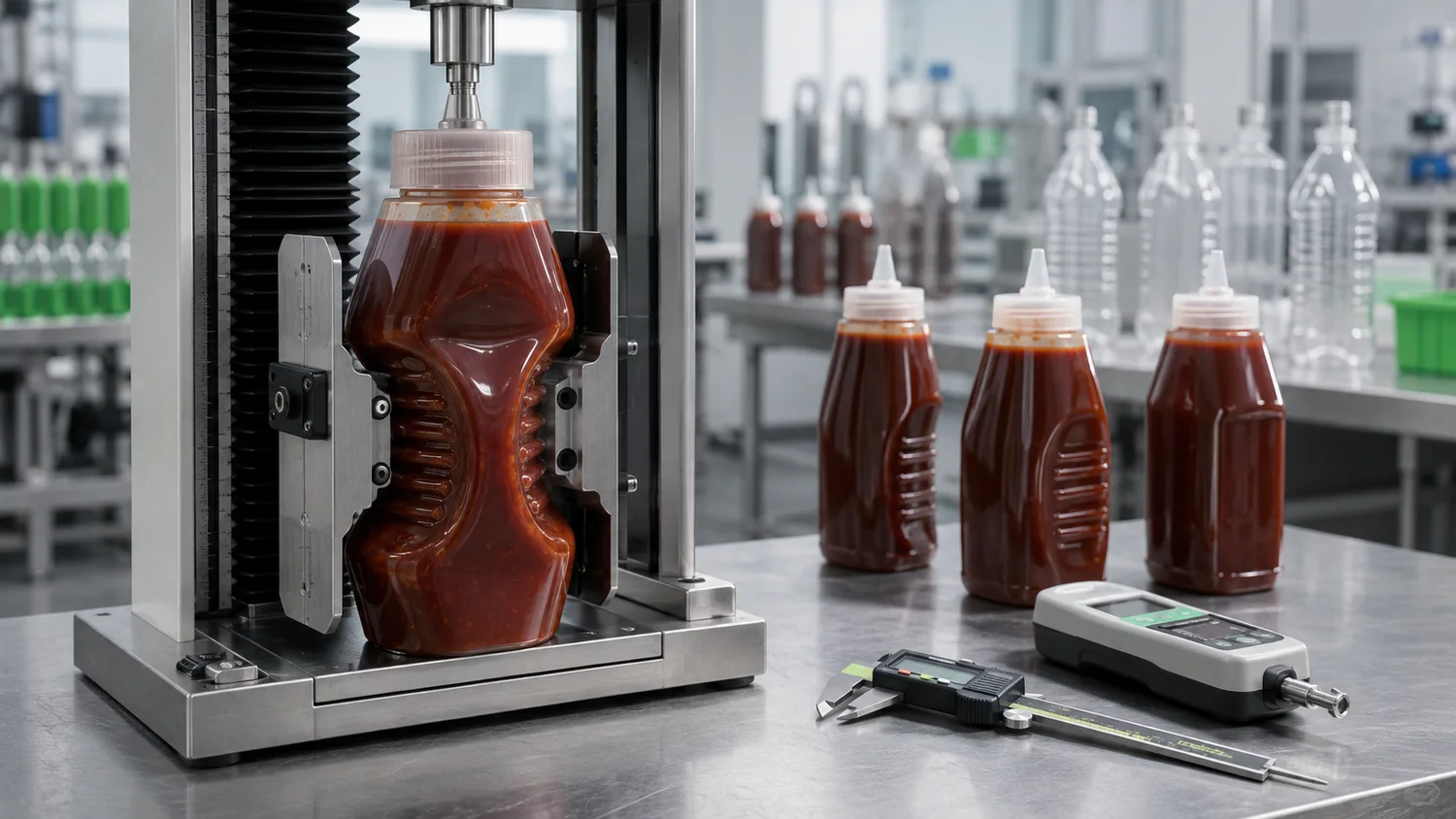
Squeezable BBQ Sauce Bottles fail when the bottle wall cannot convert hand pressure into controlled flow and then recover its original shape after release. For thick BBQ sauces in the 5,000-10,000 cPs planning range, the bottle must manage high internal resistance, sauce adhesion, delayed air return, grip-panel fatigue and cap opening pressure without creasing or staying dented.
The strongest package is not simply the softest package. A wall that is too soft can buckle before enough pressure reaches the nozzle. A wall that is too stiff can frustrate users and leave sauce trapped near the shoulders. The working design balances squeeze force, wall-thickness distribution, plastic memory, rib geometry, headspace, cap bore and the rheology of the filled sauce.
For packaging engineers and sauce brands, the question is not only whether the bottle can be squeezed once. The real approval test is whether the filled bottle dispenses a clean line, pulls air back through the closure or panel system, returns toward its shelf shape, and repeats that behavior after storage, shipping and multiple consumer use cycles.
| Engineering Variable | Weak Baseline | Better Squeeze-Bottle Route | Validation Method |
|---|---|---|---|
| Sauce viscosity | Thin-liquid bottle tested with water or syrup. | Filled sample tested with actual 5,000-10,000 cPs BBQ sauce or close pilot formula. | Dose weight, squeeze force, flow cutoff and refill-air behavior. |
| Wall thickness | Uniform wall that creases at the grip zone or stays too rigid. | Controlled map with thinner squeeze panels and reinforced shoulder, neck and base zones. | Section weight, caliper checks, squeeze cycle review and visual recovery. |
| Plastic memory | Permanent denting after compression. | Resin and geometry selected for elastic rebound and creep resistance. | Repeated compression, recovery time and shelf-shape inspection. |
| Cap and nozzle | Opening too small for thick sauce or too wide for clean control. | Nozzle cap, flip-top or valve route matched to viscosity and particle size. | Flow line shape, drip tail, clogging, cap-down leakage and cleaning behavior. |
| Filled-package stability | Empty sample approval only. | Filled bottle checked after shipping, warm storage and repeated use. | Carton compression, drop orientation, label panel and post-use appearance. |
Why Viscosity Changes the Squeeze Bottle Mechanics
BBQ sauce is usually shear-thinning: it resists movement at rest, then flows more easily when pressure and shear increase. That behavior is useful on food, but it creates a packaging challenge. The bottle wall must build enough pressure to start flow through the cap opening, then recover without sucking sauce residue into the closure or leaving the panel collapsed.
The cap opening sets the hydraulic resistance. A small nozzle may give a neat line with a thin sauce, but it can starve a thick BBQ sauce and force the user to squeeze harder. A larger bore reduces force but can create uncontrolled blobs, stringing tails or messy cap residue. The bottle body and cap cannot be selected separately.
The material also matters. LDPE and soft HDPE routes can deliver a comfortable hand feel, but they need enough shoulder and base support to prevent permanent deformation. PET can give better clarity and shelf gloss, yet it may feel too stiff for some thick sauces unless the geometry and panel placement help the user generate pressure. PP is useful for selected caps, hinges and heat-resistant components, but the final squeeze feel still depends on the whole structure.
| Sauce Behavior | Package Effect | Common Complaint | Design Response |
|---|---|---|---|
| High viscosity | More hand force is needed to start flow. | Bottle feels hard to squeeze or sauce comes out suddenly. | Tune panel softness, cap bore and nozzle length together. |
| Shear-thinning flow | Flow starts after pressure builds, then continues quickly. | User overshoots the target portion. | Use controlled nozzle geometry and elastic recovery. |
| Oil or sugar adhesion | Residue clings to cap and inner wall. | Sticky cap, drip tail and poor cleanup. | Review cap material, bore polish, valve fit and cap-down storage. |
| Pepper flakes or spice particles | Particles can bridge at small openings. | Clogging or uneven spurts. | Use larger orifice, short nozzle path or particle-clearing closure. |
| Delayed air return | Bottle stays dented after dispensing. | Poor shelf appearance and next-use sputter. | Add recovery ribs, controlled headspace and compatible cap vent behavior. |
Wall Thickness Engineering: Thin Where It Flexes, Thick Where It Holds Shape
A good squeeze bottle is a controlled spring. The grip panels need enough flexibility to move under normal hand pressure, while the neck, shoulder, label panel, heel and base need enough stiffness to protect the seal, maintain shelf appearance and prevent rocking. If the whole bottle is made uniformly soft, the weakest area can crease before the sauce moves.
In blow molding, wall distribution is shaped by parison programming, stretch ratio, mold geometry, cooling and resin behavior. For thick BBQ sauce, the design often benefits from a softer central squeeze zone with stronger ribs around it. The ribs do not exist only for style; they direct deformation, keep the bottle from folding at one point, and help the panel rebound after the force is released.
Typical sample review may compare local wall targets such as a thinner grip panel and a thicker shoulder or base zone, but the exact map depends on bottle size, resin, filling condition and cap route. For example, a small tabletop bottle can use a different flex profile than a 16 oz (473 ml) or 24 oz (710 ml) foodservice bottle that sees more filled weight and stronger hand pressure.
| Bottle Zone | Mechanical Role | If Underbuilt | Validation Check |
|---|---|---|---|
| Neck finish | Holds cap torque and sealing land geometry. | Leakage, cap wobble or poor removal torque. | Thread fit, liner compression and cap torque after squeeze cycling. |
| Shoulder | Transfers force from cap and upper body into the sidewall. | Shoulder sink, stress whitening or label distortion. | Filled squeeze test and sidewall recovery after warm storage. |
| Grip panel | Converts hand pressure into sauce movement. | Creasing, permanent denting or excessive squeeze force. | Panel deflection, recovery time and repeated-cycle inspection. |
| Rib structure | Guides flex and protects body geometry. | Random folding or unstable rebound. | Compare rib depth, spacing and deformation pattern. |
| Base and heel | Keeps the filled bottle standing and protects carton loading. | Rocking, base bulge or conveyor instability. | Standing-ring flatness and carton compression review. |
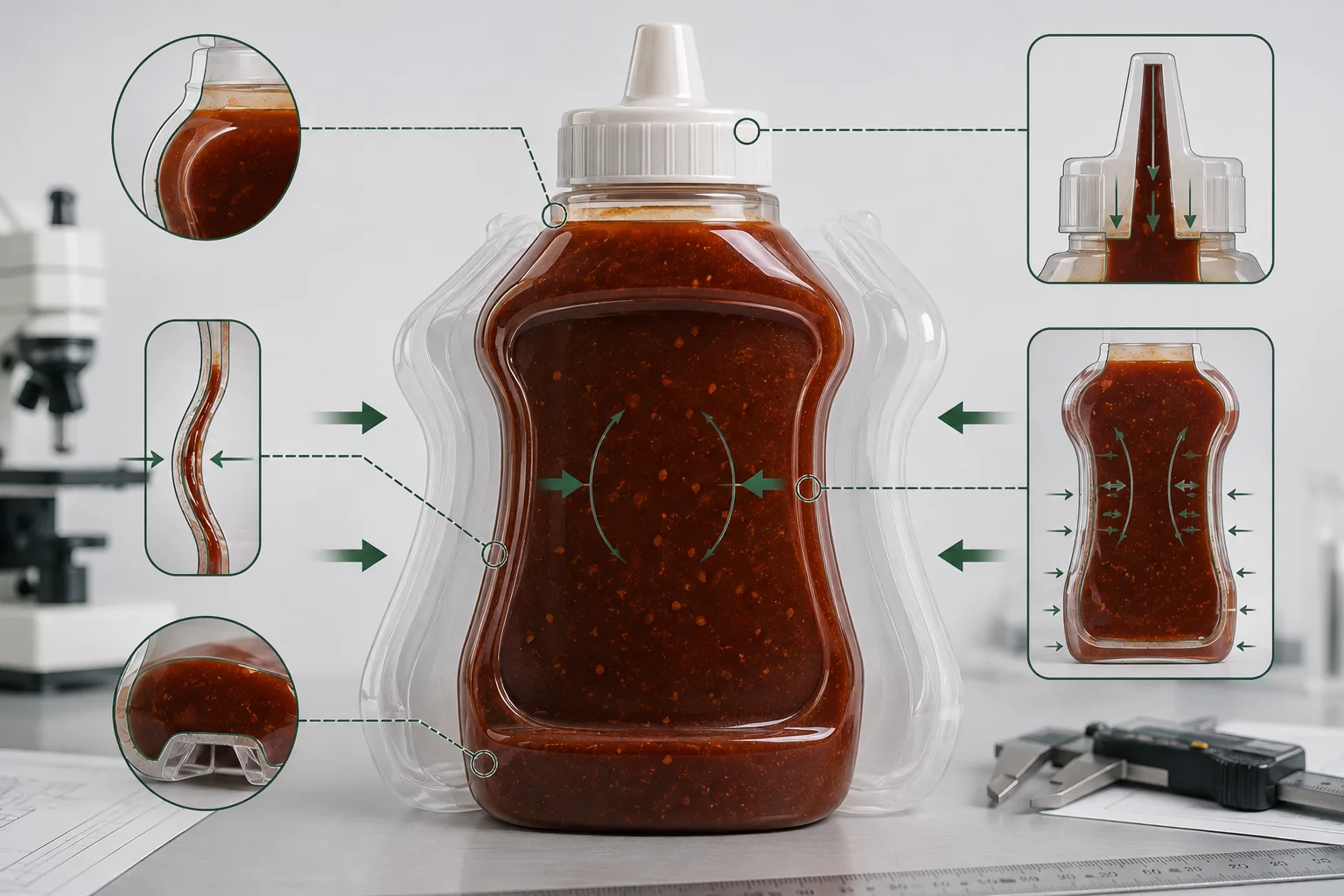
Plastic Memory and Dispensing Recovery
Plastic memory is the bottle's ability to return toward its molded shape after compression. In a thick sauce package, memory is affected by resin stiffness, wall thickness, orientation from blow molding, rib geometry, fill weight, storage temperature and how long the bottle stays compressed in a carton or in the user's hand.
Elastic recovery is fast rebound after normal squeezing. Creep recovery is slower shape return after the bottle has been held under load. Both matter for BBQ sauce. A bottle can rebound well during a short lab squeeze but still develop panel set after warm warehouse storage or after repeated cap-down use. That is why filled samples should be tested over time, not only on the day they are molded.
The cap route changes recovery because the bottle needs air replacement after dispensing. If air cannot return, the bottle may stay collapsed or sputter on the next squeeze. If the cap allows too much uncontrolled air or sauce movement, leakage and residue can increase. Nozzle cap squeeze sauce bottles, flip-top caps and silicone valve caps each need a different recovery check with the actual formula.
| Recovery Mode | What It Means | Risk in Thick BBQ Sauce | Test Method |
|---|---|---|---|
| Immediate rebound | Bottle returns after a normal squeeze. | Slow rebound frustrates repeated dosing. | Compress and release filled bottles at room temperature. |
| Creep recovery | Bottle recovers after longer compression or carton load. | Permanent denting after shipping or warm storage. | Hold under load, release, then inspect shape at set intervals. |
| Air-return behavior | Package replaces dispensed volume with air. | Sputtering, panel collapse or cap residue. | Dispense repeated portions and monitor recovery between squeezes. |
| Fatigue response | Bottle survives repeated user cycles. | Grip panel whitening, crease lines or cap loosening. | Run repeated filled squeeze cycles and cap torque checks. |
| Shelf recovery | Filled bottle still looks acceptable after use. | Poor retail or table appearance. | Inspect label panel, shoulders and base after repeated dispensing. |
Dispensing System: Nozzle, Flip-Top or Valve Must Match the Sauce
The closure is the narrowest control point in a squeeze BBQ sauce package. If the cap opening is too small, the bottle wall must carry excessive pressure before flow begins. If the opening is too large, the sauce may surge out, leave a long tail, or make controlled plating impossible. The right answer depends on viscosity, particle size, oil separation, target dose and whether the bottle will be stored upright or inverted.
Smooth BBQ sauce often works well with a nozzle or flip-top route when the bore is matched to the desired line width. A silicone valve can improve clean cutoff for compatible smooth sauces, especially in inverted formats, but it should not be treated as universal. Seeded, pulpy or spice-heavy BBQ sauces can lodge in a slit valve or small nozzle.
Cap torque and liner behavior also affect dispensing. A cap that loosens during repeated squeezing can leak at the thread even if the nozzle is correct. A liner that does not recover after compression can change the seal over time. This is why squeeze samples should be reviewed as a filled bottle and cap system.
| Closure Route | Best Fit | Watch Point | Sample Test |
|---|---|---|---|
| Nozzle cap | Controlled lines for smooth or medium-thick BBQ sauce. | Clogging and sauce tail if particles are too large. | Line width, cutoff, cap cleaning and repeated dosing. |
| Flip-top cap | Retail and foodservice bottles needing simple one-hand opening. | Opening size can be too small for thick sauce. | Opening force, hinge behavior, leakage and flow rate. |
| Silicone valve | Smooth sauces needing no-drip cutoff or cap-down storage. | Particles, seeds or dried sauce can affect valve closure. | Opening pressure, recovery, drip control and cap-down leakage. |
| Wide opening cap | Chunky BBQ sauce, marinades or sauces with visible particulates. | Less portion control if the opening is oversized. | Dose control, cleanup and consumer-use simulation. |
Factory QC for Squeeze BBQ Sauce Bottle Programs
Gracepack supports squeeze BBQ sauce bottle programs through existing mold selection, bottle and cap matching, blow-molded wall distribution review, injection-molded closure coordination, labeling, printing and export carton planning. That matters because squeeze performance is a system result, not a bottle-only feature.
The production base includes 500+ owned molds, 5,000+ standard bottle designs, 15 automatic injection molding machines, 13 automatic blow molding machines, 9 fully automatic production lines, 3 labeling machines and 5 printing machines. For thick sauce projects, this allows sample review to cover bottle body, cap, nozzle, liner, label area and carton method before the order moves into production.
Food-contact support can be matched by component route. PET, PP, PE, HDPE, LDPE and silicone-related components may each need their own review depending on sauce chemistry, destination market, filling condition and contact time. ISO 22000 food-safety system documentation, PET FDA and BPA-related routes, EU food-contact support for PET/PP/PE/silicone, HDPE and LDPE migration support, and enterprise standards for food-grade plastic bottles and caps can be organized around the final package design.
For thick BBQ sauce, the most useful sample brief includes sauce viscosity, largest particle size, oil separation, filling temperature, target capacity, cap type, storage orientation, retail or foodservice channel, label area and order quantity. With those details, existing molds can be filtered before custom tooling is considered.
| QC Area | Why It Matters | Practical Review |
|---|---|---|
| Wall distribution | Controls squeeze force, rebound and dent resistance. | Check shoulder, grip panel, ribs, heel and base. |
| Cap-to-neck fit | Protects sealing during repeated squeeze cycles. | Review thread engagement, liner compression and cap torque. |
| Nozzle or valve fit | Determines portion control and cleanup. | Test flow line, clogging, drip tail and cap-down leakage. |
| Label panel | Needs to stay flat after compression and recovery. | Apply label to filled samples before repeated-use checks. |
| Carton packing | Prevents deformation before the bottle reaches the user. | Review carton count, dividers, cap protection and pallet load. |
Decision Audit Checklist for Squeeze BBQ Sauce Bottles
Use this checklist before approving a squeeze BBQ sauce bottle sample, changing cap routes or opening custom tooling.
- [ ] Test the actual BBQ sauce or a close pilot formula, not only water or syrup.
- [ ] Record viscosity range, largest particle size, oil separation and filling temperature.
- [ ] Compare squeeze force with the filled bottle at realistic storage temperatures.
- [ ] Inspect panel recovery after 10, 50 and 100 repeated manual squeeze cycles.
- [ ] Check whether the bottle returns enough air after dispensing without leaking.
- [ ] Measure neck finish, cap torque and liner compression before and after cycling.
- [ ] Review nozzle bore, valve slit or flip-top opening against the desired portion size.
- [ ] Confirm label panel flatness after filled squeezing and carton compression.
- [ ] Match food-contact documents to bottle body, cap, liner, valve and colorant routes.
- [ ] Validate carton packing so bottles do not arrive pre-dented before filling or use.
FAQ
What makes squeeze BBQ sauce bottles different from regular sauce bottles?
Squeeze BBQ sauce bottles must handle thicker sauce, higher hand pressure, delayed air return and repeated panel recovery. The bottle body, cap opening and wall-thickness map need to be tested together.
What wall thickness is best for thick BBQ sauce bottles?
There is no single universal wall thickness. A good design normally uses flexible grip panels with stronger shoulders, neck finish, ribs and base zones so the bottle squeezes easily without creasing.
Is LDPE or HDPE better for squeeze BBQ sauce bottles?
LDPE can provide softer squeeze feel, while HDPE can provide stronger toughness and shape control. The better choice depends on viscosity, bottle size, cap route, filling condition and desired shelf appearance.
Why does a squeeze bottle stay dented after use?
The bottle may have poor plastic memory, insufficient air return, weak rib geometry, overly thin panels or creep from storage and carton pressure. Filled squeeze-cycle testing helps identify the cause.
What should I send for a squeeze BBQ sauce bottle sample review?
Send sauce viscosity, largest particle size, oil content, filling temperature, target capacity, cap preference, storage orientation, label requirement, destination market and expected order quantity.
Request a Filled-Sample Squeeze Bottle Review
A thick BBQ sauce bottle should be approved by how it behaves after filling, squeezing, recovering and shipping. The best route may be a soft LDPE body, tougher HDPE body, flexible PET direction, nozzle cap, flip-top cap, silicone valve, or an existing mold with a different wall distribution.
Gracepack can review your sauce viscosity, filling condition, target bottle size, cap route, label area and carton requirement before recommending samples. Share the current bottle, a short failure description or a pilot sauce specification to compare existing mold options before custom tooling.
- Use existing molds when the first goal is fast filled-sample validation.
- Use custom tooling after the squeeze panel, cap opening and recovery target are clear.
- Review the bottle, cap, liner, label and carton as one package system.
- Approve bulk production only after filled squeeze, leakage and packing checks.


