
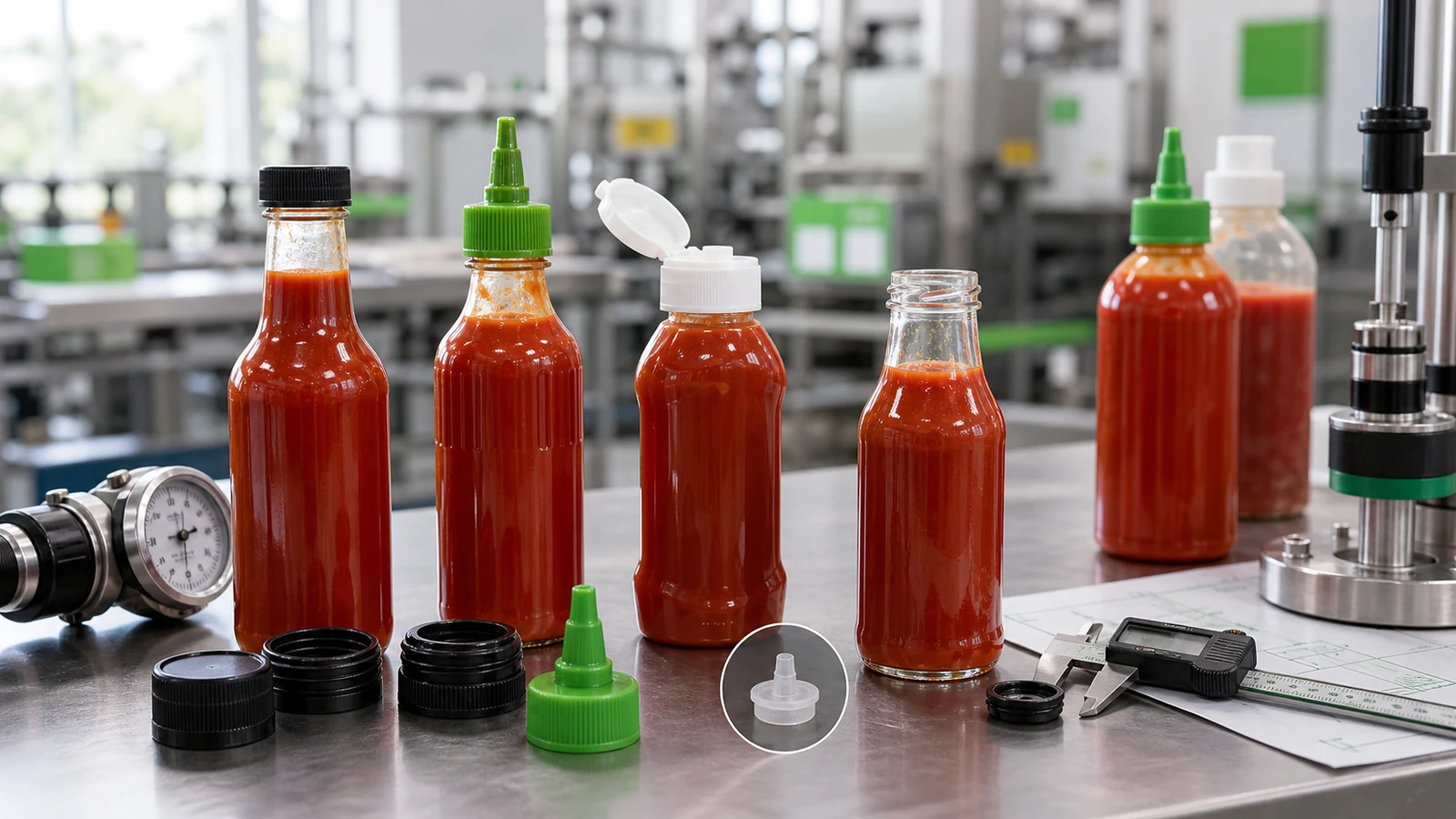
Hot sauce bottle caps protect the sauce, control the pour, keep the closure area clean and maintain the seal during filling, storage and transport. The right cap depends on sauce viscosity, particle size, bottle material, filling temperature, neck finish, liner route and whether the package is used for retail, foodservice or ecommerce.
A thin vinegar hot sauce may need a small orifice reducer or controlled flip-top cap. A seeded chili sauce usually needs a larger opening. A thick squeeze sauce may need a nozzle, valve or twist-open dispensing cap tested with the real formula. Cap selection is a mechanical packaging decision, not a finishing detail.
| Closure Type | Best Fit | Main Risk | Engineering Check |
|---|---|---|---|
| Continuous-thread screw cap | Glass woozy bottles, bulk hot sauce bottles, thicker sauces and storage formats. | Loose caps, liner mismatch, hard opening or leakage after transport. | Neck finish, sealing land, liner compression, application torque and 24-72 hour removal torque. |
| Flip-top dispensing cap | Thin to medium smooth sauces where one-hand opening and repeat use matter. | Wrong orifice size, hinge residue, cap-down leakage or snap fatigue. | Orifice diameter, hinge closure force, inverted storage and repeated open-close cycles. |
| Twist-open nozzle cap | Sriracha-style chili sauce, squeeze bottles and controlled line dispensing. | Nozzle clogging, cap contamination, broken tip seal or over-dispensing. | Nozzle bore, particle clearance, cap thread fit and closure protection during shipment. |
| Orifice reducer / dasher insert | Thin smooth hot sauce where drop-by-drop dosing is important. | Clogging with seeds or pulp, poor insert seating or inconsistent flow. | Reducer hole size, insert retention, cap clearance and real-sauce dispense testing. |
| Silicone valve cap | Smooth squeeze sauces that need clean cut-off or inverted storage. | Valve held open by particles, compression set or high opening force. | Valve slit geometry, squeeze force, sauce oil content and cap-down leakage review. |
The Role of Closures in Consumer Experience
The closure is the point where the consumer judges the package every time the sauce is used. A good bottle body can still fail commercially if the cap floods the plate, clogs after one week, leaks in an ecommerce carton or becomes sticky around the hinge. For hot sauce brands, the cap controls dosing confidence as much as it controls the seal.
For co-packers and food manufacturers, closure performance also affects line speed. A cap that does not pick up cleanly in the capper, starts its thread inconsistently or needs a narrow torque window can slow production. If sauce splashes onto the thread during filling, torque can drift because cap skirt friction, liner compression and product residue all change at once.
This is why cap choice should be tested as a complete system: bottle neck, cap thread, liner, reducer or valve, filling temperature, headspace, torque and carton orientation. A cap that works on an empty sample may behave differently after hot sauce, oil, acid, heat and transport vibration are introduced.
- Sealing prevents leakage, oxygen ingress and sauce creep around the thread.
- Dispensing controls dose size, drip behavior and perceived heat intensity.
- Opening force affects retail convenience, elderly users and foodservice speed.
- Cap cleanliness affects repeat use, shelf presentation and consumer complaints.
- Closure compatibility affects capper speed, reject rate and export carton risk.
Breakdown of Major Hot Sauce Closure Types
Hot sauce closures are often described with simple names, but the engineering difference is in the flow path and sealing interface. A continuous-thread cap removes completely. A flip-top cap opens a hinged dispensing door. A twist-open nozzle exposes or closes a small cone-shaped flow path. An orifice reducer sits inside the bottle neck and controls flow before the sauce reaches the cap.
For classic glass woozy bottles, continuous-thread PP or phenolic-style caps are common because they can be paired with a liner and, when needed, a reducer insert. For plastic squeeze bottles, flip-top, nozzle and valve caps are more common because the bottle body generates dispensing pressure. For thick chili sauces, the cap opening must be sized around the largest particle rather than the average sauce texture.
| Cap Route | Typical Bottle Route | Flow Behavior | Best Use Case |
|---|---|---|---|
| CT screw cap with liner | Glass woozy, PET hot sauce bottle, bulk condiment bottle. | Open-mouth pour after cap removal; reducer can be added for dashing. | Premium hot sauce, storage bottles, bulk supply and cap-with-liner sealing. |
| Flip-top dispensing cap | PET, HDPE or LDPE squeeze bottle. | Direct pour or squeeze stream through a molded opening. | Retail and foodservice sauces that need one-hand use. |
| Twist-open nozzle cap | Sriracha-style squeeze bottle and chili sauce bottle. | Nozzle opens by twisting or lifting; output is more directional. | Thicker chili sauce, table sauce and controlled line application. |
| Reducer insert / dasher | Narrow-neck hot sauce and pepper sauce bottles. | Drop-by-drop or narrow stream depending on hole size. | Thin vinegar-style hot sauce and high-heat sauces needing portion control. |
| Valve cap | Inverted squeeze bottle or soft squeeze body. | Opens under squeeze pressure, then closes to reduce dripping. | Smooth ketchup, dressing, mayo and selected hot sauce formulas without particles. |
Matching Cap Sizes to Standard Bottles: 24-414, 28-400 and 38-400
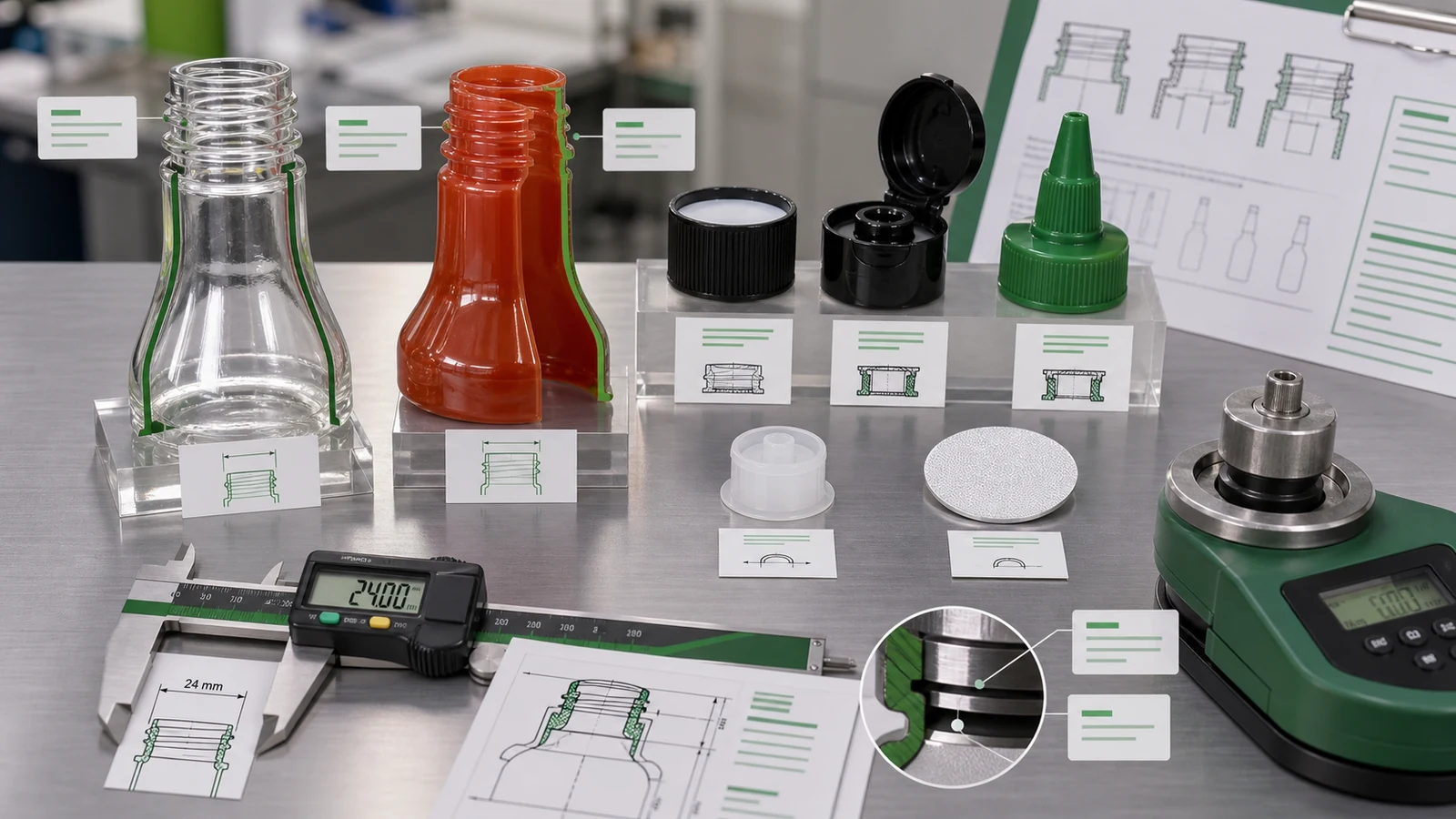
Neck-finish codes are shorthand for diameter and thread style. In a 24-414 finish, 24 refers to the nominal neck diameter in millimeters and 414 refers to a specific thread finish family. Similar logic applies to 28-400 and 38-400. The code helps narrow the search, but it does not guarantee the cap will seal.
Two bottles can share a nominal 24 mm finish and still behave differently because thread start, thread height, sealing land width, bore diameter, neck ovality and cap skirt depth vary by mold and closure design. The practical rule is simple: approve the cap and bottle together, then test torque and leakage with the filled sauce.
For hot sauce, 24 mm finishes are often discussed for woozy-style bottles and reducer-cap routes. A 28 mm finish is common for small to medium squeeze bottles and sauces that need a larger opening. A 38 mm finish is more useful for thicker sauces, refill formats, wider filling nozzles or products with visible particles.
| Neck Finish | Common Cap Match | Typical Sauce Direction | Watch Point |
|---|---|---|---|
| 24-414 / 24 mm family | CT cap, reducer insert, small flip-top or controlled pour cap. | Thin hot sauce, pepper sauce and classic woozy formats. | Reducer seating, drop control, liner clearance and cap torque. |
| 28-400 / 28 mm family | Flip-top cap, screw cap, nozzle cap or selected tamper-evident route. | Medium hot sauce, chili sauce, ketchup and squeeze condiments. | Opening size, capper chuck fit, thread engagement and leakage under squeeze pressure. |
| 38-400 / 38 mm family | Wide screw cap, larger flip-top or refill closure. | Thicker sauces, foodservice packs and formulas with particles. | Filling nozzle access, cap sealing land, carton cap protection and consumer pouring control. |
Why Caps Fail: Torque, Liners, Heat and Sauce Chemistry
Most closure failures are not caused by one visible defect. They come from several small mismatches stacking together. A warm bottle neck relaxes after capping. A liner compresses unevenly. Sauce residue changes thread friction. Headspace pressure changes during cooling according to the same gas-law logic behind $PV=nRT$. Transport vibration then exposes the weak point.
Application torque is only the first number. Removal torque after 24 hours, 72 hours and transport simulation can be more useful because plastic caps and liners experience stress relaxation. Too little torque creates leaks and cap back-off. Too much torque can strip threads, ovalize the neck, crush a soft shoulder or make the cap hard to open.
Hot sauce chemistry adds another layer. Vinegar, salt, chili oil and capsaicin-rich oils can challenge liner selection and closure cleanliness. PP and PE caps are widely used for food-contact closure routes, but the final bottle, cap, liner and valve material should be matched to the destination market and intended food-contact condition. For US and EU programs, component-level documentation matters more than a generic claim.
- Cap back-off: torque drops after liner compression, plastic relaxation or vibration.
- Thread stripping: excessive torque or poor thread engagement damages the cap or neck.
- Sauce creep: product residue migrates along the thread when the liner or sealing land is not stable.
- Reducer pop-out: insert retention is too weak for pressure, squeeze force or repeated use.
- Nozzle clogging: particle size or dried sauce exceeds the practical flow path.
- Valve leakage: particles or oil-rich sauce prevent the slit from returning cleanly.
Engineered Cap Selection by Viscosity and Particle Size
Viscosity is the starting point, but particle size often decides the final cap. A smooth high-viscosity sauce can pass through a valve or nozzle if squeeze force is acceptable. A lower-viscosity sauce with seeds can still clog a reducer because one seed can block the hole. The cap opening should be selected around the largest expected particle after settling, shaking and partial bottle use.
For thin hot sauce, a reducer insert gives good portion control and prevents accidental flooding. For medium smooth sauce, a flip-top or twist-open nozzle can improve one-hand use. For thicker chili sauce, a larger nozzle or soft squeeze bottle may work better. For salsa-style textures, a wide-mouth jar or wide screw cap may be more honest than forcing the product through a narrow dispensing path.
| Formula Behavior | Recommended Closure Direction | Avoid | Filled-Sample Test |
|---|---|---|---|
| Thin, smooth vinegar hot sauce | CT cap with reducer, small flip-top or controlled pour cap. | Large open cap if dose control is critical. | Drop count, over-pour check, inverted leakage and cap residue. |
| Medium smooth chili sauce | Flip-top, twist-open nozzle or soft squeeze cap. | Very small reducer holes. | Squeeze force, first-dose control, thread cleanliness and cap-down storage. |
| Seeded or pulpy hot sauce | Large-opening flip-top, wide nozzle or wide screw cap. | Small orifice reducers and narrow valves. | Largest-particle pass-through after settling and repeated use. |
| Oil-rich chili sauce | Lined screw cap, controlled nozzle or validated valve route. | Unverified liner or valve material. | Oil contact, migration review, torque retention and cap staining. |
| Bulk foodservice sauce | Wide screw cap, refill closure, pump-compatible cap or durable nozzle. | Fragile cap hinges and retail-only caps. | Refill speed, cleaning access, carton handling and repeated opening. |
Factory and Co-Packer SOP for Cap Approval
A cap approval should be run like a small production trial, not a desk selection. Start with the target bottle and cap samples, then fill with the real sauce at the intended temperature and headspace. Apply caps with a defined torque window, store samples upright and inverted, then inspect leakage, cap cleanliness, flow rate and removal torque after rest time.
For automated filling lines, the cap must also work with the cap sorter, chute, chuck and capping head. Cap height, skirt diameter, knurl texture, hinge orientation and tamper band geometry can affect line pickup and placement. If caps are supplied separately, cap packing should protect liners and sealing surfaces from dust and deformation.
Gracepack supports closure projects as a bottle-and-cap system. Our production base includes 15 automatic injection molding machines for caps, preforms and plastic components, 13 automatic blow molding machines for bottle bodies, 9 fully automatic production lines, plus labeling and printing support for private-label programs. That makes it easier to review cap color, bottle neck, liner, reducer, label panel and export packing together before bulk production.
- Confirm neck finish, cap family, liner type, reducer or valve route and bottle material.
- Measure neck outside diameter, bore, sealing land, thread start and cap skirt fit.
- Run application torque checks at start, middle and end of the trial.
- Measure removal torque after 24-72 hours to catch relaxation or cap back-off.
- Store filled samples upright, inverted and side-laid for leakage review.
- Dispense repeatedly after settling to check clogging, sputtering and residue.
- Validate bottle, cap, liner and valve food-contact documentation for the destination market.
- Review carton packing so caps are not compressed, scuffed or contaminated during export.
Food-Contact and Compliance Review for Caps and Liners
For hot sauce packaging, compliance should be matched by component. The bottle body, cap, liner, reducer and silicone valve may use different materials and therefore need separate document review. PP and PE cap routes, PET bottles, LDPE or HDPE squeeze bodies and silicone valves should not be treated as one generic plastic package.
Gracepack can match available PET FDA and BPA-related support, PP/PE and silicone EU migration-related support, LDPE and HDPE food-contact routes, ISO 22000 supplier documentation and plastic bottle and cap enterprise standards to the actual packaging route. For US programs, FDA 21 CFR 177.1520 is commonly relevant to olefin polymer components such as PP and PE. For EU programs, EU Regulation 10/2011 is commonly part of the food-contact plastics review.
The safest approach is to finalize the physical package first, then align documents to the selected components. Changing from a screw cap to a valve cap, or from a linerless cap to an induction-seal route, can change the material scope and the evidence needed for retailer or importer review.
FAQ About Hot Sauce Bottle Caps
What is the best cap for thin hot sauce?
Thin smooth hot sauce usually works well with a CT screw cap plus orifice reducer, a small flip-top opening or a controlled pour cap. The main goal is dose control without flooding the food.
Are flip-top caps good for hot sauce bottles?
Flip-top caps are good for smooth thin to medium sauces when one-hand opening and repeat use matter. They should be tested for orifice size, hinge cleanliness, snap force and leakage after filled storage.
When should hot sauce use an orifice reducer?
Use an orifice reducer when the sauce is thin, smooth and needs drop-by-drop dispensing. Avoid small reducers when the formula contains seeds, pulp, garlic pieces or chili flakes.
What is the difference between a screw cap and a twist-off nozzle cap?
A screw cap twists completely off and relies on the liner or sealing land for closure. A twist-open nozzle cap stays on the bottle and opens a directional dispensing path by twisting or lifting the nozzle.
What cap size fits a 5 oz woozy bottle?
Many 5 oz woozy-style hot sauce bottles use a 24 mm neck-finish family, but the exact cap must be confirmed by the bottle mold, thread finish, liner clearance and reducer fit. Do not approve caps by nominal diameter alone.
Can caps be ordered separately from bottles?
Yes, but separate cap sourcing needs sample testing. Thread engagement, torque, liner compression, reducer seating, tamper evidence and leakage should be validated on the actual bottle.
What should I send for a hot sauce cap sample review?
Send the bottle size, neck finish if known, sauce viscosity, largest particle size, filling temperature, storage orientation, cap preference, destination market, order quantity and whether you need reducer, liner, tamper-evident or valve options.
Request Cap Matching Samples for Hot Sauce Bottles
A reliable cap decision comes from filled-package testing. Share your sauce texture, bottle capacity, target neck finish, filling temperature, cap style, destination market and expected quantity. Gracepack can compare flip-top caps, screw caps, twist-open nozzle caps, reducer inserts, liners, tamper-evident options and valve routes against your real sauce behavior.
For a faster first review, send a current bottle photo or drawing, the largest visible particle size, whether the bottle will ship upright or inverted, and whether the package is for retail, foodservice or ecommerce. The output can be a practical sample set with cap options, liner direction, neck-fit notes and the filled-sample checks to run before mass production.


