
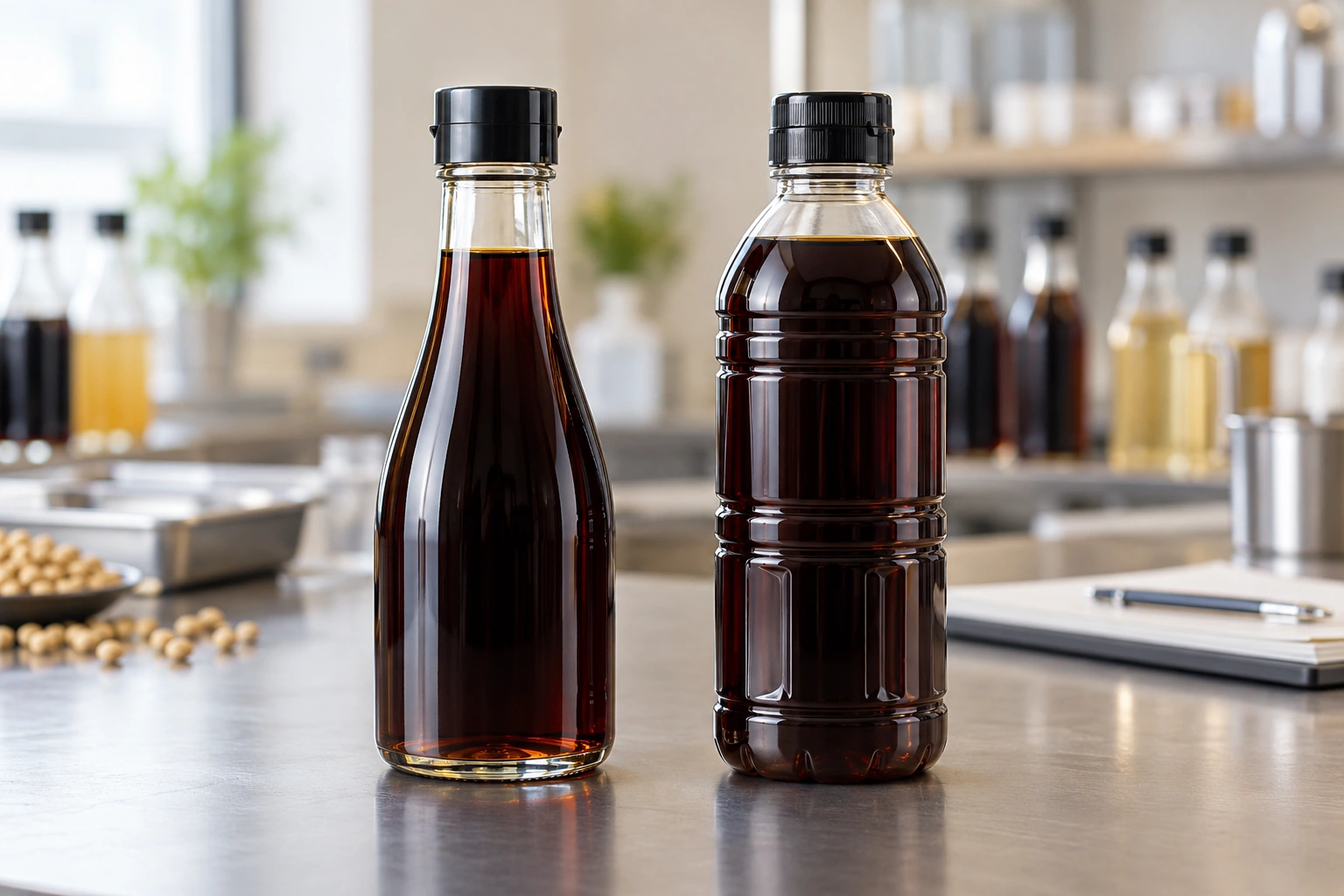
Glass is the stronger starting point when a soy sauce requires a highly impermeable bottle wall, rigid premium presentation and long unopened storage. Plastic becomes compelling when low weight, impact resistance, shipping efficiency or squeeze and refill handling carry more commercial value. Neither answer is complete until the closure, headspace, light exposure, filling process and real sauce are evaluated with the bottle.
The comparison is therefore not glass versus one generic plastic. A clear monolayer PET bottle, a tinted PET bottle and a qualified barrier plastic structure can have different oxygen and light performance. Clear glass and amber glass also provide different light protection even though both have a highly impermeable wall. The decision must name the exact bottle, resin or glass color, cap, liner or seal, fill level and shelf-life target.
For a naturally brewed soy sauce, packaging approval should preserve the brand's defined color, aroma and taste through the intended distribution period. That requires matched filled-package trials rather than conclusions drawn from an empty bottle, a resin brochure or an unsupported material ranking.
| Decision priority | Glass route | Plastic route | Evidence needed |
|---|---|---|---|
| Long unopened flavor protection | Highly impermeable bottle wall | Depends on resin, wall, barrier route and closure | Package oxygen assessment plus real-time filled storage |
| Light protection | Clear glass needs another light-control strategy; amber glass may reduce selected wavelengths | Clear, tinted, sleeved or UV-modified options are possible | Spectral transmission or defined exposure comparison on the final pack |
| Handling and distribution | Rigid and premium, with breakage and protective-carton requirements | Lighter and impact resistant, with creep and deformation to validate | Filled drop, compression, pallet and route-specific handling checks |
| Tabletop or squeeze use | Stable rigid pour with the selected spout | Rigid pour or squeezable formats can be developed | Flow, air return, last drop, leakage and repeated-use trials |
| Release decision | Approve the full glass bottle and closure assembly | Approve the exact plastic construction and closure assembly | Controlled sample, component list, test method and acceptance criteria |
1. Separate Bottle-Wall Permeation from Total Package Oxygen
The glass wall is effectively impermeable to oxygen under normal food-packaging use. That makes glass a useful low-permeation reference, but it does not make a filled glass package an oxygen-free vault. Oxygen can already be dissolved in the product or trapped in the headspace at filling, and it can enter later through a marginal cap, liner, pour insert or damaged seal.
Plastic walls have finite gas permeability. The practical rate depends on the polymer grade, wall thickness and distribution, bottle geometry, temperature, humidity and any barrier modification. A value reported for a flat film or a different bottle cannot be assigned automatically to the production pack. Finished containers add shoulders, bases, stretch ratios and thin zones that can change the result.
Treat bottle-wall OTR as one input to a package oxygen budget. The useful commercial question is whether the complete package keeps oxygen exposure within the limit required by the real sauce for the stated shelf life. That limit must account for oxygen present at filling, wall permeation, closure ingress and every opening after first use.
| Oxygen path | What controls it | How to examine it |
|---|---|---|
| Dissolved oxygen | Mixing, transfer, filtration and filling conditions | Measure or control product preparation and dissolved oxygen at pack-out |
| Headspace oxygen | Fill level, foaming, gas flushing and cap application | Record fill volume, headspace and oxygen immediately after closing |
| Bottle wall | Glass or polymer structure, wall distribution and temperature | Test or obtain data for the actual container under defined conditions |
| Closure interface | Finish dimensions, liner, seal, torque and pour insert | Leak and ingress-focused checks on the production component set |
| After opening | Dose frequency, air replacement and consumer storage | Use-cycle study that reflects the intended bottle size and service pattern |
2. Compare Glass, Monolayer PET and Barrier Plastic Without Shortcuts
Glass gives a stable, rigid body and an excellent barrier through the container wall. It can support a premium table-sauce format and provides a strong control when a development team needs to separate wall permeation from the effects of the closure and filling process. The tradeoffs are weight, breakage risk and the need for a carton and pallet system that protects the glass through distribution.

Monolayer PET offers clarity at much lower weight and is well suited to many ambient-fill soy sauce formats. It should not be approved from the material name alone. Bottle mass, wall distribution, finish stability, color or additive route and the closure determine whether the selected pack supports the required shelf life and filling conditions.
A barrier-enhanced plastic package can be considered when standard PET does not meet the oxygen target and glass creates an unacceptable handling or freight constraint. The construction may involve a purpose-designed barrier layer, coating or other qualified technology. Its benefit must be demonstrated on the finished bottle, while food-contact status, manufacturing consistency, recyclability claims and change control remain part of the approval.
| Package route | Primary strength | Watchpoint | Suitable validation role |
|---|---|---|---|
| Clear glass | Highly impermeable wall, rigidity and premium presentation | Light passes through; breakage and carton protection matter | Low-wall-ingress control with the chosen closure |
| Amber or dark glass | Wall barrier plus improved control of selected light wavelengths | Actual transmission varies by color and thickness | Reference for light-sensitive premium products |
| Clear monolayer PET | Low weight, clarity and impact resistance | Finite oxygen permeation, heat boundary and light exposure | Candidate for validated shelf life and faster-turn programs |
| Tinted or sleeved PET | Light-control options with plastic handling benefits | Tint or sleeve does not automatically improve oxygen barrier | Candidate where light is a greater risk than wall oxygen |
| Barrier plastic structure | Potentially lower oxygen ingress than standard plastic | Finished-bottle consistency, documentation and recovery route | Candidate when data justify added construction complexity |
3. Light Protection Is a Separate Design Variable
A clear glass bottle can admit substantial visible and ultraviolet light, just as a clear PET bottle can. The glass-versus-plastic label therefore does not answer the light-protection question. Bottle color, wall thickness, pigment or UV absorber, full-body sleeve, label coverage, secondary carton and retail lighting all influence the exposure received by the sauce.
Amber, dark green and opaque packages do not block every wavelength equally. A visual impression of darkness is not a transmission specification. If light sensitivity is important, compare candidate bottles with measured transmission across the relevant wavelength range or run a controlled exposure study using the final bottle, decoration and sauce.
Protection also has a commercial boundary. A fully opaque bottle can reduce light exposure but remove product visibility and fill-level inspection. A tinted transparent bottle may preserve some shelf view while lowering selected exposure. The approved route should balance the sauce response, required shelf appearance, line inspection and label contrast.
| Light-control option | What it can do | What it cannot prove alone |
|---|---|---|
| Amber or dark bottle | Reduce selected wavelengths according to its actual transmission profile | That the complete spectrum is blocked or the sauce shelf life is achieved |
| UV absorber or color masterbatch | Modify light transmission while retaining a plastic bottle format | Compatibility, migration scope or lot-to-lot consistency without supporting controls |
| Full-body sleeve | Provide high graphic coverage and an additional light screen | Protection at uncovered neck, base or sleeve seam |
| Pressure-sensitive label | Shield the covered panel and preserve a product-view window | Uniform protection around the entire bottle |
| Secondary carton or case | Limit warehouse and shipping exposure before retail display | Protection after the unit is removed from the case |
4. The Closure Can Erase the Bottle's Barrier Advantage
The bottle and closure must be evaluated as one package. A highly impermeable glass wall cannot compensate for an incomplete liner seal, a distorted finish, poor application torque or an open air path through a dispensing insert. The same is true for a barrier plastic bottle fitted with a cap that was selected only for appearance.
Control the exact neck finish, cap resin and geometry, liner or induction-seal construction, tamper feature and pour insert used in the commercial package. Record application settings and inspect sealing-land cleanliness. Soy sauce at the finish can interfere with sealing, and salt-rich residue around the outlet can change opening and reclosing behavior during repeated use.

An induction seal can strengthen unopened-package integrity when the bottle finish, foil laminate and sealing process are compatible. It does not define performance after first opening. For a controlled-pour or repeatedly opened pack, the resealing surfaces, air-return path, cap seating and consumer storage pattern determine the post-opening condition.
- Identify the bottle, cap, liner, seal and insert by item and revision.
- Record cap application method, torque window and induction-sealing settings where used.
- Check leakage and seal integrity after conditioning, transport stress and side-lay storage where relevant.
- Repeat critical checks after any neck, cap, liner, color, resin or filling-process change.
- Keep unopened barrier approval separate from post-opening use-cycle performance.
5. Build a Matched Filled-Package Shelf-Life Trial
A fair comparison changes the package while holding the product and process as constant as practical. Fill the glass control and plastic candidates from the same prepared soy sauce lot, on the same schedule, to a controlled fill volume and headspace. Use closure systems with equivalent functional intent, record application conditions and identify every sample by package and replicate.
Store enough samples to examine each planned interval without repeatedly opening the same bottle. Include the real-time condition that represents the commercial market. Add defined light exposure, elevated temperature or orientation challenges only when they answer a known distribution risk. Keep a retained control so that analytical and sensory shifts are interpreted against the starting product rather than memory.
The endpoint set should come from the product specification. Useful observations can include objective color values, dissolved or headspace oxygen where available, aroma and taste evaluated with a controlled method, leakage, closure condition, seal appearance, panel or base deformation and label changes. One visual photograph cannot approve flavor preservation.
| Trial control | Hold constant | Record for traceability |
|---|---|---|
| Soy sauce | One representative lot and preparation method | Lot, composition-sensitive attributes and baseline results |
| Filling | Fill temperature, volume, headspace and timing | Equipment, settings, oxygen-control step and deviations |
| Closure | Defined cap, liner or seal function | Item revision, torque or seal settings and inspection result |
| Storage | Temperature, light, orientation and duration | Logger or chamber record and sample location |
| Assessment | Same method and decision limits at each interval | Instrument, panel method, raw result and disposition |
6. Use Accelerated Screening Without Inventing a Calendar Shelf Life
Elevated temperature or intensified light can help eliminate weak packages and reveal likely failure modes sooner. It does not automatically convert into a precise number of months at ambient conditions. Soy sauce contains interacting color, aroma and taste components, while polymer permeability and closure behavior also change with temperature. A simple time multiplier can misrepresent the actual product response.
Use accelerated work as a screening and comparison tool. Correlate it with real-time samples before using it to support a dated shelf-life claim. If the accelerated ranking and real-time trend disagree, investigate the mechanism rather than choosing the more convenient result.
Claims such as ‘12-month flavor protection’ should appear only after a defined formula, production package, filling process and storage program meet the brand's approved limits. A supplier's generic barrier statement cannot establish the commercial shelf life of a different sauce.
- Define what the accelerated condition is intended to stress: temperature, light, closure or transport handling.
- Preserve a real-time control at the intended market condition.
- Use multiple intervals to identify the trend instead of comparing only day zero and the final day.
- Document any package change that invalidates comparison with earlier data.
- Base the final claim on the approved sauce and production-equivalent package.
7. Match the Package to the Sales and Use Pattern
A premium naturally brewed soy sauce with a long unopened shelf-life target and modest shipping distance may justify glass because wall permeation is minimized and the rigid pack supports its position. If the same product enters ecommerce, export or high-breakage channels, the protective carton, replacement loss and pallet handling become part of the decision even when product protection remains the first requirement.
A PET bottle can be appropriate for high-turn retail, refill, foodservice or lightweight export programs when the selected bottle and closure pass the required shelf-life and handling trials. Smaller fast-use packs can also limit the post-opening period, while large household bottles experience more air replacement and longer use after opening. Bottle size therefore belongs in the oxygen and sensory discussion.
Do not force one material across every SKU. A brand may keep a premium glass line and use validated plastic for foodservice or refill channels. The important control is to qualify each package-product combination and avoid transferring the shelf-life conclusion from one size, cap or channel to another without review.
| Commercial scenario | Likely starting route | Questions before approval |
|---|---|---|
| Premium long-shelf-life table sauce | Glass, clear or amber according to light risk | Closure integrity, light exposure, carton protection and sensory target |
| Lightweight retail bottle | Qualified PET or barrier plastic | Wall performance, cap seal, filling temperature and real-time shelf life |
| Foodservice or refill format | Impact-resistant plastic | Turnover rate, repeated opening, residue, cleaning and dispensing control |
| Ecommerce or long export route | Compare glass and plastic as complete pack-outs | Breakage, compression, temperature, replacement loss and shelf-life evidence |
| Multi-SKU brand range | Material may differ by channel or shelf-life target | Separate approval file for each bottle, size, color and closure combination |
8. Compare Physical Samples and Supporting Documents
Begin the comparison with identified glass and PET bottle-and-closure assemblies rather than material names alone. For each candidate, record the capacity, fill condition, intended shelf life, bottle color, neck finish, cap and liner or seal, label coverage, destination market and carton configuration before selecting test quantities.
For selected PET bottles, food-contact and migration-related reports can be matched to the proposed item and destination market. Review the cap, liner, seal and pour insert separately because a bottle report does not cover an unrelated closure component. Review export packing separately as well: glass may require stronger divider and breakage protection, while lightweight plastic may need controls for carton compression and deformation.
Approve a controlled candidate set that includes traceable bottle and closure samples, component specifications, applicable food-contact documents, packing assumptions and one filled-package test protocol. Use the same acceptance criteria for every candidate, then release only the bottle-and-closure configuration supported by the results.
| Project input | Sample-stage output | Release-stage control |
|---|---|---|
| Sauce and shelf-life target | Candidate glass and plastic directions | Approved package-product combination |
| Capacity and use channel | Bottle-size and dispensing options | Controlled item and component revisions |
| Light and oxygen risks | Clear, tinted or barrier candidates where relevant | Documented filled-package evidence |
| Destination market | Available component-level document map | Current reports matched to supplied items |
| Distribution route | Initial carton and protection assumptions | Validated pack-out and handling criteria |
FAQ About Plastic and Glass Soy Sauce Bottles
Is glass always better than plastic for soy sauce?
Glass provides a highly impermeable bottle wall, but the best commercial package also depends on the closure, light exposure, filling process, breakage risk, use pattern and verified shelf-life target. A qualified plastic package can be appropriate when it meets the product limits and offers handling advantages.
Does a glass bottle stop all oxygen from reaching soy sauce?
The glass wall is effectively impermeable, but oxygen may be present in the product or headspace and may enter through the closure. Evaluate the complete filled package rather than describing the bottle wall as the entire oxygen barrier.
Can clear glass protect soy sauce from light better than clear PET?
Material name alone does not establish light protection. Compare the actual spectral transmission of the finished clear, tinted, sleeved or labeled packages and confirm the sauce response under a defined exposure condition.
What should be held constant in a glass-versus-plastic shelf-life test?
Use the same representative sauce lot, filling schedule, fill volume, headspace target, closure function, storage condition, assessment method and decision limits. Record unavoidable differences so they can be considered when results are interpreted.
Can accelerated testing prove a 12-month soy sauce shelf life?
Accelerated testing can screen candidates and identify trends, but the relationship to real time must be justified for the specific sauce and package. Maintain real-time samples before making a dated commercial claim.
When should the packaging comparison be repeated?
Reassess affected tests after a change to the sauce, bottle material or color, wall construction, size, cap, liner, seal, fill condition, label coverage, storage target or destination route.
Request a Glass-versus-Plastic Soy Sauce Bottle Review
Send the soy sauce type, intended capacity, filling temperature, headspace or fill-volume target, required shelf life, preferred bottle color, closure style, sales channel, destination market and expected order quantity. Gracepack can use those inputs to prepare a relevant glass and plastic sample direction and identify the checks that should be completed before either route is approved.
If shelf-life evidence already exists, include the package description, storage condition, test intervals and observed failure mode. That makes it possible to determine whether the next trial should focus on wall permeability, light exposure, closure sealing, headspace control or another package variable.


