
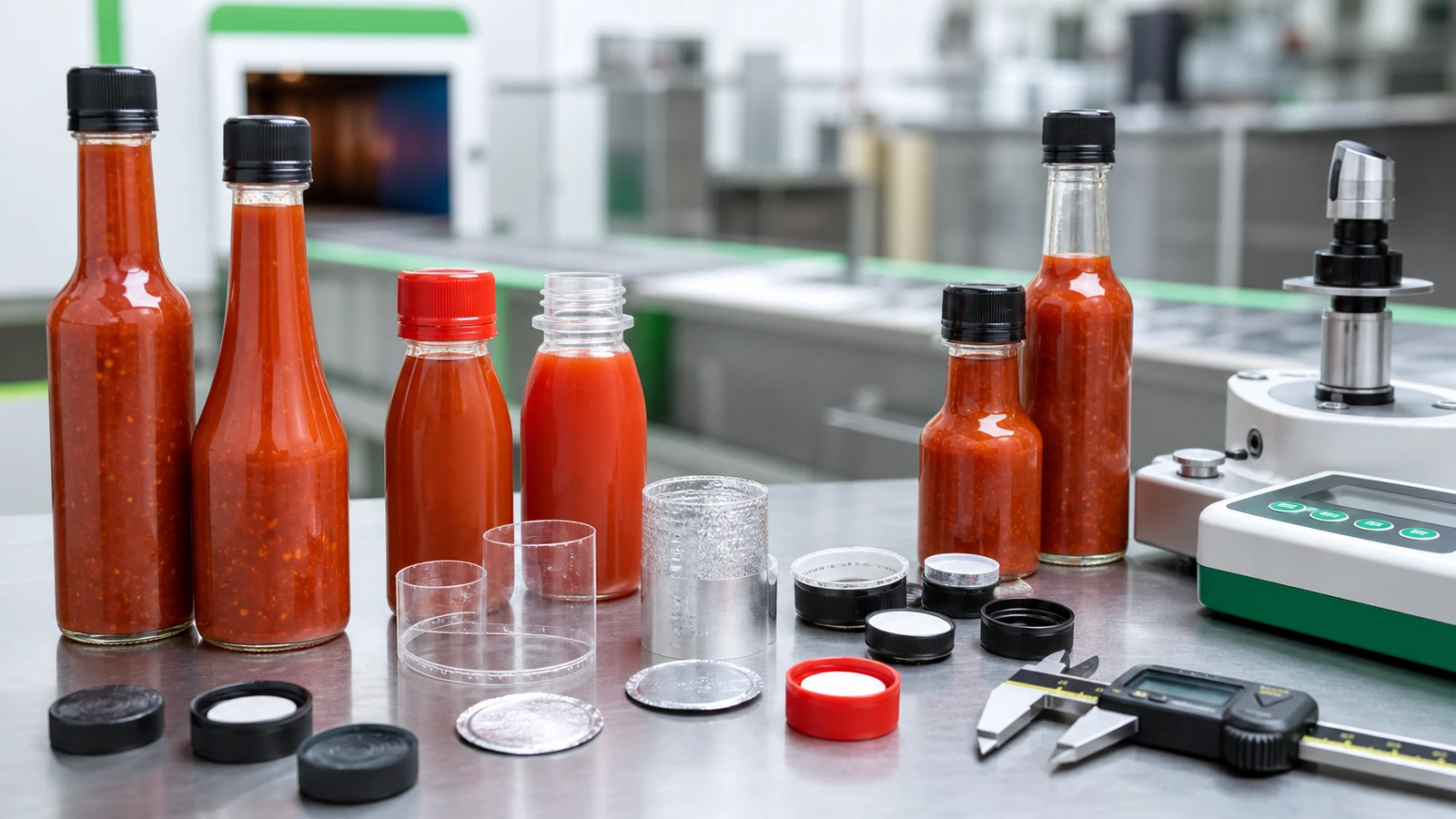
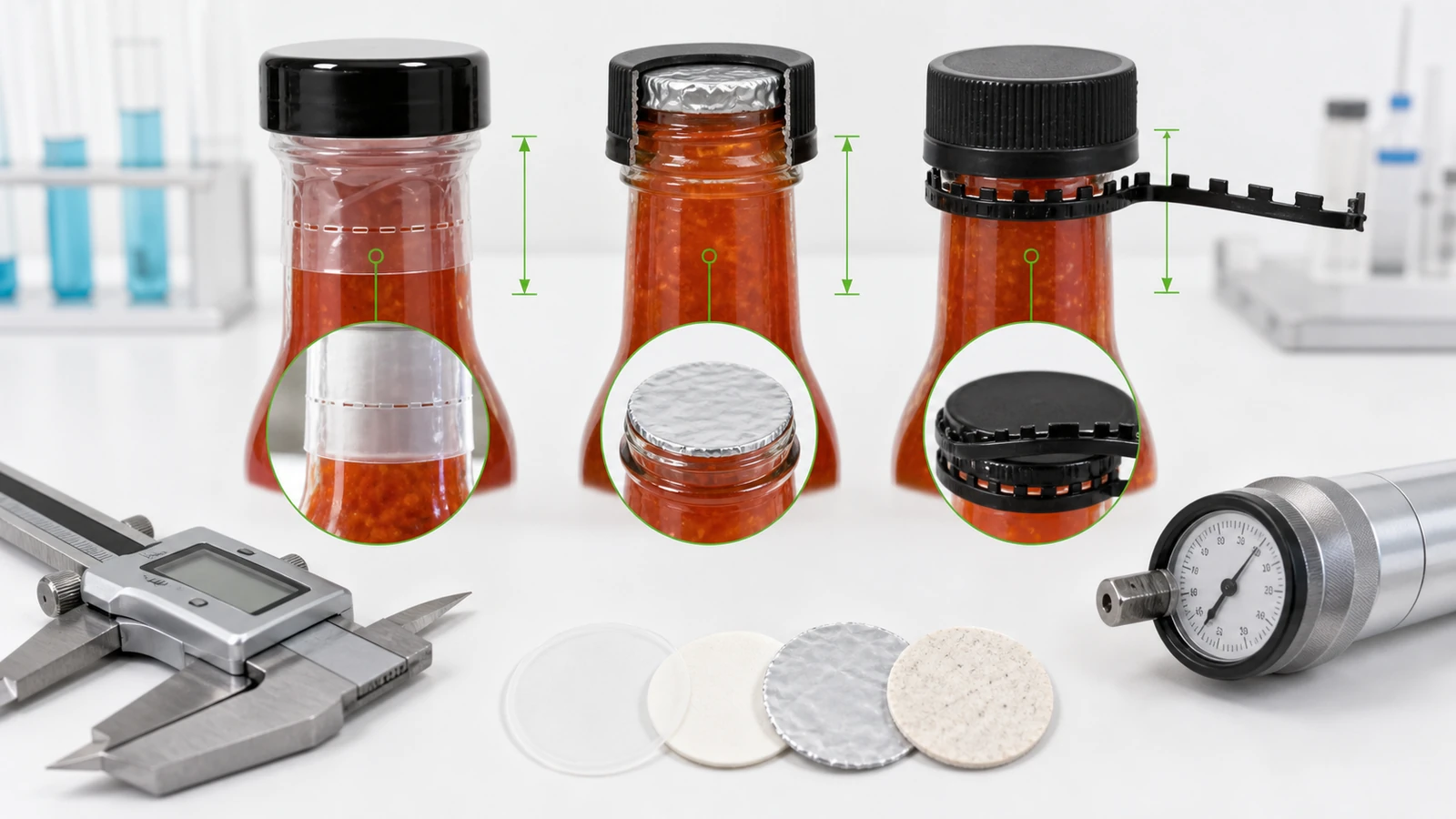
Tamper-evident packaging for hot sauces uses a visible break feature, sealed liner or destructive opening band to show whether the product has been opened before purchase. Neck bands are the simplest visual option, induction seals add leak and oxygen protection at the bottle mouth, and tear-caps integrate the evidence into the closure itself.
The best system depends on the bottle material, neck finish, cap style, filling temperature, sauce chemistry, line speed, retailer expectations and whether the sauce ships through ecommerce or pallet distribution. A strong tamper-evident signal is useful only when the cap still seals, the liner bonds cleanly and the bottle can run through filling, capping and packing without extra rejects.
| System | How It Shows Tampering | Best Fit | Main Engineering Risk |
|---|---|---|---|
| Heat shrink neck band | A clear or printed sleeve tears when the cap is opened. | Small batches, retail hot sauce, glass woozy bottles, manual or semi-automatic lines. | Uneven heat, wrinkled bands, poor skirt coverage or band splitting during transport. |
| Induction seal liner | A foil seal must be removed or punctured before the sauce can be used. | Leak-sensitive sauces, ecommerce packs, oxygen-sensitive formulas and bottles with flat sealing land. | Weak foil bond, scorched liner, cap torque mismatch or poor seal on wet/uneven neck finishes. |
| Tamper-evident tear-cap | A pull tab, tear strip or breakaway band separates during first opening. | Retail sauce bottles where integrated opening evidence and clean shelf appearance matter. | Cap-to-neck mismatch, hard opening force, broken band before sale or limited cap style choice. |
| Combined band and liner | Outer band proves cap movement; inner seal protects the mouth. | Higher-risk DTC, export and premium hot sauce projects. | Higher material and line complexity, more approval points and slower changeover. |
| Tamper-evident closure with reducer | Break band proves first opening; reducer controls sauce flow after opening. | Thin hot sauces needing both retail safety proof and controlled dosing. | Reducer clearance, cap liner stack height and thread engagement must be checked together. |
Why Hot Sauce Needs More Than a Visible Safety Band
Hot sauce is usually acidic, pigmented and often oil-bearing. Vinegar lowers pH, chili pigment stains contact surfaces, salt can crystallize around the closure, and chili oil can migrate into threads or liners if the seal is weak. A tamper-evident feature has to survive that chemistry while still giving the consumer a clear first-opening signal.
A neck band is excellent at visible shelf assurance, but it does not seal the bottle mouth. If the cap liner leaks, the band may still look intact while sauce creeps under the cap. An induction seal improves the mouth barrier and can reduce leakage, but it needs the right liner material, cap torque and sealing land. A tear-cap gives integrated proof, but it is sensitive to neck-finish compatibility and cap application force.
For co-packers, the system must also protect line efficiency. A hand-applied neck band can work for pilot runs but become a bottleneck at scale. An induction sealer can improve leakage control but adds a power, dwell-time and setup window. A tear-cap can simplify the secondary operation, but only if the cap feeds cleanly through the sorter and applies within the line's torque range.
Neck Bands: Low-Cost Visual Tamper Evidence for Retail Hot Sauce
A heat shrink neck band is a plastic sleeve that covers the cap skirt and bottle neck. Heat from a gun, steam tunnel or hot-air tunnel shrinks the band tightly around the closure. Once the consumer opens the cap, the band tears or must be removed, giving an obvious visual sign of first opening.
Neck bands are attractive for small and mid-size hot sauce brands because the equipment barrier is low. They can be applied manually during early launches, then moved to a shrink tunnel when volume increases. They also work across many glass and plastic bottle shapes as long as the band diameter, height and perforation position match the cap and shoulder geometry.
The weak point is heat control. Too little heat leaves wrinkles and loose bands. Too much heat can distort thin PET necks, scuff labels, haze printed bands or create a melted appearance. On glass woozy bottles, thermal deformation is less of a concern, but alignment still matters because a crooked band can look like poor QA even if the bottle is sealed correctly.
| Neck Band Check | What to Validate | Why It Matters |
|---|---|---|
| Band height | Coverage over cap skirt and enough neck area below the cap. | A short band may not prove cap movement; an overlong band can wrinkle over the shoulder. |
| Perforation route | Easy consumer tear without accidental splitting in cartons. | Weak perforation can break before sale; strong perforation frustrates opening. |
| Heat exposure | Shrink consistency without deforming PET, labels or cap finish. | Prevents distorted bottles, cloudy bands and uneven shelf appearance. |
| Carton friction | Band remains intact after vibration, side contact and export handling. | Scuffed or torn bands can look like tampering even when the product is safe. |
Induction Seals: Mouth-Level Leak Control and Freshness Protection
An induction seal uses a foil-based liner placed inside the cap. After the filled bottle is capped, an induction sealing head generates electromagnetic energy that heats the foil layer. The heat activates the sealing layer and bonds it to the bottle's sealing land. The consumer then sees a sealed mouth when the cap is removed.
For hot sauces, the value is practical. The seal can help control leakage in ecommerce, reduce oxygen exposure before first opening and keep sauce residue from creeping into the cap thread during distribution. It is especially useful when the sauce is thin, oil-bearing or shipped long distances.
The process window is narrow enough that it should be validated, not assumed. Cap torque controls liner contact pressure. Conveyor speed controls dwell time under the induction head. Sealing head height controls energy coupling. Bottle material controls the sealing layer choice. If any variable drifts, the result may be a weak bond, partial seal, overheated foil or hard-to-remove liner.
| Induction Variable | Typical Concern | Validation Step |
|---|---|---|
| Cap torque | Too little pressure causes partial bonding; too much can distort threads or make opening difficult. | Measure application torque and removal torque after 24-72 hours. |
| Sealing land flatness | An uneven or contaminated rim prevents continuous liner contact. | Inspect bottle mouth, fill splash and seal peel pattern. |
| Foil liner structure | PET, HDPE, PP and glass may need different liner routes. | Match liner to bottle material and sauce contact condition. |
| Dwell time and power | Underheating creates weak seals; overheating scorches liners or damages caps. | Run line-speed trials and destructive peel checks. |
| Headspace and cooling | Warm fill and cooling can change internal pressure according to $PV=nRT$. | Check paneling, leakage and seal integrity after cooling and transit simulation. |
Tear-Caps: Integrated Tamper Evidence Without Secondary Shrinking
A tear-cap builds the evidence into the closure. The consumer breaks a band, pulls a strip or separates a tamper ring before the cap can be fully removed. This gives a cleaner retail presentation than a separate shrink band and can remove one secondary operation from the packing line.
The trade-off is that tear-caps are less universal than neck bands. The cap and neck finish have to match closely, including thread start, bead geometry, skirt height, tamper-band clearance and capping torque. If the closure is forced onto a neck that was not designed for it, the band may break during capping, fail to engage or require too much opening force.
Tear-caps are a strong option when the bottle family is stable, the capper can apply them consistently and the brand wants a professional first-opening feature. They are less flexible for short experimental runs where cap style, neck finish or label direction may still change.
Failure Mechanics: Why Tamper-Evident Systems Fail in Production
Most tamper-evident failures come from interface mismatch, not from the visible feature alone. A neck band fails at the heat-shrink interface. An induction seal fails at the sealing land and liner interface. A tear-cap fails at the thread, bead and tamper ring interface. The bottle mouth, cap, liner and process settings carry the real load.
Hot sauce makes those interfaces harder to control. Sauce splash on the rim can interrupt induction bonding. Oil on the thread can change application torque. Acid and salt residue can create cap stickiness after storage. Filled bottles can also experience pressure changes during cooling and transport. The gas-law behavior behind $PV=nRT$ is simple: when temperature changes in a sealed headspace, internal pressure changes too. That pressure change can expose weak seals.
Plastic components add time-dependent behavior. PP and PE caps can relax after application. Liners compress. PET necks can be sensitive to heat if the shrink or induction process is aggressive. Glass necks resist heat better but still require flat sealing lands and compatible caps. A good approval plan checks the package after rest time, not only immediately after capping.
| Failure Symptom | Likely Root Cause | Corrective Direction |
|---|---|---|
| Band wrinkles or loose skirt | Wrong band size, uneven heat or poor bottle shoulder clearance. | Adjust band height/diameter and shrink tunnel temperature profile. |
| Band tears before sale | Perforation too weak, carton friction or cap edge scuffing. | Change perforation route, cap finish or carton protection. |
| Induction seal peels unevenly | Wet rim, uneven sealing land, low torque or wrong liner. | Improve fill control, rim inspection, torque window and liner selection. |
| Foil scorches or cap distorts | Excess power, slow dwell time or head too close. | Reduce energy, raise head height or validate line speed. |
| Tear band breaks during capping | Torque too high, bead mismatch or capper downforce issue. | Review neck finish, cap geometry and capper setup. |
| Cap leaks despite tamper evidence | Tamper feature is intact but sealing interface is weak. | Validate liner compression, induction seal, thread engagement and filled storage. |
Bottle and Closure Compatibility: Glass, PET, PP Caps and Liner Routes
The bottle material changes the tamper-evident route. Glass hot sauce bottles are dimensionally stable under heat and pair well with shrink bands, lined screw caps and induction-seal routes when the selected liner is compatible with glass. PET bottles are lighter and clear, but heat exposure from shrink tunnels and induction settings should be controlled to avoid neck distortion. HDPE and PP routes can be practical for squeeze or foodservice formats, but the sealing layer and cap fit need to be matched by material.
The cap material also matters. PP and PE closures are common in condiment packaging, while liners, reducers and silicone valves may introduce separate material scopes. A tamper-evident hot sauce bottle should therefore be documented as a component set: bottle body, cap, liner or foil seal, reducer if used, band or tear feature, color route and filling condition.
Gracepack can align PET FDA and BPA-related support, EU food-contact routes for PET/PP/PE/silicone components, HDPE and LDPE food-contact review routes, ISO 22000 supplier documentation and enterprise standards for food-grade plastic bottles and caps after the actual package structure is selected. This matters because a PET bottle report does not automatically cover a PP cap, PE liner, silicone valve or foil-seal structure.
Factory and Co-Packer SOP for Tamper-Evident Hot Sauce Approval
A tamper-evident package should be approved through a filled-line trial, even when the individual components look simple. Start with the final bottle, cap, liner or band, then fill with the real sauce at the planned temperature. Apply the cap at the target torque, run the neck band or induction process, store samples upright and inverted, then inspect after cooling, 24 hours, 72 hours and transport simulation.
For neck bands, the trial should check band alignment, shrink tightness, perforation opening and label heat exposure. For induction seals, the trial should check torque, liner bond, peel pattern, leakage and consumer removal force. For tear-caps, the trial should check capper pickup, application torque, tamper-ring engagement and first-opening force.
Gracepack's production base supports coordinated bottle and closure work with 15 automatic injection molding machines for caps, preforms and plastic components, 13 automatic blow molding machines for bottle bodies, 9 fully automatic production lines, plus labeling and printing support. That lets bottle body, cap, liner, tamper evidence, label panel and export carton protection be reviewed as one packaging system rather than separate purchases.
| Approval Gate | What to Check | Practical Acceptance Logic |
|---|---|---|
| Pre-fill sample fit | Bottle neck, cap thread, liner stack height, reducer clearance and band size. | Components assemble without forcing, rocking or cap lift. |
| Line trial | Capper torque, band shrink, induction power, dwell time and conveyor stability. | The system runs without excess rejects or manual correction. |
| Filled storage | Upright, inverted and side-laid samples after 24-72 hours. | No sauce creep, cap back-off, seal lift or premature band damage. |
| Opening check | Band tear, foil peel, tear-cap break and removal torque. | Consumer can see first opening and open the pack without tools. |
| Export review | Carton friction, cap protection, pallet pressure and vibration exposure. | Tamper features remain intact and readable after shipment simulation. |
| Document review | Bottle, cap, liner, silicone, color and factory-system files. | Evidence matches the actual finished package and destination market. |
Cost, Speed and Risk Matrix for Neck Bands, Induction Seals and Tear-Caps
The cheapest component is not always the lowest-cost system. A low-cost neck band can become expensive if it slows packing or creates cosmetic rejects. An induction seal requires equipment, but it can reduce leakage claims and improve first-opening freshness. A tear-cap may cost more per unit, but it can remove shrink-band labor and create a cleaner retail pack.
The right cost model should include component price, equipment, labor, line speed, reject rate, leakage risk, retailer requirements, ecommerce damage, rework and the cost of changing packaging after artwork approval. For growing hot sauce brands, the practical question is not which tamper-evident feature is strongest in theory. It is which system protects the product at the current volume and still leaves a route for scale-up.
| Decision Factor | Neck Band | Induction Seal | Tear-Cap |
|---|---|---|---|
| Startup cost | Low; can start manual or semi-automatic. | Medium to high; needs induction sealing equipment. | Medium; depends on cap tooling and availability. |
| Line speed impact | Can slow packing if applied manually. | Fast when dialed in, but setup-sensitive. | Fast if capper feeds and applies consistently. |
| Leak prevention | Low by itself; it proves cap movement only. | High when liner and sealing land are matched. | Depends on cap liner and neck seal design. |
| Freshness protection | Visual only unless paired with a seal. | Strong mouth-level barrier before first opening. | Moderate; depends on liner and cap seal. |
| Bottle flexibility | High across many cap and neck shapes. | Medium; liner must match bottle material and rim. | Lower; cap and neck geometry must match closely. |
| Retail appearance | Good when aligned and shrunk cleanly. | Hidden under cap until opened. | Clean integrated look without separate sleeve. |
FAQ About Tamper-Evident Packaging for Hot Sauces
What is the best tamper-evident packaging for hot sauce?
The best choice depends on the risk profile. Neck bands are useful for visible first-opening proof, induction seals are stronger for leak and freshness control, and tear-caps are useful when the brand wants integrated tamper evidence without a secondary shrink-band step.
Do neck bands stop hot sauce leaks?
No. Neck bands show whether the cap has been opened, but they do not seal the bottle mouth. Leak control still depends on the cap, liner, neck finish, torque and filled-product behavior.
Are induction seals suitable for glass hot sauce bottles?
They can be suitable when the liner structure is designed for glass and the bottle has a clean, flat sealing land. The sealing process should be validated with the final cap torque, sauce fill condition and line speed.
When should a hot sauce brand use tear-caps?
Tear-caps are a strong route when the bottle family and neck finish are stable, the capper can apply the closure consistently and the brand wants a clean integrated retail tamper-evident feature.
Can tamper-evident packaging be used with orifice reducers?
Yes, but the cap, reducer, liner and tamper feature must be checked together. Reducer height, cap clearance and liner compression can affect sealing and cap fit.
What should be sent for tamper-evident sample review?
Send the bottle size, neck finish if known, bottle material, cap style, sauce viscosity, filling temperature, storage orientation, destination market, order quantity and whether the package needs neck band, induction seal, tear-cap or a combined system.
Request Tamper-Evident Hot Sauce Packaging Samples
A reliable tamper-evident decision starts with the finished package, not a loose cap photo. Share the bottle format, sauce type, fill temperature, target cap, retailer or market requirement, expected order volume and whether leakage, freshness or visible first-opening proof is the main risk.
Gracepack can compare neck band, induction seal, tear-cap, liner and reducer routes as a matched sample set. The review can include cap-to-neck fit notes, seal direction, food-contact document matching, carton protection suggestions and the trial checks to run before bulk production.


