
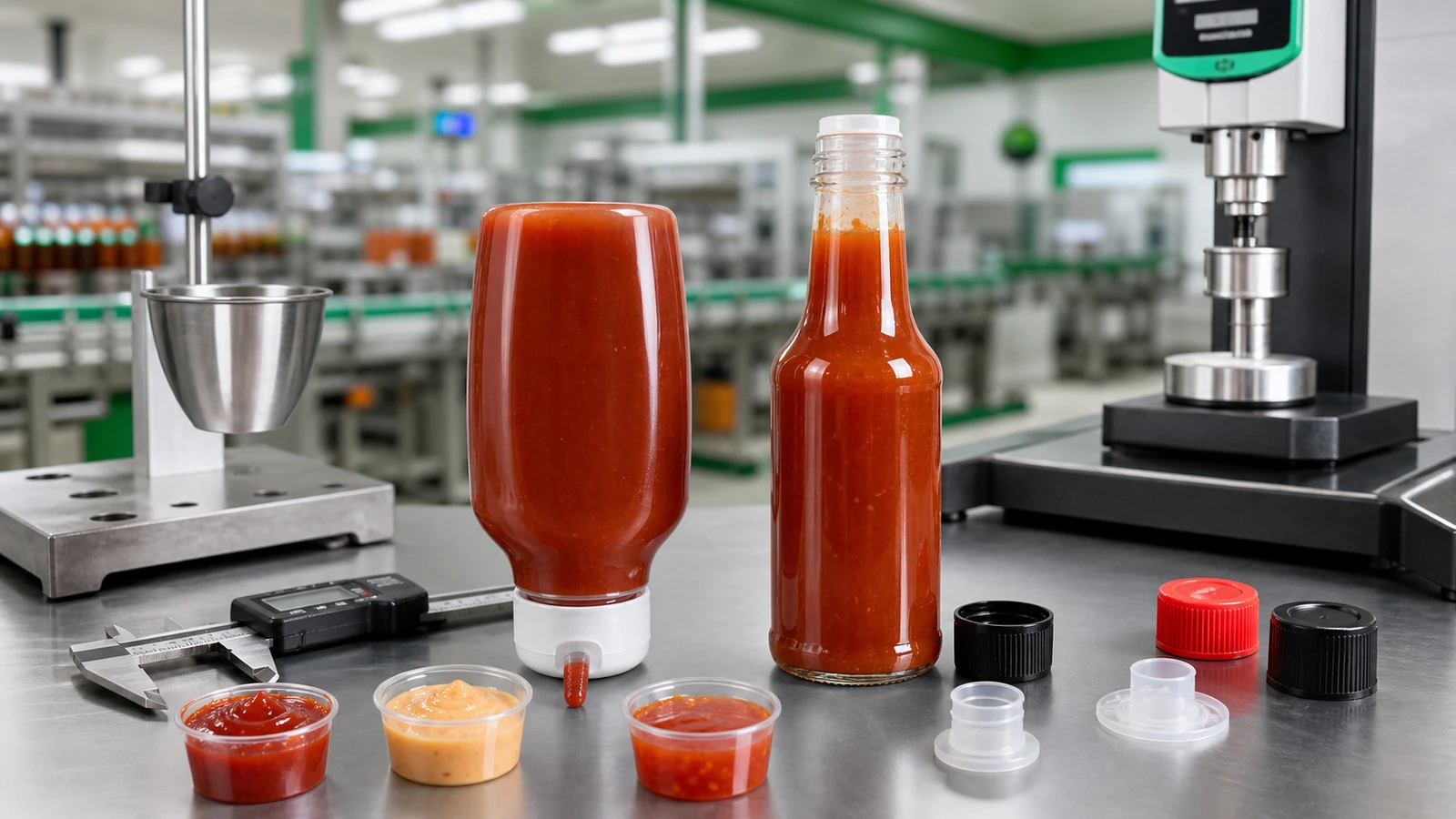
Squeeze valves are pressure-activated silicone dispensing closures that open when the bottle is squeezed and close when pressure stops. Orifice reducers are rigid snap-in inserts that restrict the neck opening, making them better for thin vinegar-based hot sauces that need drop-by-drop control.
The right choice depends on viscosity, particle size, oil content, bottle stiffness, neck finish, storage orientation and the way the sauce is used. A clean smooth sriracha-style sauce may perform well with a valve, while a thin pepper sauce usually needs a reducer. A seeded or pulpy sauce may need a larger nozzle instead of either small opening.
| Parameter | Silicone Squeeze Valve | Snap-in Orifice Reducer | Validation Method |
|---|---|---|---|
| Operating mechanism | Flexible cross-slit valve opens under squeeze pressure and rebounds closed. | Fixed plastic insert reduces the bottle bore to a smaller flow hole. | Observe first dose, cutoff, rebound and residue after repeated dispensing. |
| Best sauce behavior | Smooth medium to high viscosity sauces, spicy mayo, chili sauce, ketchup-style condiments. | Thin, smooth vinegar hot sauce and highly fluid pepper sauce. | Test the real sauce at filling, room and refrigerated temperatures. |
| Particle tolerance | Limited by slit geometry; seeds can hold the valve open or clog the slit. | Limited by hole diameter; even one pepper seed can block a small reducer. | Measure largest particle after mixing, settling and partial bottle use. |
| Drip control | Strong no-drip potential when valve recovery and sauce rheology match. | Good portion restriction, but tip crusting and slow weeping can occur. | Run upright, inverted and side-laid storage checks. |
| Cost and durability | Higher component cost and possible fatigue or compression-set review. | Lower cost, simple geometry and no moving flexible element. | Review part consistency, insert retention and repeated-use behavior. |
| Bottle format | Works best with soft squeeze bodies and inverted or controlled dispensing packs. | Works best with narrow-neck hot sauce bottles and classic dasher formats. | Validate cap, insert, neck finish and bottle squeeze force as one system. |
Why Dispensing Control Is a Safety and Flavor Feature for Hot Sauce
Flow control is not only a convenience feature. In spicy condiments, uncontrolled output can overload a meal with capsaicin, create splashing during table use and cause inconsistent flavor from one serving to the next. A small dosing error that is acceptable for ketchup can feel aggressive in a high-heat pepper sauce.
In foodservice, dosing also affects cost and speed. If staff need to wipe caps after every rush, unclog tips, replace leaking bottles or explain inconsistent pour behavior to guests, the closure is creating operating cost. The correct dispensing route keeps the serving size predictable without forcing the user to fight the package.
The package should match both the sauce and the setting: a retail woozy bottle used at the table, a squeeze bottle used on a prep line, an inverted bottle used in a condiment station or a bulk format used to refill smaller packs. Each route puts different pressure, residue and storage loads on the closure.
For high-heat sauces, portion control prevents accidental overuse. For plating sauces, clean cutoff prevents stringing tails. For cap-down bottles, leakage resistance after pressure release becomes the critical detail. The same closure can feel successful in one use case and wrong in another if the service style is not considered.
Snap-in Orifice Reducers: Fixed Flow for Vinegar-Based Hot Sauces
An orifice reducer is a rigid insert pressed into the bottle neck. It reduces the effective opening, so a thin sauce leaves the bottle in drops or a narrow stream instead of flooding the plate. This is why reducers are common in 5 oz dasher and woozy-style hot sauce bottles used for smooth, low-viscosity pepper sauces.
The engineering advantage is simplicity. There is no silicone slit, hinge or flexible valve element to fatigue. The insert either fits the neck and controls the flow, or it does not. For high-volume thin hot sauce, that low part complexity can be a major advantage when the brand wants stable dosing, low component cost and a classic table-use experience.
The weakness is that the reducer cannot adapt. If the formula contains visible chili flakes, seeds, garlic pieces, fruit pulp or thick pepper mash, the fixed hole becomes the bottleneck. It may clog, dispense unevenly or encourage users to shake harder, which can create splashing once the blockage clears.
| Reducer Check | Planning Target | Failure If Ignored | Practical Test |
|---|---|---|---|
| Hole diameter | Small enough to control thin sauce, large enough for the largest expected solids. | Clogging, delayed flow or sudden surge after shaking. | Dispense after 24 hours of settling, then repeat after refrigeration. |
| Insert retention | Reducer seats securely in the neck and does not lift during use. | Reducer pop-out, leakage or consumer complaint. | Pull, inversion and repeated cap-removal checks. |
| Cap clearance | Cap closes without pressing the reducer out of position. | Cap lift, poor seal or insert deformation. | Check assembled cap height, liner contact and closed-cap compression. |
| Neck fit | Matched to the selected bottle mold, not only the nominal neck diameter. | Loose insert, poor dosing or inconsistent assembly. | Measure bore, neck ovality and insert skirt engagement. |
Silicone No-Drip Valves: Pressure-Activated Control for Thick Sauces
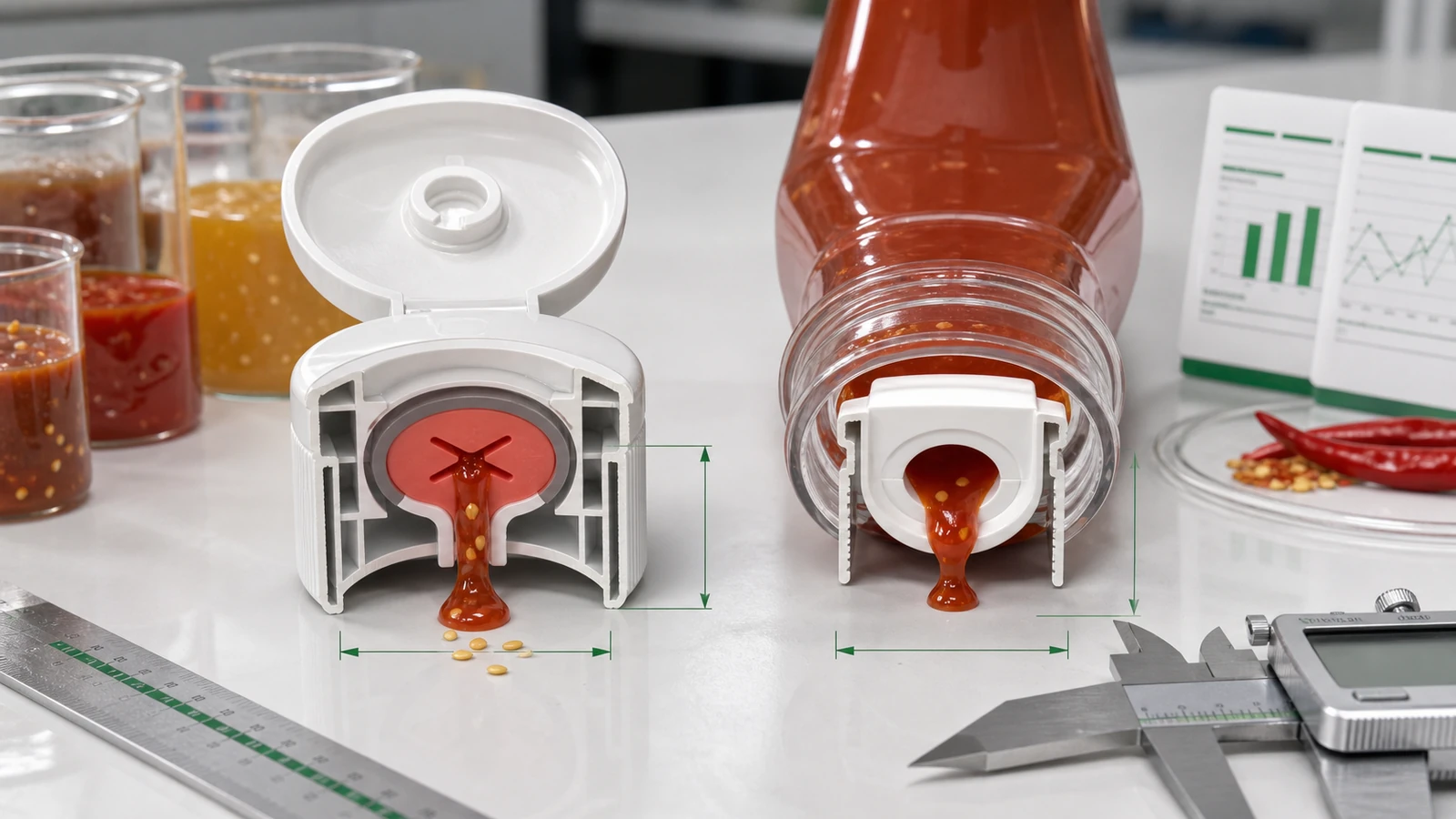
A silicone squeeze valve uses a cross-slit or shaped slit that stays closed at rest. When squeeze pressure rises, the slit opens and lets sauce pass. When pressure stops, elastic recovery closes the slit again. This makes valves useful for smooth, thicker condiments that need clean cutoff, cap-down storage or controlled lines on a plate.
The valve is especially relevant for spicy mayo, sriracha-style sauces, chili ketchup, sweet chili sauce and smooth pepper pastes where the bottle body can generate enough squeeze pressure. A softer LDPE or flexible PET/PP route may perform differently from a stiff clear bottle because the bottle wall controls how pressure reaches the valve.
Valve success depends on both rheology and material compatibility. The formula may be shear-thinning, meaning it flows more easily while squeezed and thickens again at rest. Oil, vinegar, chili pigment and capsaicin-rich phases can also affect long-term cleanliness, staining and valve feel. The valve should be reviewed with the actual sauce, not only water or syrup.
Clean-Cut Dispensing Matrix by Viscosity and Particle Size
Viscosity ranges are useful for first screening, but they are not final approval numbers. Hot sauce behavior changes with temperature, oil separation, particle settling, starch or gum system, bottle fill level and shaking pattern. A sauce that measures smoothly in a cup can still sputter through a narrow orifice after one week of storage.
The matrix below is a practical starting point for sample selection. Final approval should be based on filled packages stored in the same orientation and temperature range expected in retail, foodservice or ecommerce.
| Sauce Condition | Typical Planning Range | Preferred Direction | Reason |
|---|---|---|---|
| Watery vinegar hot sauce, no visible particles | 1-500 cP | Small orifice reducer or controlled flip-top opening. | Restricts fast flow and supports drop-by-drop dosing. |
| Pourable pepper sauce with fine solids | 500-3,000 cP | Medium reducer, flip-top cap or small nozzle. | Balances dose control with lower clogging risk. |
| Smooth sriracha-style chili sauce | 3,000-15,000 cP | Twist nozzle, larger flip-top opening or silicone valve. | Needs squeeze pressure and clean cutoff rather than a tiny fixed hole. |
| Spicy mayo, thick dressing or chili cream sauce | 15,000-50,000 cP | Silicone valve with soft squeeze body or larger nozzle. | Higher viscosity benefits from pressure-activated dispensing. |
| Visible seeds, pulp or chili flakes | Any viscosity | Large nozzle, wide flip-top or wide-mouth route. | Largest particle size matters more than average viscosity. |
| Oil-rich chili condiment | Formula-specific | Validated liner, nozzle or valve route. | Oil can affect residue, staining, seal cleanliness and valve recovery. |
Failure Modes: Clogging, Weeping, Stringing and Valve Memory
Dispensing failures usually come from mismatched flow geometry. A reducer hole that is too small creates blockage and delayed flow. A valve slit that is too stiff creates high squeeze force. A nozzle that is too wide may solve clogging but create over-dispensing. The best closure is the one that controls the real formula without creating a new complaint.
For low-viscosity liquids, flow through a fixed orifice rises sharply as pressure and opening area increase. In simple terms, a small dimensional change in the hole can produce a noticeable difference in pour behavior. For high-viscosity sauces, the issue shifts toward yield stress, squeeze force and whether the sauce breaks cleanly at the tip.
Silicone valves add one more variable: memory. The slit must open enough to dispense, then return to its closed position. If solids hold the slit open, the bottle can weep. If the valve takes a compression set after storage, cutoff quality can decline. This is why cap-down and repeated-use testing matter more than a single squeeze test on the bench.
The most common symptoms are easy to recognize during sample trials. Clogging means the largest particles exceed the practical flow path. Weeping means sauce creeps through the reducer or valve after dispensing stops. Stringing means the sauce stretches at the tip instead of cutting cleanly. Sputtering often points to trapped air, partial blockage or sauce separation. Reducer lift usually means the insert retention is too weak for cap contact, squeeze pressure or repeated handling.
Factory QC and Sample Validation at Gracepack
Gracepack reviews dispensing as a bottle, cap and sauce system. The same sauce can behave differently in a stiff bottle, a soft squeeze bottle, an inverted bottle or a narrow-neck dasher bottle. The review should cover cap fit, reducer seating, valve material, neck finish, bottle rebound, filling temperature, headspace, packing orientation and destination-market documentation.
Our production base supports both bottle bodies and closure components, including 15 automatic injection molding machines for caps, preforms and plastic parts, 13 automatic blow molding machines, 9 fully automatic production lines, and labeling and printing support. This helps keep cap color, neck compatibility, dispensing route, bottle stiffness and export packing aligned instead of treating the closure as a separate accessory.
For food-contact review, component matching matters. PET, PP, PE, LDPE, HDPE and silicone parts may require different document routes depending on the selected package and market. Gracepack can align FDA-related PET support, EU food-contact routes for PET/PP/PE/silicone components, BPA-related support, ISO 22000 supplier documentation and plastic bottle or cap standards with the actual bottle and closure selected for sampling.
| QC Area | What Gracepack Checks | Why It Matters |
|---|---|---|
| Bottle neck | Neck diameter, bore, thread fit, sealing land and insert engagement. | A reducer or valve cap cannot perform if the neck fit is unstable. |
| Closure component | Cap size, color, slit or orifice route, liner need and assembly fit. | Controls flow, leakage, shelf cleanliness and line compatibility. |
| Sauce behavior | Viscosity range, oil phase, acid level, largest particle and settling risk. | Prevents selecting a cap that works only on a clean lab liquid. |
| Filled storage | Upright, inverted and side-laid checks after rest time. | Catches slow weeping, cap residue and valve memory issues. |
| Export packing | Cap protection, carton orientation and component cleanliness. | Reduces scuffs, deformed caps and leakage during long-distance freight. |
Engineering Audit Checklist Before Choosing a Valve or Reducer
Use the checklist before approving a dispensing closure for spicy condiments. The goal is not to choose the most advanced component; it is to choose the component that keeps the sauce controlled, clean and repeatable in real use. This is the one part of the article where a checklist format is intentional, because these are approval steps rather than a recap of the paragraphs above.
- Confirm whether the sauce is thin, pourable, squeeze-grade or paste-like at the use temperature.
- Measure the largest visible particle after mixing, settling and partial bottle use.
- Decide whether the bottle will be stored upright, inverted, side-laid or shipped through ecommerce.
- Match the closure to the bottle neck finish and verify cap clearance over any insert.
- Test first-dose control after the bottle has rested for 24-72 hours.
- Run repeated dispensing cycles to check residue, stringing, clogging and valve recovery.
- Check cap torque, leakage and removal behavior if a screw or flip-top route is used.
- Validate food-contact documents for the bottle, cap, reducer, liner and silicone valve as separate components.
- Confirm carton packing protects caps and dispensing features during export handling.
FAQ About Squeeze Valves and Orifice Reducers
When should spicy condiments use a squeeze valve?
Use a squeeze valve when the sauce is smooth, medium to high viscosity and needs clean cutoff, cap-down storage or controlled lines from a soft squeeze bottle. Spicy mayo, smooth sriracha-style sauce and chili ketchup are common candidates.
When is an orifice reducer better?
An orifice reducer is usually better for thin, smooth vinegar-based hot sauce where drop-by-drop dosing is more important than squeeze output. It is simple, low cost and durable when the formula has no particles large enough to block the hole.
Do silicone valves clog with chili particles?
They can. Seeds, chili skin, garlic bits and pulpy solids may lodge in the slit, hold the valve open or make the dose uneven. Particle size should be tested after the sauce has settled, not only immediately after mixing.
Can one bottle use both a valve and a reducer?
Usually the package is designed around one primary flow-control route. Combining restrictions can raise squeeze force, slow output and create cleaning problems unless the full closure assembly is engineered for that purpose.
What viscosity range should be tested before approval?
Planning ranges can start around 1-500 cP for thin reducers, 500-3,000 cP for controlled openings, 3,000-15,000 cP for nozzle or valve trials and 15,000-50,000 cP for soft squeeze valve routes. Actual approval still requires filled-sample testing.
What should I send for a valve or reducer sample review?
Send sauce type, estimated viscosity, largest particle size, oil content, bottle size, neck finish if known, filling temperature, storage orientation, destination market, order quantity and whether the product is for retail, foodservice or ecommerce.
Request a Valve and Reducer Sample Review
A practical dispensing decision starts with real sauce behavior. Share your sauce viscosity, visible particle size, oil level, bottle capacity, preferred closure style, filling temperature and storage orientation. Gracepack can compare silicone squeeze valves, snap-in orifice reducers, twist nozzles, flip-top caps and bottle body options as a matched sample set.
For new projects, the first review can focus on fast elimination: which openings clog, which valves require too much force, which cap route leaks in cap-down storage and which bottle body gives the most stable squeeze response. That gives your team a cleaner route before artwork, mold decisions or bulk production are locked in.


