

Custom salad dressing bottle tooling earns a financial return only when the approved development cost is recovered through a defensible benefit across usable production units. Calculate the break-even volume, compare it with realistic lifetime demand, then test whether the MOQ and payment schedule fit the company’s cash and inventory limits. A mold can be technically successful and still be a poor investment if the forecast, component MOQs or launch timing are wrong.
This guide is a financial approval model for a proprietary dressing-bottle program. It does not replace a complete landed-cost comparison, a mold-development specification or an existing-mold-versus-new-mold decision. Those questions are covered in the linked specialist guides.
| Approval question | Required input | Decision signal |
|---|---|---|
| Can tooling pay back? | Approved development cost and recurring benefit per usable bottle | Break-even volume fits conservative lifetime demand |
| Can the first order be funded? | Tooling payments, component deposits, MOQ and launch receipts | Peak cash exposure stays within the approved budget |
| Can demand absorb the MOQ? | SKU forecast, inventory turns and shelf-life constraints | Order quantity does not create avoidable slow stock |
| Should the design remain custom? | Repeat volume, design life and measurable commercial benefit | Sensitivity cases remain acceptable after forecast changes |
Use the Right Break-Even Question
The U.S. Small Business Administration’s break-even guidance expresses unit break-even as fixed cost divided by the contribution available per unit. A tooling decision uses the same logic, but the denominator must be tied to the specific benefit created by the custom bottle rather than to sales revenue in general.
If a custom bottle produces a verified recurring saving against a functionally equivalent stock package, break-even volume = approved custom-development cost ÷ recurring saving per usable bottle. The word usable matters: compare complete, accepted bottle-and-closure sets, not gross molded pieces. If the custom route does not reduce recurring cost, there is no cost-saving payback. The business case then needs another measured benefit, such as additional contribution margin, an avoided failure cost or a contract requirement. Do not assign a dollar value to brand differentiation without evidence.
The planning horizon also matters. A calculation based on one million bottles over five years is not equivalent to a first order of one million bottles. Forecast the usable volume expected before the design changes, the product is retired or the tool requires a material commercial decision.
Build the Approved Development-Cost Numerator
A mold quotation is only one part of the upfront investment. The approved numerator should include every non-recurring cost required to release the custom package for commercial production. Excluding validation or expected modification work makes the break-even quantity look artificially low.
Keep the model auditable by separating quoted, budgeted and contingent amounts. Quoted values belong to an identified supplier scope. Budgeted values cover work that is required but not yet quoted. Contingency is a management allowance, not hidden supplier revenue. Replace every budget line with an approved amount before the investment decision is final.
| Cost block | What may belong in it | Control question |
|---|---|---|
| Design and engineering | Bottle drawing, capacity review, neck finish, label panel and manufacturability work | Is the scope defined before tooling starts? |
| Bottle and closure tooling | Bottle mold, preform route where applicable, dedicated cap or insert tooling | Which components actually require new tools? |
| Samples and modifications | Trial parts, shipping, measured revisions and approved change rounds | What is included in the quote and what triggers a charge? |
| Package validation | Fill, cap, leak, label, carton, line and destination-market document checks | What evidence releases the package for production? |
| Launch-specific setup | Dedicated fixtures, artwork setup or first-production inspection outside normal unit price | Is it one-time or repeated on every order? |
Forecast Usable Units, Not Optimistic Sales
Tooling cost per usable bottle = total approved development cost ÷ forecast usable units within the approved design life. Forecast usable units should begin with production demand, then account for qualification pieces, normal losses, rejected packaging and any units that cannot be used because a cap, label or filling specification changes.
Use at least three demand cases: downside, operating plan and upside. The downside case should represent a plausible delayed launch, lost customer or slower reorder pattern. The operating plan should match the budget used by purchasing and production. The upside case helps test capacity; it should not be used to justify an investment that fails under the operating plan.
For clear salad dressing bottles, a forecast also needs the actual bottle-and-cap configuration. A transparent PET bottle, a colored closure and a decorated label can have different production and purchasing constraints. Counting bottle bodies without the components needed to create a sellable package overstates usable volume.
Worked Example: Calculate the Tooling Break-Even Volume
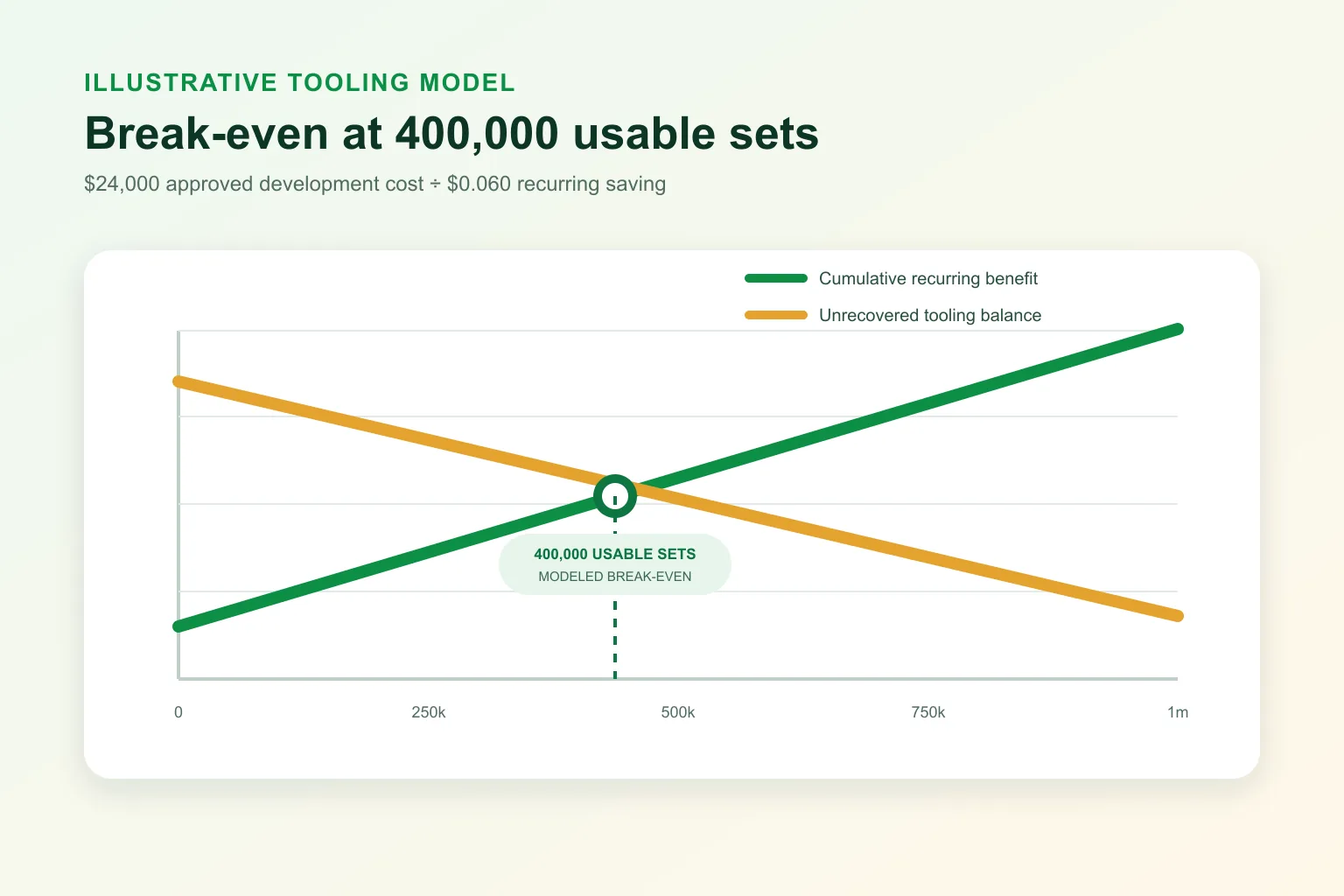
The following figures are an illustrative decision model, not a Gracepack quotation, customer result or promised saving. Assume the approved one-time development cost is $24,000. A functionally matched stock package costs $0.430 per usable bottle-and-cap set, while the proposed custom route has a verified recurring cost of $0.370 per usable set under the same commercial boundary. The modeled recurring saving is therefore $0.060 per usable set.
Break-even volume = $24,000 ÷ $0.060 = 400,000 usable sets. Below that volume, the recurring saving has not recovered the approved development cost. Above it, each additional usable set contributes $0.060 toward the modeled benefit, provided the cost difference and package specification remain valid.
The calculation does not prove that the custom bottle will sell better, does not include financing cost and does not authorize a purchase order. Replace the assumptions with matched quotations, approved sample results and a forecast signed off by the responsible commercial and finance teams.
| Forecast usable volume | Tooling allocation per usable set | Custom recurring cost plus tooling | Difference versus $0.430 stock route |
|---|---|---|---|
| 50,000 | $0.480 | $0.850 | $0.420 higher |
| 250,000 | $0.096 | $0.466 | $0.036 higher |
| 400,000 | $0.060 | $0.430 | Break-even |
| 1,000,000 | $0.024 | $0.394 | $0.036 lower |
Do Not Confuse MOQ With Break-Even Volume
MOQ is a supplier or process constraint for an order. Break-even volume is the cumulative number of usable units required to recover an approved investment. They may be equal by coincidence, but one does not establish the other. A 50,000-piece MOQ does not mean tooling pays back at 50,000 pieces, and a 400,000-piece break-even point does not require purchasing all 400,000 at once.
Model the MOQs of the complete package. A program using salad dressing squeeze bottles may have one bottle-body MOQ, while resin color, disc-top dressing caps, liners, valves, labels and printed cartons have separate minimums. The component with the highest usable-set constraint can determine the funded quantity even when the bottle machine could run a smaller batch.
Translate each MOQ into months of cover: inventory months = purchased usable sets ÷ conservative monthly usage. Then compare that coverage with warehouse capacity, forecast confidence, artwork stability and the business’s inventory policy. A lower unit price does not compensate for stock that cannot be converted into sales.
| Relationship | What it means | Approval response |
|---|---|---|
| MOQ below break-even volume | The first order limits exposure but does not recover tooling | Fund staged reorders only if cumulative demand is credible |
| MOQ near break-even volume | Payback and inventory exposure arrive together | Stress-test sell-through, storage and launch timing |
| MOQ above near-term demand | Unit economics may improve while working capital worsens | Use a stock bottle, simplify components or renegotiate the package route |
Map the Cash-Sink Window by Approval Gate
A tooling ROI can look acceptable on a cumulative chart while still creating an unaffordable cash gap before launch. Build a dated cash schedule from the first drawing or tooling payment through samples, component deposits, production balance, freight, import charges where applicable and customer receipts. Use the actual payment terms in the quotation and sales plan rather than a generic industry percentage.
Gracepack’s documented working sequence separates requirement confirmation, drawing review, tooling authorization, trial samples, customer approval and bulk-production release. The current process can include a drawing charge that is credited after tooling approval, a 50% tooling payment before mold work, signed drawing confirmation, sample approval and collection of the remaining tooling amount before or with the bulk-production payment. These are planning references; the signed quotation and pro forma invoice govern each project.
Cash exposure should be reviewed at every gate. A signed drawing controls technical scope, but it does not prove market demand. A passing sample controls the package decision, but it does not eliminate inventory risk. The purchase release should occur only when technical approval, funded order quantity and launch ownership are all clear.

Use One Bottle Platform Across Multiple Dressing SKUs
A shared bottle platform can concentrate demand from ranch, Caesar, vinaigrette and other dressing variants into one tooling case. The bottle body, neck finish and principal cap interface remain common, while labels, cap colors or controlled dispensing features distinguish the SKUs. Product families such as vinaigrette pour bottles and thicker dressing formats can share a body only if the opening, closure and consumer-use requirements remain compatible.
Do not add all flavor forecasts blindly. Check whether each SKU uses the same bottle resin, weight, neck, cap interface, fill process, label area and carton. A flavor that needs a different valve, hot-fill route or bottle color can create a separate component MOQ and a different usable-set count even when the mold is shared.
The financial benefit of platforming comes from concentrating qualified volume and reducing duplicated tooling exposure. The operational benefit comes from common line settings, packaging specifications and spare-component planning. The trade-off is concentration risk: a body or neck change affects every SKU on the platform.
Evaluate Multi-Cavity Tooling as a Capacity Decision
A multi-cavity tool can increase output per molding cycle, but more cavities usually increase upfront tool investment, qualification work and cavity-to-cavity control requirements. The financial question is whether annual demand and required delivery rate use that additional capacity often enough to justify it.
Ask for a matched comparison of tool cost, expected output under the proposed machine and material, planned maintenance, expected changeover pattern and recurring part cost. Use accepted production output rather than theoretical pieces per hour. If the forecast does not require the capacity, a lower-cavity route may protect cash even when its unit conversion cost is higher.
Keep the technical detail in the tooling specification. This ROI model needs only the approved cost, usable output, recurring cost and capacity constraint. The technical tooling-development guide covers drawing, prototype, T0/T1, ownership and production-release controls without duplicating them here.
Run a Sensitivity Test Before Financial Approval
A single break-even number hides the variables most likely to change. Recalculate the model when forecast volume, recurring saving, accepted yield, development changes, exchange rate or design life moves. The decision is stronger when it survives a reasonable downside case rather than only the operating plan.
In the illustrative model, reducing the recurring saving from $0.060 to $0.040 raises break-even volume from 400,000 to 600,000 usable sets. Increasing approved development cost from $24,000 to $30,000 raises it to 500,000 at the original $0.060 saving. If both changes occur, break-even rises to 750,000. That range is more useful for approval than presenting 400,000 as a fixed truth.
| Illustrative case | Approved development cost | Recurring saving per usable set | Break-even volume |
|---|---|---|---|
| Operating model | $24,000 | $0.060 | 400,000 |
| Lower recurring benefit | $24,000 | $0.040 | 600,000 |
| Higher development cost | $30,000 | $0.060 | 500,000 |
| Combined downside | $30,000 | $0.040 | 750,000 |
Choose Stock Validation or Custom Tooling at the Right Gate
Continue with an existing mold when formula, capacity, closure, filling method, artwork, channel or repeat demand is still moving. A stock route can test the commercial package without forcing an early tooling assumption. The custom mold vs. stock bottle guide explains that route decision in detail.
Move to custom tooling when the package requirement is stable, the technical gap cannot be solved with available molds, the conservative lifetime volume supports the investment and the cash schedule is funded. A proprietary silhouette alone is not enough if the bottle has not been matched to filling, capping, labeling, carton and consumer-use requirements.
| Gate | Stay with an existing mold | Advance custom tooling |
|---|---|---|
| Demand | Launch or reorder forecast remains uncertain | Conservative cumulative demand exceeds the approved threshold |
| Package specification | Formula, fill, cap or label is still changing | Bottle, closure, fill and artwork requirements are frozen |
| Financial model | Payback depends on an unverified sales uplift | Recurring benefit and development cost have evidence |
| Cash and inventory | MOQ creates excessive months of cover | Payment gates and inventory exposure are funded |
Build the Gracepack Tooling-ROI Review File
Gracepack can begin by screening existing bottle, preform and closure resources before recommending new tooling. For a custom dressing-bottle review, the working file connects the reference bottle or drawing with target capacity, material, neck finish, bottle weight, cap and sealing requirement, filling product, filling temperature, first-order quantity and annual demand. This allows engineering and commercial assumptions to be reviewed from the same brief.
The review should then separate one-time development items from recurring bottle, closure, decoration and packing costs. Sample records, signed drawings, package configuration, carton method and production-release evidence provide the physical reference behind the financial model. The purpose is not to promise an ROI before sampling; it is to show which values are quoted, which are forecast and which still require validation.
A tooling request is easier to assess when the buyer supplies a downside demand case, intended design life, target recurring cost boundary and maximum acceptable inventory coverage. Gracepack can compare the available mold route with the proposed custom direction before a new tool is authorized.
FAQ About Custom Salad Dressing Bottle Tooling ROI
Is MOQ the same as tooling break-even volume?
No. MOQ controls the minimum order or production campaign, while break-even volume is the cumulative usable quantity needed to recover the approved development investment.
Does a lower custom-bottle unit price guarantee a positive ROI?
No. The comparison must use the same bottle, closure, decoration, quality and commercial boundary. It must also include the approved development cost and usable yield.
Can several dressing flavors share one tooling model?
Yes, when they use the same qualified bottle platform. Separate colors, caps, labels or fill conditions can still create component-specific MOQs and validation work.
Should a brand order the entire break-even volume at launch?
Not automatically. Break-even is cumulative. Order timing should follow demand, inventory policy, supplier campaign constraints and the funded cash plan.
What should be sent for a tooling ROI review?
Send the current or target bottle, required capacity, material, cap, filling conditions, first-order quantity, annual forecast, expected design life, destination market and matched stock-versus-custom cost boundary.
Request a Custom Bottle Tooling ROI Input Review
Send the target dressing bottle or drawing, capacity, formula and filling conditions, closure route, first-order quantity, annual forecast, planned design life and the commercial boundary you want to compare. Include separate downside, operating and upside demand cases if they are available.
Gracepack can screen existing mold options, identify the package components that may require new tooling, and organize the quoted and still-unverified inputs for a break-even and cash-flow review. Final ROI approval remains the buyer’s financial decision and should use signed quotations, approved samples and current logistics or import costs where applicable.


