
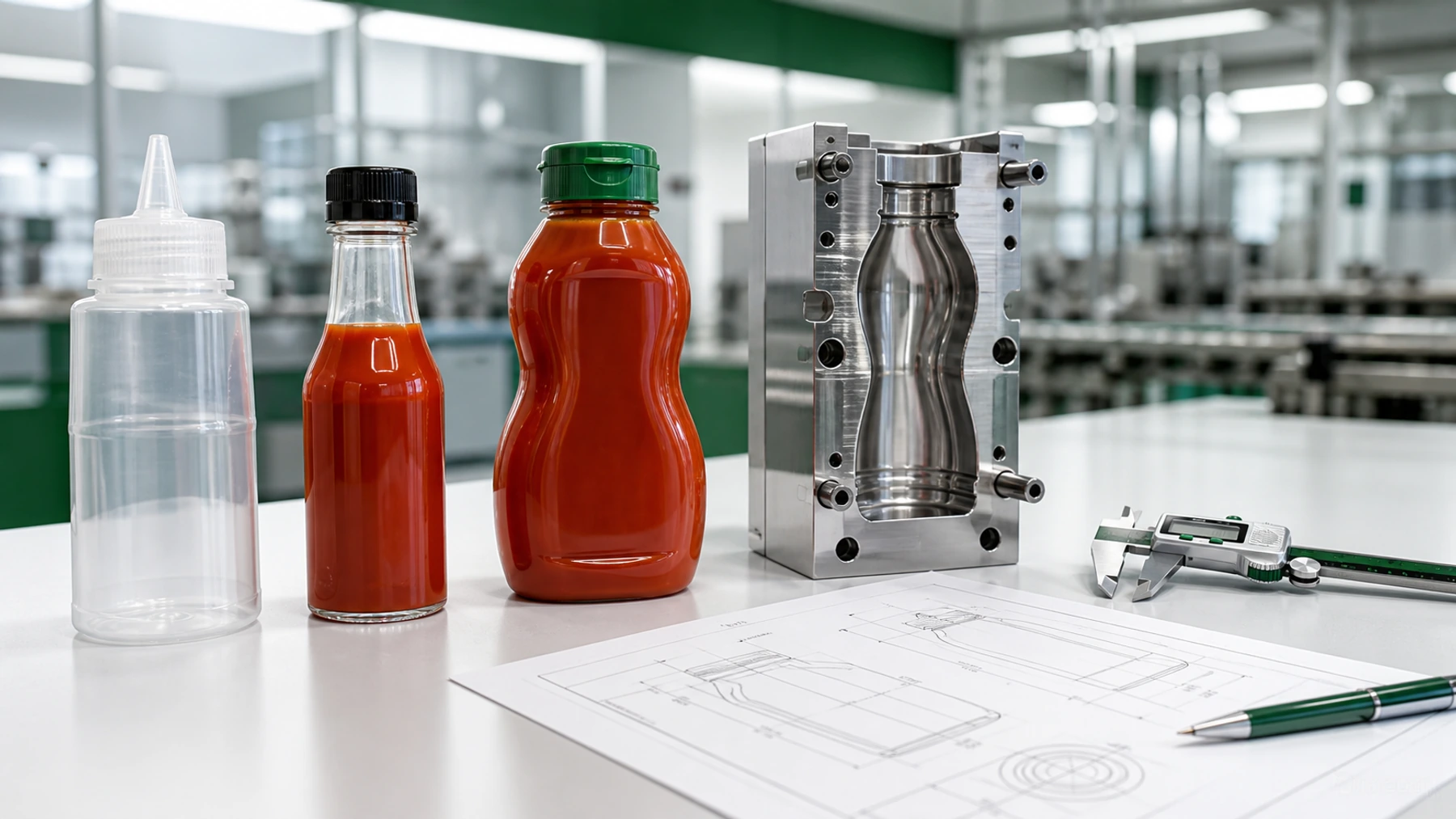
A sauce brand should invest in custom tooling when repeat demand, package function and brand differentiation are strong enough to justify the mold cost, sampling time and production commitment. Stock bottles are usually the better first route for market testing, short launch schedules and lower-risk MOQ planning.
The custom mold vs stock bottles decision is not just a branding question. A bottle mold locks in neck finish, shoulder geometry, label panel, wall-thickness direction, base stability, cap compatibility and carton density. If those details are wrong, the cost of tooling is only the first loss; line downtime, leakage, rework and slow inventory movement can cost more.
| Decision Factor | Stay With Stock Bottles | Invest in Custom Tooling | Validation Method |
|---|---|---|---|
| Demand stage | New SKU, uncertain repeat orders or retailer trial. | Stable repeat sales with a reliable annual forecast. | Review 6-12 months of sales, reorder pattern and SKU survival. |
| Upfront budget | Tooling cash is better used for production, labels, freight or launch promotion. | The project can absorb mold cost without starving inventory or marketing. | Build a landed-cost model including tooling amortization. |
| Our planning data | Stock samples can often be supplied within 3 days when available. | Custom samples commonly need about 10-15 days after drawing direction is confirmed. | Confirm material, capacity, closure and sample approval gate. |
| MOQ direction | Many standard routes can start around 5,000 pcs, depending on bottle and cap. | Custom color commonly starts around 10,000 pcs; new tooling may need a separate run plan. | Confirm bottle MOQ, cap MOQ, color MOQ and packing method together. |
| Tooling cost direction | No new bottle mold cost when an existing mold works. | Bottle mold planning may start around USD 1,300; multi-cavity cap tooling may range around USD 2,500-5,000 depending on structure. | Confirm cavity count, steel, cap design, trial sampling and revision scope. |
| Functional need | Standard neck, normal label area and proven cap options work. | Special squeeze recovery, wide mouth, grip, reducer, valve, embossing or proprietary shape is required. | Run filled samples, capping torque, leakage, label and carton checks. |
| Brand defensibility | Label, cap color and sleeve can create enough shelf difference. | Bottle silhouette or embossed geometry needs to become a brand asset. | Review shelf set, trademark strategy and copy risk. |
Downtime and Cash Flow: Why the Mold Decision Is Operational
For early sauce launches, stock bottles protect cash flow. The brand can buy a known bottle, test shelf response, confirm fill volume, validate label artwork and keep the launch schedule moving. If the first packaging direction changes after retailer feedback, the project has not locked capital into a shape that may be abandoned.
For established sauce brands, stock bottles can become limiting. A common bottle may reduce shelf recognition, force a label panel that does not fit the brand system, or fail to handle sauce viscosity and dispensing behavior. If every production run needs manual wiping, cap rework or special carton handling, a custom package can be less about appearance and more about removing recurring operating cost.
The financial test is simple: compare the one-time tooling investment against the repeated per-unit, labor, scrap, leakage and brand-value costs of staying with a bottle that almost works. Custom tooling is not justified because it looks interesting; it is justified when it removes a repeated constraint.
Stock Bottle Route: Fast, Lower Risk and Often Custom Enough
A stock bottle is an existing mold route that can move quickly into sample review and quotation. It is the best starting point when a brand is testing demand, comparing several sauce sizes, or still deciding whether the product belongs in a woozy bottle, squeeze bottle, wide-mouth jar or foodservice container.
Stock does not mean generic. A standard bottle can still support cap color, resin color, label shape, shrink sleeve, induction liner, carton plan and retail set configuration. For many private label and distributor programs, that level of customization is enough to create a professional shelf presence without the risk of new tooling.
At Gracepack, we usually start with a stock-mold review because our factory has 500+ owned mold resources and more than 5,000 standard bottle types. That lets your sauce project test size, neck finish, cap style and label area before committing to a new bottle mold.
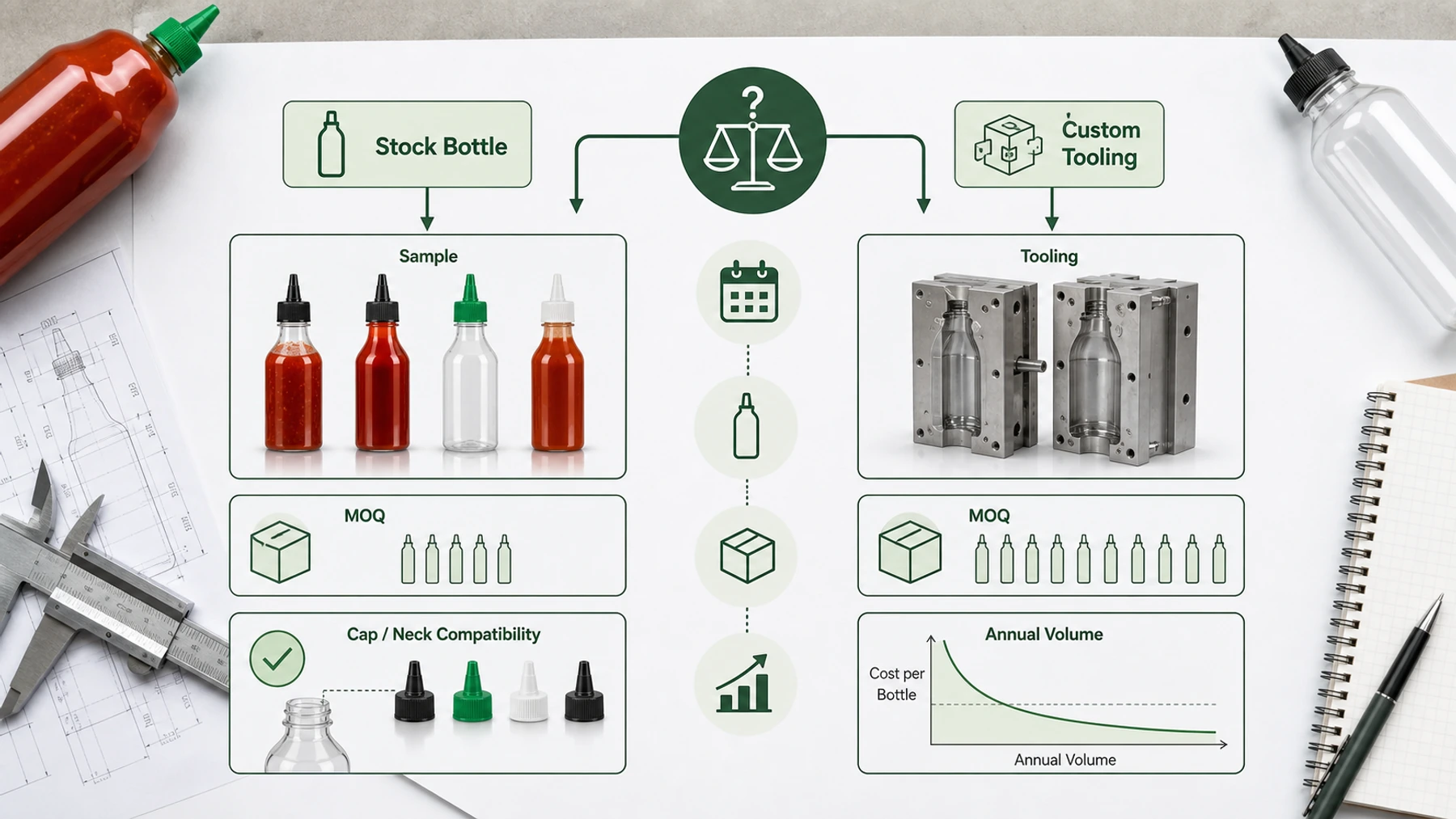
Custom Tooling Route: Proprietary Shape, Function and Control
Custom tooling becomes important when the bottle itself needs to solve a defined commercial or mechanical problem. That may be a signature shelf silhouette, an ergonomic grip, a wider filling mouth, a controlled squeeze panel, an embossed logo field, a special base, or a neck finish that supports a specific cap, valve or reducer.
A custom mold should not begin from a sketch alone. The engineering brief should define capacity, overflow target, material route, filling temperature, sauce viscosity, largest particle size, cap type, neck finish, label area, carton count and destination market. Each of those variables can change tooling geometry.
Bottle tooling and cap tooling should also be treated separately. A new bottle mold may be relatively simple when the shape is conventional. A cap mold, especially a multi-cavity flip-top, nozzle or tamper-evident closure, can require more precision around hinge behavior, sealing land, thread engagement, cooling balance and cavity-to-cavity consistency.
| Tooling Element | What It Controls | Risk if Not Confirmed Early |
|---|---|---|
| Neck finish | Cap thread, liner compression, reducer fit and capping torque. | Leaking, cross-threading, poor tamper band release or capper jams. |
| Shoulder and body geometry | Shelf shape, label panel, squeeze feel and wall distribution. | Wrinkled labels, denting, poor squeeze recovery or local thin spots. |
| Base design | Conveyor stability, carton packing and top-load behavior. | Rocking bottles, line tip-overs or pallet compression damage. |
| Cap mold cavity count | Output, unit economics and cavity-to-cavity dimensional repeatability. | Higher cap cost, inconsistent sealing or slower production scale-up. |
| Embossing / grip features | Brand memory and tactile control. | Sink marks, cleaning issues, label interference or hard-to-fill geometry. |
The Tooling ROI Calculation: Mold Cost Per Bottle
The easiest way to make the custom tooling decision objective is to amortize the mold cost across confirmed repeat volume. A USD 1,300 bottle mold spread across 5,000 bottles adds USD 0.26 per bottle before production cost. The same mold spread across 100,000 bottles adds USD 0.013 per bottle. At 500,000 bottles, the tooling load becomes almost invisible at the unit level.
The formula is simple: tooling cost per bottle = total tooling cost / expected qualified production volume. The important word is qualified. Do not amortize tooling against a dream forecast; use a conservative volume that the brand can realistically sell after sample approval and retailer confirmation.
Cap tooling changes the equation. A multi-cavity cap mold can cost more than a simple bottle mold because closures require thread accuracy, hinge life, tamper band function, liner fit or valve control. If the stock bottle can use an existing cap family, that may be the better route until annual volume proves the custom cap business case.
| Planning Scenario | Example Tooling Cost | Qualified Volume | Tooling Load Per Bottle |
|---|---|---|---|
| Small trial | USD 1,300 bottle mold | 5,000 pcs | USD 0.260 per bottle |
| Growing SKU | USD 1,300 bottle mold | 50,000 pcs | USD 0.026 per bottle |
| Stable annual program | USD 1,300 bottle mold | 100,000 pcs | USD 0.013 per bottle |
| High-volume program | USD 1,300 bottle mold | 500,000 pcs | USD 0.0026 per bottle |
| Custom cap route | USD 2,500-5,000 cap mold planning range | Depends on cavity count and cap structure | Calculate separately from bottle tooling |
MOQ, Samples and Timeline: What to Plan Before Approval
MOQ is where creative packaging meets factory scheduling. A typical standard route may start around 5,000 pcs when the bottle, cap, material and color are available. Custom color commonly needs a higher planning quantity, often around 10,000 pcs, because resin color, production setup and batch consistency need a cleaner run.
Sampling timing also changes by route. Stock samples can often be supplied within 3 days when the sample is available. Custom sample development normally needs about 10-15 days after the drawing direction is confirmed, and that clock should not start before the bottle capacity, cap route and critical dimensions are clear.
A realistic launch plan should include review gates: stock sample or 3D direction, drawing confirmation, cap compatibility, prototype sample, filled-sample testing, label fit, carton packing, document matching and final production approval. Skipping one gate usually only moves the delay later in the project.
- Use stock samples when the SKU is still validating size, closure and market demand.
- Use custom samples when the package needs a proprietary shape or function.
- Separate bottle MOQ from cap MOQ, label MOQ, color MOQ and carton requirements.
- Do not approve a mold until the filling temperature, viscosity, cap style and label panel are confirmed.
- Plan a second adjustment window for new tooling, especially when the bottle has grips, embossing, wide-mouth geometry or special squeeze panels.
Engineering Checks Before Opening a New Mold
A custom sauce bottle has to survive the full packaging system: filling, capping, labeling, packing, freight, storage and consumer dispensing. A drawing can confirm nominal size, but it cannot prove leakage, squeeze recovery, cap torque or line stability. Those are filled-package tests.
For thin hot sauce, the priority may be neck finish, reducer fit and controlled pouring. For ketchup and BBQ sauce, the priority may be squeeze force, panel recovery and no-drip cap behavior. For chunky salsa or relish, filling access and wide-mouth geometry may be more important than a narrow retail silhouette. A mold route should follow the formula.
| Check Point | Target Question | Failure Mode Prevented |
|---|---|---|
| Sauce viscosity and particles | Can the formula fill and dispense through the selected neck and cap? | Clogging, slow filling, consumer frustration and cap residue. |
| Filling temperature | Will the material and geometry hold shape after fill and cooling? | Panel sink, ovality shift, vacuum distortion or thread deformation. |
| Cap torque | Does the cap seal without stripping or distorting the neck? | Leakage, cross-threading and inconsistent tamper evidence. |
| Label panel | Does artwork fit the real curvature and seam requirement? | Wrinkling, bubbles, barcode distortion and poor shelf presentation. |
| Carton and pallet plan | Does the custom shape pack efficiently? | Higher freight cost, scuffing, top-load damage and unstable pallets. |
| Food-contact documentation | Do bottle, cap, liner and valve documents match the selected materials? | Retailer delay, customs questions and late component changes. |
Gracepack Factory Controls for Custom Mold Projects
Custom tooling works best when bottle body, cap, label and packing decisions are coordinated inside one technical review. At Gracepack, we support this with 9 fully automatic production lines, 15 automatic injection molding machines for caps and plastic parts, 13 automatic blow molding machines for bottle bodies, 3 labeling machines and 5 printing machines.
That manufacturing base matters because a custom bottle cannot be approved as an isolated shape. The neck finish must match the closure, the label panel must match decoration, and the carton must match the final bottle footprint. A broad mold library also gives the project a lower-risk starting point: compare stock families first, then open new tooling only when the technical or commercial reason is strong.
Food-contact support can be matched by component after the route is selected, including PET, HDPE, LDPE, PP, PE, silicone, cap and liner directions. For US, EU and export programs, documentation review should happen before mass production so the approved sample and the quoted compliance path remain aligned.
Decision Audit Checklist
Before approving custom tooling, use a practical checklist that connects brand intent with production behavior and cash flow.
- [ ] Is the SKU already generating repeat demand, or is it still a market test?
- [ ] Can an existing mold solve 80-90% of the requirement with cap, color, label or carton customization?
- [ ] Is the expected volume high enough to make tooling cost per bottle acceptable?
- [ ] Has the bottle mold cost been separated from cap mold, label, color and carton costs?
- [ ] Are bottle capacity, fill level, neck finish and cap route already confirmed?
- [ ] Has the sauce viscosity, particle size, acidity, oil content and filling temperature been reviewed?
- [ ] Will the custom shape run on the filler, capper, labeler and packing line without special handling?
- [ ] Does the label panel support barcode scan, regulatory copy and shelf-facing design?
- [ ] Does the package need a proprietary shape for brand defensibility, or would decoration be enough?
- [ ] Are sample timing, adjustment rounds, MOQ and launch date realistic?
FAQ About Custom Mold vs Stock Bottles
When should a sauce brand invest in custom tooling?
A sauce brand should invest in custom tooling when repeat volume is stable, the package needs a proprietary shape or function, and the mold cost can be amortized across qualified production without damaging cash flow.
When should a sauce brand stay with stock bottles?
Stock bottles are usually better for new launches, test SKUs, tight timelines, lower upfront budget and projects that can achieve a strong brand look through cap color, labels, sleeves and carton design.
How much does a sauce bottle mold cost?
A simple bottle mold planning figure may start around USD 1,300, while cap tooling can vary widely. A multi-cavity cap mold may require a separate planning range around USD 2,500-5,000 depending on structure, cavity count and closure function.
What MOQ should I plan for stock or custom sauce bottles?
Many standard bottle routes can be discussed from around 5,000 pcs, while custom color commonly starts around 10,000 pcs. New tooling MOQ should be confirmed by bottle size, material, cap route and production schedule.
How long do samples take?
Stock samples can often be supplied within 3 days when available. Custom sample development commonly needs about 10-15 days after the drawing direction and key dimensions are confirmed.
Can a stock bottle still look custom?
Yes. Material color, cap color, label structure, shrink sleeve, carton design, tamper evidence and set configuration can create a custom market presentation without opening a new bottle mold.
What information is needed before a custom mold review?
Send the target capacity, reference bottle or sketch, sauce viscosity, largest particle size, filling temperature, cap style, label area, expected annual volume, destination market and launch date.
Request a Custom Tooling Feasibility Review
If your current package is close but not quite right, start with a mold-route review before committing to tooling. Gracepack can compare stock bottle families, modified standard routes and new custom tooling against your sauce formula, annual volume, launch date and cap requirement.
Send the target capacity, product type, viscosity, filling temperature, preferred closure, label direction, annual forecast, desired sample date and destination market. The review can identify whether stock samples, custom color, bottle mold development or cap tooling should be the next practical step.


