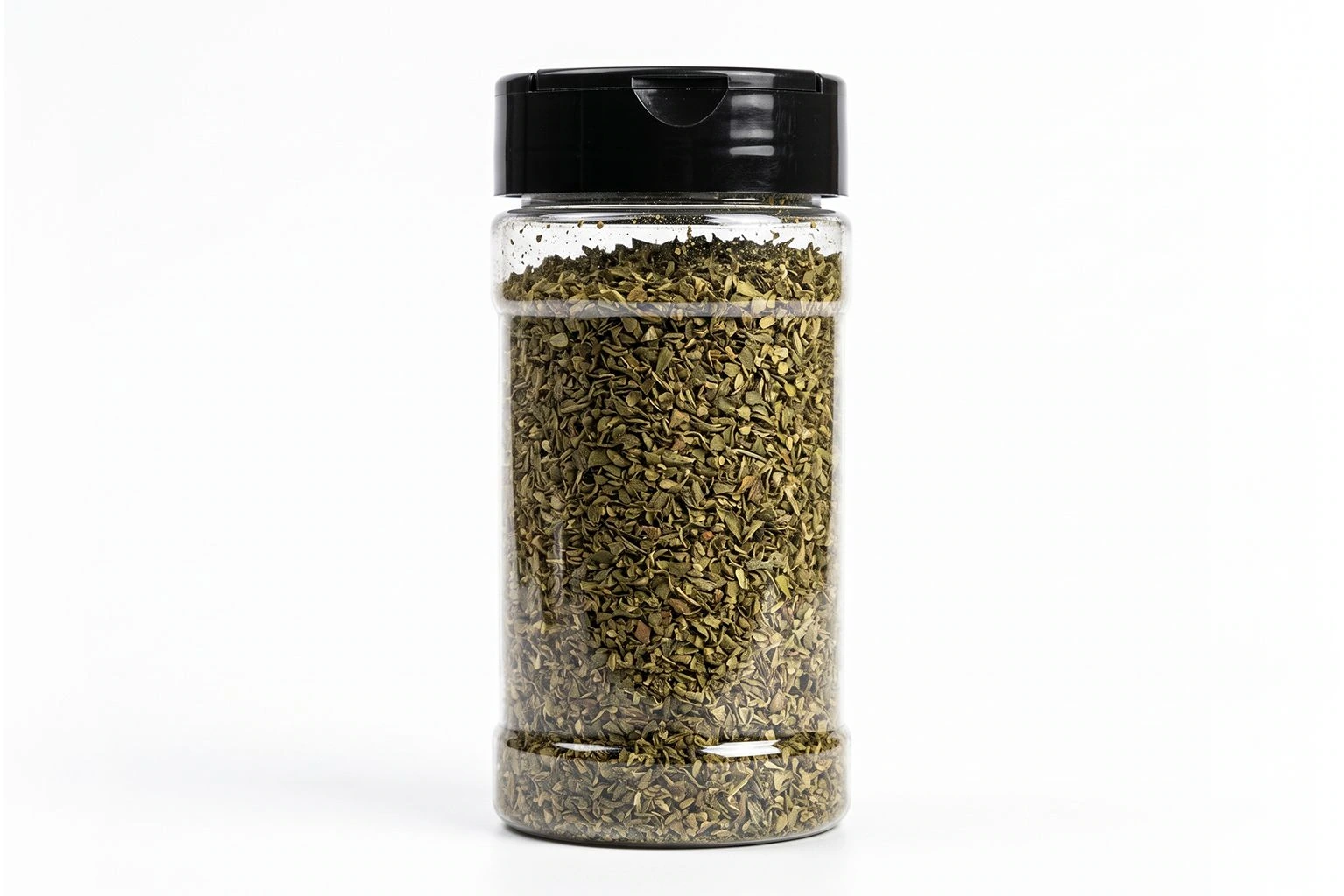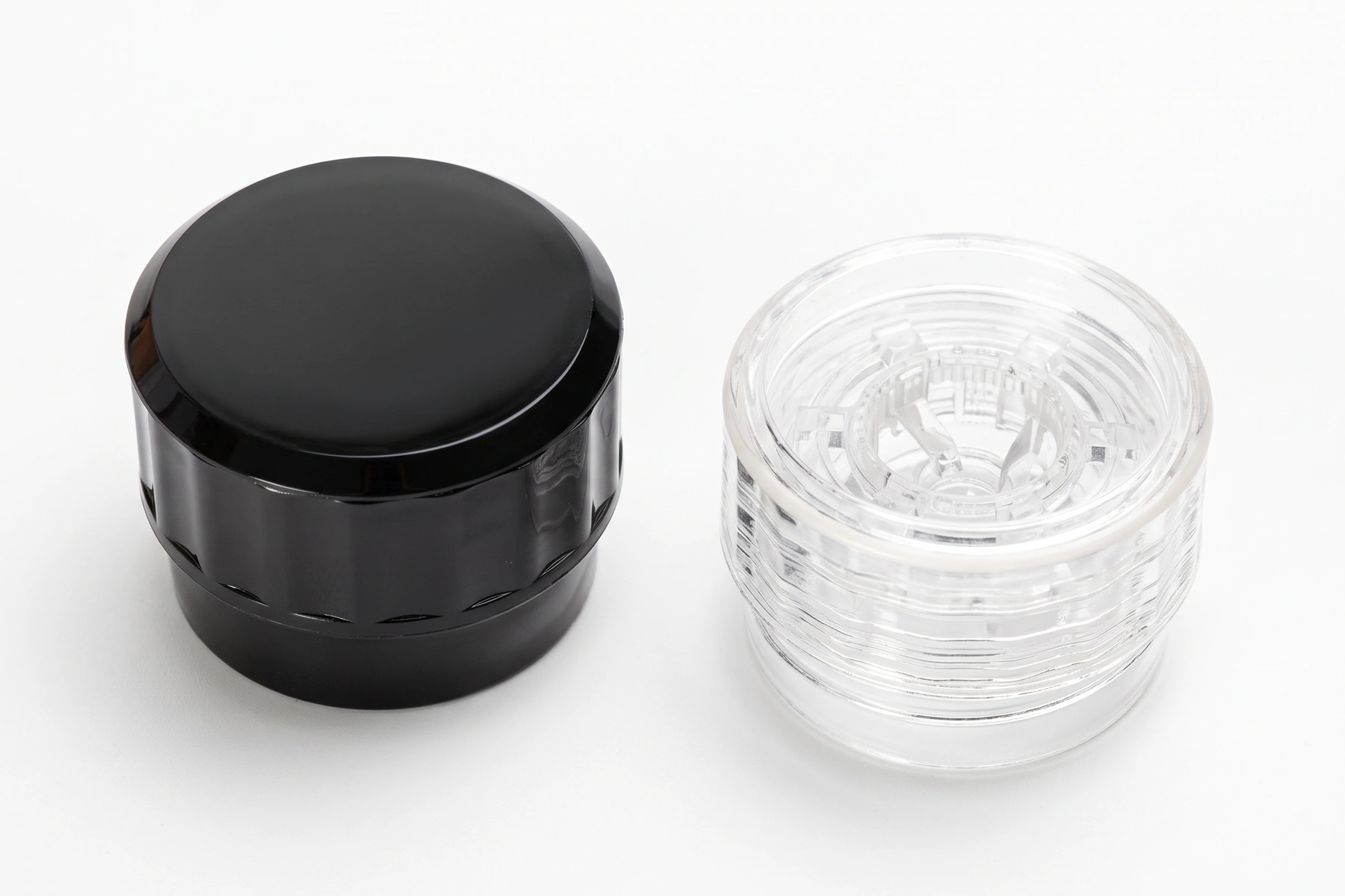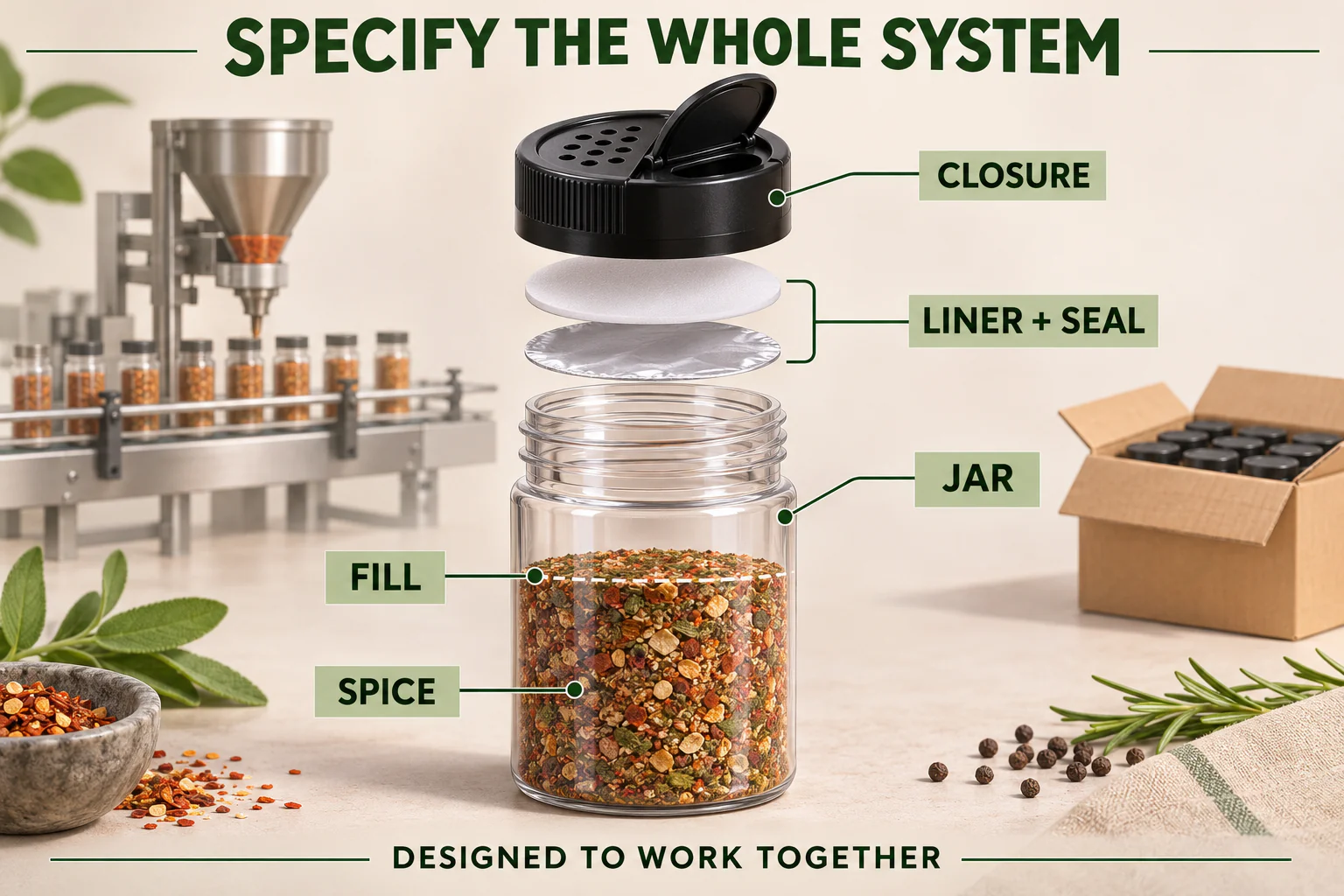
The best commercial spice jars are not selected by nominal ounces, a photograph or the lowest unit price. They are specified as a working system: spice, fill weight, jar, neck, dispensing closure, liner, tamper evidence, label, filling line and distribution case. If one interface is left vague, a jar that looks right in a sample room can dust the cap, bridge over the shaker holes, lose aroma or stall the capping line in production.
For a packaging manager, the shortest route to a dependable specification is to begin with the product and the consumer action. A fine garlic powder behaves differently from dried parsley flakes; a coarse barbecue rub behaves differently from whole peppercorns. The first needs controlled sifting and moisture protection, the second needs a larger pour path, and the third needs a grinder that can survive repeated use without producing an erratic grind.
Use this guide in the same order that you would develop the package: define the spice, establish the working volume, choose the jar material, match the closure and liner, and then confirm the complete system on your filling line. By the end, you will have the information needed to request samples and quotations without leaving critical details open to interpretation.
Many spice packaging projects begin with a sentence such as, “We need a clear 8-ounce jar with a black shaker top.” That is a useful starting point, but it does not reveal whether 8 ounces means fluid capacity or net weight, whether the product is a free-flowing granule or a cohesive powder, whether the cap needs a pour side, or whether the package needs an induction seal. At Gracepack, we begin by filling in those gaps so the proposed jar, cap and liner are designed around the product rather than selected from appearance alone.
A better buying process starts with a performance brief. The brief tells the packaging team what the seasoning must do from filling through the final consumer use. It identifies the product, the declared weight, the expected shelf and distribution conditions, the desired dispensing action and the line that will assemble the pack. Only then does the team translate those needs into dimensions, materials and test methods. This order keeps the jar from becoming the answer before the problem has been defined.
Your spice jar has to work on the shelf, on the filling line and in the consumer's hand. It needs enough visual presence for the brand, stable feeding and capping for production, traceable materials for your quality file, dependable supply for repeat orders, and a closure that opens, dispenses and recloses cleanly. Treating these needs as one package system prevents a good-looking jar from creating problems later in production or everyday use.
A reliable project follows a straightforward sequence: identify how the spice behaves, calculate the working volume from net weight and measured bulk density, choose a material for the actual filling and distribution environment, select a closure through dispensing trials, match the neck and liner as one sealing system, and confirm the result on the production line. The following sections take you through each decision with practical examples.
1. Start With the Spice, Not the Jar
Write a one-page product profile before asking for samples. Record whether the product is a fine powder, free-flowing granule, irregular flake, coarse blend or whole spice. Add the minimum and maximum particle size, not only an average. A blend containing salt crystals, chile flakes and fine seasoning can segregate during handling, so the closure must work for the least cooperative fraction as well as the bulk of the product.
Moisture and oil matter just as much as particle size. Hygroscopic powders can cake around small openings after repeated kitchen exposure. Oil-rich spices can leave residue on a liner or reduce the clean appearance of a clear jar. Volatile aromatics make the seal system and storage study more important. None of these conditions can be solved by calling a resin food grade; they have to be evaluated with the actual formulation and intended shelf life.
Define the use occasion. A consumer who seasons at the stove may want one-handed shaking and a wide pour side for measuring spoons. A foodservice operator may value a large opening, fast refill and a cap that stays attached. A premium pepper line may need an adjustable grinder. This use case is the bridge between the spice profile and the closure choice.
Begin by observing how the product moves before it reaches the package. Scoop it, pour it through a funnel and leave it exposed to the expected room conditions. Fine powders may aerate during filling and occupy more volume for several minutes before settling. Flakes may interlock and form a temporary bridge above the filler outlet. Mixed seasonings can separate when the jar vibrates, placing dense salt crystals at the bottom and lighter herbs near the top. Those behaviors affect the filler, the fill-height appearance and the dose delivered through the cap. A single particle-size number rarely captures all three.
For blended seasonings, document the particle-size distribution rather than reporting only the largest visible piece. A barbecue rub might contain fine paprika, sugar crystals, cracked pepper and herb flakes. If the shaker holes pass the paprika but retain the pepper and herbs, the consumer receives a progressively different formula over the life of the jar. If the holes are enlarged until every component passes freely, the first shake may deliver far too much fine powder. A dual-function closure, or a reformulated size distribution, may be more reliable than trying to solve the whole problem with one hole diameter.
Flowability also changes over time. A product that runs cleanly on a dry test bench can behave differently after it has spent weeks in a humid warehouse or has been opened repeatedly above a steaming stove. Ask the product development team whether the formula contains hygroscopic salts, sugars or carriers, and whether anticaking agents are used. The packaging team does not need to redesign the recipe, but it does need to know which condition represents the realistic worst case. Use that condition for the dispensing and shelf-life study.
Oil and aroma should be treated as product-package compatibility questions. Strongly colored or oil-rich spices may stain a closure, leave a visible ring at the liner or soften printed decoration. Volatile flavor compounds may be lost through repeated opening even when the unopened package passes a barrier test. A useful study compares an unopened control, a pack opened and reclosed on a defined schedule, and the proposed package under the intended temperature and light exposure. Sensory review should be performed by the brand's qualified team rather than inferred from the polymer name.
Finally, write down the dose the user is trying to achieve. “Shaker cap” is a component description; “approximately one light, even coating over a sheet pan without a burst of dust” is a use requirement. The second statement can be converted into a trial with a defined number of shakes, angle, distance and product mass. Foodservice applications may need a faster pour into a measuring spoon, while table seasonings may need controlled delivery over a plated meal. When the required action is explicit, closure evaluation becomes much less subjective.
- Send a representative production batch for trials, not a perfectly screened laboratory sample.
- State whether the pack will be stored above a hot range, in humid retail environments or in foodservice kitchens.
- List allergens, strong colors and oils that could affect cleaning, staining or compatibility studies.
- Define the desired dose: a light dusting, a measured shake, a spoon-sized pour or a fresh grind.
| Spice characteristic | Packaging risk | Specification response |
|---|---|---|
| Fine powder; narrow particle range | Dusting, over-dosing and sealing-land contamination | Small-hole sifter trial, dust extraction at filling and seal-land inspection |
| Coarse blend; wide particle distribution | Segregation, bridging and inconsistent dose | Dual-flap shake-and-pour trial using top, middle and bottom product samples |
| Dried leafy herbs | Flakes catch in holes, crush during filling or look underfilled | Larger pour area, gentle fill handling and settled fill-height approval |
| Whole peppercorns or sea salt | Grinder jamming, weak grind output or mechanism wear | Particle limits, grinder-cycle test and retained-sample comparison |
| Hygroscopic or aroma-sensitive seasoning | Caking, aroma loss and closure fouling after opening | Liner and reseal study under the intended humidity and shelf-life conditions |
2. Define Fill Weight, Capacity and Headspace
A 6-ounce jar does not reliably hold six ounces by weight of every spice. Fluid ounces describe volume; the net contents on a dry spice pack describe weight. The conversion depends on the product's measured loose bulk density, which can change with grind, aeration, vibration and formulation. Use the production product and the filling method that the co-packer expects to run.
For an initial calculation, divide target net weight by measured loose bulk density. For example, 100 g of seasoning at 0.50 g/mL occupies 200 mL: 100 ÷ 0.50 = 200. If the team uses a provisional 15% allowance for fill variation, closure clearance and settling, the preliminary jar volume is 200 × 1.15 = 230 mL. That 15% is an illustration, not a universal rule; the commercial jar still requires a fill trial and a settling trial.
Keep three capacity terms separate. Brimful or overflow capacity is the volume to the top sealing plane under a stated method. Usable capacity is the volume the pack can hold while leaving room for the closure and normal operation. Headspace is the unfilled space above the settled product at the approved net weight. A jar can pass a brimful-capacity check yet look short after vibration or place powder against the liner. Approve the working fill level across representative product lots.
Current Gracepack spice-jar formats make the distinction visible. Examples in the range measure 113 mL at the shoulder and 127 mL brimful, 210 mL and 240 mL, 450 mL and 495 mL, 500 mL and 548 mL, and 695 mL and 752 mL. The difference is roughly 8% to 14% in these examples, but it is not a recommended headspace percentage. It is simply the space between two defined capacity points on those particular shapes. The usable fill still has to be set by net weight, bulk density, closure intrusion, settling and the appearance of the finished pack.
Measure loose bulk density with a written method. Use a container of known volume, fill it without deliberate compaction, level it consistently and record the product mass. Repeat the measurement from multiple production samples. If the filler aerates the product, collect samples immediately after filling as well as after a defined settling period. Tapped density can be useful for understanding transport settling, but it should not silently replace loose density in the initial volume calculation. The two values answer different questions: loose density helps predict the pack at filling, while the settled condition helps predict shelf appearance and closure clearance after distribution.
Do not select the jar from one average density result when the formulation has meaningful lot-to-lot variation. Suppose the same 100 g product measures 0.46 g/mL in one lot and 0.54 g/mL in another. The occupied volume changes from about 217 mL to about 185 mL before headspace. A jar chosen around the average may look crowded in one run and underfilled in the next. Ask your product and operations teams for a realistic density range, then fill samples at both ends. This is more useful than negotiating a nominal jar capacity to an extra decimal place.
Headspace is not simply empty space that should be minimized. It allows the filler to control net weight without placing product on the sealing land, gives fitments and liners physical clearance, and can make repeated dispensing cleaner. Too much headspace, however, can make a retail pack look underfilled and may increase movement and segregation during transit. Establish a visual window using filled samples at minimum, target and maximum expected product volume. Review those samples upright and after the planned vibration or settling sequence, with the final label applied.
Jar geometry changes how a given volume appears. A tall, narrow body produces a larger change in fill height for the same volume variation than a short, broad body. Rounded shoulders may hide some headspace, while a square shoulder can make the level more obvious. Label artwork can also create an optical fill line. For that reason, capacity selection should include the final shape and label panel, not just a laboratory cylinder. A technically adequate volume can still create a poor shelf impression if the product settles below the most visible part of the label.
The closure consumes space too. A deep plug, grinder mechanism, sifter fitment or retained liner can extend below the neck. Product that appears to fit an open jar may interfere when the finished closure is applied. Ask for the closure intrusion dimension on the drawing, then confirm it with the actual assembly. During trials, inspect for powder on the liner, product trapped in the threads and closure lift. These are signs that the working capacity is too close to the package limit or that dust control needs improvement.
Once a candidate size is chosen, perform a small fill matrix rather than approving a single jar. Fill representative low-, target- and high-density product to the commercial net weight; include the normal filler variation; apply the final fitment and cap; and condition the packs through the expected settling sequence. Record net weight, fill height, headspace, closure clearance and shelf appearance. This matrix turns a capacity guess into an auditable approval and gives operations a practical range for incoming product variation.
3. Choose Between PET, HDPE and Glass
Material selection should connect shelf presentation, handling, barrier needs, filling conditions and end-of-life goals. PET is often chosen when a brand wants glass-like clarity at lower shipping weight. HDPE is tougher and more opaque, with a softer visual character. Glass provides high rigidity, an inert product-contact surface and a premium hand feel, but it adds breakage control, case weight and line-handling requirements.
Do not turn a general material comparison into an approval. Resin grade, wall distribution, colorant, closure material, liner and decoration all belong to the finished system. A clear PET jar may present a colorful rub beautifully but also exposes it to retail light. An amber or opaque route may be more appropriate if a shelf-life study shows color or aroma loss. Glass can remove some polymer-compatibility questions while adding impact and closure-torque questions of its own.
Match the compliance file to the actual components and destination market. For U.S. programs, confirm the FDA food-contact regulatory basis for the resin, additives, colorant, closure and liner under the intended conditions of use. For EU programs, identify the applicable EU food-contact materials legislation and request declarations and supporting test reports for the actual construction. A generic certificate for a different resin or a logo sheet cannot establish the status of the jar system you plan to use.
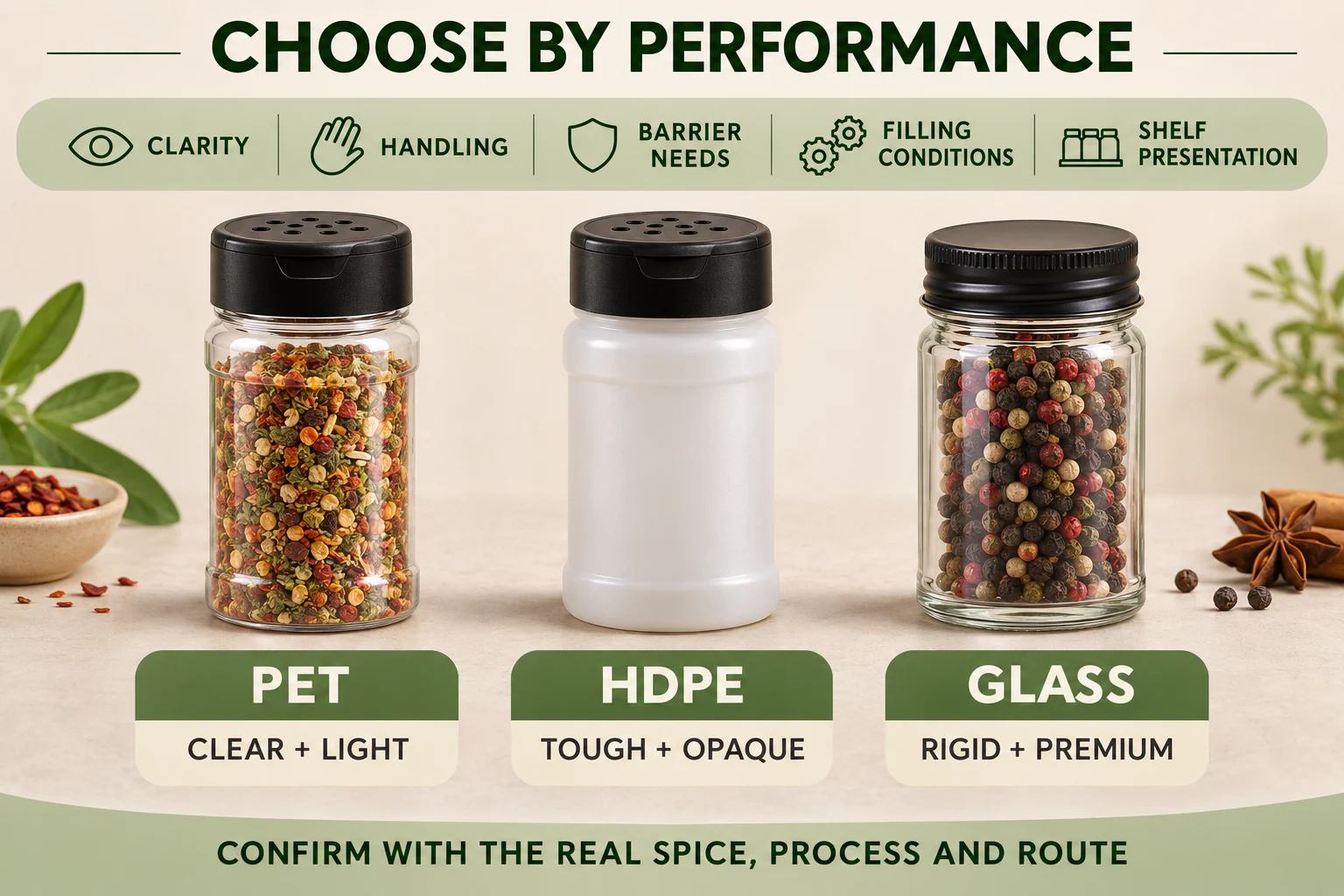
PET is a common starting point for retail spices because it combines clarity, low mass and good impact resistance in normal handling. It also lets you inspect color, particle distribution and fill level without opening the pack. Balance those benefits against light exposure and the actual barrier required by the seasoning. A transparent package can make red chile blends and layered seasonings attractive on shelf, but a light-sensitive product may need a tint, sleeve, carton or different material strategy. Confirm the decision through a shelf-life study rather than assuming that visibility is always an advantage.
HDPE can be appropriate when toughness, an opaque appearance or squeeze-resistant handling matters more than glass-like clarity. Its lower surface gloss and translucent-to-opaque body create a different brand language, which may suit foodservice, value-oriented or light-sensitive products. Review panel stiffness, label adhesion and decoration with filled samples. Because consumers cannot easily see the fill level through an opaque wall, the label and declared net contents carry more of the trust burden, and incoming capacity control becomes especially important.
Glass remains attractive when a brand wants rigidity, weight and a premium sensory cue. It provides a strong wall barrier, but the package is not automatically risk-free. Breakage on the filling line and in distribution requires guarding, cleanup procedures and appropriate dividers. Finish variation, cap torque, liner compression and thermal shock still require control. The additional case and pallet weight can change freight economics and manual handling. Compare the complete landed and operating effect, not only the unit cost of the empty container.
Filling temperature deserves an early, explicit answer. Most dry seasonings are filled near ambient conditions, yet some projects introduce heated components, sanitation steps or a warm product from upstream processing. Standard PET should not be described as hot-fill capable without a defined resin and container design. HDPE and glass also have grade- and system-specific limits. Give suppliers the actual product temperature at filling, the exposure time before cooling, the ambient conditions and any post-fill treatment. If the process has not been finalized, state that uncertainty so the packaging choice is not approved against an unrealistically mild condition.
Several current Gracepack stock PET spice-jar platforms specify machine filling at no more than 60°C and explicitly exclude hot filling. That is a working limit for those identified jar designs, not a blanket rating for every PET container. A project above that temperature needs a separate review of the resin, preform and jar construction, exposure time, neck stability, closure, liner and cooling process before samples are approved.
Compare sustainability options on the same basis: a complete package protecting the same quantity of spice through the same distribution route. Resin weight, recycled-content goals, recyclability guidance, breakage, carton design and freight weight may all matter. Avoid broad claims such as “plastic is greener” or “glass is always sustainable.” Local collection systems and destination-market labeling rules differ, so describe the actual package attributes and support any environmental claim with evidence for the market where the product will be sold.
Decoration can narrow the material choice. Pressure-sensitive labels, shrink sleeves, direct printing and paper labels interact differently with surface energy, body shape and recycling goals. Apply the real label to conditioned jars, not only to empty samples. Check bubbles, edge lift, scuffing, barcode readability and whether the label hides or exaggerates fill variation. For clear jars, inspect the back panel through the product as well as the front presentation; powders can collect behind a label edge and make an otherwise clean package look dusty.
| Material | Clarity | Weight | Breakage | Barrier considerations | Filling-temperature considerations |
|---|---|---|---|---|---|
| PET | Usually clear; tinting is possible | Light | Low in normal handling, subject to design | Useful general moisture barrier; light and aroma performance require product-specific study | Standard PET must not be assumed suitable for hot fill; verify resin, design, time and temperature |
| HDPE | Translucent to opaque | Light | Low; tough in distribution | Moisture resistance is useful, while aroma and oxygen performance require shelf-life confirmation | Temperature capability depends on grade, wall design, closure and process; validate the filled pack |
| Glass | Clear or colored | Heavy | Higher breakage risk | Inert wall with strong gas and moisture barrier; closure remains a critical path | Handles many thermal processes, but thermal shock, finish, cap and line conditions still need validation |
4. Match Shaker, Pour and Grinder Closures
Choose the dispensing action with a bench test, not a catalog label. Shaker or sifter caps suit selected fine powders and small free-flowing granules; pour openings and spoon-access closures suit flakes or foodservice dosing; grinder caps suit compatible whole spices; and a standard continuous-thread screw cap may suit refill or scoop applications. Every route still needs a defined initial seal and reseal strategy.
Dual-flapper spice jars combine a shaker field and a larger pour opening, which is useful for barbecue rubs and mixed seasonings used both at the stove and with measuring spoons. Specify hole count, hole diameter, total open area, opening force, hinge durability, snap retention and whether each flap stays open during dosing. A familiar cap silhouette does not mean the dispensing pattern or consumer performance is equivalent.
For grinder caps for spice jars, define the grinder material, particle-size range, target grind range, number of use cycles and whether adjustment is required. Test for jamming, dust generation, inconsistent output and accidental loosening. For shaker caps with liners, confirm how the liner is retained and removed: the consumer should not have to pry against a fragile shaker deck or leave fragments in the dispensing area.
The closure route can be narrowed with real dispensing choices instead of a generic request for a shaker top. A compact shaker can provide controlled coverage for fine pepper or powdered seasoning. A dual-flap cap can combine a small-hole sifter with a wider opening for measuring or pouring, while a grinder is designed for compatible whole spices and coarse salt. Some shaker decks use only a few openings and others spread the flow across a wider field. Choose the pattern by testing the actual spice and dose; cap diameter, thread geometry, liner space and jar finish still have to work as one assembly.
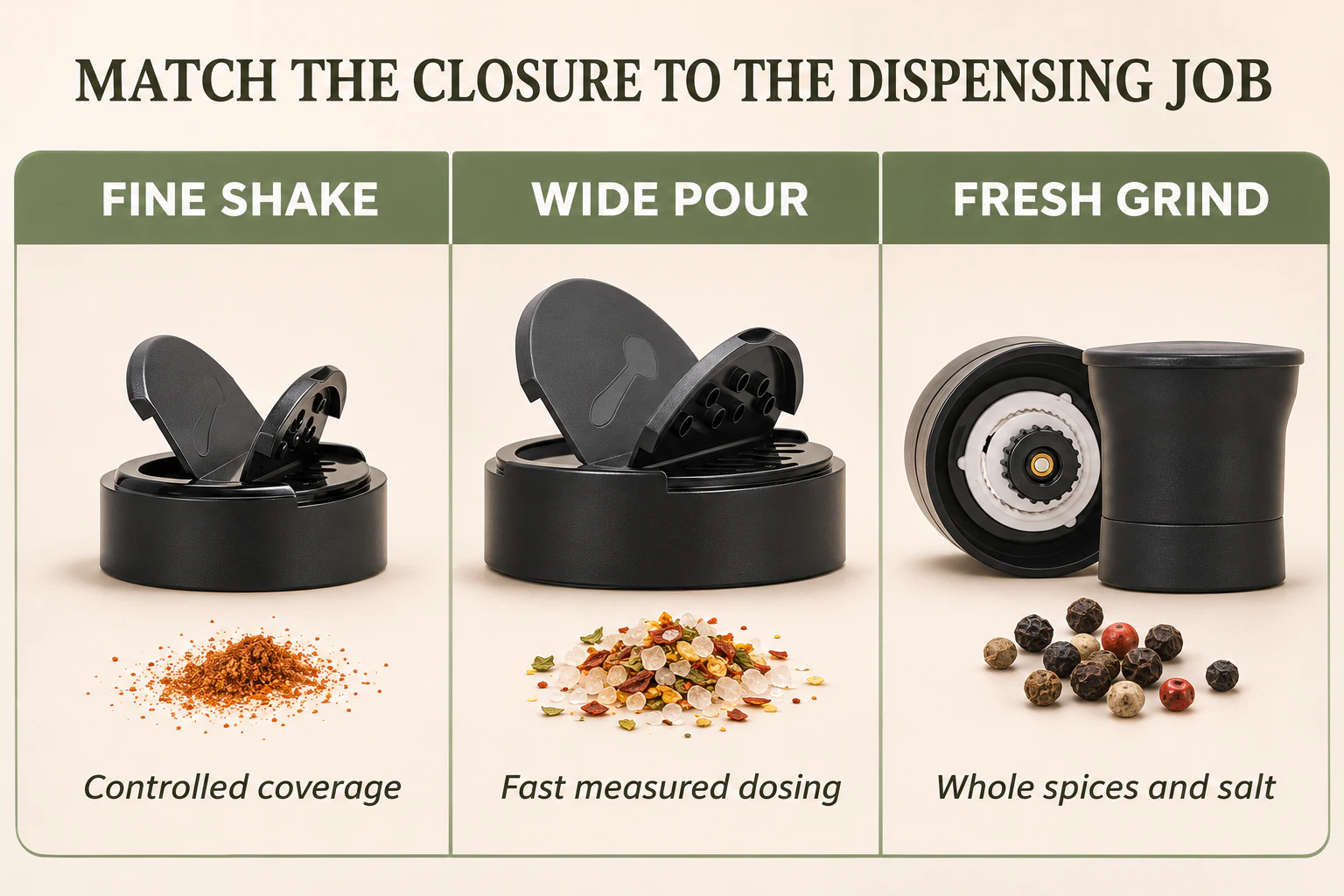
A shaker pattern is a flow-control device. Hole diameter matters, but so do hole count, spacing, deck thickness and total open area. Widely spaced holes can distribute a light coating more evenly, while a concentrated pattern may create a narrow stream. A thick deck can behave like a short tube and hold cohesive powder. The cap angle and the amount of air that returns through the opening also affect output. Rather than requesting a “medium shaker,” ask the supplier for drawings or measured patterns and include at least two alternatives in the dispensing trial.
Build a repeatable bench method before comparing caps. Condition the spice and packages to the same environment, fill each jar to the same net weight, and use the same shaking motion or a simple fixture. Record the mass delivered after a defined number of shakes, then repeat at the beginning, middle and end of the jar. Observe bridging, bursts, dust clouds and residue on the deck. The goal is not to force every consumer to use an identical motion; it is to identify a closure that remains predictable across plausible use and fill levels.
Dual-flap closures solve two different jobs only when both sides are usable. The shaker flap should open without excessive fingernail force and remain stable while the jar is inverted. The pour flap should admit a measuring spoon or deliver a controlled stream without detaching. Check whether the hinge collides with the label or the user's hand, whether spice collects under the flap, and whether repeated opening weakens the snap. If the cap is colored, inspect whitening at the hinge after cycling because it can be an early visual sign of stress.
Grinder selection begins with the spice, not with a desired external cap shape. Whole peppercorns, coarse salt and mixed botanicals have different hardness, shape and moisture behavior. Define the largest and smallest particles and remove outliers that could jam the mechanism in commercial production. Measure output at each adjustment setting, inspect the size distribution of the ground product and repeat the test after storage. A grinder that works for ten turns in a showroom may not remain smooth through the expected life of the package.
For spoon-access and foodservice packs, opening diameter and hand clearance are part of ergonomics. A wide mouth can speed dosing, but it also increases the exposed product area and makes an initial seal more important. Check whether standard measuring spoons fit without scraping the neck and whether the cap can be handled with gloves. If a scoop is supplied, specify its storage location and confirm it does not interfere with the liner or become buried in a way that frustrates the first user.
Cap color and surface finish affect more than branding. Dark glossy closures can show powder and scuffs; light textured closures can hide residue but may collect fine dust. Strong spice colors can make contamination visible around a hinge or thread. Evaluate production samples after filling, capping, case packing and repeated consumer use. A cap that looks excellent when clean may appear untidy after the first week if its geometry traps product where it cannot be wiped away.
Child resistance is not normally implied by a standard spice closure, and tamper evidence is not the same as child resistance. If a formula, market or retail channel creates a special safety requirement, state it explicitly and involve the appropriate compliance specialists. Do not assume a tight snap, a shrink band or an induction seal satisfies a regulated child-resistant protocol. The closure must be evaluated for the requirement it is actually intended to meet.
| Spice form | Dispensing behavior | Recommended closure direction | Test required |
|---|---|---|---|
| Fine powder | Light, repeatable sifting without a dust cloud | Sifter cap with trial-selected hole pattern | Dose per shake, bridging, dusting and cap cleanliness |
| Coarse mixed seasoning | Shake for finishing; pour for measuring | Dual-flap or flip-and-sift cap | Hole-size trial, pour control, opening force, hinge cycles and snap retention |
| Leafy herbs or large flakes | Low-damage pour or spoon access | Wide pour opening, spoon-access closure or standard CT cap | Flake clearance, access, reseal and consumer-use observation |
| Whole peppercorns or sea salt | Consistent fresh grind | Grinder cap matched to minimum and maximum particle size | Grind output, adjustment, jamming, dust and cycle life |
| Bulk refill or foodservice pack | Fast scoop, refill or measured pour | Wide-mouth CT screw cap | Opening ergonomics, liner removal, reseal and handling test |
5. Specify Neck Finish, Liner and Tamper Evidence
A neck diameter alone is not a closure specification. Two jar openings can measure approximately the same across the top and still require different caps because their thread shape, thread position, finish height and sealing surface are different. One cap may start to engage but stop before the liner is compressed; another may tighten while sitting crooked or leaving too little thread contact. Compare the jar and closure drawings together, then confirm the proposed pair with physical samples and torque and seal testing.
A liner can have three different jobs: provide a resilient reseal surface, create an initial barrier seal, or offer visible tamper evidence. These functions are not interchangeable. A foam or pressure-sensitive liner may improve certain dry-product packs, but performance depends on the cap, land, product and storage conditions. An induction foil can provide a strong initial seal and visible opening evidence, yet its heat-seal layer must match the container material and the sealing window must be established on the production machine.
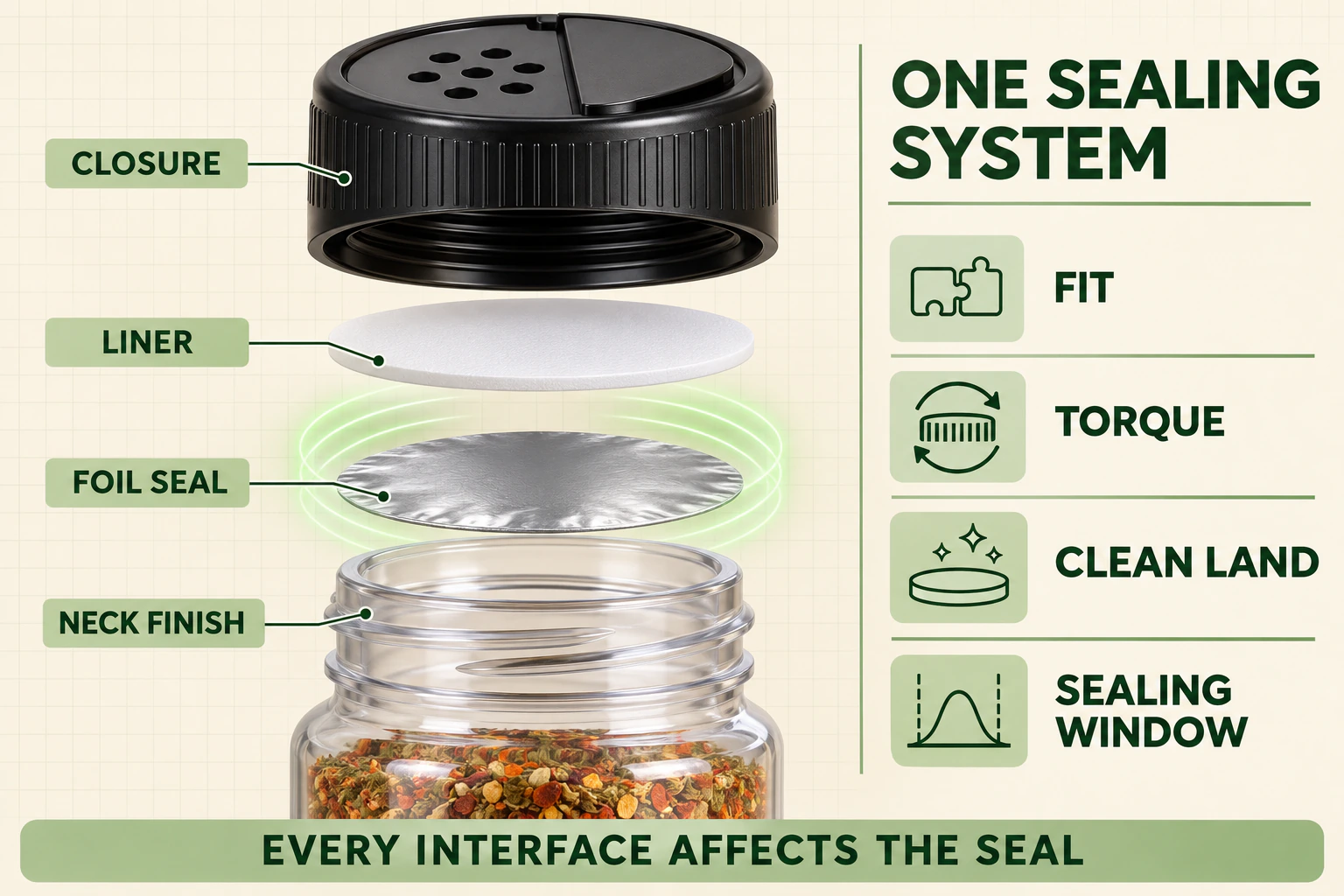
Current medium- and wide-mouth PET spice-jar systems can be paired with pressure-sensitive, foamed foil, paperboard-backed foil or PE liner routes, depending on the cap and jar combination. The foil's heat-seal layer must be specified for PET, PP or PE rather than transferred from one resin to another by assumption. Pressure-sensitive liners in current spice-jar specifications are intended for suitable dry products and are not recommended for liquids, edible oils or seasonings with a high oil content. An induction or other validated barrier route is the more appropriate starting point for those applications.
Tamper evidence can come from an induction seal, tear band, breakaway feature or shrink band. Select it around market expectations, line equipment and consumer access. Then define what counts as intact, how operators verify it, and what the consumer sees at first opening. Do not describe an ordinary liner as tamper evident unless the unopened condition is visibly distinguishable.
The jar drawing and closure drawing should be reviewed together. Compare the thread start, thread profile, minimum and maximum outside dimensions, finish height, sealing-land width and any bead that retains a tamper band or snap fitment. Tolerances can stack in the least favorable direction: a jar at one dimensional limit and a cap at the opposite limit may behave differently from the hand-selected samples used during development. Production approval should therefore include multiple cavities or manufacturing lots when practical, not one perfect pair.
Thread engagement affects both sealing and the consumer experience. Too little engagement can allow cocked caps, inconsistent liner compression or loss of retention during distribution. Excessive interference can increase application torque, damage threads or make opening difficult. Marking the cap and jar can help the line team observe how far the closure travels, but the acceptance criterion should come from drawings, torque data and seal performance rather than a visual mark alone. Record cross-threading and incomplete application during the line trial.
The sealing land deserves its own inspection. It should be sufficiently flat, clean and dimensionally controlled for the selected liner. Spice dust, molding flash, damage or an uneven land can create a leak path even when cap torque appears correct. Induction seals are especially sensitive to contamination between the foil and container. Include a camera or operator inspection point after filling if the product routinely leaves dust on the neck, and evaluate whether the filler nozzle or dust extraction needs adjustment.
Foam liners are often used to provide a resilient compression surface and support reseal after opening. Request the actual construction, thickness and material rather than relying on a trade-style shorthand. The liner must fit the cap, compress against the land and recover adequately after storage. It does not automatically create visible tamper evidence, and it should not be credited with an unopened moisture barrier without testing. Check whether the liner rotates, wrinkles or drops out during cap handling.
Pressure-sensitive liners can be attractive because they do not require an induction unit, but their adhesion depends on the container surface, pressure, dwell time, temperature and product cleanliness. They are not appropriate for every resin, finish or distribution environment. A liner that adheres during a short office demonstration may lift after cold storage or fail when spice dust is present. If this route is considered, validate it at the lowest and highest expected application conditions and define what the consumer should see when the pack is first opened.
Induction sealing adds a controlled thermal process to the line. The foil's heat-seal layer must match the jar material, and the cap must apply enough consistent pressure to keep the liner in contact while it seals and cools. Establish a process window rather than one nominal machine setting: power, conveyor speed, head gap, container position, cap torque and cooling time all matter. Inspect for incomplete bonds, overheated or scorched liners, channels and weak edges. A destructive peel or leak method should be defined so operators can distinguish a continuous seal from a foil that merely looks attached.
One-piece and two-piece induction constructions lead to different after-opening experiences. A one-piece membrane can leave the cap without a separate reseal liner, so the molded cap-to-land interface becomes important after removal. A two-piece construction may leave a backing component in the cap, but separation and retention need to be consistent. Observe whether the consumer can find and grip the pull tab, whether fragments remain on the land and whether the backing shifts into the dispensing holes.
Tamper evidence should be visible, understandable and compatible with the sales channel. A foil membrane can show first opening, a shrink band can show external disturbance, and a breakaway cap feature can provide an integrated signal. Ecommerce distribution may place different loads on these features than retail cases. Define pass and fail photographs for incoming and final inspection, and ensure label artwork does not cover the evidence. If multiple tamper features are used, confirm they do not make opening unnecessarily difficult for the intended user.
| Liner type | Initial seal | Moisture protection | Tamper evidence | Equipment required | Key limitation |
|---|---|---|---|---|---|
| EPE or F217-type foam | Compression seal under the cap | Can support dry-product reseal when correctly compressed | No inherent visible tamper evidence | Capper with controlled application torque | Generic foam names do not define density, thickness or food-contact suitability |
| Pressure-sensitive liner | Adheres after cap application and dwell | Project-specific; verify with the jar surface and storage climate | May show first opening but is not equivalent to a validated induction seal | No induction unit; controlled torque and dwell are required | Sensitive to land condition, dust, product and temperature |
| One-piece induction liner | Foil membrane heat-sealed to the jar | Strong unopened-pack barrier when the seal is continuous | Yes, if removal visibly breaks the original seal | Induction sealer matched to line speed and container material | After opening, reseal performance depends on the cap design |
| Two-piece induction liner | Foil seals to the jar while a backing component remains in the cap | Initial barrier plus a separate reseal surface | Yes, through the removable foil | Induction sealer and controlled cap application | Separation behavior, backing retention and consumer removal need testing |
| No-liner molded seal | Molded plug, land or sealing feature in the closure | Depends entirely on molded fit and closure design | None unless another feature is added | Capper and verified torque window | Not automatically suitable for hygroscopic spices or long distribution |
6. Validate the Complete System on the Filling Line
Bench samples answer fit and appearance questions; they do not release a production pack. Run the proposed jar, closure and liner on the intended filler, capper, induction sealer and labeler. Record speed, stoppages, dust at the sealing land, cross-threading, cap feed orientation, applied torque and seal rejects. Spice dust on the neck is a process variable that should be recreated during the trial, not wiped away for the photograph.
Establish a torque window with the closure supplier and capper team, then measure application and removal torque over time. Too little application torque can weaken compression; too much can distort threads, make opening difficult or damage a liner. For induction sealing, document power, line speed, head position and cooling time instead of approving a single sample produced with unrecorded settings.
After the line run, condition filled packs in upright, side and inverted orientations as appropriate. Include ambient and elevated humidity conditions, vibration or parcel simulation for ecommerce, and the longest expected warehouse and transport period that can be modeled before launch. Open packs throughout the study to observe caking at the holes, liner lift, aroma change, closure contamination and changes in dispensing dose.
Plan the trial with operations before samples arrive. Record the equipment make and model, change parts, normal line speed, expected speed range and current container platform. A jar that can be capped by hand may not feed through an unscrambler, remain stable on a conveyor or enter a star wheel without scuffing. Square and lightweight containers can require orientation or guide adjustments. If the proposed package needs new change parts, include their cost, timing and ownership in the commercial decision.
The filler is part of the package system because it determines aeration, dust and product placement. Auger fillers, volumetric fillers and weigh fillers can produce different product flow and contamination patterns. Observe the neck immediately after filling and quantify how often the sealing land requires cleaning. If an insert or sifter is pressed into the finish after filling, confirm that the product level leaves enough room and that insertion does not force powder into the threads.
Cap feeding can expose weaknesses that are invisible in bagged samples. Hinged flaps may open in the bowl, liners can shift, and closures can nest or orient inconsistently. Run enough components to observe normal variation rather than feeding a handful manually. Record misfeeds, upside-down caps, open flaps, liner loss and jams. If the supplier sends preassembled fitments or liners, confirm how those assemblies will be packed and protected during shipment so the production condition matches the trial.
Torque should be treated as a process distribution, not a single reading. Measure multiple heads and multiple points in the run, then recheck removal torque after a defined dwell and conditioning period. Review the measurement method and instrument calibration with the quality team. The target is a window that produces adequate liner contact and consumer opening without thread damage. If a change in cap color or resin affects friction, repeat the study; identical geometry does not guarantee identical application behavior.
Induction sealing trials should challenge the edges of the proposed window. Run at slightly lower and higher line speeds or power settings within the equipment team's safe plan, then inspect the resulting seals. This shows whether normal process drift will produce acceptable packs or whether the operating window is too narrow. Include filled jars with realistic dust levels and samples from different capper heads. The outcome should be a documented recipe and inspection frequency, not simply a box checked “seal passed.”
Labeling trials need filled and conditioned containers because body dimensions and surface condition can change after filling. Verify the label fits within the panel, clears the cap and base radii, and does not bridge a recessed area. Run the final facestock, adhesive, varnish and ink. Inspect after case vibration and humidity exposure for edge lift, wrinkling and scuffing. Scan barcodes at multiple orientations and check date or lot coding for contrast on every cap or container color.
Finish the line trial at the case packer and pallet. A container that survives individual drop testing may still scuff, rotate or loosen its cap when bottles contact one another in a case. Check the case count, divider design, top load, pallet footprint and stretch-wrap settings with filled weight. Photograph the approved pack pattern and retain it with the package specification. Distribution validation is far more useful when the tested case matches the production case exactly.
- Production flow: jar feed → auger, volumetric or weigh filling → sifter-fitment insertion → cap application → induction seal when specified → code/label → inspect → case pack → palletize.
- Jar feeding and orientation: confirm base stability, unscrambler handling and whether a square jar presents consistently.
- Filling: select auger, volumetric or weigh filling around the product; record target weight, variation, dust control and settled fill height.
- Capping: verify fitment insertion, cap-feed orientation, cross-thread rate, application torque and removal torque after conditioning.
- Sealing: establish an induction window for power, conveyor speed, head gap and cooling; check continuity, peel and channel leaks.
- Coding and labeling: confirm label-panel dimensions, seam clearance, scuffing, code legibility and barcode readability.
- Case and pallet: assess closure retention, jar damage, carton compression, pallet stability and consumer-ready appearance at production speed.
7. Documents, Samples and Tests to Request
Request documents by component and revision. The jar, closure, shaker insert, grinder mechanism, colorant and liner may not share the same material or supplier. Build a simple bill of materials that connects every drawing and declaration to the approved sample. If the supplier changes a resin grade, liner construction or sub-supplier, the change-control process should trigger review before production.
A useful sample set contains more than two showroom pieces. Ask for unfilled dimensional samples, closure and liner samples, filled line-trial samples, and retained golden samples signed or coded by both parties. For Gracepack sample preparation, each jar is protected in an individual bag, the item reference and measured water capacity are marked on the jar or label, the packed set is photographed, and shipment and tracking details are retained. Give every sample set its own ID and link it to the relevant drawings, trial settings and feedback.

Testing should answer a named risk. Dimensional checks confirm the drawing; dispense testing confirms the consumer dose; seal and torque tests confirm closure performance; migration or compliance documentation addresses food-contact use; and distribution testing evaluates the finished case. Avoid a long generic test list that never defines acceptance criteria.
Start the document pack with controlled drawings. The jar drawing should identify the finish, major dimensions, capacity definition, label panel and tolerances that matter to fit and line handling. The closure drawing should identify thread or snap geometry, liner cavity, overall height and functional features. A technical data sheet can summarize material and general properties, but it does not replace the dimensions used for incoming inspection. Record the drawing revision in the purchase specification so a later update cannot be introduced without review.
Food-contact evidence should follow the bill of materials. Ask which document supports the jar resin, masterbatch or colorant, closure resin, fitment, grinder components, liner layers, adhesive and printing that contact or may reasonably contact the food. The exact file set depends on destination market and conditions of use. Check the scope, sample identification, test conditions, dates and issuing laboratory rather than accepting a folder simply because it contains the words FDA or EU. Where a statement relies on supplier declarations rather than testing, keep that distinction visible.
Create sample stages with different purposes. An appearance sample answers shape, color and shelf-presence questions. A dimensional set supports fit and measurement. A functional set contains the actual product for dispensing, seal and compatibility work. A production-equivalent set comes from the intended tooling, materials and line process. Finally, the golden sample represents the approved system. Labeling all of them “sample approved” hides important differences and can cause a hand-finished prototype to become the reference for mass production.
Define acceptance criteria before the test begins. “No leakage” should identify orientation, duration, temperature and detection method. “Cap opens easily” should be converted into an agreed torque or user panel method. “Good shaker performance” should include dose range, bridging and visible dust criteria. “Passes drop test” should name the filled weight, drop sequence and whether cosmetic damage is allowed. Written criteria prevent the team from moving the goalposts after seeing a preferred sample.
For a pepper-jar flapper closure, one practical Gracepack retention check drops the assembled pack from 1.5 m three consecutive times. The flap should remain secure and the hinge should show no obvious whitening. The same inspection stage rejects neck cracks, finish deformation, thread slip and finish flash that interferes with closure engagement. This test is a useful starting point for that closure type; the final protocol still needs the actual filled weight, floor surface, orientations and acceptance limits required by the project.
A golden sample is most useful when it is linked to data. Mark the jar, closure and liner codes; record color standards, drawing revisions, cavity or tooling information, trial date and line settings; and keep photographs of the assembly and packed case. Store samples under conditions that do not distort them or fade the reference color. If a later shipment differs, the team can compare measurements and records rather than relying on memory.
Change control should name which changes require notification and possible revalidation. Examples include resin or colorant grade, closure sub-supplier, liner layer or adhesive, mold refurbishment, production site, packing configuration and material recycled-content level. Not every change requires repeating every test, but your team needs enough information to assess the effect before production. A supplier that can explain its notification and traceability process provides more useful control than one that simply promises the product will remain “the same.”
8. Commercial Spice Jar RFQ Checklist
The RFQ should make suppliers solve the same problem. Attach the product profile, target pack, required drawings and destination-market documents. Ask suppliers to identify assumptions and exceptions in a separate column. That makes a quote with an existing mold comparable with a quote requiring a new closure or liner trial.
Do not ask only for an ex-works unit price. Request the jar, closure, liner, decoration, packing, tooling, sample and freight basis separately, along with pack quantity and carton dimensions. For a family of SKUs, ask whether one neck platform can support several jar sizes without forcing a capper change. Common-neck planning can reduce component complexity, but only after each jar-cap combination is validated.
Separate mandatory requirements from preferences. A destination-market food-contact file, maximum line diameter or compatible neck finish may be mandatory. A particular shoulder shape, cap texture or percentage of label visibility may be negotiable. Suppliers can then offer an existing platform that meets the critical needs and clearly identify where customization would add cost or time. Without that hierarchy, a supplier may reject a practical stock solution or quote a new mold simply to reproduce a nonessential visual detail.
Give every bidder the same product information and sample access. If one supplier receives the real spice while another sees only a photograph, their recommendations are not comparable. Include a confidentiality process when the formula or product sample is sensitive. Ask each supplier to state whether its proposed closure pattern was tested with the sample, inferred from a similar product or selected only from experience. Those are three different levels of evidence and should not be presented as equal.
Request a component-level minimum order quantity. The jar may be available at one quantity, while a custom cap color, printed label, induction liner or export carton requires a higher commitment. Ask how unused custom components are handled and whether color batches must be purchased at once. For multi-SKU programs, clarify whether components can be shared or combined in production. A low jar MOQ does not help if the custom closure creates a much larger inventory exposure.
Lead time should be broken into approval and production stages. Sample preparation, artwork approval, color matching, tooling, pilot production, testing, mass production and ocean or inland transit are different activities. Rather than accepting one optimistic number, ask what starts each clock and which decisions are on the critical path. This also helps the brand reserve enough time for a line trial and corrective action before a fixed retail launch.
Ask how the empty packaging will be packed. Jars can scuff, deform or collect dust before they reach the filling plant. Closure liners can shift if caps are compressed or exposed to heat. Request carton dimensions, bagging method, quantities per carton, pallet pattern and container-loading assumptions. Those details affect freight cost, warehouse space, operator handling and the condition in which components arrive at the line.
A decision-ready RFQ includes written acceptance criteria and a process for exceptions. Suppliers should identify any requirement they cannot confirm, any test that needs your actual spice, and any statement that depends on final tooling or line conditions. This is not a weakness in the quote; it shows that the limits of the recommendation are understood. The greater risk is a proposal that promises universal compatibility without asking for density, particle size, filling method or destination market.
- Company, destination market, annual forecast, first-order quantity and required delivery window.
- Spice name, ingredient form, particle-size range, oil/moisture behavior and production sample availability.
- Target net weight, measured loose bulk density, expected settling and required headspace appearance.
- Preferred material and color, required jar capacity, shape, maximum dimensions, label panel and case constraints.
- Complete neck-finish drawing, closure function, hole pattern or grinder range, cap color and opening-force target.
- Liner construction, induction-seal requirement, tamper-evidence method and consumer removal behavior.
- Filler, capper, induction sealer and labeler details, target speed and trial quantity.
- Required food-contact documents, drawings, test reports, samples, golden-sample control and change notification.
- Initial order, annual forecast, sample quantity, customization and written quality acceptance criteria.
- Quote breakdown, component MOQ, packing method, carton dimensions, Incoterm, delivery port, target timeline and assumptions.
9. Turn the Specification Into a Smooth Production Order
Once the jar, closure and liner have been tested, bring the technical and commercial details into one order specification. This keeps the approved sample, drawings, colors, liner construction, packing method and delivery terms connected to the same package. It also prevents a quotation for the jar alone from being mistaken for the cost of the finished system.
Build the landed cost from the complete component set: jar, cap, fitment, liner, decoration, packing, freight, duties and local handling. Add any one-time items such as tooling, filling-line change parts, pilot runs and inspection fixtures. Use the planned carton quantity and freight cube rather than comparing empty-container prices in isolation. A slightly lighter jar does not necessarily reduce cost if its packing arrangement uses substantially more shipping space.
Jar and cap carton quantities rarely match one-for-one. As two current examples, a compact 240 mL spice jar is packed at 288 jars per carton while its selected caps are packed at 1,500 per carton; a larger 548 mL spice jar is packed at 153 jars per carton while selected caps are packed at 1,000 per carton. Convert both sides into complete jar-and-cap sets before estimating freight, warehouse space or the number of cartons required. Confirm the final export packing plan with the quotation because cap choice, liner assembly and protective packing can change the count.
Clarify who is responsible for every component and document. The jar and closure may come from different production processes, while the liner or grinder mechanism may come from a specialist partner. What matters is that each part has an identifiable code, controlled drawing and clear change-notification path. When we assemble a proposed Gracepack system, we match these component details before moving to samples and line testing.
Keep technical performance separate from commercial convenience. A jar may dispense and seal well but require an order quantity that does not suit the launch plan. Another option may be readily available but need more testing with the actual spice. Seeing both sides clearly helps you decide whether to adjust the order plan, choose another existing format or develop a customized component.
Use samples to answer the most important question first. If dispensing is uncertain, test two shaker patterns before considering a new jar mold. If line feeding is the concern, trial an existing jar with a similar diameter and finish. If shelf life is the longest part of the project, begin the liner and storage study early. This step-by-step approach keeps the project moving without committing to tooling or inventory before the main performance questions are resolved.
Before the production order is released, connect the approved bill of materials, drawing revisions, color standard, golden-sample code, test results, packing method and change-control requirements. The order can then reference one controlled package specification instead of relying on details scattered across email threads.
After launch, continue watching filling losses, cap and liner rejects, consumer feedback and transport damage. If the spice formula, grind, filler, closure or distribution route changes, repeat the checks affected by that change. This ongoing feedback turns a successful first order into a repeatable packaging system for future production.
10. What We Can Confirm Before Production
At Gracepack, we use primary regulatory sources to identify the applicable food-contact questions, then match the selected components with their documents and test conditions. FDA and EU sources explain the regulatory framework, while the jar, closure, colorant and liner files identify the actual materials being supplied. Closure and induction-equipment guidance can help establish test variables, but final settings still need to be confirmed with your spice, jar and production line.
Gracepack's current technical-file library includes selected PET, HDPE, PP, PE and LDPE component reports, supporting files for silicone parts where used, BPA-related reports, U.S. and EU food-contact test files, and ISO 22000 quality-system documentation. The presence of a report in the library does not make it valid for every jar or every market. Before using any file in your specification, match its component code, material, color, report scope, intended conditions of use, destination market and revision to the package you plan to order. Use filled samples and a line trial to confirm the remaining details for your spice, closure and filling process.
FAQ — Commercial Spice Jar Specifications
Are PET spice jars food safe?
PET can be used in food-contact packaging when the specific resin, additives, colorants and manufacturing conditions have an appropriate regulatory basis for the intended market and use. Do not treat the word PET as automatic approval. Request documents tied to the actual jar, then include the closure, liner and decoration in the review because those components may use different materials and suppliers.
What size jar holds 100 g of spice?
There is no single jar size because 100 g of fine salt, leafy herbs and barbecue rub occupy different volumes. Measure the production spice's loose bulk density first. At 0.50 g/mL, 100 g occupies about 200 mL before headspace. Apply a provisional allowance only for sample selection, then approve the final jar through actual fill-weight, settling and closure-clearance trials.
Why can two caps with the same nominal diameter still be incompatible?
Diameter describes only one part of the connection. The thread profile, starting position, finish height, sealing-land width and liner compression can differ even when two openings look similar. A cap that appears to fit may cross-thread, stop too early or fail to compress the liner consistently. Compare the drawings and physical samples, then verify application torque, removal torque and sealing on the exact jar-and-cap combination before ordering production quantities.
Do dry spices need an induction seal?
Not every dry spice pack requires one, but induction sealing may support initial moisture protection, tamper evidence and distribution security. The decision depends on the seasoning's hygroscopicity, aroma sensitivity, shelf life, market expectations and line equipment. If selected, match the foil heat-seal layer to the jar material and establish a documented production window rather than sealing a few samples by trial and error.
Which liner is suitable for hygroscopic seasoning?
Start by defining the required unopened barrier, reseal performance after opening, distribution climate and consumer-removal experience. Foam, pressure-sensitive and induction liners work differently; none can be selected from a generic name alone. Test the actual liner construction with the selected neck finish, application torque and spice under expected humidity, including opened-and-reclosed packs if the seasoning will be used over several months.
How should shaker-hole size be selected?
Use the minimum and maximum particle size, desired dose and real dispensing behavior—not only the spice name. Trial multiple hole diameters and total open areas with representative product from different parts of the batch. Record dose per shake, bridging, dusting, cap contamination and consumer effort. For mixed rubs, also check whether fine and coarse fractions segregate and produce a changing dose during use.
Can standard PET spice jars be hot filled?
Standard PET should not be assumed suitable for hot filling. Performance depends on the resin, preform and bottle design, crystallinity, fill temperature, exposure time, cooling process, neck finish, closure and liner. Dry spices are normally packed without a hot liquid process, but if a sanitation or heated-fill step is proposed, provide the complete time-temperature profile and validate dimensional stability and sealing on the intended line.
What information belongs in a commercial spice jar RFQ?
Include the spice form and particle-size range, target net weight, measured loose bulk density, headspace goal, jar material and dimensions, complete neck finish, closure function, hole pattern or grinder range, liner and tamper evidence, filling and capping equipment, induction sealer, destination market, order and annual volume, customization, documents, sample quantity, delivery port, timeline and written quality acceptance criteria.
Conclusion: Approve the System, Then Request a Quote
Before placing the production order, make sure the package protects the spice, runs on the filling line, dispenses cleanly for the consumer and has the documents required for the destination market. Shortlist the material and closure route, bench-test with the real spice, run the complete pack at production speed, and confirm the finished case through the planned conditioning and distribution checks. A low jar price cannot compensate for caking, cap mismatch, weak seals or line downtime.
To narrow the options, send us your target fill weight, measured loose bulk density, particle-size range, preferred material, dispensing action, filling method, destination market and forecast volume. We can then identify suitable existing systems and propose a focused sample plan before the jar, closure and liner move into final quotation and production testing.