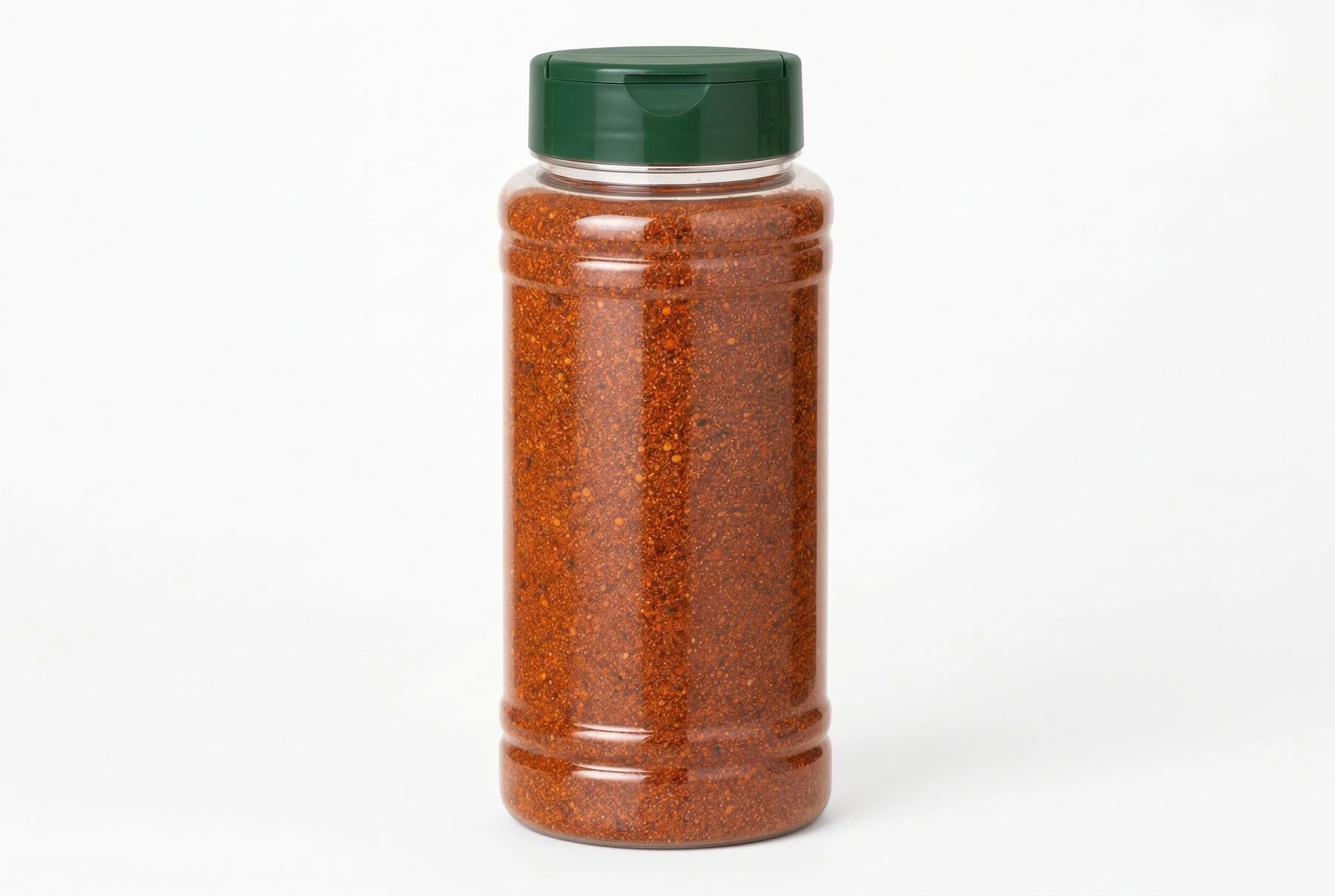
Quick answer: choose the plastic by spice behavior, filling route and sales channel
When sourcing wholesale Plastic Spice Bottles, choose PET when shelf clarity and product color matter, PP when the bottle or cap must tolerate higher heat and repeated hinge movement, HDPE when opacity, drop strength and moisture protection matter more than visibility, and PS only for limited low-risk dry applications where brittleness and oil resistance are not major concerns.
For spice manufacturers, seasoning brands, private label spice companies and co-packers, the material decision should not be made from price alone. Dry spice packaging has to protect aroma, reduce moisture pickup, survive filling and carton transport, match shaker caps or grinder caps, support label application and meet the food-contact document expectations of the destination market.

Why material choice matters in wholesale spice packaging
Spices are dry products, but they are not simple products. Fine seasoning powders can cake when moisture enters the package. BBQ rubs may contain sugar, salt, paprika, garlic powder and oil-rich flavor components. Pepper, chili, cumin, cloves and mixed herbs can release aromatic oils that challenge weak materials or poor cap sealing. A bottle that looks acceptable in a sample photo can still fail after warehouse heat, ecommerce drops or repeated consumer use.
This is why wholesale spice bottle selection should connect four decisions: bottle resin, closure resin, sealing method and use environment. PET, PP, PS and HDPE each solve a different part of the packaging problem. The wrong choice can create cracked bottles, cloudy appearance, poor heat tolerance, cap fatigue, label issues, caking, odor loss or compliance uncertainty.
Use PET when clarity and retail shelf presentation are the priority
PET, or polyethylene terephthalate, is often the best choice for retail spice bottles because it gives a glass-like transparent appearance with much lower weight than glass. Teams can see the color of turmeric, paprika, chili powder, mixed herbs or BBQ rub, and the brand can use the spice itself as part of the shelf presentation.
PET also offers useful gas barrier performance for many dry seasoning programs. For aromatic spices, this helps reduce oxygen exposure compared with weaker packaging routes, especially when the cap, liner and induction seal are selected correctly. For supermarket seasoning bottles, private label spice lines and transparent shaker bottles, PET is usually the first material to test.
The limitation is heat. PET is not the right route for hot-fill, high-temperature sterilization or storage conditions that may deform the bottle. If your filling process, shrink sleeve tunnel, warehouse or transport chain exposes the bottle to sustained high temperatures, confirm the actual temperature profile before approving PET.

Use PP when heat tolerance and cap fatigue resistance are more important than perfect clarity
PP, or polypropylene, is the practical choice when the package must tolerate higher temperature or repeated flexing. It is widely used for caps, flip-top closures, shaker lids and snap-on components because it performs well under hinge movement. If a seasoning bottle uses an integrated flip-top cap that will be opened and closed many times, PP is often the better closure material.
PP can also be considered for bottle bodies in warmer filling or kitchen-use environments. Local supplier FAQ materials describe PP bottles as the main route when projects need packaging that can stand around 120 degrees C for hot filling or high-temperature sterilization. That does not mean every PP bottle design is automatically suitable; wall thickness, cap route, deformation control and cooling process still need to be checked with real samples.
The trade-off is appearance. PP is naturally more semi-translucent or milky than PET, so it does not give the same premium crystal-clear spice display. Use PP when function, heat tolerance or cap endurance matters more than optical clarity.

Use HDPE when opacity, toughness and moisture protection matter most
HDPE, or high-density polyethylene, is selected when the project cares more about durability and protection than product visibility. It is tough, impact resistant and naturally opaque or milky. For institutional foodservice, restaurant-supply seasoning containers, bulk dry powder bottles and light-sensitive formulations, HDPE can be a strong choice.
HDPE also provides good moisture barrier performance, which matters for hygroscopic powders such as salts, onion powder, garlic powder, powdered seasoning bases and some blends that cake easily. If the product will move through long export shipping, warehouse storage or rough distribution, HDPE deserves serious review.
The limitation is merchandising. A fully opaque HDPE bottle hides the product from the shopper. That may be acceptable for foodservice, refill programs and industrial supply, but retail spice brands often need label design, color coding or window alternatives to compensate for the reduced product visibility.

Be careful with PS for commercial spice bottles
PS, or polystyrene, can look clear and rigid, which is why packaging teams sometimes compare it with PET for low-cost packaging. For modern commercial spice packaging, however, PS is rarely the safest first recommendation. It is more brittle than PET, PP or HDPE, so it can crack under drop impact, carton compression or rough handling.
PS is also less forgiving when a spice blend contains aggressive aromatic oils, oleoresins or strong flavor compounds. Chili, clove, cinnamon, cumin and other pungent spices may not behave like neutral dry powders over time. If PS is being considered, the project should request compatibility testing with the actual spice blend, not only empty bottle photos.
A practical rule is simple: use PS only when the product is dry, low-oil, low-impact, low-risk and cost-sensitive. For export wholesale, ecommerce, foodservice or premium retail spice lines, PET, PP or HDPE usually gives a more reliable path.
Material comparison for sourcing teams
PET is best for clear retail spice bottles, supermarket seasoning shakers, premium dry herbs and colorful rubs where visibility helps sales. Check heat exposure, cap sealing and oxygen-sensitive formulas before approval.
PP is best for high-heat use, PP caps, flip-top shaker closures, repeated hinge movement and warm-fill projects. Check clarity expectations and confirm the whole bottle design, not only the resin name.
HDPE is best for opaque bulk containers, foodservice spice bottles, moisture-sensitive powders, light-sensitive blends and heavy-duty export distribution. Check whether the brand can accept no product visibility.
PS is best avoided for most wholesale spice programs. It may be acceptable for low-cost rigid dry packaging, but it brings brittleness and weaker resistance to some spice oils.
Bottle and cap materials should be specified separately
A common mistake is asking for a PET spice bottle and assuming every component is PET. In real packaging, the bottle body, shaker insert, flip-top cap, liner, induction foil, grinder mechanism and decorative label may all use different materials. A clear PET bottle may use a PP dual-flapper cap. An HDPE foodservice bottle may use a PP cap and PE liner. A grinder bottle may combine plastic, ceramic or metal-related components depending on the design.
For procurement managers, this matters because food-contact documents and testing scope should match the final package. Ask the supplier to identify the material of the bottle, cap, liner and any insert. Then request the food-contact reports that correspond to those materials and the destination market.
Food-contact compliance and tests teams should ask about
For export spice packaging, teams should not treat a material name as a certificate. Ask for documents by material and component. Local Gracepack materials include PET FDA food-contact support, PET BPA-related testing, HDPE EU food-contact testing, PP and PE cap EU food-contact reports, plastic bottle and cap enterprise standards, and ISO 22000 supplier documentation.
Useful test language includes overall migration, specific migration of heavy metals, primary aromatic amines, BPA-related screening where relevant, sensory odor and taste examination, cap torque, leak testing, drop testing, dimensional inspection, capacity check, weight check and AQL pre-shipment inspection. For spice bottles, moisture protection and cap sealing are just as important as the bottle body resin.
If the spice blend contains essential oils, oleoresins, high salt, strong colorants or aggressive aromatics, ask for sample compatibility testing under realistic storage conditions. A short visual check is not enough for formulas that may attack weak plastic or stain the inside wall.
How to choose material by project scenario
For supermarket spice brands, start with PET bottle bodies and PP shaker caps. This gives strong shelf visibility, practical cap function and a familiar retail appearance. Confirm label panel size, cap hole pattern, liner choice and carton packing.
For private label seasoning companies, choose PET when the brand wants one transparent family across many SKUs. Choose HDPE when the program is value-focused, opaque, bulk-oriented or moisture-sensitive. Use common neck finishes where possible so caps and liners can be standardized across flavors.
For food co-packers and contract packers, choose the material after checking the filling line. Confirm bottle stability on the conveyor, cap application torque, filling temperature, dust control, label application and whether the same bottle family can support multiple spice blends.
For restaurant and foodservice supply, HDPE and PP routes often deserve more attention because impact resistance, repeated use, large capacity and kitchen heat can matter more than crystal-clear retail appearance.
Wholesale specification checklist before ordering samples
Before requesting samples or a quotation, prepare the spice type, powder or granule size, whether the blend contains oils or oleoresins, target capacity, bottle shape, preferred material, cap style, liner or induction seal requirement, label area, filling method, filling temperature, order quantity, destination country and expected shelf life.
Also confirm commercial details early: MOQ, sample availability, custom color quantity, tooling requirement, carton count, pallet requirement, freight route and required documents. Gracepack standard project references include MOQ around 5,000 pieces for many standard bottle and jar projects, with custom colors often requiring higher quantity such as 10,000 pieces per color depending on model and stock status.
If you are comparing suppliers, make sure every quote uses the same assumptions. A PET bottle with a basic cap is not the same package as a PET bottle with dual-flapper cap, liner, induction seal, printed label, carton dividers and food-contact document support.
Questions to ask a plastic spice bottle supplier
Which bottle materials are available for this shape: PET, PP, HDPE or PS?
What is the cap material, and is it suitable for repeated flip-top or shaker use?
Can the bottle and cap be tested with my actual spice blend, including oil-rich or strongly aromatic formulas?
Which food-contact reports match the bottle body, cap, liner and destination market?
What MOQ applies to standard shapes, custom colors, printing, labeling and new mold development?
Can the same neck finish support several shaker caps, grinder caps or liners across my product range?
How will the bottles be packed for export: nested, capped, separated, carton dividers, palletized or bulk carton?
What inspection items are checked before shipment, such as dimensions, capacity, cap fit, leakage, drop resistance and appearance?
Conclusion: match Plastic Spice Bottles to the real packaging risk
The best material for Plastic Spice Bottles depends on what the project is protecting. Use PET when the spice must sell through clear shelf visibility. Use PP when heat tolerance, flip-top fatigue or closure performance matters. Use HDPE when opacity, moisture protection and transport toughness are the priority. Be cautious with PS unless the application is low-risk and the spice blend has been tested.
If you are evaluating PET, PP, PS or HDPE spice bottles wholesale, send your spice type, target capacity, cap requirement, filling method, destination market and expected annual quantity. A suitable bottle, cap, liner and document route can then be recommended based on the product and supply chain conditions.
FAQ about plastic spice bottle materials
What is the best plastic for clear retail spice bottles?
PET is usually the best starting point because it gives high transparency and a strong retail appearance for colorful spices and seasoning blends.
Is PP better than PET for hot filling?
PP is generally the better route for higher-temperature filling or sterilization review, but the actual bottle design, wall thickness, cap and cooling process must be tested.
Is HDPE suitable for spice powders?
Yes. HDPE is useful for opaque, moisture-sensitive or heavy-duty foodservice spice packaging, especially when product visibility is less important.
Should spice brands use PS bottles?
Usually no for mainstream wholesale spice packaging. PS can be clear and rigid, but it is brittle and less resistant to some spice oils and impact conditions.
Can one spice bottle use different materials?
Yes. A project may combine a PET or HDPE bottle with a PP shaker cap, PE liner, induction seal or grinder mechanism. Teams should request material information for each component.